
Catch Basin Pumping, Grease Trap Pumping, Septic Pumping, Storm Drain Cleaning — What Each Service Is, When You Need It, and What It Costs in 2026
There’s a category of plumbing service that most people never think about until something goes wrong — and when it goes wrong, it goes wrong fast. Catch basins that stop draining during a storm. Grease traps that overflow in the middle of a dinner rush. Septic tanks that back up into the basement after years without service. Storm drains that flood a parking lot every time it rains.
These are vacuum truck pumping problems. They’re different from the drain cleaning and sewer repair work most people associate with a plumber — they require specialized vacuum truck equipment capable of removing large volumes of liquid waste, sludge, and debris. And in Chicago’s specific environment — with its aging infrastructure, heavy clay soil, combined sewer system, and the sheer density of commercial and residential properties across Cook and DuPage Counties — they come up more often than most property owners expect.
This guide covers every major vacuum truck pumping service available in the Chicago area: what each one is, who needs it, how often, what the warning signs of a neglected system look like, what it costs, and what happens when you let it go too long. Whether you’re a homeowner with a backyard catch basin, a restaurant owner managing grease trap compliance, a property manager with a commercial parking lot, or a homeowner on a septic system at the edge of the Chicagoland service area — this guide is for you.
What Vacuum Truck Pumping Is and How It Works
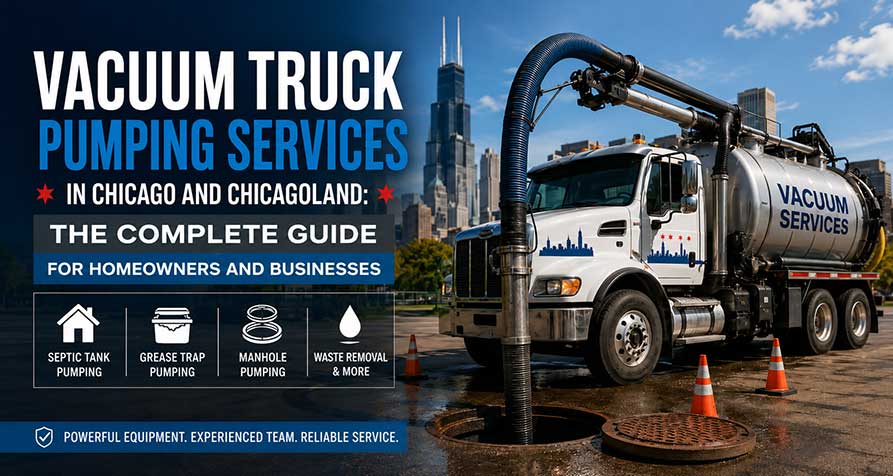
A vacuum truck is exactly what it sounds like — a large truck equipped with an industrial-grade vacuum pump and a sealed waste tank, typically ranging from 3,000 to 5,000 gallons. The vacuum pump removes air from the sealed tank, creating a pressure differential that generates enormous suction at the end of a hose. When that hose is inserted into a catch basin, septic tank, grease trap, or storm drain, the suction pulls liquid waste, sludge, debris, and solids up through the hose and into the truck’s sealed tank. The collected waste is then transported to a licensed disposal facility.
The advantage of vacuum truck service over simple drain cleaning or rodding is volume and versatility. A drain snake clears a blockage. A vacuum truck removes the accumulated contents of an entire chamber — hundreds or thousands of gallons of material — in a way that mechanical clearing never could. After pumping, technicians can also manually clean residual material from the interior walls of a basin or tank, inspect the structural condition of the chamber, and assess connected pipe conditions through camera inspection.
Our vacuum truck pumping services are available throughout Chicago and Chicagoland — same-day and emergency response available across Cook and DuPage Counties and surrounding communities.
Catch Basin Pumping: The Most Common Vacuum Truck Service for Chicagoland Properties
Catch basins are underground drainage structures — rectangular or cylindrical chambers set beneath grates in driveways, backyards, parking lots, and commercial properties — that collect surface water and direct it to the underground drain system. The sump at the bottom of the basin traps sediment, debris, and solids before they enter the downstream pipes.
Over time, that sump fills. Sediment accumulates. Debris from leaves, yard waste, and surface runoff builds up layer by layer. In commercial applications, food waste, grease, and organic material add to the accumulation. When the sump is full, the catch basin loses its ability to trap debris — solids bypass the chamber and enter the pipe system, creating blockages downstream. The effective drainage capacity of the system is significantly reduced. And in severe cases, a completely filled catch basin contributes to surface flooding during significant rain events.
When to pump: Most residential catch basins should be pumped every one to three years depending on the volume of debris reaching the basin. Commercial catch basins in high-traffic parking lots or properties with significant organic loading — restaurants, food processing, areas with heavy leaf fall — should be pumped annually at minimum, and more frequently if inspection shows rapid accumulation.
Warning signs: Water pooling near the basin grate after rain that previously drained quickly. A sump depth that has visibly decreased when you remove the lid and look inside. Sewer odors near the basin. Evidence of debris appearing in downstream drain lines.
What it costs: Standard residential catch basin pumping typically runs $300 to $500 for a single basin. Commercial catch basins with larger sump volumes, multiple basins, or those requiring manual cleaning after pumping run $500 to $1,200 or more depending on volume and access.
Real jobs we’ve done: Our crews have pumped catch basins throughout Chicago and Chicagoland — from a six-unit condominium in Oak Park where regular maintenance keeps the parking lot drainage functioning to a 300-gallon basin pumping in Riverside to commercial catch basin pumping at properties in La Grange Highlands combined with hydro jetting and camera inspection. We’ve also completed catch basin repair and rebuilding in Chicago where accumulated waste had contributed to structural deterioration requiring concrete restoration after pumping.
Our catch basin cleaning and pumping services and catch basin repair and rebuilding services cover the full Chicagoland area. For a deeper look at what structural catch basin failure looks like and what rebuilding actually involves, read our complete catch basin repair and rebuilding guide for Chicago homeowners.
Grease Trap Pumping: The Compliance-Critical Service for Chicago Food Service Operations
A grease trap — also called a grease interceptor — sits between the kitchen drain lines and the municipal sewer, capturing fats, oils, and grease (FOG) before they enter the sewer system. In Chicago’s combined sewer environment, FOG that bypasses a neglected trap builds up in the sewer infrastructure, contributes to blockages and overflows, and eventually reaches the MWRD’s treatment system — where it creates operational problems at a regional scale.
Chicago requires grease traps to be cleaned when FOG and solids reach 25% of the trap’s capacity — the “25% rule.” Minimum cleaning frequency is every 90 days even if the 25% threshold hasn’t been reached. Records must be maintained for three years. Violations carry fines starting at $500 per incident and escalating to $10,000 for repeat or severe violations. A food service establishment whose grease trap overflows faces immediate health code consequences on top of plumbing fines.
How grease trap pumping works: Our vacuum truck removes all accumulated grease, solids, and liquid from the trap through the access port. The interior walls and baffles are scraped and cleaned to remove residual grease buildup — not just pumped, but thoroughly cleaned. We provide full written service documentation with the date, volume removed, technician information, and disposal destination — everything required for your compliance records.
When to pump: Quarterly at minimum for most Chicago food service operations. Monthly for high-volume restaurants, steakhouses, fried food concepts, pizza kitchens, or any kitchen running extended hours. If you’re noticing slow kitchen drains, backup at floor drains, or odors from the trap, pump immediately.
What it costs: Standard under-sink grease trap pumping runs $350 to $500 for most commercial kitchens. Larger outdoor interceptors run $600 to $1,500 or more depending on the size of the tank and the volume of material. Emergency service outside business hours carries a premium.
Real jobs we’ve done: We’ve pumped grease traps at some of Chicago’s most prominent venues — including Goodman Theatre and Soldier Field — and across hundreds of commercial kitchens throughout Chicagoland including restaurants in Wilmette, Lombard, Oak Lawn, Joliet, Aurora, Schaumburg, and Chicago itself. We’ve handled emergency grease trap pumping at a restaurant in Schaumburg where a clog in the outtake pipe caused the trap to overflow and blocked all floor drains during service. We’ve completed 2,500-gallon commercial septic and grease trap cleanouts in Chicago Heights combining sewer rodding, hydro jetting, and vacuum truck pumping service to restore full system flow.
Our grease trap cleaning and pumping services cover restaurants, commercial kitchens, schools, hospitals, and food service facilities throughout Chicagoland. For a complete breakdown of Chicago’s legal requirements, the 25% rule, and what violations actually cost, read our Chicago restaurant grease trap compliance guide.
Septic Tank Pumping: Essential Maintenance for Homes and Properties on Private Systems
While most of Chicago’s dense urban core and established suburbs are connected to municipal sewer systems, a meaningful number of properties in the outer Chicagoland area — in communities like Burr Ridge, River Grove, Glen Ellyn, Medinah, and similar communities at the suburban fringe — still operate on private septic systems. And those systems require regular pumping to function safely and legally.
A septic tank is a buried, watertight container that receives all household wastewater. Solids settle to the bottom forming sludge. Greases and lighter materials float to the top forming scum. The clarified liquid in the middle flows to the drain field. Over time, the sludge and scum layers build up. When they accumulate to the point where the middle liquid layer is reduced, solids begin escaping to the drain field — clogging the soil, causing backups, and eventually requiring drain field replacement at a cost far exceeding the pumping that would have prevented it.
According to the Illinois EPA’s Septic System Maintenance guidance, septic systems should be inspected annually for the amount of sludge and solids present, and pumped every two to three years or more often if needed. The Illinois EPA also specifically warns that gases from open septic systems are toxic — pumping should never be attempted by untrained individuals.
When to pump: Every 2 to 3 years for a typical residential system as a standard maintenance schedule. Systems serving larger households, homes with garbage disposals that add significant organic material, or systems that have never been pumped regardless of age should be assessed sooner. A system that has never been pumped in 5 or more years should be treated as an emergency assessment situation.
Warning signs: Slow drains throughout the house — not one fixture, all of them. Sewage odors inside the home or in the yard above the tank or drain field. Unusually green, lush grass directly above the septic system (the effluent is fertilizing the grass because the drain field is saturated). Gurgling sounds from drains. Any sewage backup into the lowest fixtures in the home.
What it costs: Residential septic tank pumping in the Chicago area runs $350 to $650 for a standard 1,000-gallon tank. Larger commercial septic tanks — 2,500 gallons, 5,000 gallons, and above — run proportionally more depending on volume and access conditions.
Real jobs we’ve done: We’ve completed septic pumping across the Chicagoland fringe — a 1,000-gallon septic tank pump-out in Glen Ellyn, septic pumping in River Grove with the tank located in the backyard, a pump-out in Burr Ridge, vacuum truck septic pumping in Medinah, and a septic pump-out in Calumet City combined with camera inspection. We’ve also handled larger commercial septic work including a 2,500-gallon commercial septic tank cleanout in Chicago Heights.
Our septic pumping services cover all Chicagoland communities with residential and commercial septic systems.
Storm Drain Cleaning: Keeping Stormwater Infrastructure Functional Across Chicagoland
Storm drains — the grated inlets in streets, parking lots, and commercial properties — collect surface water runoff and direct it to the storm sewer system or to retention structures. They’re distinct from catch basins in that they’re typically set in the street or right-of-way and managed by the municipality, but commercial properties and large residential properties often have private storm drain systems on their own property that are the owner’s responsibility to maintain.
The Metropolitan Water Reclamation District of Greater Chicago manages wastewater treatment and stormwater management for Cook County — and its Infiltration/Inflow Control Program actively monitors the condition of stormwater infrastructure throughout the county. Commercial properties with inadequate storm drain maintenance can receive notices from municipalities and the MWRD requiring remediation.
Storm drain cleaning with vacuum trucks removes accumulated sediment, debris, leaves, and organic material from storm drain structures that would otherwise restrict flow, contribute to surface flooding, and allow pollutants to enter the stormwater system. For commercial parking lots with multiple storm drain inlets, annual cleaning keeps the system functioning at capacity and reduces the property owner’s flooding liability.
When to clean: Commercial storm drain systems should be cleaned at minimum annually — typically in spring before peak storm season and/or in fall after leaf drop. Properties with high debris loads or those that have experienced surface flooding despite dry weather warrant more frequent service.
What it costs: Commercial storm drain cleaning with a vacuum truck runs $400 to $1,500 for a standard parking lot system depending on the number of inlets, volume of material, and access conditions. Large commercial or industrial storm drain systems run higher depending on scope.
Our storm drain cleaning services cover commercial and industrial properties throughout Chicago and Chicagoland. If your municipality has issued a sewer smoke test defect notice related to your storm drainage, read our complete Chicago sewer smoke testing guide to understand exactly what’s required.
Pit Pumping and Industrial Vacuum Services
Beyond the four primary residential and commercial vacuum truck services, our vacuum trucks handle a range of specialty pumping needs across Chicagoland:
Flooded basement pumping — emergency water removal from flooded basements following pipe failures, sewer backups, or storm flooding. Our vacuum trucks can remove large volumes of standing water quickly, supporting the water extraction and drying process that follows a flooding event.
Pit pumping — we’ve completed pit pumping with high-pressure jetting and camera inspection in Des Plaines, clearing buildup and inspecting lines to confirm proper flow. Industrial pits, sumps, and collection chambers require periodic vacuum pumping to prevent overflow and maintain function.
Garage and commercial drain pumping — we’ve pumped grease traps in a garage in Chicago, removing built-up grease and waste from a non-restaurant commercial application. Any commercial space with floor drains and process drainage that accumulates grease or organic material benefits from vacuum truck service.
Combination vacuum and hydro jetting — for the most effective drain system maintenance, vacuum truck pumping is frequently combined with hydro jetting — high-pressure water cleaning that removes residual buildup from pipe walls after solids are removed by the vacuum truck. We’ve completed combined grease line and floor drain rodding, camera inspections, hydro jetting, and catch basin pumping at commercial properties in Chicago, La Grange Highlands, and throughout Chicagoland.
How to Know Which Vacuum Truck Service Your Property Needs
Not every property needs every service — and understanding which applies to your specific situation determines what to schedule and how urgently.
You have a catch basin if there’s a grated drain in your backyard, driveway, or parking lot. Catch basins need pumping every 1 to 3 years for residential, annually for commercial.
You need grease trap service if you operate a food service business in Chicago or the suburbs. It’s legally required at a minimum quarterly, and your municipal health department or the Department of Water Management will enforce it.
You’re on a septic system if your property is not connected to a municipal sewer — typically homes in outer suburban or semi-rural areas. Pump every 2 to 3 years minimum.
You need storm drain cleaning if you manage a commercial parking lot, industrial facility, or large property with private storm drain infrastructure. Annual service is the standard.
If you’re not sure what you have or what condition it’s in, our team can assess during a service visit. We combine vacuum truck pumping with sewer camera inspection when the condition of connected pipes is unknown — giving you a complete picture of your drainage system’s health in a single visit.
Frequently Asked Questions: Vacuum Truck Pumping in Chicago
How much does catch basin pumping cost in Chicago?
Residential catch basin pumping typically runs $300 to $500. Commercial basins with larger volumes, multiple basins, or those requiring manual cleaning after pumping run $500 to $1,200 or more. We provide upfront quotes before starting — no hidden fees.
How often should a restaurant grease trap be pumped in Chicago?
Chicago law requires cleaning when FOG and solids reach 25% of capacity — regardless of calendar schedule — and at minimum every 90 days. High-volume kitchens typically need monthly service. Grease trap records must be maintained for three years and available for city inspection on demand.
How do I know if my septic tank needs to be pumped?
Slow drains throughout the house, sewage odors inside or in the yard, unusually lush grass above the tank or drain field, gurgling sounds from drains, or any sewage backup are all indicators that require immediate attention. As a standard schedule, pump every 2 to 3 years regardless of symptoms.
Can you pump catch basins, grease traps, and septic tanks on the same visit?
Yes — our vacuum trucks are equipped to handle all waste types in a single visit for properties that have multiple systems. Combining services into one dispatch call is more efficient and more cost-effective than scheduling separate visits.
Do you provide documentation after grease trap pumping for Chicago compliance records?
Yes — we provide full written service documentation after every grease trap cleaning including date of service, volume removed, technician information, and disposal destination. This documentation meets Chicago’s three-year record-keeping requirement.
What can’t you pump with a vacuum truck?
We pump septic tanks, grease traps, catch basins, storm drains, flooded basements, industrial wastewater, sludge, and debris. We cannot pump hazardous waste, chemical waste, petroleum products, radioactive materials, or medical waste — these require special permits and licensed hazardous waste haulers.
Need Vacuum Truck Pumping in Chicago or the Suburbs?
Catch basin pumping, grease trap cleaning, septic pumping, storm drain cleaning, and emergency pit pumping — available same-day and 24/7 across Chicago and all of Chicagoland. Send us a message and we’ll get back to you fast.
For emergencies call: 708-518-7765 | Open 24/7
—
Suburban Plumbing Sewer Line & Drain Cleaning Experts
Licensed & Insured | Open 24 Hours | Serving Chicago & the Suburbs
📞 Suburbs: 708-801-6530
📞 West Suburbs: 630-749-9057
📞 Chicago: 773-570-2191
🚨 24/7 Emergency Line: 708-518-7765