
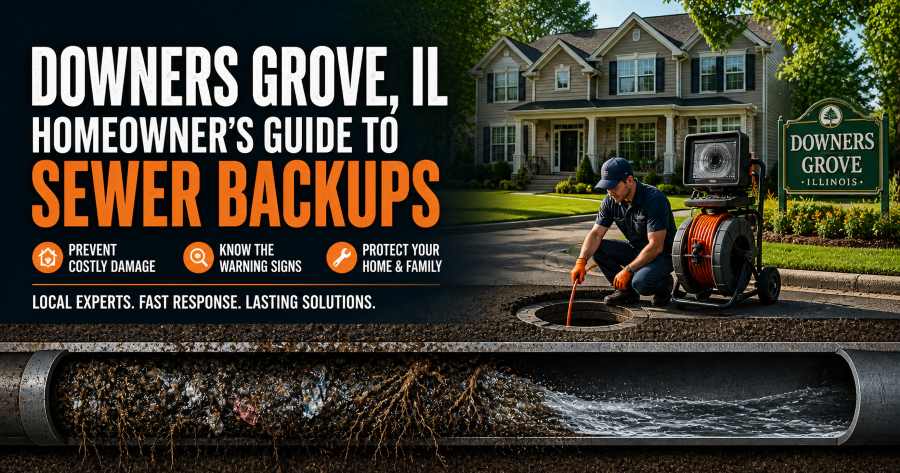
If Your Basement Has Ever Flooded From a Sewer Backup — or You Want to Make Sure It Never Does — This Guide Is For You
Sewer backups are one of the most disruptive and expensive plumbing disasters a Downers Grove homeowner can face. They happen without warning, they create a health hazard the moment they occur, and they leave homeowners scrambling to figure out who’s responsible, what their insurance covers, and how to make sure it never happens again.
The answers to those questions are more complicated in Downers Grove than in most Chicagoland communities — because Downers Grove has a unique sewer system structure that most residents don’t fully understand until a backup forces them to learn it the hard way.
This guide covers everything Downers Grove homeowners need to know about sewer backups — what causes them in this specific community, who’s responsible for what, what the Downers Grove Sanitary District can and can’t do for you, how your insurance coverage works, and what you can do right now to dramatically reduce your risk.
Understanding Downers Grove’s Unique Sewer System
Most Downers Grove homeowners assume the village manages their sewer system. It doesn’t — and this distinction matters enormously when a backup occurs.
The Downers Grove Sanitary District (DGSD) is a completely separate unit of local government — independent of the Village of Downers Grove — that was organized in 1921 under the State of Illinois’ Sanitary District Act of 1917. The DGSD operates and maintains over 250 miles of sewer main and a Wastewater Treatment Center serving more than 60,000 people across 20,000 residential, commercial, industrial, and institutional customer accounts. It serves not just Downers Grove but also portions of Westmont west of Cass Avenue, and parts of Woodridge, Lisle, Lombard, Oak Brook, and Darien.
This matters for backup situations because when you have a sewer problem, you need to know who to call. The DGSD is responsible for the public sewer mains — the underground infrastructure running beneath your streets. You as the homeowner are responsible for your private sewer lateral — the pipe running from your home’s foundation to the connection point with the DGSD’s main.
If your basement backs up, the first call should be to the DGSD at (630) 969-0664 — their technicians are available at all hours. They will check whether the backup is caused by a problem in the public main. If the main is clear and functioning properly, the problem is in your private lateral — and at that point you need a licensed plumber.
As your local Downers Grove, IL plumber, we work alongside the DGSD regularly — and understanding exactly where the DGSD’s responsibility ends and yours begins is the foundation of addressing any backup situation correctly.
Why Sewer Backups Happen in Downers Grove
Downers Grove’s housing stock creates specific sewer backup risk factors that are worth understanding before a problem develops.
Aging clay tile and cast iron laterals. A significant portion of Downers Grove’s established neighborhoods — particularly in the older sections of town near downtown, along Fairview Avenue, Grant Street, and the blocks surrounding Downers Grove North and South High Schools — were developed in the 1940s through 1960s. The sewer laterals installed beneath those homes have been in the ground for 60 to 80 years. Original clay tile joints crack, offset, and allow root intrusion. Cast iron corrodes from the inside. What was a properly functioning lateral in 1965 may now be significantly compromised without showing any visible symptoms until a backup occurs.
Tree root intrusion. Downers Grove is a beautifully treed community — the mature oaks, silver maples, and cottonwoods lining parkways throughout the village send root systems 40 to 60 feet underground in search of moisture. Clay tile sewer lateral joints that have been in the ground for decades are exactly what those roots find. Root intrusion builds gradually — a small tendril through a failed joint becomes a dense root mass over three to five years that catches debris and eventually blocks the line entirely. Annual drain cleaning that keeps getting slower is almost always root intrusion building toward a full backup.
Heavy rainfall and system surcharge. While Downers Grove uses a separate sewer system — storm sewers and sanitary sewers in separate pipes, unlike Chicago’s combined system — heavy rainfall events can still overwhelm the DGSD’s infrastructure and create elevated pressure in the public mains. During major storms, that pressure can push back through private laterals and into basement floor drains if the lateral connections aren’t properly protected. The DGSD’s own sewer backup resources acknowledge this risk and offer guidance to affected homeowners.
Flushable wipes and non-flushable materials. Despite marketing claims, wipes do not break down in water. They accumulate in sewer laterals — particularly at root intrusion points, offset joints, and bends — and build into blockages faster than organic waste alone. In Downers Grove’s older homes with clay tile laterals, a root-impacted line combined with wipe accumulation is one of the most common backup causes we find on camera inspection.
Sump pump discharge into the sanitary sewer. Some older Downers Grove homes have sump pump discharge lines connected to the sanitary sewer rather than to the exterior or storm system. This is a code violation that contributes to inflow during rain events — and when the DGSD’s system is under load from a major storm, that additional clear water load exacerbates surcharge conditions. If your sump pump discharges into a floor drain or directly into the sanitary system, that connection should be rerouted.
Who Is Responsible for What: The Homeowner vs. DGSD Breakdown
This is the question that creates the most confusion after a backup event — and the answer is more nuanced than most homeowners expect.
The DGSD is responsible for:
- The public sewer mains beneath the streets
- The lateral connection point at the main (the “wye” or “tee” where your private lateral connects)
- Responding to reported sewer emergencies in the public system 24 hours a day at (630) 969-0664
- Investigating whether a backup was caused by a public main failure
You as the homeowner are responsible for:
- Your entire private sewer lateral from your home’s foundation to the connection with the DGSD main — including the portion that runs beneath the public parkway
- All interior plumbing above the lateral connection
- Floor drains, clean-out caps, and all access points on private property
- Any repair or replacement of your private lateral
The gray area — the parkway portion of your lateral: The section of your sewer lateral that runs beneath the public parkway — between your property line and the DGSD main — is typically the homeowner’s financial responsibility even though it’s located in the public right of way. This surprises many homeowners who assume the parkway portion is the DGSD’s problem. It isn’t. Confirm the exact boundary with the DGSD when you call to report a backup.
The DGSD Assistance Program: The DGSD maintains a sewer backup assistance program for homeowners who experience backups caused by DGSD system conditions. If the District determines that the backup was related to their system — a main blockage, a capacity issue — they have a process for reviewing claims and providing assistance. Ask specifically about the assistance program when you report a backup to the DGSD. Keep all documentation, photographs, and repair receipts.
The Lead Service Line Situation in Downers Grove
Separate from sewer backup concerns, Downers Grove homeowners need to understand the current lead service line replacement program — because it affects a significant number of properties and the timeline for required action is approaching.
According to the Village of Downers Grove Water Department, the village estimates approximately 2,426 lead service lines exist in the community as of end of 2026. Homes built prior to 1930 most likely have a lead water service line. Homes built between 1930 and 1960 may have one. The village is required under state and federal law to replace all lead service lines — and the replacement program is scheduled to begin after November 15, 2027.
Under the current plan, the village is responsible for replacing the public side of the service line from the water main to the b-box shutoff near the property line. Homeowners are responsible for the private side from the b-box to the house — a replacement that the village estimates costs between $7,000 and $10,000 or more depending on line length and site conditions.
You can check whether your property’s service line material has been identified by entering your address into the Village’s Water Service Line Map. If you have a confirmed or likely lead service line, our lead service line replacement specialists can assess your situation and provide a written estimate well before the 2027 replacement program begins — giving you time to plan rather than react.
How to Dramatically Reduce Your Backup Risk Right Now
Understanding what causes backups in Downers Grove is only useful if you act on that knowledge. Here are the most impactful things you can do proactively:
Get a sewer camera inspection. This is the single most valuable thing a Downers Grove homeowner with an older clay tile or cast iron lateral can do. A sewer camera inspection runs a high-resolution camera through your lateral and shows you in real time exactly what’s there — root intrusion, offset joints, pipe belly, crack locations, the overall structural condition of the pipe. If you’ve never had one and your home is more than 25 years old, you don’t know what’s in your lateral. A camera inspection costs $200 to $400 and can prevent a $20,000 to $40,000 basement flooding event. If you want to understand exactly how roots form, grow, and eventually cause sewer backups in Chicago-area homes, read our full guide on tree roots and sewer lines in Chicago.
Annual sewer rodding if you have mature trees near your lateral. Downers Grove’s tree canopy is one of its great assets — and one of its great plumbing liabilities. If you have silver maples, cottonwoods, or large oaks within 40 feet of your sewer lateral path, annual rodding is the most cost-effective way to keep root intrusion from accumulating to the point of a full backup. Our drain cleaning and sewer rodding services cover all of Downers Grove and the surrounding DuPage County communities.
Install a backwater valve. A backwater valve — also called a backflow preventer — installs in your main sewer lateral in the basement floor and physically prevents sewage from flowing backward into your home during a surcharge event. It’s the most effective single protection against backup events caused by elevated main conditions during heavy rain. Many DuPage County municipalities offer rebate programs for backwater valve installation — call your village hall and ask before scheduling the work.
Not sure whether a backwater valve, sump pump, or French drain is right for your specific situation? Read our complete comparison guide: French Drain vs. Sump Pump vs. Backwater Valve — Which One Does Your Chicago Home Actually Need?
Address any sump pump drain connections. If your sump pump discharges into the sanitary sewer, have that rerouted to exterior discharge. Beyond being a code violation, it contributes to the system conditions that cause surcharge backups during storms. If your sump pump is older, unreliable, or running continuously during heavy rain, replacing it before it fails can help protect your basement from groundwater flooding. Learn more in our guide, Why Downers Grove Residents Need Expert Sump Pump Replacement.
Never flush wipes. Not “flushable” wipes. Not paper towels. Not feminine hygiene products. Not anything other than human waste and toilet paper. In a Downers Grove home with an older lateral, every non-flushable item that goes down the toilet is accelerating toward the next backup.
What to Do During an Active Sewer Backup
If sewage is actively backing up into your basement right now, here’s what to do in order:
Step 1 — Stop using all water immediately. Every flush, every sink run, every shower sends more sewage toward a line that can’t handle what’s already in it. Turn off all fixtures and appliances.
Step 2 — Call the DGSD at (630) 969-0664. Before calling a plumber, call the DGSD to report the backup. They’ll check the public main. If the main is clear, you need a plumber. If the main is the problem, that’s their responsibility to address.
Step 3 — Stay out of the sewage water. Raw sewage is Category 3 contaminated water — it contains E. coli, hepatitis A, and other dangerous pathogens. Keep family members and pets completely out of the affected area.
Step 4 — Document everything before cleanup. Photograph and video the affected area, water levels, and the point of entry before anything is moved or cleaned. This documentation is essential for your insurance claim.
Step 5 — Call our emergency line at 708-518-7765. We respond 24 hours a day across Downers Grove and all of DuPage County. We’ll get there fast, clear the blockage, run a camera to show you what caused it, and give you a written assessment for your insurance claim and any required repairs.
Step 6 — Call your insurance company. Report the event promptly. If you have a water backup endorsement, this is a covered loss — but only if you report it in a timely manner and document everything before cleanup begins.
Frequently Asked Questions: Sewer Backups in Downers Grove
Who do I call first when my basement backs up in Downers Grove?
Call the Downers Grove Sanitary District at (630) 969-0664 before calling a plumber. They’ll investigate whether the public sewer main has a problem. If the main is clear, the issue is in your private lateral — at that point call us at 708-518-7765. This sequence matters because if the DGSD determines the backup was related to their system, it affects how any assistance program claim is handled.
Is the DGSD the same as the Village of Downers Grove?
No — they are completely separate units of local government. The DGSD was organized independently in 1921 and operates independently of the village. They manage the public sewer mains and wastewater treatment. The village manages water supply. Your sewer bill goes to the DGSD. Your water bill goes to the village. They have separate phone numbers, offices, and budgets.
Am I responsible for the sewer lateral under my parkway?
Generally yes. The private sewer lateral — including the section running beneath the public parkway between your property line and the DGSD main — is typically the homeowner’s financial responsibility. Confirm the exact boundary with the DGSD when you call to report a backup, as specific conditions can affect this determination.
My drains have been slow for two years and I just rod them every spring. Should I be worried?
Yes — recurring slow drains that require regular rodding to keep moving are almost always a sign of progressive root intrusion or structural pipe damage that rodding isn’t solving. Rodding cuts roots and clears blockages but doesn’t close the failed joint that’s letting roots in. A sewer camera inspection will show you exactly what’s building in your lateral before it reaches the point of a full backup. The difference between discovering moderate root intrusion on a scheduled camera inspection and discovering the same root mass during an emergency backup is thousands of dollars in emergency service costs and potential basement damage.
Does Downers Grove have a rebate program for backwater valves?
Contact your village hall directly — municipal rebate programs for flood control installations change frequently and availability depends on current budget allocations. Some DuPage County municipalities have offered rebates for backwater valve installation in the past. A five-minute phone call before scheduling installation is always worth it.
How do I check if my home has a lead service line?
Enter your address into the Village of Downers Grove’s Water Service Line Map. Homes built before 1930 most likely have lead. Homes built between 1930 and 1960 may have lead. If your line is identified as lead or unknown, our lead service line replacement team can assess your situation and provide a written estimate.
Had a Backup in Downers Grove? Want to Prevent One?
We serve Downers Grove and all of DuPage County 24 hours a day — camera inspections, drain cleaning, backwater valve installation, sewer repair, and emergency response. Send us a message and we’ll get back to you fast.
For emergencies call: 708-518-7765 | Open 24/7
Serving Downers Grove, IL
Your Local Plumber — Just Minutes Away
Suburban Plumbing Experts is based in Brookfield, IL — a short drive from Downers Grove. We provide licensed, 24/7 plumbing, sewer, and drain services throughout DuPage County and all of the western suburbs.
- 📍9100 Plainfield Road, Suite #9A, Brookfield, IL 60513
- 📞708-801-6530 — Suburbs | 630-749-9057 — West Suburbs
- 📞773-570-2191 — Chicago
- 🚨708-518-7765 — 24/7 Emergency Line
- 🕐Open 24 Hours · 7 Days a Week · 365 Days a Year
—
- ⭐4.9★ Rated · 400+ Google Reviews — See what your neighbors are saying!