
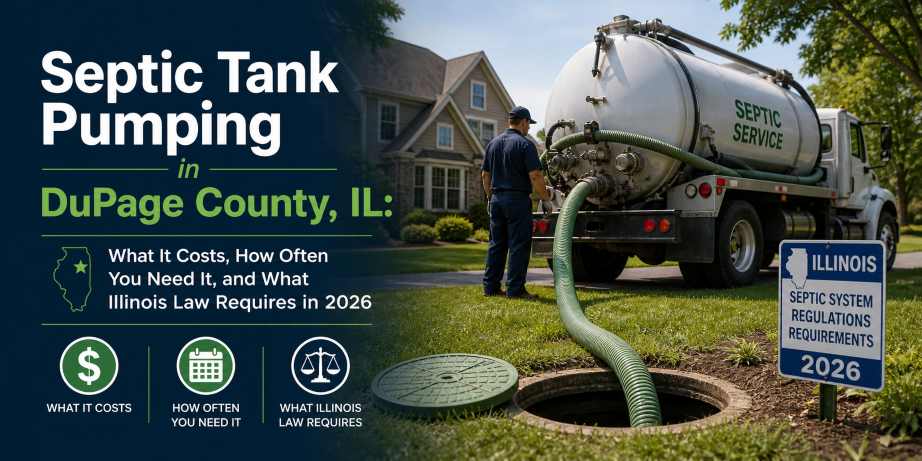
The Complete Guide for DuPage County Homeowners With Septic Systems
If your home runs on a septic system in DuPage County, you already know you’re in the minority. Most of the county is served by municipal sewer. But in the townships, unincorporated areas, and older rural pockets of communities like Naperville, Lisle, Woodridge, Bolingbrook, Lemont, and Plainfield that border DuPage, tens of thousands of homes still depend entirely on private onsite wastewater systems — and those systems need to be pumped regularly to function correctly and stay compliant with Illinois environmental law.
This guide covers everything you need to know about septic tank pumping in DuPage County: what it costs, how frequently your system actually needs service, what Illinois law requires, how DuPage County’s specific soil and groundwater conditions affect your system, what happens when you fall behind on maintenance, and how to know when pumping has become the least of your problems.
How a Septic System Works — And Why Pumping Is Non-Negotiable
Before getting into the specifics of DuPage County, it’s worth understanding exactly what a septic system does and why pumping is the single most important maintenance task you can perform.
Everything that leaves your home through a drain or toilet flows into the septic tank buried in your yard. Inside the tank, the waste separates naturally into three layers: heavy solids sink to the bottom and form a layer of sludge, grease and lighter materials float to the top as scum, and the liquid in the middle — called effluent — exits through an outlet pipe to the drain field, where the soil filters and treats it before it re-enters the groundwater table.
The tank’s job is to hold the solids long enough for separation to occur and to prevent them from flowing out to the drain field, where they would cause catastrophic and expensive damage. But the tank only holds so much. Over time, sludge accumulates at the bottom and scum builds at the top. As those layers grow, the space available for effluent shrinks — until the tank can no longer separate waste effectively and solid material begins pushing through to the drain field.
Once solids reach the drain field, you’re no longer looking at a pumping problem. You’re looking at a drain field replacement — a project that costs $10,000 to $30,000 or more in DuPage County, disrupts your landscaping, and may require DuPage County Health Department involvement and permitting. The drain field depends on a network of buried pipes, often called leach lines, to distribute effluent through the surrounding soil. Learn more about what leach lines are and when they should be replaced and why their condition is so important to the overall septic system.
Pumping removes the accumulated sludge and scum before that happens. It’s the maintenance task that keeps a $300 service call from becoming a $25,000 system replacement. If you’re ready to schedule routine maintenance or want to learn more about our professional septic tank pumping process, visit our full Chicagoland septic tank pumping guide. You’ll find information about our pumping process, inspection checklist, service areas, and how routine maintenance helps protect your septic system for years to come.
How Often Does a DuPage County Septic Tank Need to Be Pumped?
The standard recommendation is every three to five years — but that’s a starting point, not a rule. The actual frequency your system needs depends on several factors specific to your household and your tank.
Tank size is the primary variable. Most residential septic tanks in DuPage County range from 1,000 to 1,500 gallons. A 1,000-gallon tank serving a two-person household accumulates sludge far more slowly than the same tank serving a family of five. As a general guideline:
- 1,000-gallon tank, 2 people: pump every 5–6 years
- 1,000-gallon tank, 4 people: pump every 2–3 years
- 1,500-gallon tank, 4 people: pump every 3–5 years
- 1,500-gallon tank, 6+ people: pump every 2–3 years
Age of the system matters too. Older concrete tanks — common in DuPage County’s pre-1980 housing stock in communities like Lisle, Downers Grove, and unincorporated Naperville Township — may have deteriorated baffles, cracked walls, or inlet/outlet issues that cause solids to move through the system faster than a well-functioning tank would. If you’ve inherited an older system or bought a home without a recent inspection, a pumping and inspection together gives you a baseline to work from.
Garbage disposal use significantly increases sludge accumulation. Homes with active garbage disposals can generate up to 50% more solid waste into the tank compared to homes without. If you use a disposal regularly, pump more frequently than the standard schedule.
Recent high-volume events — large gatherings, a week of houseguests, a basement renovation with heavy water use — can temporarily overwhelm a tank that’s already approaching capacity. If you’ve had a significant water-use event and your system is overdue for service, don’t wait.
The most accurate way to know whether your tank needs pumping is a professional inspection. When we pump a tank, we measure sludge depth before extraction and assess the condition of the baffles, inlet, and outlet. That gives you a data point for setting the right schedule going forward rather than guessing.
What Septic Tank Pumping Costs in DuPage County
Pricing in DuPage County runs slightly higher than the Illinois statewide average due to access conditions, local disposal requirements, and the generally deeper tank installations common in the county’s frost-line environment.
Standard residential pumping (1,000–1,500 gallon tank, accessible location): $350 to $600. This covers the pumping itself, basic visual inspection of the accessible components, and compliant disposal of the removed material. This is what a routine, on-schedule pumping call looks like for most DuPage County homeowners.
Pumping with full inspection (recommended every other service): $450 to $750. Includes sludge depth measurement, baffle condition assessment, inlet/outlet check, and a written report on system condition. Strongly recommended if you’ve recently purchased a home with a septic system or haven’t had documented service in more than five years.
Pumping with riser installation: $600 to $1,200 depending on depth. If your tank lids are buried more than 12 inches below grade — common in DuPage County where tanks are installed below the frost line — riser installation brings the access point to grade level, making every future pumping faster, easier, and less expensive. It’s a one-time cost that pays for itself within two service cycles.
Emergency pumping (system backup, overflow, or failure): $500 to $900+. Emergency calls outside business hours, systems showing signs of failure, or jobs requiring vacuum truck work beyond standard pumping carry a premium. Emergency availability is one of the most important things to confirm when selecting a septic service provider in DuPage County — a system that backs up on a Sunday afternoon doesn’t wait until Monday.
What drives costs higher: Deep tank installation, limited equipment access (tight yards, fencing, landscaping over the tank), tanks that haven’t been serviced in a decade or more requiring extra time to locate and excavate lids, and systems with multiple tanks or compartments all add to the cost. A thorough quote requires knowing your tank size, approximate location, and last service date.
For a full breakdown of septic pumping cost factors across Illinois, see our guide to septic tank pumping costs in Illinois.
Illinois Law and DuPage County Regulations: What You’re Required to Do
Illinois takes onsite wastewater systems seriously — and DuPage County enforces state requirements actively through the DuPage County Health Department’s Environmental Health division.
The Illinois Private Sewage Disposal Code (77 Ill. Adm. Code 905) governs all private septic systems in the state. Under Illinois law, property owners are responsible for maintaining their systems in proper working order and preventing system failures that could contaminate groundwater or create a public health hazard. A system that is overflowing, surfacing effluent in the yard, or discharging to a waterway is a violation — and the DuPage County Health Department has the authority to issue compliance orders and fines.
DuPage County Health Department oversight means that any new septic installation, significant repair, or system modification in the county requires a permit and inspection. The Health Department also maintains records of permitted systems — which means if your system has a documented history of violations or failed inspections, that history follows the property. For a real-world example of how utility structure and municipal system design can vary significantly across nearby Will County communities — and how those differences impact homeowner plumbing, sewer, and septic considerations — see our guide on Homer Glen’s unique infrastructure conditions.
Point-of-sale inspection requirements are one of the most commonly misunderstood aspects of septic ownership in DuPage County. If you’re selling a home with a septic system, the buyer’s lender or the county may require a current septic inspection as a condition of the transaction. Getting ahead of this with a pre-listing pumping and inspection is consistently the right financial decision — a failed inspection discovered by a buyer’s inspector gives them significant negotiating leverage. Our article on how septic inspections affect property value covers this in detail.
Groundwater protection is a particular priority in DuPage County. The county sits over a series of aquifers that supply drinking water to a significant portion of the region. A failing or overflowing septic system in DuPage County isn’t just a property problem — it’s a potential drinking water contamination issue with real legal and financial consequences for the property owner. The county takes enforcement seriously.
DuPage County’s Soil and Groundwater Conditions: Why They Matter for Your Septic System
Not all septic systems are created equal, and not all soil conditions are equally forgiving. DuPage County’s geology creates some specific conditions that DuPage homeowners with septic systems should understand.
Clay-heavy soils are common across much of DuPage County — a legacy of glacial deposits. Clay is notorious for draining poorly, which creates stress on drain fields. When the soil can’t absorb effluent fast enough, it backs up toward the tank, reduces the effective capacity of the drain field, and accelerates the conditions that lead to surfacing effluent and system failure. Homes in areas with heavier clay content need to be more vigilant about pumping frequency and water conservation — the drain field has less natural buffer.
Shallow water table conditions in low-lying areas of the county — particularly in areas near the DuPage River, Salt Creek, and their tributaries — can affect drain field performance during wet seasons. When the water table rises, the drain field’s ability to treat and disperse effluent is reduced. Homes in these areas should be on a more aggressive pumping schedule and should avoid high-water-use activities (large laundry days, extended showers, filling large bathtubs) during sustained wet periods.
Frost depth in DuPage County averages around 42 inches, which means septic tanks are typically installed at significant depth to prevent freezing. This is why buried lids are so common in the county — and why riser installation is such a practical investment for DuPage homeowners with older systems.
Warning Signs Your DuPage County Septic System Needs Immediate Attention
Regular pumping prevents most septic problems. But systems can deteriorate between service cycles, and knowing the warning signs allows you to act before a manageable problem becomes a system failure.
Slow drains throughout the house — not just one fixture, but multiple — can indicate a tank that’s approaching or exceeding capacity. When a single drain is slow, the problem is usually in that drain line. When multiple fixtures drain slowly, the problem is typically downstream of the house, in the tank or drain field.
Gurgling sounds in the plumbing after flushing or draining indicate pressure or venting issues that can be related to a tank that’s too full to allow normal flow.
Sewage odors inside the home or near the tank are a direct indicator that something is wrong — either the tank is venting improperly, baffles have failed, or the system is backing up. Odors inside the home near drains are particularly urgent.
Wet, spongy, or unusually green grass over the drain field indicates that effluent is surfacing or near-surfacing. This is a system failure condition that requires immediate professional assessment. In DuPage County, surfacing effluent is a regulatory violation and a health hazard.
Sewage backup into basement drains or toilets is the most urgent sign — the system has reached or exceeded capacity and is actively failing. This requires emergency service.
If you’re seeing any of these signs, our septic pumping services are available across DuPage County seven days a week including emergency response.
For a more detailed look at warning signs that may indicate your system is reaching the end of its service life rather than just needing pumping, see our guide on signs it’s time to replace your septic tank in Illinois.
What Happens During a Professional Septic Pumping Service Call
Understanding what a professional service call involves helps you evaluate quotes and know what to expect — and what to watch out for.
Locating the tank. If you don’t have records of your tank’s location, our technicians locate it using probing and, when necessary, your home’s plumbing layout as a guide. Having a diagram or records from previous service calls saves time and reduces cost. After your first service with us, we provide you with a record of the tank location and access point for future reference.
Exposing the access lids. The lids are excavated or accessed via existing risers. Most tanks have two lids — one over the inlet end and one over the outlet end. Both should be opened and inspected; a service that only opens one lid is not doing a complete job.
Measuring sludge and scum depth. Before pumping, sludge depth is measured. This tells us how overdue the tank was and helps establish the right service interval going forward.
Pumping the tank. The vacuum truck removes the accumulated sludge, scum, and liquid from the tank. A properly pumped tank removes essentially all of the contents — not just the liquid layer. Be cautious of services that pump quickly and leave significant residual sludge.
Inspecting the accessible components. With the tank empty, the inlet and outlet baffles, the walls of the tank, and the condition of the access ports are visually inspected. Cracked or missing baffles are one of the most common findings in older DuPage County systems and should be repaired promptly — a failed baffle allows solids to reach the drain field.
Backfilling and site restoration. Access points are covered, any excavated area is backfilled, and the site is left clean.
Documentation. We provide a written service record including tank size, sludge depth before pumping, condition findings, and recommended next service date. Keep this documentation — it has value at resale and may be required by the DuPage County Health Department.
For more on building a complete maintenance program for your system, see our 6 septic tank maintenance tips and our guide on the importance of regular septic tank maintenance in Illinois.
DuPage County Communities We Serve
Our septic pumping and service team operates throughout DuPage County and the surrounding area, including:
Naperville, Downers Grove, Lisle, Woodridge, Bolingbrook, Darien, Westmont, Lombard, Elmhurst, Burr Ridge, Willowbrook, Lemont, Homer Glen, Plainfield, Romeoville, and all unincorporated areas of DuPage and Will County.
If you’re not sure whether we cover your address, call us — we almost certainly do.
Frequently Asked Questions: Septic Tank Pumping in DuPage County
How do I find my septic tank if I don’t know where it is?
Start with the DuPage County Health Department — they maintain records of permitted septic systems that may include a site diagram. Your home’s original construction records, if available, may also show the tank location. If records aren’t available, a licensed septic contractor can locate the tank by probing the yard along the sewer line running from your foundation. We include tank location as part of our service call at no additional charge.
Does DuPage County require a septic inspection when I sell my home?
DuPage County does not mandate a septic inspection for every sale, but many lenders require one, and buyers increasingly request them as a condition of purchase. More importantly, a pre-listing inspection protects you from last-minute renegotiations and deal failures. An inspection that finds problems before listing lets you control how those problems are addressed — rather than having a buyer’s inspector use them as leverage at the worst possible moment.
Can I use a garbage disposal with a septic system?
Yes, but use it sparingly and pump more frequently. Garbage disposals add significant organic solid load to the tank — studies suggest they can increase sludge accumulation by up to 50%. If you use a disposal regularly, subtract a year from whatever pumping interval you’d otherwise follow.
What should I never put into a septic system?
Grease, cooking oils, “flushable” wipes, paper towels, feminine hygiene products, medications, paint, solvents, bleach in large quantities, and antibacterial soaps that kill the bacterial ecosystem inside the tank. For the complete list and the reasoning behind each, see our guide on preventative septic tank care.
What’s the difference between my septic tank and my drain field — and which one is more expensive to fix?
The tank is the underground container that holds and separates waste. The drain field is the network of perforated pipes buried in the soil downstream of the tank that disperses the treated effluent. Pumping the tank is routine maintenance that costs a few hundred dollars. Replacing a failed drain field costs $10,000 to $30,000 or more depending on soil conditions and system size. Regular pumping is the primary way to protect the drain field from the premature failure that occurs when solids overflow from a neglected tank. For more on the drain field specifically, see our article on leach lines and when they need replacement.
How long does a septic pumping service call take?
A standard residential pumping in DuPage County takes 45 minutes to 2 hours depending on tank size, access conditions, and the amount of sludge present. Tanks with buried lids that require excavation add time. Systems that haven’t been serviced in many years and have extreme sludge accumulation may require additional time.
Is the liquid I see in the tank after pumping normal?
Yes. A properly functioning tank will refill to its normal operating liquid level relatively quickly after pumping as household wastewater enters. Some liquid remaining immediately after pumping is also normal — the goal is to remove the sludge and scum layers, not to achieve a completely empty tank.
Need Septic Tank Pumping in DuPage County?
Licensed, insured, and locally based in Brookfield since 1978. We serve all of DuPage County and the surrounding area — same-day and next-day scheduling available, with 24/7 emergency response for system backups and failures. Written quotes before we start, and our own licensed technicians on every job.
Or call us directly: 630-749-9057 | Open 24/7
—
Suburban Plumbing Sewer Line & Drain Cleaning Experts
Licensed & Insured | Open 24 Hours | Serving DuPage County & Chicagoland