
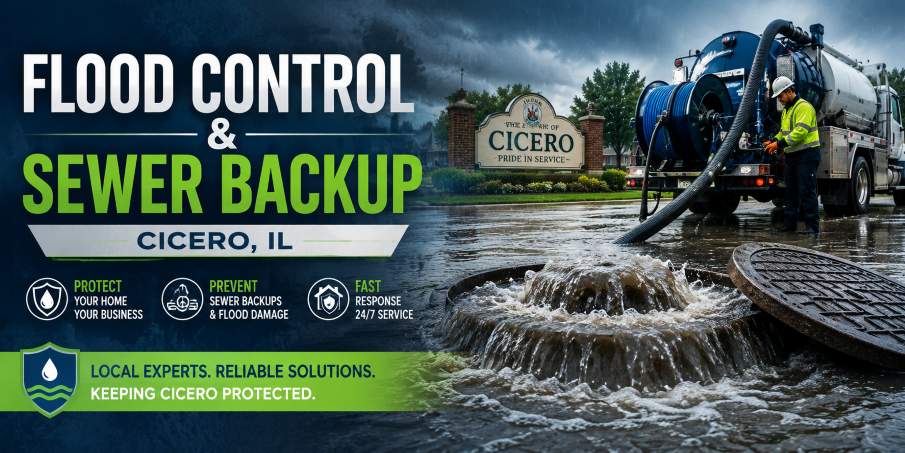
The Complete Guide for Cicero Homeowners Who Want to Understand What’s Actually Being Done About Flooding — and What Only They Can Do for Themselves
On July 2, 2023, 8.6 inches of rain fell on the Town of Cicero in a single day. The resulting flooding was so severe — so far beyond anything the town’s combined sewer infrastructure could handle — that it triggered three separate FEMA disaster declarations: DR-4728-IL, DR-4729-IL, and DR4819-IL. Hundreds of Cicero homes flooded. Basements that were being used as living spaces by multigenerational households filled with sewage. Families lost belongings, flooring, drywall, and the ability to use entire portions of their homes.
The federal government responded with the largest single flood mitigation grant awarded to any individual suburb in Illinois history: $96,004,000 from the United States Department of Housing and Urban Development, allocated specifically to the Town of Cicero to combat persistent flooding and enhance community infrastructure. Ninety-six million dollars. The federal government looked at what happened in Cicero on July 2, 2023 — and the decades of infrastructure conditions that made it possible — and committed nearly one hundred million dollars to address it.
That number tells you everything you need to know about the scope of Cicero’s flooding challenge. And it raises the question that every Cicero homeowner needs to answer: while the town spends $96 million on the public infrastructure, what happens to the private side of each home’s connection to that system?
The answer is the same as it is for every Chicago-area municipality that’s investing in its public sewer infrastructure: the private sewer lateral from your home to the main, the flood control devices installed in your basement, and the drain and supply systems inside your walls remain your responsibility. The town’s investment improves the shared infrastructure. It doesn’t install a backwater valve in your basement. It doesn’t replace your aging lateral. It doesn’t protect your finished basement from the next surcharge event while the $96 million project is being implemented.
What does protect it — and what the Town of Cicero is helping pay for — is the focus of this guide.
The $2,000 Homeowner Backup Valve Program — What Every Cicero Homeowner Needs to Know Before Calling Any Contractor
Before any Cicero homeowner signs a flood control installation contract, this program needs to be understood:
As the Town of Cicero Water Department’s program page confirms, the Town of Cicero provides a $2,000 grant to homeowners to install water backup protection valves. The valves are installed by plumbing companies, and the Water Department provides a recommended list of installers. The Town also recommends checking backup protection valves annually — oiling them and ensuring the valve has not jammed.
This is a direct $2,000 grant — not a loan, not a reimbursement after a lengthy process, but financial assistance specifically for the installation that protects Cicero homeowners from the combined sewer surcharge backup that flooded their neighbors in 2023.
Combined with the $96 million federal investment in public infrastructure, the Town of Cicero is doing more to address its flooding problem than almost any municipality in Illinois. The $2,000 homeowner program is the private-side component of that effort — the town acknowledging explicitly that individual homeowners need flood protection assistance on their private property, not just improved public infrastructure.
Homeowners interested in how other south suburban communities are helping residents reduce flood risk should also review our Oak Lawn Flood Control & Sewer Backup Grant Guide, which covers local flood-control incentives, sewer backup prevention strategies, and homeowner protection options available in another community facing similar flooding challenges.
What to do: Contact the Town of Cicero Water Department at (708) 656-3600 before signing any backwater valve installation contract. Ask specifically about the Backup Valve Program, the application process, and the current status of program funding. Request the current list of recommended installers.
Why Cicero’s Flooding Problem Is Different From Most Chicago Suburbs
The Oldest Combined Sewer Infrastructure in the Region
Cicero’s combined sewer interceptors — the large diameter pipes that carry both stormwater and sanitary flow — extend north into Chicago on Laramie Avenue and west through Berwyn and north through Oak Park. These large diameter brick sewers were constructed in the early 1900s by tunneling methods. They are, in the most literal sense, more than 120 years old.
As the MWRD’s Understanding Your Sewer resource explains, combined sewer systems carry both stormwater and sanitary waste in the same pipes — and when heavy rain overwhelms their capacity, pressure reverses through residential laterals. Catch basins and street drainage systems are often the first point of failure during these storms, and when they’re overwhelmed, it directly contributes to sewer backup conditions in surrounding homes. You can learn more about how that system is maintained here: Catch Basin Cleaning, Pumping & Repair in Cicero & Berwyn. In Cicero’s case, those interceptor sewers were designed and constructed before most of Cicero’s current density existed, before the impervious surface coverage of modern residential development was understood, and before the extreme precipitation events that climate change has made more frequent.
The result: the July 2023 event wasn’t an anomaly. It was an extreme version of the pressure dynamic that Cicero’s combined sewer system creates during every significant storm event — when rainfall exceeds stormwater capacity and sewage and rainwater from storm drains flow in the same pipes together, overwhelm that capacity, and reverse into residential basements.
Stormwater That Has Nowhere to Go
Cicero’s flooding researchers identify the core mechanism: stormwater in Cicero is collected in a combined sewer system that drains both sanitary flow and stormwater runoff. The Town experiences flooding and basement backups when the combined sewer system becomes overwhelmed after heavy rainfall.
The contributing factor that makes Cicero particularly vulnerable is density. Cicero is one of the most densely populated communities in Illinois — approximately 83,000 residents in a compact geographic footprint. Dense urban development means maximum impervious surface: rooftops, streets, driveways, sidewalks, parking areas — all producing stormwater runoff that cannot be absorbed into the ground and must enter the combined sewer system. When 8.6 inches of rain falls in a single day on that maximum-impervious urban landscape, the combined system simply cannot handle the volume.
The town’s response — $7 million specifically for flood storage and 3,000 feet of sewer along 57th Court, 57th Avenue, and 56th Court to protect 99 residential structures and 300 basements — reflects the scale of the challenge. Winter introduces another major risk in these same homes: frozen and burst pipes in older bungalow and two-flat construction during extreme cold events. Even with $96 million in federal investment, Cicero’s Director of Public Works acknowledged directly: “While $96 million sounds like a lot, the scope of necessary improvements is vast.”
Multigenerational Households and Basement Living
Cicero’s flooding has a specific humanitarian dimension that makes it more severe than flooding in many comparable suburbs: multigenerational households in the community commonly use basements as living spaces. When combined sewer surcharge backup floods a basement in Cicero, it isn’t flooding a utility space with a water heater and storage boxes. In many Cicero homes, it’s flooding a bedroom, a living area, and the daily living space of family members — including, in some cases, elderly relatives or children.
This specific housing reality is why community organizations like Voces Fieles Comunitarias Contra la Opresión specifically focus on ensuring Cicero residents understand the health risks of sewage backup — because in Cicero, a basement flood isn’t just property damage. It’s a health emergency for the people who live there.
The Flooding Types in Cicero — What Each Requires
Type 1: Combined Sewer Surcharge Backup — The Dominant Cicero Flooding Mechanism
The flooding that the July 2023 disaster produced, that the $96 million HUD grant is designed to address, and that the town’s $2,000 backup valve program exists to prevent — this is combined sewer surcharge backup.
The diagnostic signature: Water entering through the basement floor drain during or after heavy rain. The water has a sewage odor. The sump pump may be running correctly at the same time. The flooding correlates specifically with storm events — peak rain intensity, not gradual accumulation.
What doesn’t work: A sump pump has no effect on combined sewer surcharge backup. A French drain has no effect. The sump pump manages groundwater — water entering through the foundation. Sewage backing up through the floor drain enters through the drain system, to which the sump pump has no connection. One of the most common and most expensive mistakes Cicero homeowners make is installing a new sump pump after a combined sewer surcharge flood — spending $1,500 on a system that cannot address the mechanism that flooded the basement. For the complete guide to this mistake and nine others, see our guide to the 10 most expensive Chicago plumbing mistakes.
What works — Backwater Valve (the $2,000 town program solution): A backwater valve installed in the main sewer lateral physically prevents combined sewer pressure from entering your home’s drain system during a surcharge event. When the city’s sewer surcharges, the valve closes — blocking backward flow. This is the specific installation the Town of Cicero’s program was designed to fund with up to $2,000. Our team has documented installing flood control systems in Cicero including sewer backflow prevention valves specifically for this mechanism. Our sewer backflow prevention services handle backwater valve installation throughout Cicero with all permits.
What works — Overhead Sewer Conversion (permanent structural protection): An overhead sewer conversion reroutes all basement drain connections above the surcharge level — making combined sewer backup physically impossible regardless of storm intensity. For Cicero homeowners who have had repeated severe flooding, who have basement living spaces where any flooding event is a health emergency, or who have already had a backwater valve and still experienced flooding — the overhead conversion is the permanent structural alternative. Our team has documented completing an overhead sewer installation in Cicero specifically for this purpose. The Town’s backup valve program provides $2,000 toward overhead sewer installations as well as valve installations. Our overhead sewer services cover the full conversion throughout Cicero.
For the complete framework on which flood control systems work for each flooding type in Chicago’s combined sewer environment, see our complete guide to Chicago flood control systems that actually work.
Type 2: Groundwater Intrusion
Secondary to the combined sewer surcharge problem but present in Cicero’s clay-heavy soil substrate — groundwater intrusion through the foundation floor and walls during sustained rain events.
The diagnostic signature: Water with no sewage odor. Enters gradually during or after sustained rain. Appears through the floor slab or wall-floor joint.
What works: Sump pump with battery backup. Our sump pump services cover installation, battery backup addition, and replacement throughout Cicero with same-day and 24/7 emergency response.
The Private Sewer Lateral in Cicero — What 100 Years of Combined Sewer Does to a Clay Tile Pipe
Cicero’s early 20th century housing stock has clay tile sewer laterals that are now 80 to 100+ years old — connecting homes built in the 1920s, 1930s, and 1940s to combined sewer infrastructure that’s even older. In Cicero’s mature residential neighborhoods, those laterals have been under root pressure and freeze-thaw cycling for a century.
The lateral condition matters for flood control specifically: a clay tile lateral with multiple open root intrusion joints and structural displacement provides more pathways for combined sewer pressure to enter the home beyond just the floor drain connection. A sound lateral with a functioning backwater valve offers more complete protection than a deteriorated lateral with the same valve.
Our team has documented a sewer line repair in Cicero and a sewer camera inspection in Cicero — the diagnostic and repair services that confirm lateral condition and address structural failures before they compound the flooding vulnerability that the combined sewer system already creates.
Our sewer camera inspection service is available throughout Cicero with same-day scheduling. For every warning sign a Cicero sewer lateral sends, see our complete Chicago sewer line warning signs guide.
The Green Infrastructure Programs — What the Town Is Building
Cicero’s approach to the flooding challenge includes significant green infrastructure investment alongside the traditional pipe and vault approach. The Green Alley Program has converted 9 alleyways with permeable paving surfaces that allow stormwater to absorb into the ground rather than entering the combined sewer. More alleyways are planned.
The Kolar Park stormwater management facility — a water detention system beneath the softball field at 3600 S. 61st Avenue — provides underground stormwater storage capacity that reduces peak combined sewer loading during heavy rain events.
These public investments reduce the volume of stormwater entering the combined sewer during rain events — directly reducing the surcharge pressure that produces residential basement flooding. Every gallon of stormwater that absorbs through a Green Alley or is detained beneath Kolar Park is a gallon that doesn’t become surcharge pressure in a residential lateral. The $96 million HUD grant is intended to dramatically expand these investments.
What green infrastructure and public detention systems cannot do is protect individual homes that are already connected to the combined sewer through below-grade floor drains. That protection is the backwater valve — the private-side installation that the town’s $2,000 program funds, and that our team has installed throughout Cicero.
What Cicero Homeowners Should Do Right Now
Step 1: Contact the Town of Cicero Water Department at (708) 656-3600. Ask about the Backup Valve Program, the current application status, and the recommended installer list. This call should happen before any flood control contractor is engaged.
Step 2: Diagnose your flooding type. Does the water smell like sewage? Combined sewer surcharge — backwater valve or overhead sewer. No sewage odor — groundwater — sump pump. The diagnosis before installation prevents the wrong-system mistake.
Step 3: If your home was built before 1960 and hasn’t had a sewer camera inspection: Schedule one. A Cicero clay tile lateral from the 1930s or 1940s has been through 85 to 90 Chicago winters and deserves a condition assessment before any flood control installation planning.
Step 4: If your home has basement living space: Prioritize flood protection. In a Cicero multigenerational household where family members use the basement as living quarters, a flooding event is a health emergency. The $2,000 town program makes flood protection more accessible — use it.
Step 5: If your sump pump is more than 7 years old and has no battery backup: Add a battery backup to your sump pump now. The storms that produce the worst combined sewer surcharge events are the same storms most likely to knock out power.
What Flood Control Services Cost in Cicero in 2026
Backwater valve installation (with permits): $2,500 to $5,500. After the Town of Cicero’s $2,000 program — net cost to the homeowner as low as $500 to $3,500 for qualifying installations.
Overhead sewer conversion: $12,000 to $30,000. Town program provides $2,000 toward qualifying overhead sewer installations. For Cicero homeowners with basement living space or repeated severe flooding, permanent structural protection.
Sump pump replacement with battery backup: $700 to $1,500. For groundwater intrusion — not eligible for the sewer backup program but the highest-value groundwater protection upgrade available.
Sewer camera inspection: $200 to $450. For any Cicero home with original clay tile lateral that hasn’t been camera-assessed in the current ownership period.
Our flood control systems and basement flooding services include a complete flooding type assessment before any installation recommendation.
Frequently Asked Questions: Cicero Flood Control and Sewer Backup
The town received $96 million for flooding. Does that mean my basement flooding will stop automatically? No — and this is the most important distinction for every Cicero homeowner to understand. The $96 million HUD grant funds public infrastructure improvements: underground stormwater detention systems, green alley expansion, sewer improvements along specific corridors. These improvements reduce combined sewer surcharge frequency and severity — but they are being implemented over years, not immediately. During the implementation period, and even after improvements are complete, individual homes without private-side flood protection remain vulnerable to surcharge events that exceed the improved system’s capacity. The town’s $2,000 backup valve program exists specifically because the town knows public infrastructure improvements don’t replace private flood protection.
My basement flooded in July 2023. Did I qualify for FEMA assistance? FEMA disaster declaration deadlines have passed for the July 2023 events. If you registered for FEMA assistance during the application period and received assistance, that assistance doesn’t preclude installing private flood protection — FEMA assistance covers damage remediation, not prevention of the next event. The town’s $2,000 backup valve program is the current active assistance for flood prevention installation.
I’m a renter in Cicero and my landlord’s basement flooded. Who is responsible for flood control installation? The sewer lateral and flood control devices in a residential property are the property owner’s responsibility — not the tenant’s. A landlord who has experienced basement flooding in a rented property and hasn’t installed flood protection has an ongoing liability exposure for the next flooding event’s damage to the tenant’s belongings and habitation. The town’s backup valve program applies to homeowners — property owners should contact the Water Department to confirm eligibility for rental properties.
Need Flood Control or Sewer Service in Cicero? Let’s Help You Access the Town’s $2,000 Program.
Licensed, insured, and based in Brookfield — right next door to Cicero — since 1978. We’ve installed overhead sewer systems, backflow valve systems, ejector pump systems, and sewer backflow prevention valves throughout Cicero. We know this town’s housing stock and its flooding conditions. Written quotes before we start, all permits pulled, our own licensed plumbers on every call. Send us a message and we’ll get back to you fast.
Or call us directly: 708-801-6530 | Open 24/7
—
Suburban Plumbing Sewer Line & Drain Cleaning Experts
Licensed & Insured | Open 24 Hours | Serving Cicero & Cook County Since 1978 — Based in Neighboring Brookfield
📞 Suburbs: 708-801-6530 | 📞 Chicago: 773-570-2191 | 🚨 Emergency: 708-518-7765