
Soggy Yard? Flooded Basement? Here’s Exactly What a French Drain Costs in Chicago and the Suburbs — and What Drives the Price Up or Down
If water is pooling in your yard after every rainstorm, seeping into your basement through the foundation, or sitting in low spots that never seem to dry out, a French drain is probably the conversation you need to have with a licensed plumber. Many homeowners are surprised to learn that French drain installation often involves plumbing code compliance, sump pump connections, and municipal drainage requirements that go beyond basic landscaping work. Before requesting estimates, learn why you should hire a licensed plumber instead of a landscaper for French drain installation.
Search online and you’ll find price ranges so wide they’re almost useless. The truth is that French drain cost in Chicagoland depends on a specific set of factors — and understanding those factors before you get a quote puts you in a much stronger position to evaluate what you’re being told and make the right decision for your property.
This guide breaks down exactly what French drain installation costs in the Chicago area in 2026, what drives those costs up or down, the difference between exterior and interior systems, and how to know which type your property actually needs.
What Is a French Drain and Why Does Chicagoland Need Them?
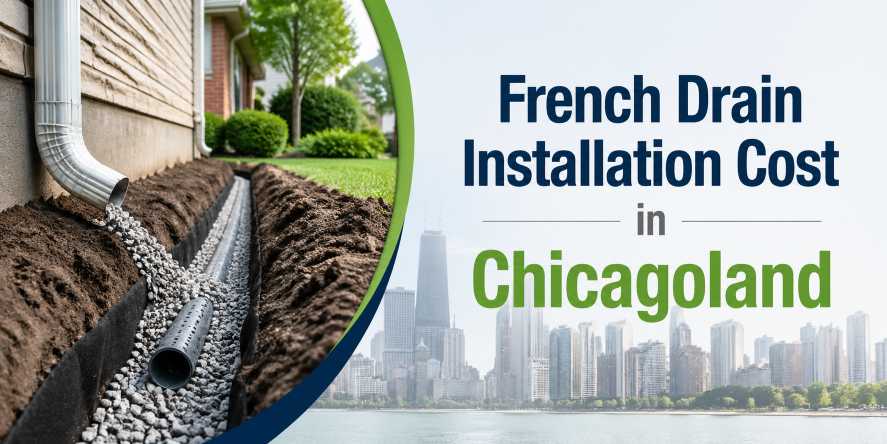
A French drain is a drainage system consisting of a trench filled with gravel or crushed stone containing a perforated pipe that collects and redirects water away from a problem area — whether that’s a foundation, a basement, or a chronically wet section of yard. Water flows into the gravel, enters the perforated pipe, and is channeled to a safe exit point such as a catch basin, a dry well, a bubbler pot, or the street.
The system is elegant in its simplicity — no moving parts, no electricity required for basic exterior installations, and when properly installed it can last 30 to 50 years with minimal maintenance.
Chicagoland’s environment makes French drains not just useful but often essential. The region’s heavy clay soil absorbs rainfall slowly and holds water at the surface for days after a storm — creating the chronic pooling and saturation problems that plague basements and yards across Cook and DuPage Counties. Add over 38 inches of annual precipitation, significant spring snowmelt, and a combined sewer system that surcharges during major rain events, and you have conditions that make proper drainage one of the most important investments a Chicagoland homeowner can make.
French Drain Installation Cost in Chicagoland: The Real Numbers
According to Fixr’s 2025 French drain cost data, the national average cost for French drain installation ranges from $2,800 to $6,500, with costs running $10 to $100 per linear foot depending on drain type, depth, and location. Interior basement systems run significantly higher — often $50 to $100 per linear foot due to concrete removal and more complex installation.
In Chicagoland specifically, here’s what homeowners typically pay:
Exterior shallow French drain (yard drainage, surface water diversion) — $25 to $50 per linear foot. A typical 50 to 80 foot installation runs $1,500 to $4,000 depending on depth, soil conditions, and exit point complexity.
Exterior deep footing drain (foundation perimeter, water table management) — $50 to $75 per linear foot. More excavation, more material, and more labor — a full perimeter installation on a typical Chicagoland home can run $4,000 to $9,000.
Interior basement French drain (sub-slab perimeter drain with sump pump) — $80 to $120 per linear foot in Chicagoland. Concrete saw cutting, slab removal, excavation, pipe installation, and slab restoration make this the most labor-intensive option. A full basement perimeter system typically runs $6,000 to $15,000 depending on basement size and sump pump requirements.
Combined systems — many Chicagoland properties need both exterior and interior solutions working together. A full property drainage solution — exterior yard drains, foundation perimeter drain, and interior system with sump pump — can range from $8,000 to $20,000 for a typical suburban property.
These numbers are ranges — not quotes. Every Chicagoland property is different, and the only accurate price for your specific situation comes from a licensed contractor who has actually walked your property and assessed where water is entering, where it needs to go, and what the soil and access conditions look like.

What Drives the Cost Up in Chicagoland
Soil conditions. Chicago’s heavy clay soil is one of the most challenging environments for drainage work. Clay compacts tightly, requires more effort to excavate, and sometimes requires specialized equipment. If your property also has buried tree roots, existing utility lines, or compacted fill soil from previous construction, expect the excavation cost to be on the higher end.
Depth required. A shallow yard drain two feet deep is dramatically less expensive to install than a deep footing drain six feet below grade. Depth is driven by where water is entering and what needs to be protected — a basement that floods requires a deeper solution than a soggy corner of the backyard.
Length of the system. This is the most straightforward cost driver — more linear feet means more pipe, more gravel, and more labor. A 200-foot system costs roughly twice as much as a 100-foot system, all else being equal.
Access and landscape obstacles. A French drain installation in an open backyard with easy equipment access costs less than one that requires hand digging through tight side yards, under decks, around mature tree roots, or in areas where mechanized equipment can’t reach. Several of our past Chicagoland jobs have required entirely hand-dug trenches due to access constraints — that labor adds up quickly.
Exit point construction. Where does the water go when it exits the pipe? If there’s a natural grade that allows water to daylight at the property edge, that’s the simplest and least expensive option. If the water needs to be collected in a catch basin, directed to a dry well, or connected to a bubbler pot in the parkway, those structures add cost. In some Chicagoland municipalities, connecting to the municipal storm system requires permits and sometimes inspections.
Interior vs. exterior. Interior basement French drains require concrete demolition, removal, and restoration on top of the actual drainage work. That’s a significant cost multiplier compared to exterior systems — but for a basement that floods through the floor during heavy rain, interior drainage is often the only solution that actually works long-term.
Sump pump integration. Interior systems almost always require a sump pump to move collected water out of the pit and away from the foundation. If you don’t have a sump pump or your existing one is undersized, that’s an additional cost. A quality sump pump installation adds $400 to $1,200 depending on the pump and any backup power requirements.
Exterior vs. Interior French Drain: Which One Does Your Property Need?
This is the question that matters most before any cost discussion, and the honest answer is that it depends entirely on where your water problem is originating.
Exterior French drains solve surface water problems — yard pooling, foundation seepage from above-grade water, and drainage from downspouts or neighboring properties. If your yard holds water for days after rain, if water runs toward your foundation rather than away from it, or if your window wells flood during heavy rain, an exterior solution addresses the source of the problem directly.
Interior basement French drains solve subsurface water problems — water that enters through the floor, through cracks in the foundation wall at or below grade, or through hydrostatic pressure from a high water table. If your basement floor is damp or wet after rain even though your yard drains reasonably well, the water is coming from below — and an exterior drain alone won’t stop it.
Many Chicagoland properties need both. An exterior system manages surface water and reduces hydrostatic pressure from above; an interior system with a sump pump captures what still gets through. Our French drain and drainage tile installation team assesses both the exterior and interior conditions before recommending a solution — because the wrong diagnosis leads to an expensive installation that doesn’t solve the problem.
Real Jobs We’ve Done Across Chicagoland
To give you a realistic picture of what French drain projects actually look like in this market, here are a few examples from recent jobs our team has completed:
In Oak Brook, we installed a French drain system to redirect water away from the property and reduce yard flooding — protecting the foundation from excess moisture that was accumulating after every significant rain event.
In Aurora, we installed a 120-foot French drain system, connecting three downspouts to black perforated corrugated pipe with gravel to promote drainage, ensuring proper runoff management and eliminating persistent standing water near the foundation.
In LaGrange Highlands, we placed 120 feet of perforated and solid piping, connected sump pump discharge lines to code, and channeled water to bubbler boxes in a dry section of the yard — addressing chronic lawn drainage that had been a problem for years.
In Addison, we excavated up to 35 feet in both front and back yards, installing two French drain systems using 3/4-inch washed stone and Schedule 40 PVC pipe to manage water flow across a property with complex grading challenges.
In Hoffman Estates, we connected backyard gutter lines and a sump pump discharge to a subsurface drain system, extending the line to the parkway and adding a bubbler box for efficient groundwater collection.
Every property is different. These jobs ranged significantly in scope and cost — which is exactly why a site visit and assessment is the only way to get an accurate number for your specific situation.
How to Evaluate a French Drain Quote in Chicagoland
When you get quotes for French drain installation, here’s what to look for and what to be cautious about:
A legitimate quote should specify the type of system being installed, the pipe diameter and material, the type and depth of gravel or stone, the exit point and how collected water will be managed, whether permits are required and who pulls them, and what the restoration work looks like — grading, seeding, or concrete patching as applicable.
Be cautious of quotes that are purely per-linear-foot without any site assessment. A contractor who quotes you $X per foot without walking your property doesn’t know what they’re dealing with — soil conditions, access constraints, depth requirements, and exit point complexity all vary dramatically from one Chicagoland property to the next. And if you already have an older drain tile or French drain system that has stopped performing, don’t automatically assume you need a complete replacement. In some cases, cleaning and restoring the existing system may be a more practical option. Our drain tile cleaning cost guide for Chicago homeowners explains what drain tile cleaning costs, when cleaning makes sense, and when a damaged or failed system requires more extensive work.
According to Angi’s 2026 French drain cost guide, labor rates for drainage work typically run $50 to $100 per hour, and homeowners should always obtain multiple quotes from licensed contractors before committing. Ask specifically whether the contractor is licensed and insured in Illinois, whether they pull permits where required, and whether they provide a warranty on the installation.
French Drain vs. Other Flood Control Options
A French drain is one tool in the flood control toolkit — not always the right one, and sometimes not sufficient on its own. Here’s how it compares to other common solutions:
Sump pump — addresses water that has already entered the basement by removing it mechanically. Often used in conjunction with an interior French drain that collects and channels water to the sump pit. Our sump pump installation and repair services cover the full range from basic replacement to full battery-backup systems.
Backwater valve — prevents sewer backup from entering the home through floor drains during combined sewer surcharge events. Addresses a completely different problem than a French drain — flooding from the municipal system rather than groundwater or surface water. Our flood control system installation team frequently installs both backwater valves and French drains together for comprehensive basement protection.
Overhead sewer — the most comprehensive flood control solution for Chicago-area homes, rerouting all drainage above the level of the city main. Physically prevents sewer backup from entering regardless of what happens in the municipal system. Higher upfront cost but permanent protection.
Regrading — addressing the slope of the yard so water flows away from the foundation rather than toward it. Sometimes sufficient on its own for mild yard drainage issues, often combined with a French drain for more significant problems.
The right solution — or combination of solutions — depends entirely on your specific property and the source of your water problem. We assess every Chicagoland property individually before making recommendations.
Frequently Asked Questions: French Drain Installation Cost in Chicagoland
How much does French drain installation cost in the Chicago suburbs?
For a standard exterior French drain in Chicagoland, expect to pay $25 to $75 per linear foot depending on depth, soil conditions, and exit point complexity. A typical residential installation runs $2,000 to $6,000 for an exterior system and $6,000 to $15,000 for an interior basement perimeter drain with sump pump. The only accurate price for your property comes from a site assessment by a licensed contractor.
Do I need a permit for French drain installation in Chicagoland?
It depends on the municipality and the scope of the work. Exterior yard drains that don’t connect to the municipal system typically don’t require a permit. Systems that connect to catch basins, storm sewers, or involve significant excavation near the foundation may require permits from your village or city building department. We handle permit requirements as part of every job and will tell you upfront what’s needed for your specific installation.
How long does a French drain last in Chicagoland?
A properly installed French drain using quality pipe and stone can last 30 to 50 years. The most common cause of premature failure in Chicagoland is root intrusion from the mature trees that are common throughout the area — roots find their way into the perforated pipe over time. Regular inspection and occasional flushing can extend the system’s life significantly.
Can I install a French drain myself?
Exterior shallow yard drains are sometimes DIY-able for homeowners with the right equipment and a clear understanding of grading and drainage. Deep footing drains, interior basement systems, and any installation that connects to municipal infrastructure should be handled by a licensed contractor. A poorly installed French drain that drains toward the foundation instead of away from it — or that has no adequate exit point — can make your water problem significantly worse.
How long does French drain installation take in Chicagoland?
A standard exterior installation typically takes one to two days. Interior basement systems with concrete removal and restoration take two to four days depending on the perimeter length. Complex multi-system installations with both exterior and interior components can take three to five days.
What’s the difference between a French drain and a drain tile system?
In Chicagoland these terms are often used interchangeably, though technically drain tile refers to the perforated pipe or tile used inside the system. When local contractors refer to “drain tile installation” they typically mean the same thing as a French drain — a trench-and-pipe drainage system that collects and redirects water. Our drainage tile and French drain installation services cover both exterior yard systems and interior basement perimeter systems throughout the Chicago area.
Get a French Drain Quote for Your Chicagoland Property
Every property is different. Send us a message and we’ll schedule a site assessment — we’ll tell you exactly what your drainage problem needs and what it will cost before any work begins.
Or call us directly: 708-801-6530 | Open 24/7
—
Suburban Plumbing Sewer Line & Drain Cleaning Experts
Licensed & Insured | Open 24 Hours | Serving Chicago & the Suburbs Since 1978
📞 Suburbs: 708-801-6530
📞 West Suburbs: 630-749-9057
📞 Chicago: 773-570-2191
🚨 24/7 Emergency Line: 708-518-7765