
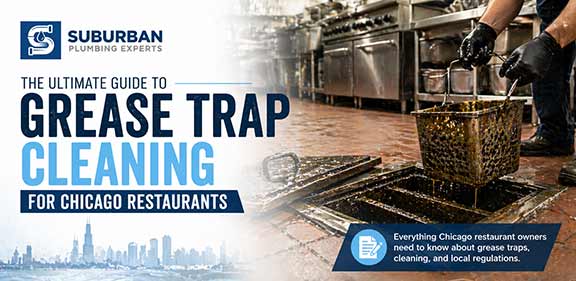
If You Own or Manage a Food Service Establishment in Chicago, This Is Not Optional — Here’s Exactly What the Law Requires and What Happens If You Don’t Comply
Running a restaurant in Chicago is demanding enough without a surprise visit from a city inspector, a kitchen shutdown during a Friday dinner rush, or a $10,000 fine showing up in your mailbox. But for restaurant owners and property managers who haven’t stayed on top of grease trap maintenance, that’s exactly the kind of scenario that plays out — regularly, across Chicago and the suburbs.
Grease trap cleaning is one of the most commonly neglected compliance requirements in the Chicago food service industry. Not because owners don’t care, but because the rules are more specific than most people realize, the consequences of noncompliance are more severe than most people expect, and finding a licensed plumber who handles commercial grease work correctly is harder than it sounds.
This guide covers everything Chicago restaurant owners, kitchen managers, and commercial property managers need to know — what a grease trap actually does, what Chicago law specifically requires, how often cleaning needs to happen, what the violations look like, and how to stay compliant without disrupting your operation.
What a Grease Trap Is and Why Chicago Requires Them
A grease trap — also called a grease interceptor — is a plumbing device installed between your kitchen’s drain lines and the municipal sewer system. Its job is to capture fats, oils, and grease (FOG) before they enter the city’s sewer infrastructure, where they cool, solidify, and accumulate into blockages that can affect entire city blocks.
The physics are simple. Wastewater from your kitchen enters the trap and slows down. As it cools, FOG rises to the top of the chamber and is retained. Solid food particles sink to the bottom. Relatively cleaner water flows out through an outlet pipe and into the sewer. Over time, the accumulated FOG and solids fill the trap — and when the trap is full, grease bypasses the baffles and enters the sewer line exactly as if no trap existed at all.
Chicago has some of the most extensive combined sewer infrastructure in the country, and FOG accumulation in those lines is a serious and expensive problem. The Metropolitan Water Reclamation District of Greater Chicago manages wastewater for over 5 million Cook County residents, and FOG discharge from commercial kitchens is one of the leading causes of sewer blockages and overflows across the system. That’s why the city takes grease trap compliance seriously — and why violations carry real financial consequences.
What Chicago Law Actually Requires
The legal requirement for grease interceptors in Chicago food service establishments is established in multiple overlapping regulatory frameworks. The Chicago Department of Public Health food safety requirements require that all food establishments connect sinks in which food, utensils, and equipment are washed to a catch basin or approved grease interceptor. This is not a suggestion — it is a condition of operating a food service establishment in the City of Chicago.
At the state level, Illinois Administrative Code Section 890.510 establishes grease interceptor requirements for all commercial establishments and institutions in which grease, fats, or culinary oils are wasted from kitchens or food processing areas. All waste lines and drains carrying grease, fats, or culinary oil must be directed to one or more interceptors.
Chicago’s Department of Water Management enforces FOG regulations under the city’s Sewer Use Ordinance. The key requirements every Chicago food service operator needs to know:
Installation is mandatory. Every food service establishment must have properly sized and installed grease interceptors. The size of the interceptor must be adequate to handle the volume of wastewater generated by the specific operation — a 10-gallon under-sink trap is not adequate for a high-volume kitchen that produces hundreds of pounds of FOG per week.
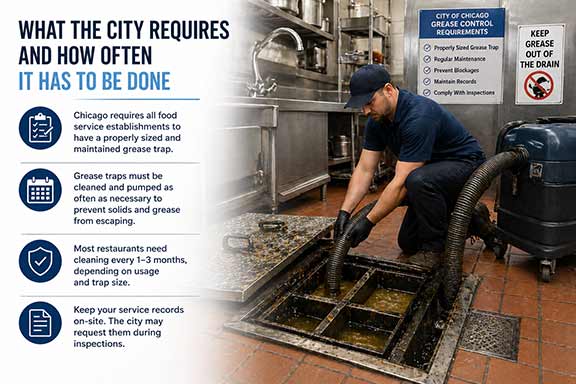
The 25% Rule governs cleaning frequency. Chicago requires grease traps to be cleaned when FOG and solids occupy 25% of the trap’s capacity — regardless of how recently the last cleaning took place. This is the trigger, not a calendar date. Inspectors use depth measurements to verify compliance, and a trap that has reached 25% capacity without being cleaned is a citable violation even if it was serviced just two weeks ago.
Minimum cleaning frequency is every 90 days. Even for low-volume operations, Chicago regulations require cleaning at least once every 90 days. High-volume operations — steakhouses, pizza kitchens, fried food concepts, and any establishment with extended operating hours — typically need cleaning monthly or even more frequently to stay below the 25% threshold.
Record keeping is mandatory for three years. Every cleaning must be documented with the date of service, the name and contact information of the service provider, the volume of material removed, and the disposal destination of the waste. These records must be available for inspection on demand. Missing documentation is itself a citable offense — even if your trap is otherwise clean and compliant.
Waste disposal must go to permitted facilities. All grease waste removed from a Chicago food service establishment must be transported to a facility with valid disposal permits. Using a hauler who dumps grease waste improperly exposes the restaurant to liability — it’s your establishment’s name on the waste, not the hauler’s.
Enzyme and biological additives are not a substitute. Chicago’s ordinance specifically prohibits relying on enzyme treatments, biological additives, or chemical products in place of proper mechanical cleaning and pumping. These products may reduce odors temporarily but do not prevent FOG accumulation. They shift grease downstream rather than eliminating it — and using them in lieu of proper maintenance is a violation.
How Often Does Your Chicago Restaurant Actually Need Cleaning?
The honest answer is that it depends on your operation — but here are realistic ranges based on what we see across Chicagoland:
Small cafes, coffee shops, low-volume kitchens: Every 90 days (quarterly) is typically sufficient. These operations produce relatively low FOG volumes and a properly sized trap will stay well below the 25% threshold at this frequency.
Mid-volume restaurants, full-service dining: Every 60 days (every other month) is a common and safe schedule. A busy full-service restaurant with a standard American menu will typically hit the 25% threshold somewhere in the 45-90 day range depending on menu composition and cover counts.
High-volume operations, pizza kitchens, steakhouses, fried food concepts: Monthly cleaning is the standard — and for very high-volume frying operations, bi-weekly service may be necessary to stay compliant. A kitchen running a busy deep-fry operation can fill a trap to the 25% threshold in three to four weeks.
24-hour operations and extended-hour establishments: More frequent than monthly is often required. The continuous operation of a 24-hour diner or a bar kitchen that runs until 4 a.m. generates FOG volume that standard monthly scheduling may not adequately address.
The only way to know for certain what frequency your specific operation requires is to have a licensed plumber inspect and measure your trap after known intervals and establish a cleaning schedule based on actual accumulation rates. A schedule built around your real FOG output is cheaper than emergency service calls and cheaper than fines.
What Violations Look Like and What They Cost
Chicago takes grease trap noncompliance seriously and has the enforcement mechanism to back it up. City inspectors from the Department of Public Health and the Department of Water Management conduct routine and unannounced inspections of food service establishments. Here’s what the penalty structure looks like:
First violation: Written warning and compliance order with a specific remediation deadline. The clock starts immediately.
Continued noncompliance: Fines starting at $500 per incident. Each day of continued noncompliance can be treated as a separate violation.
Repeat or severe violations: Fines escalating to $10,000 per violation. At this level, the city may also pursue suspension of your food service license — meaning you can’t operate until the violation is resolved and documented.
Environmental violations: In cases where FOG discharge has caused damage to city infrastructure or contributed to sewer overflows, additional penalties under federal Clean Water Act provisions are possible on top of city fines.
Beyond fines, the operational consequences of a neglected grease trap are significant. A trap that overflows backs up into your kitchen floor drains — exactly what you don’t want during a dinner service. Emergency service calls outside of business hours carry premium rates, often 1.5 to 2 times standard pricing. And a kitchen shutdown during peak hours costs far more in lost revenue than a routine cleaning ever would.
The Difference Between a Grease Trap and a Grease Interceptor
These terms are often used interchangeably but technically refer to different devices — and understanding the distinction matters for Chicago compliance because the two have different cleaning requirements and service procedures.
Grease traps are smaller, passive devices typically installed under the sink inside the kitchen. They handle lower flow rates and require more frequent cleaning — often monthly or more — because of their limited capacity. Under-sink grease traps in Chicago restaurants are typically 10 to 100 gallons.
Grease interceptors are larger tanks installed underground outside the building, typically in a concrete vault accessible via a manhole cover. They handle higher flow rates and have much larger capacity — often 500 to 2,000 gallons or more. Because of their size, they require less frequent cleaning but the service cost per cleaning is higher given the volume of material removed. Outdoor interceptors are typically pumped rather than hand-cleaned.
Many Chicago restaurants have both — an under-sink trap that handles the immediate kitchen output and a larger outdoor interceptor that catches overflow from the system. Both require separate maintenance on appropriate schedules.
What Proper Grease Trap Cleaning Actually Involves
A proper professional cleaning is more involved than simply pumping out the contents. Here’s what a thorough service should include:
The technician removes the trap lid and measures the current FOG and solids levels — this is your compliance documentation. All accumulated FOG, food solids, and liquid contents are pumped out using a vacuum truck. The interior of the trap is inspected for damage, corrosion, baffle condition, and proper seating of the inlet and outlet fittings. The trap is rinsed and cleaned — residual buildup on the walls and baffles is removed. The lid is replaced and sealed. The technician provides a written service record with all information required for your compliance log — date, gallons removed, service provider information, and disposal destination.
The preferred cleaning method in Chicago is pump-and-return — where the FOG is removed for disposal but the gray water is returned to the trap before the clean water enters. For a complete look at all vacuum truck services available for your commercial property — including catch basin pumping, septic service, and storm drain cleaning — read our complete Chicago vacuum truck pumping guide. Dry pumping, which removes the entire contents including gray water, leaves the trap temporarily dry and can cause strong odors until water is reintroduced. Some municipalities mandate one method over the other — ask your service provider which is appropriate for your specific installation.
Our grease trap cleaning services for Chicago area restaurants cover the full service process for both indoor grease traps and outdoor interceptors, with proper documentation for your compliance records.
What to Look for in a Grease Trap Service Provider
Not every plumber handles commercial grease work, and not every grease trap service provider does the job correctly. Here’s what to verify before you hire:
Licensed plumbing contractor. In Illinois, grease trap work that connects to the plumbing system must be performed by a licensed plumbing contractor. Verify the license before signing a service agreement. Our Illinois Plumbing License number is #055-044116.
Proper waste disposal. Ask specifically where your grease waste will be disposed of and confirm the disposal facility has valid permits. This protects you if the hauler is ever audited.
Written service records. Your service provider should automatically provide complete written documentation after every cleaning — date, gallons removed, service technician, disposal destination. If they don’t, find someone who does.
Experience with Chicago compliance requirements. The 25% rule, the record-keeping requirements, the three-year documentation mandate — your service provider should know these without being asked. If they don’t, they’re not the right fit for a Chicago operation.
Commercial Plumbing Beyond Grease Traps
Grease trap maintenance is one piece of a larger commercial plumbing picture for Chicago restaurants and food service properties. Our commercial plumbing services for Chicago and the suburbs cover the full range of needs for restaurants, multi-unit buildings, and commercial properties — from grease trap cleaning and drain cleaning to sewer camera inspections, water heater replacement, and emergency plumbing response. For a deeper look at commercial plumbing systems, common problems, maintenance requirements, and solutions for Chicagoland businesses, read our complete guide to commercial plumbing in Chicago and the suburbs.
For business owners and commercial property managers in DuPage County, our article on Commercial Plumbing in Lombard, IL explains the most common plumbing issues commercial buildings face, how preventative maintenance protects your property, and what businesses should expect from a professional commercial plumbing company.
For restaurant owners dealing with slow kitchen drains, floor drain backups, or recurring plumbing issues beyond the grease trap itself, our commercial drain cleaning services address the full drain system — not just the trap.
Frequently Asked Questions: Grease Trap Cleaning in Chicago
How often does Chicago require grease trap cleaning?
At minimum, every 90 days — but the real trigger is the 25% rule. Chicago requires cleaning when FOG and solids reach 25% of trap capacity, regardless of calendar schedule. High-volume operations often need monthly or more frequent cleaning to stay below that threshold. The 90-day minimum applies even if your trap hasn’t reached 25% capacity.
What records do I need to keep for Chicago grease trap compliance?
You must maintain cleaning logs for a minimum of three years documenting the date of each service, the name and contact information of the service provider, the volume of material removed, and the disposal destination of the waste. These records must be available for city inspection on demand. Missing or incomplete records are a citable violation.
What are the fines for grease trap violations in Chicago?
First violations typically result in a compliance order with a deadline. Continued noncompliance brings fines starting at $500 per incident, escalating to $10,000 for repeat or severe violations. In extreme cases, food service license suspension is possible — meaning you can’t operate until the violation is remediated and documented.
Can I use enzyme treatments or additives instead of cleaning?
No. Chicago’s ordinance specifically prohibits using enzyme treatments, biological additives, or chemical products as a substitute for mechanical cleaning. These products may temporarily reduce odors but do not prevent FOG accumulation and do not satisfy the city’s cleaning requirements.
What’s the difference between grease trap cleaning and pumping?
Pumping refers specifically to removing the contents of the trap using a vacuum truck. Cleaning is more comprehensive — it includes pumping plus inspection of the interior, removal of residual buildup from walls and baffles, and assessment of the trap’s condition. A proper service should include both. Ask your provider what’s included in their service before scheduling.
Do I need a licensed plumber for grease trap cleaning in Illinois?
Yes. Grease trap work that involves the plumbing system in Illinois must be performed by a licensed plumbing contractor. Verify your service provider’s Illinois plumbing license before engaging them for commercial work.
Need Grease Trap Cleaning for Your Chicago Restaurant or Commercial Property?
We provide licensed grease trap cleaning and maintenance for restaurants and commercial properties across Chicago and Chicagoland — with full compliance documentation after every service. Send us a message and we’ll get back to you fast.
Or call us directly: 708-801-6530 | Open 24/7
—
Suburban Plumbing Sewer Line & Drain Cleaning Experts
Licensed & Insured | Open 24 Hours | Serving Chicago & the Suburbs Since 1978
📞 Suburbs: 708-801-6530
📞 West Suburbs: 630-749-9057
📞 Chicago: 773-570-2191
🚨 24/7 Emergency Line: 708-518-7765