
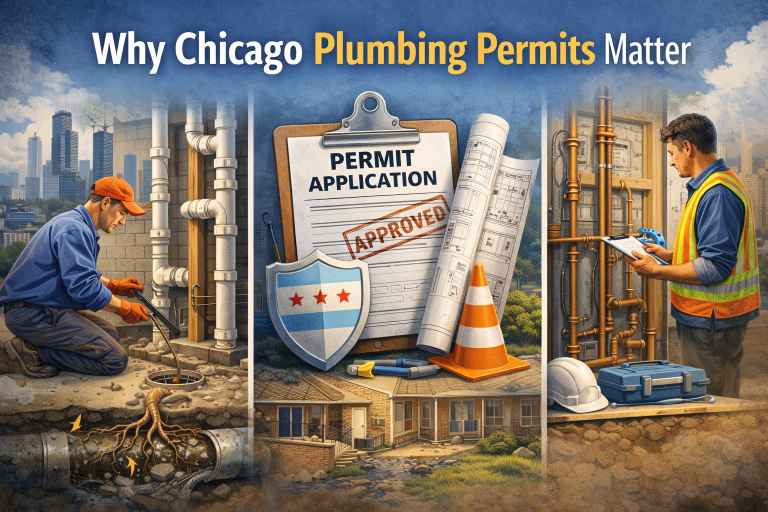
Most Homeowners Don’t Think About Permits Until It’s Too Late. Here’s What You Need to Know Before Starting Any Plumbing Work in Chicago.
Someone gives you a quote to replace your water heater. Another guy says he can fix the sewer line for cash, no paperwork, done by Friday. A neighbor got their bathroom remodeled last summer and nobody pulled a permit — and everything seems fine. So why bother?
Here’s why: unpermitted plumbing work in Chicago can stop a home sale cold, trigger daily fines from the city, force you to tear open finished walls for inspection, or leave you holding the bag when something fails and insurance won’t cover it. The permit isn’t just a piece of paper — it’s the thing that protects you legally, financially, and physically when plumbing work doesn’t go as planned.
This guide explains exactly which plumbing projects require a permit in Chicago and the surrounding suburbs, what happens when you skip one, how the permit process actually works, and what to look for when hiring a plumber who handles permits properly.
What the Chicago Plumbing Code Actually Says About Permits
Chicago’s plumbing permit requirements are governed by the Chicago Plumbing Code, Section 18-29-102.4, which requires a permit for any addition, alteration, or repair to a plumbing system. This is not a narrow rule — it covers the majority of plumbing work performed in residential and commercial properties throughout the city.
Permits for plumbing work in Chicago are issued through two departments depending on the scope of the work. The Department of Buildings handles building permits for structural and major renovation work. The Department of Water Management handles plumbing-specific permits for work involving water supply, drainage, and sewer connections. For larger jobs — a sewer line replacement, a water line repair, a bathroom addition — permits may be required from both.
The code also specifies who can pull a plumbing permit in Chicago. In most cases, permits must be pulled by a licensed registered plumbing contractor bonded with the City of Chicago. Owner-occupants of single-family residences have limited rights to perform their own plumbing work, but that work still must comply with all applicable codes and is subject to inspection. If you hire a plumber who isn’t licensed and bonded with the city, they cannot legally pull a permit for the work they’re doing — and that’s a significant red flag.
Which Plumbing Projects Require a Permit in Chicago
Not every plumbing call requires a permit. A clogged drain, a dripping faucet, a running toilet — routine repairs and maintenance generally don’t require permits. But the moment work involves altering, replacing, or extending your plumbing system in a meaningful way, a permit is almost certainly required. Here are the most common projects that do:
Sewer line repair or replacement — any work on your building’s sewer lateral, including spot repairs, full sewer line replacement, trenchless lining, or new sewer connections, requires a permit. This is one of the most commonly unpermitted plumbing jobs in Chicagoland and one of the most consequential when discovered.
Water line repair or replacement — replacing your main water service line from the city connection to your home requires permits from both the Department of Water Management and often the Department of Buildings. Our water line repair and replacement services include full permit handling from application through final inspection.
Water heater installation or replacement — even a straightforward tank-for-tank water heater swap requires an Easy Permit through Chicago’s Department of Buildings. This is one of the most commonly skipped permits in residential plumbing, and one of the easiest and cheapest to pull — typically approved the same day of application.
Sump pump installation — new sump pump installations and pit construction require a permit. Replacement of an existing unit in the same location may qualify for a simpler permit process depending on the scope of work.
Flood control system installation — backwater valve installation, overhead sewer conversions, and ejector pump system installations all require permits. These are significant structural modifications to your home’s drainage system and are subject to inspection to verify code compliance.
Bathroom additions or plumbing fixture relocations — adding a bathroom, relocating a toilet, moving a sink, or adding new drain lines all require plumbing permits. This is especially important when a bathroom is being modified for long-term accessibility, such as relocating fixtures, improving clearances, or changing plumbing connections to accommodate an aging-in-place design. Our guide to aging-in-place bathroom plumbing in Chicago explains the plumbing considerations homeowners should think about before starting this type of bathroom project. Work that involves new rough-in or changes to your drain-waste-vent system requires a licensed plumber and permit regardless of the scale of the project.
Gas line work — any modification to a gas line, including adding a gas connection for a range, dryer, or fireplace, requires a permit and inspection.
Lead service line replacement — replacement of a lead water service line under the city’s replacement program requires permits and coordination with the Department of Water Management. Our lead service line replacement team handles all permit requirements as part of the replacement process.
What Doesn’t Require a Permit
To be equally clear — plenty of common plumbing calls don’t require permits. Unclogging a drain, rodding a sewer line, repairing a leaking faucet or supply line, replacing a toilet flapper, clearing a backed-up floor drain, fixing a running toilet, replacing a showerhead or faucet in the same location — these are all routine maintenance and repair work that doesn’t trigger the permit requirement.
The practical test is this: if the work involves changing, extending, or altering the plumbing system in a way that affects its configuration, capacity, or connection to the water supply or drainage system, it likely needs a permit. If it’s a like-for-like repair or a routine service call, it probably doesn’t. When in doubt, ask your licensed plumber — a reputable contractor will tell you straight.
The Chicago Permit Process: How It Actually Works
Chicago offers several permit pathways depending on the scope of your project. Understanding which track your job falls into helps you set realistic expectations about timeline and cost.
The Easy Permit Program is the fastest track for routine plumbing work — water heater replacements, minor repairs, and similar straightforward jobs. Easy Permits are approved the same day of application in most cases and don’t require architectural drawings or detailed plan review. For common residential plumbing work that doesn’t involve structural changes or new sewer connections, this is typically the applicable pathway.
Standard Plan Review applies to more complex projects — new sewer connections, water line replacements, flood control installations, and any work involving significant changes to the plumbing system. Standard permits require submitted drawings and a formal plan review process. In Chicago, standard permit review can take four to twelve weeks depending on the complexity and current Department of Buildings volume. Suburban municipalities in Cook County and DuPage County typically process standard permits in one to three weeks — faster and generally less complex than the city.
Inspection is the final step after permitted work is complete. A city inspector visits the property to verify the work was done to code before the permit is closed out. This inspection is not optional — unpermitted work that was never inspected has no official record of code compliance, which creates problems down the road.
The cost of permits is generally modest relative to the cost of the work itself. Chicago plumbing permits typically run $25 to $500 depending on the scope of the project. Easy Permits for common replacements are on the lower end. The Department of Buildings provides a permit fee calculator on its website for more specific estimates based on project type and scope. According to the City of Chicago’s official permit guidance, most residential plumbing permits can be applied for online through the city’s Inspection, Permitting and Licensing portal.
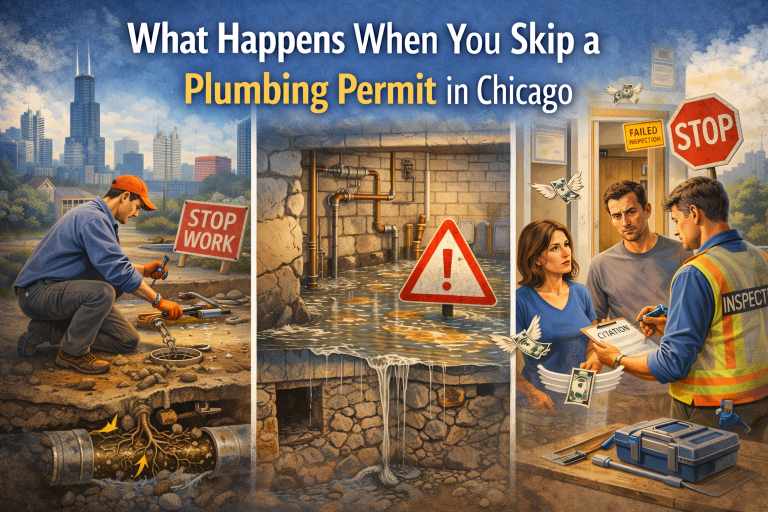
What Happens When You Skip a Permit
This is where homeowners get into real trouble — and it’s almost always the homeowner, not the contractor, who pays the price when unpermitted work surfaces.
Fines from the city. The Department of Buildings can issue fines of $500 to $1,000 per violation per day until the situation is resolved. A stop-work order can be issued requiring all work to halt until proper permits are obtained. If the unpermitted work is already complete, you may be required to retroactively permit it — which sometimes means opening finished walls so an inspector can see what’s behind them.
Problems when you sell. Unpermitted plumbing work is one of the most common deal-killers in Chicago real estate transactions. A buyer’s inspector or their attorney may discover the work through a title search or physical inspection. At that point you’re either required to remediate the issue before closing — which can mean tearing out and re-doing work — or the sale falls through. Disclosure requirements under Illinois law mean sellers have an obligation to disclose known unpermitted work, and failing to do so opens the door to liability after the sale.
Insurance won’t pay. If unpermitted plumbing work fails and causes damage — a water heater installed without a permit that develops a gas leak, a sewer line repair that collapses and causes a backup — your homeowners insurance has grounds to deny the claim entirely. The unpermitted work is a material misrepresentation of the condition of your home, and insurers use it to justify denial.
Future permit problems. Once you have unpermitted work on record — or worse, open permits that were never closed out — every future permit application is flagged. The Department of Buildings checks for outstanding violations and unresolved permits before issuing new ones. If you try to pull a permit for a legitimate future project and there’s unpermitted work in your history, you may be required to resolve it before the new permit is approved.
How to Tell If Your Plumber Is Pulling the Permit
The simplest way to protect yourself is to confirm permit status directly — don’t take a contractor’s word for it. Here’s how:
Ask your contractor for the permit number before work begins. A licensed plumber pulling a permit will receive a permit number from the city and can provide it to you immediately. If they can’t provide a number, either the permit hasn’t been pulled yet or it isn’t being pulled at all.
You can verify active permits on properties in Chicago through the city’s open data portal at data.cityofchicago.org, which maintains a searchable database of building permits by address. If a permit was pulled for your property, it will show up there.
Be skeptical of any plumber who proactively discourages permits or suggests skipping them to “save money” or “keep things simple.” A licensed, bonded plumber with nothing to hide pulls permits because it’s the law and because it protects you. A contractor who avoids permits is often avoiding the inspection process because the work wouldn’t pass — and that tells you everything you need to know about the quality of what they’re doing.
Permits and Your Licensed Plumber
At Suburban Plumbing Experts, we are fully licensed and bonded with the City of Chicago — IL Plumbing License #055-044116 and Sewer License #2565. We pull all required permits for work that requires them, coordinate with the Department of Buildings and Department of Water Management, and schedule inspections as part of the job. You don’t have to navigate the permit process yourself — we handle it.
If you’ve had plumbing work done by someone else and you’re not sure whether it was permitted, we can help you figure that out too. Whether you’re preparing to sell, concerned about a previous repair, or planning a new project and want to do it right from the start, our residential plumbing services team can assess the situation and walk you through your options.
Our plumbing code violation correction services specifically address situations where unpermitted or non-compliant work needs to be brought up to code — whether you discovered the issue yourself, were cited by the city, or it came up during a real estate transaction.
Frequently Asked Questions: Chicago Plumbing Permits
Do I need a permit to replace my water heater in Chicago?
Yes. Water heater replacement in Chicago requires an Easy Permit through the Department of Buildings. The good news is that Easy Permits for water heater replacements are typically approved the same day of application and cost relatively little. Any licensed plumber should pull this permit automatically as part of the job — if yours doesn’t mention it, ask why.
Can I do my own plumbing work in Chicago without a permit?
Owner-occupants of single-family residences have limited rights to perform their own plumbing work under the Chicago Plumbing Code, but that work must still comply with all applicable codes and is subject to inspection. You cannot hire unlicensed help to assist you. For any significant plumbing project — water heater, sewer line, water line, flood control — working with a licensed contractor who pulls the proper permits is almost always the right call.
What happens if a previous owner did unpermitted plumbing work and I just bought the house?
This is unfortunately a common situation. Your options depend on the nature of the work and whether it’s causing active problems. In some cases unpermitted work can be retroactively permitted through an after-the-fact permit application and inspection. In others, the work may need to be redone to meet current code before a permit can be issued. Our code violation correction team can assess the specific situation and tell you what path makes the most sense.
Does permit work take longer to complete?
Routine jobs using the Easy Permit pathway — water heater replacements, minor repairs — typically add only a day or two to the process since Easy Permits are usually approved same-day. More complex work requiring Standard Plan Review can take longer given Chicago’s permit review timeline, but that timeline exists regardless of which contractor you hire. The answer is never to skip the permit — it’s to hire a contractor who manages the process efficiently.
Do suburbs have the same permit requirements as Chicago?
Permit requirements exist throughout Chicagoland but vary by municipality. Most suburban Cook County and DuPage County municipalities require permits for the same categories of work as Chicago — water heater replacements, sewer work, water line repairs, flood control installations. The good news is suburban permit review is generally faster than Chicago’s — typically one to three weeks for standard permits versus four to twelve weeks in the city. We handle permits across all of our service area, from Chicago to the western suburbs.
How do I check if a permit was pulled for work on my property?
For Chicago properties, you can search the city’s public permit database at data.cityofchicago.org using your property address. Suburban permits are managed by each municipality’s building department — you can call your village or city hall directly to request a permit history for your address. If you’re buying a home and want to verify permit history before closing, this is a step worth taking.
Need Permitted Plumbing Work Done Right the First Time?
We’re fully licensed and bonded with the City of Chicago and pull all required permits as part of every job. No shortcuts, no surprises. Send us a message and we’ll get back to you fast.
Or call us directly: 708-801-6530 | Open 24/7
Suburban Plumbing Sewer Line & Drain Cleaning Experts Licensed & Insured | Open 24 Hours | Serving Chicago & the Suburbs Since 1978
📞 Suburbs: 708-801-6530 📞 West Suburbs: 630-749-9057 📞 Chicago: 773-570-2191 🚨 24/7 Emergency Line: 708-518-7765