
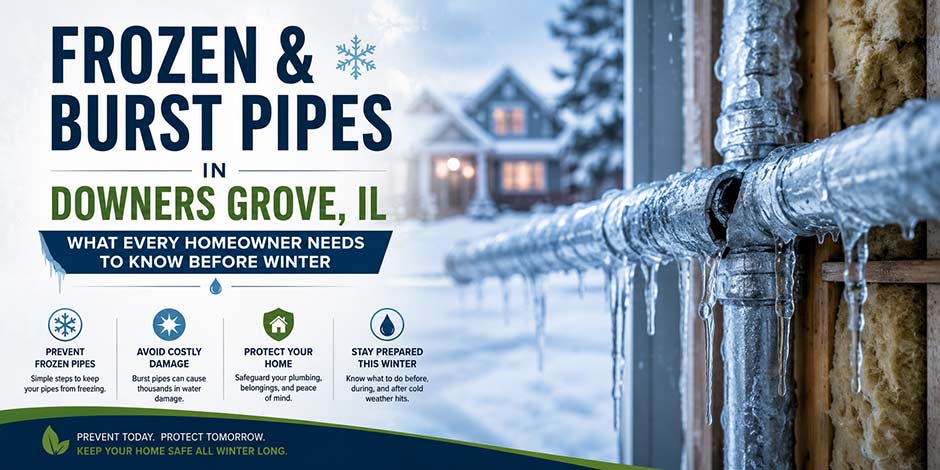
Downers Grove Has One of the Most Varied Housing Stocks in the Western Suburbs — Sears Catalog Homes from the 1920s, Split-Levels from the 1960s, Slab-on-Grade Ranches from the 1970s, and New Construction Teardowns on the Same Block. Each Era Has Its Own Freeze Profile. Most Homeowners Don’t Know Which One They’re Living In.
Downers Grove is a village of 50,000 people spread across 14 square miles of south central DuPage County — and its housing stock spans more construction eras than almost any other western suburb. The village was settled in 1832, incorporated in 1873, and developed continuously through the mid-century expansion, the I-88 and I-55 corridor growth of the 1960s through 1980s, and the teardown-and-rebuild wave that has been replacing small postwar ranches with large new homes on the same lots for the past twenty years. What this means for frozen pipes is something almost no one talks about: the freeze vulnerability profile of a Downers Grove home is almost entirely determined by when it was built and what construction method was used — and two homes three blocks apart can have completely different winter plumbing risk profiles based on nothing more than their construction year.
The record low for Downers Grove — minus 26 degrees Fahrenheit, set in January 1985 — defined a generation of frozen pipe calls across the western suburbs. The February 2021 polar vortex event, which held temperatures below zero for several consecutive days across DuPage County, produced a wave of burst pipe calls from homes in the mid-century housing stock whose supply line routing through unheated garage spaces or exterior-facing wall cavities had never been addressed because they’d survived most previous winters without incident. “Most previous winters” is exactly the problem. A pipe that has survived twenty winters in a marginally protected location is not a pipe that is safe — it’s a pipe that hasn’t been tested hard enough yet.
This guide covers the frozen and burst pipe picture specifically for Downers Grove — the construction eras, the specific vulnerability patterns by housing type, what DuPage County’s clay soil does to burst pipe water damage that makes the situation worse than it would be in better-draining environments, the Downers Grove Sanitary District’s programs that are relevant to winter plumbing emergencies, and what every Downers Grove homeowner needs to do before the next polar vortex warning appears on the forecast.
The Downers Grove Housing Stock — Why Construction Era Determines Freeze Risk
Pre-1940: The Historic Core — Sears Homes, Craftsman Bungalows, and Genuine Victorian Infrastructure
The oldest residential properties in Downers Grove — concentrated in the historic downtown area around Main Street and Curtiss Street, and extending through the blocks west of the BNSF railway stations — date from the 1870s through the 1930s. This era includes the Sears Roebuck Catalog homes that are among the most identifiable residential architecture in the village, original Victorian and Craftsman construction, and early 20th century housing built to standards of the era. Census data shows approximately 8.8 percent of Downers Grove’s housing stock predates 1940 — about 1,800 homes.
The freeze profile of pre-1940 Downers Grove homes is defined by one characteristic above all others: plumbing that was added or extended to houses that were not originally designed around it. In many cases, water supply lines in these homes run through wall cavities that were retrofitted during plumbing additions decades after the original construction, and those cavities were not insulated at the time of installation because insulation standards of the era didn’t require it. A supply line running through an exterior wall cavity in a 1920s Sears Catalog home in downtown Downers Grove has probably been there for 70 years. If it has survived previous polar vortex events without freezing, it has done so with a thin margin — and each structural change, insulation removal during renovation, or deterioration of the original wall material has narrowed that margin further.
Galvanized steel supply lines in the oldest unrenewed properties are also a freeze concern that is distinct from the freeze vulnerability itself: galvanized steel that is 80 or more years old has internal corrosion scale that has progressively narrowed the effective pipe diameter. When a partially scaled galvanized line freezes and then thaws, the expansion pressure during the freeze cycle concentrates at the narrowest points — often the corroded joints — where the pipe wall is thinnest. These are not clean burst failures that produce an obvious spray when they let go. They produce hairline fractures at corroded joint faces that leak slowly behind walls, in floor cavities, or in basement ceiling spaces, accumulating damage for days before the water reaches a visible surface. Our complete guide to what your home’s age tells you about its plumbing covers the full material breakdown for every construction era — including the galvanized steel supply line failure patterns specific to pre-war homes.
1940–1965: The Postwar Expansion — When Downers Grove Built Its Biggest Surge
The largest single construction era for Downers Grove’s housing stock is the postwar period — approximately 31.7 percent of all homes were built between 1940 and 1969. These are the mid-century ranches, Cape Cods, and early split-levels that fill the residential streets south and west of downtown, extending through the neighborhoods that developed as the BNSF and Burlington rail access made Downers Grove a desirable commuter destination for the postwar generation of Chicago professional families.
The freeze vulnerability in this era is concentrated in three specific locations that appear consistently across mid-century DuPage County construction:
Garage-to-house penetrations: Mid-century homes typically have an attached or detached garage with water supply access — a hose bib on the garage wall, a utility sink in the garage itself, or supply lines running through the garage wall to serve an adjacent laundry room or bathroom. These lines pass through an unheated space and then penetrate the heated building envelope. The penetration point — where the supply line enters the heated space from the garage — is the most common freeze location in this housing era. The garage is not heated, and the supply line running through it has no thermal protection between the exterior temperature and the water inside. On a night when the garage temperature drops to 10°F and holds there for six hours, the section of supply line in the garage wall will freeze.
Crawl space supply line routing: Many mid-century ranches in Downers Grove have partial or full crawl spaces rather than full basements — a construction cost-saving decision common in the 1950s and 1960s. Supply lines in these crawl spaces run below the floor deck and above the ground surface in a space that receives whatever ambient temperature the crawl space vent configuration allows. Crawl space supply line freezing is the freeze event that Downers Grove homeowners most often describe as “coming out of nowhere” — because the crawl space itself is invisible, the homeowner had no indication that anything was wrong until the kitchen or bathroom fixtures went dry on a cold morning.
Exterior wall supply runs: Post-war construction in DuPage County used exterior wall framing primarily designed for structural support rather than thermal efficiency — 2×4 construction with minimal insulation by contemporary standards. Supply lines routed through exterior-facing wall cavities in these homes occupy a space where the effective insulation between the pipe and the outside air may be as little as a few inches of compressed fiberglass. This is adequate in a normal Chicago winter. It is not adequate during a polar vortex event that holds temperatures below minus 10°F for 36 hours.
1965–1985: Split-Levels, Bi-Levels, and the Slab-on-Grade Era — The Highest Burst Pipe Risk per Square Foot
The construction era from roughly 1965 through the early 1980s produced the split-level and bi-level homes that are among the most common housing types in Downers Grove’s established neighborhoods — and this era contains, in our experience across hundreds of service calls, the highest concentration of burst pipe risk per square foot in the village’s housing stock. The median construction year for Downers Grove is 1974, squarely in this band.
The reason is specific: split-level and bi-level homes from this era have intermediate floor levels that create partially exposed mechanical spaces — the lower level mechanical room that is partially below grade but not fully conditioned, the utility areas at the intermediate landing level where supply lines run between the garage and the main living areas, and in many cases a slab-on-grade lower level where supply lines were embedded in or run along the slab surface with minimal thermal protection. When a slab-on-grade lower level in a 1971 Downers Grove split-level drops to 35°F during a polar vortex event because the intermediate level door to the garage has a gap at the threshold that nobody noticed in October, the supply line running along the slab surface freezes. When it thaws, it bursts — not at a joint or fitting, but at the weakest section of the pipe wall, which in 50-year-old copper may be anywhere along a corroded section.
Slab-on-grade supply line bursts are the most damaging frozen pipe events we respond to in Downers Grove for a specific reason: the water from the burst has nowhere to go vertically. In a full-basement home, a burst pipe in the basement ceiling releases water that falls to the basement floor — contained, visible, accessible. In a slab-on-grade lower level, a burst pipe releases water that floods the slab surface, migrates under door thresholds to adjacent rooms, and saturates any floor covering in contact with the slab. In DuPage County’s clay soil environment — where the subgrade beneath the slab retains moisture rather than allowing rapid drainage — the water that penetrates the slab edge or finds any pathway to the subgrade creates a moisture condition under the slab that can persist for weeks after the surface is visibly dry.
Post-1985 and New Construction: Lower Risk, Not Zero Risk
Post-1985 construction in Downers Grove — including the teardown replacements that have been a significant feature of the village’s housing market for two decades — generally has better pipe protection than the older stock. Contemporary insulation standards, tighter building envelopes, and plumbing code requirements for supply line protection in unconditioned spaces reduce the freeze vulnerability relative to mid-century construction. The specific freeze risks in newer Downers Grove homes are concentrated in four areas: exterior hose bibs that have not been properly winterized and shut off from inside; supply lines in attached garage walls that serve second-story bathrooms or laundry rooms above the garage; irrigation system winterization failures; and in the largest new construction homes, supply lines to exterior features — outdoor kitchen rough-ins, hose connections to outbuildings — that were not adequately protected when the outdoor plumbing was designed.
What Happens When a Pipe Bursts in Downers Grove — Why Clay Soil Makes It Worse
A burst pipe in a Downers Grove home releases water under pressure — typically 40 to 80 PSI for a residential supply line — until the main water shutoff is closed. A half-inch copper line bursting at 60 PSI can release 10 to 20 gallons per minute. In the time between when the pipe bursts and when a homeowner discovers the leak, closes the main shutoff, and stops the flow, a significant volume of water has already entered the structure. In a full-basement home, that water falls to the basement floor and is visible immediately. In a split-level or slab-on-grade home, it migrates laterally under flooring, through wall cavities, and to the lowest accessible space — and in DuPage County clay soil, what happens next is the second problem.
DuPage County’s Drummer and Flanagan series clay soils — common across Downers Grove’s residential neighborhoods — have extremely low permeability. Water that reaches the soil beneath or adjacent to a foundation in a clay soil environment does not drain away. It saturates the clay and raises the water table locally, applying hydrostatic pressure against the foundation from outside at exactly the time when the structure is already dealing with water intrusion from inside. The combination of a burst pipe event with the subsequent soil saturation in clay conditions is why burst pipe water damage in Downers Grove homes tends to be more extensive than equivalent events in better-draining suburban soil environments. The water doesn’t just cause immediate damage and then drain away — it creates a sustained elevated moisture condition in the soil around the foundation that prolongs the drying process and increases mold risk.
This is the specific reason that immediate response to a burst pipe in Downers Grove matters more than homeowners sometimes appreciate. The pipe can be repaired in a single service call. The structural moisture condition in the foundation and subgrade from an extended leak event can take weeks to fully resolve — and every hour the water is flowing before the main is shut off adds to the drying timeline. Know where your main water shutoff is before this winter. Confirm it operates freely. A shutoff valve that has seized from years of non-use is a shutoff valve that doesn’t stop the flow when you need it most. If you’re not certain where your main shutoff is or whether it operates, call on our Downers Grove plumbers before the first freeze — not during one.
If a burst pipe does occur, choosing an experienced local plumber can make a significant difference in how quickly your home recovers. Read our guide on choosing a local pro after a burst pipe in Downers Grove before hiring a contractor.
When a pipe freezes or shows signs of imminent failure during extreme cold, knowing how to respond in the moment can prevent a full burst and significantly reduce damage — this step-by-step guide on how to thaw a frozen pipe in Chicago safely and prevent burst damage explains the correct thawing methods, what not to do, and how to avoid turning a freeze into a full-scale flooding event.
The Downers Grove Sanitary District — What It Is and Why It Matters for Winter Plumbing Emergencies
A Separate Government Entity — Not the Village of Downers Grove
One of the most important things Downers Grove homeowners need to understand about their plumbing infrastructure is that the sanitary sewer system — the pipes carrying wastewater from the home to treatment — is operated by the Downers Grove Sanitary District, an independent unit of local government that is entirely separate from the Village of Downers Grove. The District, organized in 1921 under the State of Illinois’ Sanitary District Act of 1917, provides sewer service to more than 60,000 people across Downers Grove and portions of Westmont, Woodridge, Lisle, Lombard, Oak Brook, and Darien — it maintains over 250 miles of sewer main and operates a Wastewater Treatment Center at 5003 Walnut Avenue with an 11 million gallon per day design capacity.
This separation matters in a frozen pipe emergency because the agency you call for a sewer backup problem — the Downers Grove Sanitary District at 630-969-0664 — is different from the agency that manages village streets, water mains, and storm drainage. When a burst pipe event involves sewer line damage, the Sanitary District is the relevant authority. When it involves the water main in the street, the Village of Downers Grove’s Public Works is the contact at 630-434-5460. Understanding which system is affected by a plumbing emergency determines which call to make first — and on a night when multiple systems are affected by the same freeze event, that clarity saves time.
The Sanitary District’s Programs That Downers Grove Homeowners Need to Know About
The Downers Grove Sanitary District operates four assistance programs that are relevant to homeowners dealing with sewer-related plumbing conditions — including conditions that can be worsened by freeze events:
The Building Sanitary Service Repair Assistance Program provides cost-sharing for property owners who need to repair the private sanitary service line — the sewer lateral from the home to the District’s main. A freeze event that causes a lateral to crack or shift — rare but possible in extreme freeze-thaw cycling in DuPage County clay soil — could make this program relevant to a homeowner facing an unexpected lateral repair expense.
The Reimbursement Program for the Installation of Overhead Sewers and Backflow Prevention Devices provides a $3,000 reimbursement for homeowners who install backflow prevention systems. This program is relevant beyond the frozen pipe context — it applies to any Downers Grove homeowner who experiences sewer backup and wants flood control protection. Contact the District at 630-969-0664 or visit dgsd.org to confirm current program availability, dollar amounts, and application requirements before hiring any contractor.
The Reimbursement Program for Sanitary Sewer Backups Caused by Public Sewer Blockages covers verified backup events that originate from District main blockages rather than private lateral conditions. If your basement backs up and the cause is confirmed as a District main blockage rather than a private lateral problem, this program is your first call after the event is resolved.
Contact the District directly at 630-969-0664 for current program details and eligibility requirements — program dollar amounts and terms are updated periodically and should be confirmed directly with the District before making any contractor decisions. Our existing Downers Grove burst pipe emergency guide covers the immediate response steps in detail — what to do in the first minutes after a pipe bursts, how to minimize damage before the plumber arrives, and what to tell your insurance company.
The Specific Freeze Vulnerability Locations in Downers Grove Homes — A Room-by-Room Assessment
The Garage: The Highest-Probability Freeze Location in Mid-Century Downers Grove Homes
Attached and detached garages in Downers Grove’s mid-century and split-level housing stock are the single highest-probability freeze location we find on pre-winter assessments. The pattern: a supply line that serves a garage hose bib, a utility sink, a laundry room adjacent to the garage, or a bathroom above the garage runs through a wall cavity that separates the heated living space from the unheated garage. During normal Chicago winters, the garage temperature stays above freezing because the door seal is reasonably tight and the adjacent conditioned space radiates enough heat through the shared wall. During a polar vortex event with sustained temperatures below minus 10°F and strong winds, that thermal balance tips and the pipe in the garage wall cavity hits freezing temperature.
The preventive measures: install pipe insulation sleeves on any supply line visible in the garage; check the door threshold seal — a gap at the base of the door between the garage and the house is a cold air path directly to the supply lines; if there is a hose bib on the garage wall, confirm there is a shutoff valve inside the heated space that allows you to drain the exterior section of that bib before winter. A hose bib shutoff valve that doesn’t exist — common in 1960s construction — means the bib and its supply line are exposed to whatever temperature the garage reaches. Install one if it’s missing. The cost is $200 to $400 for a licensed plumber to install a proper frost-free shutoff valve. The cost of a burst supply line in the garage wall is $800 to $3,500 depending on access and the scope of water damage.
Crawl Spaces: The Invisible Freeze Location
Downers Grove ranches with crawl space construction — common in the 1950s and 1960s — have supply lines running below the floor deck in a space whose temperature is determined by the crawl space venting configuration and the quality of the access panel seals. A crawl space with open foundation vents — designed to reduce moisture in summer but catastrophic in a polar vortex — will drop to ambient outdoor temperature within hours of a severe cold event. Supply lines in that space will freeze at the same rate as exposed outdoor pipes.
Before winter: confirm whether your crawl space vents are open or closed. If they are open in winter, close them before the first significant cold snap. Check that the crawl space access panel seals tightly — a loose access hatch is a direct cold air path into the crawl space from the exterior. Consider pipe sleeve insulation on supply lines visible in the crawl space, particularly where they approach the exterior foundation wall. If your home has a crawl space and you have never thought about the supply lines inside it, this winter is the time to find out what’s there before a polar vortex does it for you.
The Meter Pit and Water Service Line: The External Threat
For Downers Grove homes with a water meter pit — typically in the front yard near the street — the meter pit and the service line feeding it represent a freeze vulnerability that is separate from the home’s interior plumbing. Meter pits are designed to protect the meter from frost at normal winter temperatures, but during extended extreme cold events, shallow meter pits in DuPage County clay soil can freeze if the insulating cover is damaged, missing, or displaced. A frozen meter stops water delivery to the home entirely — not a burst pipe event, but an emergency that requires the Village of Downers Grove’s water division and sometimes a plumber depending on the extent of the freeze. Check your meter pit cover in the fall — it should be intact, properly seated, and free of damage. If it’s cracked or missing, contact the Village of Downers Grove Public Works at 630-434-5460 to report the condition before winter.
Exterior Hose Bibs: The Easiest Prevention in the Entire Home
Every exterior hose bib in Downers Grove should be winterized before the first hard freeze — typically by mid-November at the latest, and earlier in years with early cold snaps. Winterizing means: disconnecting all garden hoses from the bibs (a hose left connected to a frost-free bib traps water in the bib body and defeats the frost-free design), shutting off the interior supply valve for each bib, and opening the bib to drain the remaining water from the section between the shutoff valve and the bib. A frost-free hose bib that doesn’t have its hose disconnected freezes at exactly the same rate as a non-frost-free bib. The frost-free design only works when the hose is off, the bib is open after shutoff, and the water in the bib body drains back past the shutoff seat into the heated space. This is a five-minute maintenance task that prevents a $500 to $1,500 repair. Do it before November 15 every year without exception.
When a Pipe Freezes — What to Do and What Not to Do
A frozen pipe that has not yet burst is a window of opportunity. The pipe has ice in it. The ice is applying expansion pressure to the pipe wall. Whether that pressure causes a burst depends on the pipe material, age, condition, and how long the freeze holds. A pipe that froze at 2 a.m. and thaws by 9 a.m. has spent seven hours under expansion pressure — the outcome depends on whether the pipe wall held. Here’s what to do during that window:
Open the affected fixture’s faucet. Both hot and cold. This relieves pressure as the ice melts and gives the meltwater somewhere to go. A faucet that is completely dry with no drip at all confirms the section between the meter and that fixture is frozen. A faucet with a small trickle may be partially frozen — keep it running.
Apply gentle, indirect heat to the frozen section if you know where it is. A hair dryer on low held six inches from the pipe, moving continuously along the frozen section from the faucet end toward the frozen area. Electric heating pads designed for pipe thawing. Warm towels wrapped around the pipe. Do not use open flame of any kind — propane torches, cigarette lighters, any direct flame source — on residential supply lines. Cast iron and copper conduct heat rapidly and the sections adjacent to where you apply heat can reach damaging temperatures before the frozen section is clear.
Do not crank the thermostat. A sudden dramatic temperature increase in the home doesn’t help the frozen section and puts mechanical stress on the heating system. The frozen section is in the wall, crawl space, or unheated area — the ambient air temperature in the living space is not what’s warming it. Time and gentle direct application of heat to the frozen section is what thaws it.
Know where your main shutoff valve is before you start. If the pipe is going to burst — and at some point during the thaw, you’ll hear a crack, see a spray, or notice a sudden wet ceiling — you need to close the main shutoff within seconds. Practice finding it before the emergency, not during it. In Downers Grove’s mid-century housing stock, the main shutoff is typically at the water meter inside the home — in the utility room, the mechanical room, or in the crawl space near where the service line enters the foundation. Know it. Label it. Make sure every adult in the house knows where it is.
Call us if you can’t locate the frozen section or the pipe isn’t thawing. A frozen section in a wall cavity or under a slab requires professional pipe thawing equipment — electric pipe thawing tools that apply current through the pipe itself, safely warming the entire run without localized heat that damages adjacent materials. Our burst pipe repair service covers Downers Grove with 24/7 emergency response — if the pipe has already burst by the time you call, we stop the leak, assess the damage scope, and repair the failed section. If it hasn’t burst yet, we can often thaw it safely and prevent the burst entirely. Call 708-518-7765 any time for emergency service.
If a pipe freezes or bursts during extreme cold conditions, immediate response matters more than anything else — this step-by-step emergency guide for Chicago emergency plumber frozen pipe burst sewer backup response explains exactly what to do in the first minutes to minimize damage and prevent further loss. For a broader look at the winter plumbing emergencies that affect homeowners throughout the Chicago area — including frozen pipes, burst pipes, sewer backups, sump pump failures, and emergency prevention steps — our complete Winter Plumbing Emergencies in Chicagoland Guide covers the seasonal threats every homeowner should prepare for before extreme cold arrives.
When a Pipe Bursts — The Immediate Sequence That Determines the Damage Scope
A burst pipe in a Downers Grove home is a water damage event whose severity is almost entirely determined by how quickly the water supply is shut off. Every minute the main valve stays open after a burst is a minute of additional damage. Here is the correct sequence:
Close the main water shutoff immediately. Don’t try to find the burst first. Don’t assess the damage first. Close the main shutoff. If you don’t know where it is, go to the street and look for the curb stop valve access box in the parkway — but note that curb stop operation requires a specialized T-bar tool that most homeowners don’t have. The interior main shutoff is always the faster option if it is accessible and operational.
Open the lowest faucet in the house. After the main is closed, open a faucet at the lowest floor level to drain water from the supply lines and relieve any residual pressure. This reduces the total water volume that continues to flow from the failed section after the main is closed.
Document everything before cleanup begins. Photograph the affected area, the damaged pipe if visible, and the extent of water on floors, walls, and ceilings. This documentation is your insurance claim support. Do not discard damaged materials — flooring, drywall sections, personal property — before photographing them.
Protect electrical equipment from water. If water is near any electrical panel, outlet, or fixed appliance, do not enter the affected area until the circuit breaker for that zone is off. Water and live electrical circuits in the same space are a life safety issue, not a property damage issue.
Call us and your insurance company simultaneously. The plumber stops the source. The insurance company starts the claim. Both calls happen as soon as the main is closed and the immediate safety situation is stabilized. Waiting to call the insurance company until after the plumber has already been on-site and started repairs can create documentation gaps that complicate the claim. Call them in parallel. Once the water is shut off and the immediate emergency is under control, the next critical phase is understanding how to handle the damage that’s already been done — this guide on what to do after a burst pipe floods your Chicago home explains the exact steps homeowners should take in the hours and days following a flooding event to reduce long-term damage and prevent mold growth.
Pre-Winter Preparation for Downers Grove Homes — The November Checklist
The best frozen pipe response is the one that never happens because the preparation was done right. For Downers Grove homeowners, the following actions before mid-November address the specific vulnerability patterns of the village’s housing stock:
Disconnect all garden hoses from all exterior bibs and confirm each bib’s interior shutoff valve is closed and the bib is draining. Schedule irrigation system blowout if the home has an in-ground system — compressed air winterization before the first hard freeze. Check garage supply lines and the garage-to-house door threshold seal. Inspect crawl space vents and access panel seals. Confirm the main water shutoff valve operates freely — physically turn it and confirm it moves. Check the meter pit cover if the home has one. Have the water heater anode rod inspected if it’s more than 3 years old — Chicago area hard water and the DuPage Water Commission’s Lake Michigan supply creates mineral accumulation that reduces water heater efficiency and can produce the popping, rumbling sounds that signal a heavily scaled tank.
For any Downers Grove home built between 1945 and 1975 — the era with the highest freeze vulnerability in the village’s housing stock — a pre-winter plumbing assessment is worth scheduling before November. We check the specific vulnerability locations for the home’s construction era, identify any pipe runs that need insulation or additional protection, and confirm that the shutoff valves throughout the home are functional. The assessment costs a service call fee. The burst pipe it prevents can cost $5,000 to $25,000 in combined pipe repair and water damage restoration. Our sewer backflow prevention service also covers Downers Grove — the Sanitary District’s $3,000 reimbursement program makes this a reasonable winter-adjacent investment for homeowners who have experienced backups and haven’t yet installed protection.
Frequently Asked Questions: Frozen and Burst Pipes in Downers Grove
My Downers Grove home was built in 1968 and has a split-level design with a lower level on a slab. Which pipes are most at risk in a polar vortex?
The highest-risk locations in a 1968 Downers Grove split-level on a slab are: supply lines running along or near the slab surface on the lower level, particularly any section that runs adjacent to an exterior wall; supply lines in the wall cavity between the lower level mechanical space and the attached garage; the garage hose bib and its supply section if it routes through the garage wall; and any pipe runs that pass through the lower level floor penetrations where cold air from the garage or crawl space can migrate into the lower level mechanical space. For a house of this vintage that has never had a pre-winter plumbing assessment, we’d recommend scheduling one before the first significant cold event this season — specifically to identify whether any of these sections are exposed and whether insulation or shutoff valves need to be added.
I’m not sure whether my Downers Grove sewer is served by the Village or the Downers Grove Sanitary District. How do I find out?
The Downers Grove Sanitary District is the sanitary sewer authority for the vast majority of Downers Grove residential properties, but the District’s service area also extends into portions of Westmont, Woodridge, Lisle, Lombard, Oak Brook, and Darien — and there are some properties in Downers Grove served by different sanitary districts. The fastest way to confirm: call the Downers Grove Sanitary District at 630-969-0664 with your property address. They can confirm within minutes whether your property is in their service area. For water supply, Downers Grove drinking water comes from Lake Michigan via the DuPage Water Commission pipeline — contact Village Public Works at 630-434-5460 for water supply questions. If you experience a sewer backup or water main issue, knowing which agency to call first saves significant time during an emergency.
A pipe burst in my basement during the last polar vortex and I just had it repaired. Do I need to do anything else before next winter?
Yes — and the repair alone doesn’t address the vulnerability that caused the burst. The pipe that burst failed because it was in a location that reached freezing temperature during the event. Unless the underlying vulnerability — the uninsulated wall cavity, the unheated crawl space section, the garage supply line exposure — has been specifically addressed, the same pipe location will be at risk again during the next comparable event. Have the repaired section and its surrounding environment assessed by a plumber who can recommend whether pipe insulation, heat tape, a relocated shutoff valve, or a rerouted supply line run is the appropriate long-term fix. A repaired pipe in a vulnerable location is still a vulnerable location.
My Downers Grove home has a crawl space. It gets very cold in winter but I’ve never had a frozen pipe. Should I still be concerned?
Yes — and the specific phrase “I’ve never had a frozen pipe” in the context of a cold crawl space is exactly the situation that precedes many of the burst pipe calls we respond to after polar vortex events. A crawl space supply line that has survived previous winters without freezing has done so because previous winters didn’t reach the sustained temperature the pipe’s current protection level can’t handle. The polar vortex events that produce widespread frozen pipe calls across DuPage County are the events that push past the threshold of “usually cold enough.” At a minimum: confirm crawl space vents are closed before winter, confirm the access panel seals tightly, and add pipe sleeve insulation to any supply lines visible in the crawl space near the exterior foundation wall. The incremental cost is under $100 in materials. The exposure it addresses is real.
Frozen or Burst Pipe in Downers Grove? Call 24/7. Or Schedule a Pre-Winter Assessment Before the First Hard Freeze.
Licensed, insured, and serving Downers Grove since 1978. We handle frozen pipe thawing, burst pipe repair, emergency water shutoff, pre-winter plumbing assessments for mid-century and split-level homes, garage and crawl space supply line insulation, hose bib shutoff valve installation, sewer backflow prevention for the Sanitary District’s reimbursement program, sump pump service, and complete residential plumbing throughout Downers Grove and the surrounding DuPage County communities. Emergency line answered 24/7. Written quotes before any repair work begins.
Emergency line: 708-518-7765 | Main line: 630-749-9057 | Open 24/7
—
Suburban Plumbing Sewer Line & Drain Cleaning Experts
Licensed & Insured | Open 24 Hours | Serving Downers Grove Since 1978
📞 Downers Grove: 630-749-9057 | 🚨 Emergency: 708-518-7765