
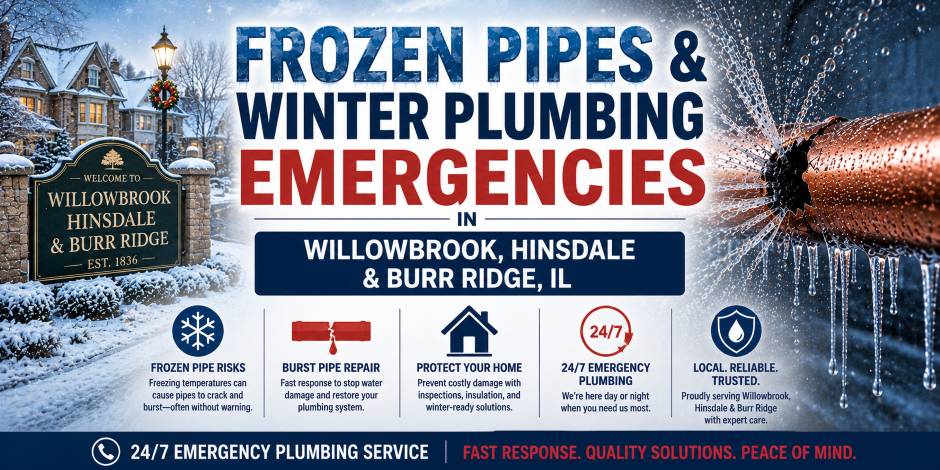
A Burst Pipe in a Standard Suburban Home Costs $5,000 to $40,000 in Water Damage Remediation. A Burst Pipe in a Hinsdale Victorian With Original Plaster Walls, Period Woodwork, and Preservation Commission Oversight Can Cost $150,000 to $400,000. The Pipe Repair Is the Same. What It Repairs Into Determines Everything.
Willowbrook, Hinsdale, and Burr Ridge sit in adjacent territory in the southwestern DuPage and Cook County corridor — three communities that share borders, school districts, and in some cases the same ZIP code, but that represent three completely different financial and architectural contexts for winter plumbing emergencies. The median home value in Hinsdale is $1,418,500 — among the highest in the Chicago metropolitan area. The Robbins Park Historic District, a National Register of Historic Places-listed neighborhood, contains over 360 contributing structures built primarily between the 1870s and 1930s, making it the most concentrated and architecturally significant collection of historic homes in the western Chicago suburbs. Burr Ridge’s large-lot luxury estates on the Valparaiso Moraine, with Flagg Creek running through the village, represent some of the most expensive residential construction in Cook and DuPage counties. Willowbrook, with its higher percentage of condos and townhouses than most DuPage County suburbs, has the HOA responsibility question familiar from Woodridge — but at a different market tier and with a different housing stock profile.
What unites all three communities in a frozen pipe context is not the construction era or the pipe material — it is the financial consequence of a burst pipe event relative to the structures the pipes serve. In a standard 1975 DuPage County ranch, a burst pipe in an exterior wall cavity releases water that damages drywall, insulation, and carpet in a space that restoration contractors can remediate and rebuild with standard materials at standard costs. In a Hinsdale Robbins Park Victorian with original plaster and lath walls, period crown molding, oak floors with original finish, handcrafted built-in cabinetry, and a Historic Preservation Commission that governs what restoration materials and methods are acceptable, the same burst pipe event releases water into wall cavities that cannot be opened with a standard drywall saw and repaired with standard drywall. The plaster must be removed by someone who understands original plaster construction. The lath must be assessed before the plaster is replaced. The replacement plaster must match the original in composition and finish. The millwork that absorbs water must be dried, assessed, and in many cases replaced with period-appropriate materials. The costs are not comparable — and the preparation and prevention investment that is appropriate for a $1.4M historic home is categorically different from what is appropriate for a $400,000 postwar ranch.
This guide covers the winter plumbing picture for all three communities — the specific freeze risks in Hinsdale’s historic housing stock, what the Valparaiso Moraine means for Burr Ridge’s large-lot estates, Willowbrook’s attached housing context, the Flagg Creek and Salt Creek flooding overlays, and what every homeowner in all three communities needs to understand about the relationship between their home’s value, their pipe vulnerability, and the appropriate level of preparation before a polar vortex event arrives.
Hinsdale: The Highest Stakes Frozen Pipe Market in the Western Suburbs
The Robbins Park Historic District — Where Burst Pipe Remediation Is a Preservation Project
The Robbins Park Historic District’s 360-plus contributing structures, built primarily between the 1870s and 1930s, represent every major residential architectural style of the era — Queen Anne, Prairie School, Italianate, Colonial Revival, Tudor Revival, and French Provincial. Exterior modifications to homes within the district require a Certificate of Appropriateness from Hinsdale’s Historic Preservation Commission. Interior restoration work following water damage is not subject to the same formal approval process — but the practical requirements of restoring original plaster walls, period woodwork, and historic building materials to their pre-damage condition in these homes creates remediation costs that bear no resemblance to standard suburban water damage restoration.
The specific cost amplifiers in a Hinsdale Robbins Park burst pipe event:
Original plaster and lath walls. A Hinsdale Victorian with original plaster and lath construction has walls that cannot be opened, dried, and restored using standard drywall remediation techniques. Opening a plaster wall to access a failed pipe section or to dry a wet wall cavity requires a restoration contractor with plaster expertise, not a standard drywall crew. The plaster removal must be controlled to prevent damage to adjacent original surfaces. The framing and lath beneath must be assessed before anything is replaced. The replacement plaster must be applied in multiple coats to match the original surface profile — a skilled plasterer in the Chicago market charges $80 to $150 per square foot for period-appropriate plaster restoration. A water damage event that saturates 200 square feet of original plaster wall generates a restoration cost estimate that begins at $16,000 for the plaster alone, before millwork, flooring, and painting.
Period woodwork and millwork. The built-in cabinetry, crown molding, door casings, window surrounds, and baseboards in a Hinsdale historic home are original craftsmanship from the era of construction — typically quartersawn oak, old-growth heart pine, or other period materials that are not available from standard lumber suppliers. When a burst pipe event saturates millwork of this type, the drying process is slow and careful — rapid forced-air drying that works on contemporary dimensional lumber can crack and distort original millwork. Where replacement is required, matching the wood species, grain pattern, profile, and finish of original period millwork requires a millwork specialist, not a standard trim carpenter. Replacement costs for period-appropriate millwork in Hinsdale’s historic homes range from $300 to $1,200 per linear foot for custom reproduction work.
Original hardwood floors. Water damage to original hardwood floors in a Hinsdale historic home — particularly quartersawn oak or heart pine floors that are irreplaceable — requires drying, assessment, and potentially refinishing or board replacement that must match the existing floor exactly. A water damage event that reaches the original hardwood floor can raise the boards through moisture expansion, create cupping across the flooring width, and in severe cases delaminate the floor from the subfloor. Full restoration of a raised or cupped original hardwood floor in a Hinsdale historic home costs $12 to $25 per square foot, and replacement with matched wood at $30 to $60 per square foot — significantly more than the $5 to $10 per square foot cost for standard contemporary hardwood replacement.
The total remediation cost for a burst pipe event in a Hinsdale Robbins Park home that saturates a 400-square-foot section of original plaster wall, damages period millwork in three rooms, and raises a 200-square-foot section of original quartersawn oak floor can legitimately reach $150,000 to $400,000 — for a pipe failure event whose repair cost is $800 to $2,500. The pipe is fixed in an afternoon. The historic interior it damaged takes months and significant capital to restore.
The Freeze Vulnerability in Hinsdale’s Historic Housing Stock
The plumbing infrastructure in Hinsdale’s oldest homes reflects the era of their construction. A home in the Robbins Park Historic District built in 1895 has supply lines that have been through 130 Chicago winters. The supply system in the oldest unrenewed properties contains galvanized steel pipe — and in some cases, the original lead supply lines that were standard before galvanized steel was widely adopted for interior residential plumbing. Galvanized steel at 100-plus years old is at and past end of service life. The internal corrosion that has progressively narrowed its effective diameter also means the pipe wall is significantly thinner at corroded joint faces — precisely the points that fail under freeze expansion pressure. The failure mode is the slow-weep hairline fracture at a corroded joint face behind an original plaster wall — the failure that develops silently for hours before the moisture reaches the wall surface, by which time the original plaster has been absorbing water through its full thickness and into the lath behind it.
Even Hinsdale homes that have been fully renovated carry specific freeze vulnerabilities that expensive renovation work can obscure. A Robbins Park Victorian that received a complete kitchen and bathroom renovation in 2018 — new fixtures, new tile, new cabinetry — may have new supply line connections at the fixtures and new finish valves, while the supply runs in the exterior wall cavities behind the new tile remain the original galvanized steel from 1895. The renovation upgraded the visible plumbing at the fixture level. It did not address the supply line runs in the exterior wall cavities. In the 2021 polar vortex, Hinsdale received calls from homeowners with beautifully renovated historic homes whose burst pipes were in the original wall cavity runs — behind the new tile, in the 1895 galvanized steel that the renovation didn’t touch.
The pre-winter assessment for a Hinsdale historic home must specifically address the supply line material and condition in the exterior wall cavity runs — particularly the north and west-facing walls — and in the attic supply runs serving any upper-floor bathrooms that were added during the home’s renovation history. Our complete guide to what your home’s age tells you about its plumbing covers the full material breakdown and freeze failure patterns for pre-war construction in the Chicago area. Our Hinsdale plumber service covers pre-winter assessments, supply line replacement, and emergency frozen and burst pipe response throughout the village — with specific experience in the historic construction methods that make Hinsdale homes different from standard suburban plumbing work.
Hinsdale’s Newer Construction — The Teardown Replacement Context
Hinsdale, like Elmhurst, has experienced a significant teardown and rebuild wave — large new custom homes replacing older properties throughout the village. Hinsdale has an incentive program that gives homeowners tax freezes or expedited permits to prevent older homes from being torn down for newer ones — reflecting a village that is actively managing the tension between preservation and new construction. For the new construction that has occurred, the freeze vulnerability profile mirrors what we described for Elmhurst’s teardown replacements: over-garage suites with supply lines in the floor assembly above the unheated garage bay, three-floor supply line runs in large custom homes, and the interface zones between new and original construction in partially rebuilt properties. The financial stakes in Hinsdale’s new construction market are similarly elevated — a $3M custom home with a finished lower level, home theater, wine cellar, and custom kitchen carries burst pipe water damage potential that is proportionate to its construction value, not to the cost of the pipe that failed.
Burr Ridge: The Valparaiso Moraine, Large-Lot Estates, and Flagg Creek
The Moraine Terrain and What It Creates for Winter Plumbing
Burr Ridge’s gently rolling hills were carved by glaciers at the end of the last ice age, and most of the village lies on the Valparaiso Moraine. Flagg Creek, a tributary of the Des Plaines River, runs through town. The Valparaiso Moraine in Burr Ridge creates the same topographic conditions we described for the Palos communities — north-facing slope exposures, hilltop wind exposure, and cold air pooling in valley locations between ridges — but in a housing context that is entirely different from the Palos split-levels. Burr Ridge’s housing stock consists primarily of large-lot luxury estates built from the 1960s through the 2000s on property that was developed specifically to capitalize on the moraine’s wooded, rolling character. These are not the 1,200-square-foot split-levels that follow the terrain in Palos Hills — they are 4,000 to 10,000 square foot estate homes on one-to-five-acre wooded lots, with large attached garages, extensive outbuilding infrastructure, and in many cases pool houses, guest structures, and equipment buildings that have their own plumbing connections.
The freeze vulnerability profile in Burr Ridge’s large-lot estate homes combines the slope exposure factors from the Palos article with the over-garage and three-floor supply line vulnerabilities from the Elmhurst and Darien articles — at a scale and construction complexity that is unique to this housing type. A Burr Ridge estate home with a five-car garage, a pool house with its own bathroom and kitchen, a guest cottage with its own mechanical system, and a main house with a finished lower level has more plumbing infrastructure in more diverse locations than any housing type in this series — and more locations where supply lines in unheated or partially heated spaces can reach freeze conditions during a polar vortex event.
Flagg Creek Flooding Overlay — The Burst Pipe and Rising Water Combination
Flagg Creek runs through Burr Ridge and has produced flooding in residential properties along its corridor during significant rain and snowmelt events. For Burr Ridge properties near the Flagg Creek corridor, the burst pipe and water damage equation has the same overlay we described for Naperville’s DuPage River corridor and Elmhurst’s Salt Creek corridor: a burst pipe water damage event during a polar vortex freeze can occur during the same 48-to-72-hour window as a Flagg Creek thaw surge that raises groundwater against the foundation from outside. The combination of interior water from a burst pipe and exterior hydrostatic pressure from elevated groundwater is the worst-case water damage scenario for any property — and it is a realistic scenario for Flagg Creek corridor Burr Ridge properties during the thaw period following a hard polar vortex event. Our sump pump service covers Burr Ridge with battery backup installation and proper sizing assessment for the groundwater loads specific to Flagg Creek corridor and moraine slope properties. Our Burr Ridge plumber service covers the full range of frozen pipe response, pre-winter assessment, and emergency burst pipe repair throughout the village.
Outbuilding Plumbing — The Freeze Risk Unique to Large-Lot Estates
The detached garages, pool houses, guest cottages, and equipment buildings that serve Burr Ridge’s large-lot estate properties are among the most freeze-vulnerable plumbing in any community in this series — and among the most overlooked. A pool house with a bathroom, kitchen, and outdoor shower on a wooded Burr Ridge lot is a building that may be used intensively from May through September and completely unheated from October through April. The supply lines serving that pool house are in an unheated building for six months of the year. During a polar vortex event that holds temperatures below zero for 36 hours, those supply lines will freeze if they haven’t been winterized — and “winterized” means the interior shutoff for the pool house supply is closed, the isolated section is drained, and the fixtures are opened to confirm the drain is clear. It does not mean assuming the pool house is fine because it was fine last year.
A complete pre-winter outbuilding plumbing assessment for a Burr Ridge estate property covers every structure with plumbing connections: the main house supply line runs in garage walls and mechanical spaces, the pool house winterization, the guest cottage mechanical room, the equipment building water connections, and any irrigation system zones that terminate near outbuildings. This is a more complex pre-winter assessment than the single-family home assessment that most suburban homeowners schedule — and it is appropriate for the property type and the financial stakes involved.
Willowbrook: The Attached Housing Context and the I-55 Corridor Profile
Condos, Townhomes, and the HOA Responsibility Question
Willowbrook has a higher percentage of condos and townhouses than most DuPage County suburbs, with a median townhouse or attached unit value of $369,109 — significantly less than Hinsdale’s $1.4M median but still representing substantial financial exposure in a burst pipe event. The HOA plumbing responsibility question we covered in depth for Woodridge applies in Willowbrook’s attached housing communities as well — end unit townhomes with exterior wall supply line exposure, mechanical closets adjacent to exterior walls in end units, and the multi-unit damage cascade when a burst pipe in one unit sends water into the adjacent unit. Willowbrook townhome owners who have not read their association’s declaration to confirm where the association’s supply line responsibility ends and their unit’s responsibility begins are operating without essential information that determines who pays for what when a freeze event occurs.
The specific Willowbrook addition to the HOA responsibility discussion: Willowbrook’s Route 83 corridor and I-55 adjacent commercial and residential development means the attached housing communities in the village have a broader range of construction vintages than Woodridge’s more uniformly 1970s-1990s stock. Some Willowbrook condominium communities date from the 1970s and 1980s with CPVC or early copper supply systems; others are 2000s and 2010s construction with modern PEX. The supply line material — and therefore the freeze failure mode to prepare for — differs between communities. End unit owners in a 1982 Willowbrook townhome complex with CPVC supply lines in their exterior end wall have a different freeze preparation priority than end unit owners in a 2008 complex with modern PEX. Identify your supply line material before preparing for polar vortex season.
Our Willowbrook plumber service covers the full range of frozen pipe response, pre-winter assessment, and HOA plumbing documentation for both single-family and attached housing throughout the village.
Willowbrook’s Single-Family Stock — Route 66 Era Homes and the 1960s-1970s Expansion
Willowbrook was incorporated in 1960, growing from the Ridgemoor subdivision, and in the 1980s new development began along IL-83 and I-55. The single-family housing stock in Willowbrook spans the 1960s through the 1990s — a range that includes the early split-levels and ranches from the village’s first decade of incorporation, the 1970s-1980s colonials that define the main residential streets, and the 1990s construction along the IL-83 corridor. This is a housing stock range similar to Darien’s — dominated by 1970s and 1980s construction with copper supply systems now 40 to 55 years old in the age range where thermal cycling fatigue at solder joints becomes relevant during polar vortex events. The freeze vulnerability profile for Willowbrook’s single-family stock is the same as for Darien: garage wall supply lines, exterior wall cavity runs on north and west-facing walls, and the specific joint locations — elbows and tees in exterior wall cavities — where 40-to-55-year thermal cycling stress has accumulated.
Salt Creek Corridor — The Flooding Overlay That Runs Through All Three Communities
Salt Creek runs through and adjacent to all three communities — through Hinsdale’s eastern sections near the Fullersburg Woods Forest Preserve, along Burr Ridge’s eastern boundary near the Salt Creek Club and Fullersburg Woods, and through portions of Willowbrook’s watershed. The creek creates a flooding overlay for properties in all three communities near its corridor that compounds burst pipe water damage events during polar vortex thaw periods — the same mechanism we described for Naperville’s DuPage River corridor and Elmhurst’s Salt Creek corridor. The thaw that follows a hard polar vortex event raises Salt Creek levels and elevates groundwater throughout its watershed simultaneously with the thaw-triggered burst pipe events in affected homes. Properties near Salt Creek in any of the three communities should treat sump pump maintenance and battery backup as a winter preparation priority equal to frozen pipe prevention — because both events can occur in the same 72-hour window.
Smart Water Shutoff Devices — The Right Investment for High-Value Homes
Throughout this series, we have mentioned smart water shutoff devices as the appropriate financial protection for high-value finished basements in Naperville and large custom construction in Elmhurst. In the Willowbrook, Hinsdale, and Burr Ridge context — where the financial consequences of a burst pipe event are the highest of any community in the series — the smart water shutoff device is not a supplementary consideration. It is the most cost-effective single insurance instrument available for protecting the historic plaster walls, period woodwork, original hardwood floors, and high-value finished spaces that characterize homes in all three communities at their respective market tiers.
A smart shutoff device monitors the water flow rate at the main supply and closes the supply automatically when it detects an anomalous flow pattern consistent with a burst pipe — typically within two to five minutes of the burst event. For a Hinsdale Robbins Park Victorian whose owner is at work or on vacation during a polar vortex event, two to five minutes of automatic shutoff response versus the two hours it takes to discover the leak on return represents the difference between a $15,000 restoration event and a $200,000 one. The device costs $600 to $1,200 installed. The plaster wall, millwork, and hardwood floor it protects cost more per square foot than the device costs in total. For any homeowner in all three communities with a home valued above $700,000 and historic construction, original plaster, or high-value finished spaces — the smart shutoff device is the winter preparation investment with the most dramatic potential return.
When a Pipe Freezes or Bursts in a Willowbrook, Hinsdale, or Burr Ridge Home
The Historic Home Frozen Pipe Response — What’s Different
A frozen pipe in a Hinsdale historic home requires the same fundamental response sequence as any Chicago-area freeze event — with one critical addition: do not apply open flame to any supply line in a plaster and lath wall. This is not just general safety guidance — in a Hinsdale Victorian, the narrow cavities between the original lath strips are highly combustible spaces with 130 years of accumulated dust and wood drying. Any plumber who proposes using a torch on a supply line behind an original plaster wall in a Hinsdale historic home does not understand historic construction. The correct thawing method for frozen supply lines in original plaster and lath construction is the electrical pipe thawing technique — applying current through the pipe itself to warm the frozen run from the inside uniformly, without localized surface heat.
Our pipe thawing service covers all three communities with professional electrical thawing equipment specifically appropriate for aged supply systems in historic construction. For the full sequence of what to do while you wait — including the specific warning signs across all pipe materials that tell you the pipe has already cracked and you should close the main shutoff rather than continuing to apply heat — our Chicago frozen pipe thawing guide covers the complete protocol.
When a Pipe Bursts — The High-Value Home Response Protocol
A burst pipe in any of these three communities follows the same immediate response sequence: close the main shutoff immediately, open the lowest faucet to drain residual pressure, protect electrical circuits near any water, and document everything before touching anything. The documentation step is especially critical in Hinsdale’s historic homes and Burr Ridge’s large-lot estates — where the insurance claim involves historic property assessment, period restoration cost estimation, and potentially multiple specialized contractors whose scopes of work need to be coordinated and documented before any work begins.
For Hinsdale homeowners with historic properties: photograph the water entry point, all affected wall surfaces, all period woodwork and millwork showing water exposure, all flooring showing moisture, and all personal property affected — before any remediation contractor enters the space. The original condition of the affected surfaces is the insurance claim baseline. Once remediation begins, that baseline is gone. For all three communities: our complete guide to what happens after a burst pipe floods your home covers the full 72-hour post-event sequence — the mold timeline, the insurance coordination process, what a public adjuster does for high-value historic properties, and how to manage multiple specialty contractors after a complex water damage event. For emergency pipe repair right now: our 24/7 emergency plumber services — 708-518-7765 — is answered by a licensed plumber around the clock.
Pre-Winter Checklist for Willowbrook, Hinsdale, and Burr Ridge Homeowners
Hinsdale historic homes (pre-1940 construction): Confirm supply line material in accessible basement runs and exterior wall penetrations — if galvanized steel is present in any section, particularly in north or west exterior wall cavity runs or in attic supply runs serving upper-floor bathrooms, those sections are pre-winter assessment priorities. Add foam sleeve insulation to every accessible galvanized section. Add rim joist insulation in the basement perimeter. For renovated historic homes: confirm whether the renovation addressed supply line condition in exterior wall runs, or only the visible fixture-level connections. Confirm main shutoff valve location and operation. Seriously consider a smart water shutoff device — for a historic Hinsdale home, the device cost is trivial relative to the restoration value it protects.
Hinsdale newer construction and teardown replacements (post-1990): Inspect over-garage space for supply lines in the floor assembly. Keep over-garage spaces continuously heated at 55°F minimum during polar vortex events. Inspect third-floor exterior wall supply runs if accessible. Confirm three-car garage third bay wall supply line condition. Consider smart water shutoff device for finished lower levels and high-value interior spaces.
Burr Ridge estate homes: Complete pre-winter outbuilding plumbing assessment — pool house winterization confirmed, guest cottage mechanical room checked, equipment building water connections drained. Inspect moraine slope exterior wall supply runs on north-facing elevations. Confirm sump pump function and battery backup for Flagg Creek corridor properties. Confirm main shutoff location for the main house and any outbuildings with their own supply shutoffs.
Willowbrook single-family homes: Inspect garage wall supply lines and add foam sleeve insulation to exposed sections. Confirm interior hose bib shutoff operates. Check garage interior door threshold seal. Confirm main shutoff operates. For CPVC supply systems in 1980s-1990s construction: identify CPVC runs in garage walls and exterior wall cavities and add insulation.
Willowbrook townhome and condo owners: Read the HOA declaration before winter — confirm where association supply line responsibility ends and unit responsibility begins. Locate and test the unit shutoff valve. Confirm unit owner’s insurance covers water damage to adjacent units from a pipe originating in your unit. Keep mechanical closet doors cracked during polar vortex events in end units.
All three communities: Disconnect garden hoses from all exterior bibs. Schedule irrigation system blowout before mid-October. Confirm sump pump function and battery backup — Salt Creek and Flagg Creek corridor properties especially. Confirm the main shutoff valve operates freely.
Frequently Asked Questions: Frozen and Burst Pipes in Willowbrook, Hinsdale, and Burr Ridge
My Hinsdale home is in the Robbins Park Historic District and was built in 1908. What is my most urgent frozen pipe risk and what would a burst pipe actually cost me?
Your most urgent frozen pipe risk is the supply line condition in the exterior wall cavity runs on your north and west-facing walls — specifically whether those runs contain original galvanized steel that is now 117 years old, or whether they were replaced during renovation work. If the home has galvanized steel in any exterior wall cavity section, those sections are at the intersection of maximum freeze risk (aged wall at the wall face of a north-facing exterior wall) and maximum damage consequence (if a joint fails behind original plaster, the restoration cost per square foot of affected wall is 5 to 10 times the cost of standard drywall restoration). For the cost question: a burst pipe event that saturates a 300-square-foot section of original plaster wall with period millwork and original hardwood floors in a Robbins Park Victorian can generate remediation and restoration costs of $150,000 to $300,000 or more, depending on the extent of the water travel and the scope of original material affected. The pipe repair itself costs $1,000 to $2,500. The restoration is what is proportionate to the home’s character and value.
I own a large estate home in Burr Ridge with a pool house and guest cottage. Do I need to winterize those outbuildings every year?
Yes — every year without exception. A pool house or guest cottage that is not actively heated during the winter months has supply lines in an unheated building that will reach outdoor temperature during a polar vortex event. “It was fine last year” is not a relevant observation — the threshold at which those supply lines freeze depends on the specific polar vortex event’s temperature and duration, and an event that didn’t trigger a freeze in your pool house last winter may exceed the threshold this winter if it is colder or longer. Winterization means: interior shutoff for the outbuilding supply confirmed closed, the isolated section between the shutoff and the fixtures drained by opening the fixtures and confirming water stops flowing, and the fixtures left open to allow any residual drain. For outbuildings with floor drains or P-traps, add automotive antifreeze to the traps as a precaution against trap freezing during extended cold. Schedule the winterization as a firm mid-October appointment, not a late-November item that gets skipped if the weather is mild.
I own an end unit townhome in Willowbrook built in 1987. Last winter the pipe in my end wall froze but didn’t burst. My HOA says that wall is a common element. Who owns the pipe inside it?
The answer depends entirely on the language of your specific declaration, not on a general principle. Many Illinois condominium and townhome declarations classify exterior walls as common elements while treating the plumbing within those walls as unit plumbing where the pipes exclusively serve a single unit. Under this structure — the association owns the wall, the unit owner owns the pipe in it — the frozen pipe in your end wall is your repair responsibility even though the wall itself belongs to the association. Other declarations are more generous to unit owners. The only reliable answer is the text of your declaration, interpreted by your association’s attorney if the language is ambiguous. Given that the pipe in your end wall has now frozen once, it has identified itself as a freeze-vulnerable location that will freeze again in the next comparable event. Whether the declaration assigns that pipe to you or to the association, the appropriate action this winter is adding pipe sleeve insulation to every accessible section of that end wall supply run — which is a $30 materials investment that prevents the event that produces the dispute.
My Burr Ridge home backs to Flagg Creek. How does that affect my burst pipe risk during a polar vortex?
It adds a concurrent exterior water intrusion risk during the thaw period that follows the polar vortex event. The polar vortex freeze that can cause supply lines to burst is followed, typically within 48 to 72 hours in northeastern Illinois, by a warming period that thaws the frozen ground and raises creek levels. During that thaw period, Flagg Creek corridor properties experience elevated groundwater from the creek’s drainage surge simultaneously with the warming temperatures that trigger thaw-period burst pipe events in supply lines that cracked during the freeze but held under ice pressure. The combination — interior water from a burst pipe and exterior hydrostatic pressure from elevated groundwater — is the worst-case scenario for basement water damage. A battery-backup sump pump that continues operating during polar vortex power outages is the tool that handles the exterior groundwater during this combination event. Confirm the sump pump function and battery backup capacity before polar vortex season, not during the event that tests both simultaneously.
Frozen or Burst Pipe in Willowbrook, Hinsdale, or Burr Ridge? We Know What’s at Stake in All Three Communities — Historic Plaster, Period Woodwork, Large-Lot Estates, and HOA Responsibility Questions That Have to Be Answered Before the Polar Vortex Arrives.
Licensed, insured, and serving all three communities since 1978. We handle frozen pipe thawing with electrical equipment appropriate for historic plaster and aged galvanized steel, burst pipe repair in original plaster and lath construction, galvanized and lead supply line assessment and replacement, Hinsdale historic home supply line pre-winter assessment, Burr Ridge outbuilding and estate property winterization assessment, smart water shutoff device installation, Willowbrook HOA end unit supply line insulation and freeze prevention, Salt Creek and Flagg Creek corridor sump pump service and battery backup, and complete residential plumbing throughout all three communities. Emergency line answered 24/7 — 708-518-7765.
Emergency line: 708-518-7765 | Main line: 630-749-9057 | Open 24/7
—
Suburban Plumbing Sewer Line & Drain Cleaning Experts
Licensed & Insured | Open 24 Hours | Serving Willowbrook, Hinsdale & Burr Ridge Since 1978
📞 Willowbrook/Hinsdale/Burr Ridge: 630-749-9057 | 🚨 Emergency: 708-518-7765