
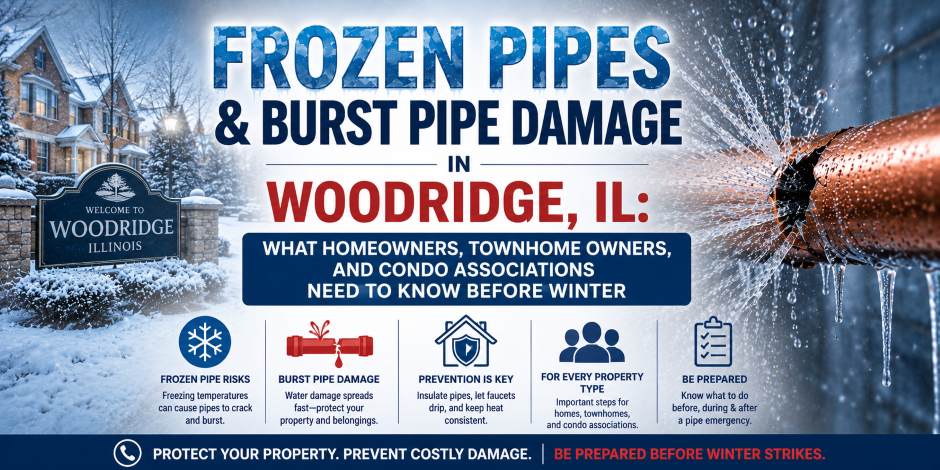
Nearly 40 Percent of Woodridge’s Housing Units Are Attached — Townhomes, Condos, and Multi-Unit Buildings Where HOA Declarations Determine Who Owns the Pipe That Just Froze. Most Residents Have Never Read Their Declaration. Most Are About to Find Out Why That Matters.
Woodridge was incorporated in 1959 by developer Albert Kaufman, named for its position on a wooded hillside — “The Ridge” — overlooking the East Branch of the DuPage River. It was built almost entirely after that incorporation date, with the vast majority of its residential construction concentrated in the 1970s, 1980s, and 1990s. The median construction year is 1980. The record low temperature — minus 26 degrees Fahrenheit, set in January 1985 — arrived right in the middle of the decade that produced the largest share of Woodridge’s housing stock.
What makes Woodridge distinctive in this series is not primarily its construction era — it shares the 1970s-1990s DuPage County suburban boom profile with Downers Grove and Naperville. What makes Woodridge distinctive is its housing mix. Single-family detached homes account for exactly 50 percent of Woodridge’s housing units. The other 50 percent is a mix of townhomes, condos, duplexes, and large apartment buildings that represents one of the highest attached-housing ratios of any community in the DuPage County residential market. Nearly 40 percent of Woodridge’s homeowner-occupied and renter-occupied units are in attached buildings — townhomes built in phases from 1975 through the 1990s, condo complexes from the same era, and newer attached construction near the Seven Bridges development along Route 53.
For frozen pipe purposes, that attached housing percentage is the story that no other article in this series has addressed — because attached housing in Woodridge doesn’t just create a different construction type. It creates a fundamentally different question about who owns the pipe that just froze, who is responsible for the repair, and whose homeowner’s insurance covers the damage when a burst pipe in one unit delivers water into the unit next door, above, or below. The HOA declaration governs the answer. Most Woodridge townhome and condo owners have never read it. This guide covers that question in detail — along with the physical freeze vulnerabilities unique to Woodridge’s housing stock, The Ridge bluff exposure, what the June 2021 EF-3 tornado’s 225 damaged homes and the subsequent reconstruction mean for pipe protection in rebuilt and repaired Woodridge properties, and everything every homeowner and association in the village needs to do before the first polar vortex warning of the season.
The HOA Plumbing Responsibility Question: Who Owns the Pipe in a Woodridge Townhome or Condo?
Why This Is the Most Important Winter Plumbing Question for Nearly Half of Woodridge Residents
When a pipe freezes and bursts in a single-family detached home, the ownership question is simple: it’s your pipe, it’s your repair, it’s your insurance claim. When a pipe freezes and bursts in a Woodridge townhome or condo, the ownership question is not simple at all — and the answer has major financial consequences for everyone involved.
In a typical Woodridge townhome or condominium association, the plumbing system is divided into three categories that the association’s declaration document defines with varying degrees of clarity: common element plumbing (owned by the association, maintained and insured by the association), limited common element plumbing (serving one unit but potentially the association’s maintenance responsibility), and unit plumbing (owned by the individual unit owner, maintained and insured by the owner). The problem is that where one category ends and another begins is defined differently in different declarations — and in Woodridge’s 1970s and 1980s townhome communities, many of those declarations were written with minimal specificity about exactly where the association’s responsibility ends and the owner’s begins on the plumbing system.
The most commonly contested freeze location in Woodridge attached housing: the supply line in the exterior wall cavity of a unit’s garage or end wall. In a townhome row where end units have exterior wall exposure that interior units don’t have, the end unit’s exterior wall supply line is in a freeze-vulnerable location that the interior unit’s equivalent supply line isn’t. When that end unit’s exterior wall supply line freezes and bursts, sending water into both the end unit and the adjacent interior unit, the question of who owns the pipe — and therefore who pays for the repair and for the water damage in both units — depends entirely on what the declaration says about exterior walls and the plumbing within them. Some declarations clearly assign exterior walls as common elements. Others are silent. In the ones that are silent, disputes between unit owners and associations over freeze event repair costs are predictable and expensive.
What to Do Before Winter if You Own a Woodridge Townhome or Condo
Read your association’s declaration before the first polar vortex event of the season. Specifically: find the definition of “unit” and “common element” and “limited common element,” find the plumbing responsibility section, and confirm whether the supply lines in your exterior walls — if your unit has exterior wall exposure — are unit plumbing or common element plumbing. If the declaration is unclear, ask your association’s property manager or attorney for a written interpretation before a dispute arises from an actual event.
Confirm what your individual homeowner’s or unit owner’s insurance policy covers for water damage from a burst pipe — both damage to your unit and damage to adjacent units if the water travels. In Illinois, condominium associations are required to maintain master property insurance covering the common elements and the original unit construction. Individual unit owners are responsible for insuring improvements and betterments and their personal property. In a Woodridge townhome community with a common wall structure, water damage that originates in one unit’s plumbing and damages an adjacent unit creates a coverage question that typically involves both the individual unit policies and the association’s master policy simultaneously — and the coordination between those policies in a freeze event is something to understand before the event, not during it.
Know where the shutoff for your unit’s plumbing is located. In a Woodridge townhome, the individual unit shutoff is typically in the mechanical closet or utility room within the unit. In a condo, it may be in the unit’s mechanical room, in a common mechanical space, or at a shutoff valve accessible within the unit itself. If you don’t know where it is, find it now. Label it. Every adult in the unit should know where it is. When a pipe bursts in your unit at 3 a.m., the speed with which you close that shutoff determines how much water enters your unit, your neighbor’s unit, and the unit below you before the flow stops.
What Woodridge Association Boards Need to Know
Association boards in Woodridge’s 1970s and 1980s townhome and condo communities should specifically address frozen pipe risk in their seasonal preparation protocols. The specific items for board consideration before winter: confirm that the association’s declaration clearly assigns responsibility for exterior wall supply lines, garage-adjacent supply lines, and any supply lines in common mechanical spaces; confirm that the association’s master insurance policy is current and that the deductible is known by the property management team; confirm that every unit owner has been notified of the unit shutoff location and advised to test it before winter; and schedule a pre-winter assessment of any common-element plumbing in exposed locations — supply lines in common mechanical rooms adjacent to exterior walls, domestic hot water recirculation lines in crawl spaces under common areas, and irrigation system winterization for common-area landscaping systems. We work with Woodridge HOA boards and property management companies on pre-winter plumbing assessments and emergency response planning — call 630-749-9057 to schedule.
The Physical Freeze Landscape: What Makes Woodridge Properties Vulnerable
“The Ridge” — The Bluff Above the DuPage River and What It Creates
Woodridge’s name comes from its position on a wooded ridge above the East Branch of the DuPage River — a genuine topographic feature, not a marketing name. The ridge runs roughly north-south through the eastern section of the village, and the bluff face that drops toward the river valley creates north and east-facing slope exposures for properties along the ridge line that produce some of the same cold air and wind exposure conditions we described for the Palos communities’ moraine slopes. Properties on or near the ridge bluff — particularly those on the north-facing section of the ridge above the river valley — experience wind-driven convective cooling of their exterior wall surfaces during northwest polar vortex events that increases freeze risk in exposed north and east wall cavities relative to sheltered interior-lot properties at the same outdoor temperature reading.
For the townhome communities built along the ridge — several of Woodridge’s 1970s and 1980s attached housing developments were sited on the ridge terrain for the river valley views — end units with north-facing or east-facing exterior wall exposure on the bluff side have a higher freeze vulnerability profile than interior units in the same building. This is the overlap between the HOA responsibility question and the physical freeze risk: end units have both greater freeze vulnerability and the ambiguous declaration language about exterior wall supply line responsibility. The end unit owner in a ridge-line Woodridge townhome community is the person with both the highest freeze risk and the greatest need to understand their declaration’s plumbing responsibility language before winter.
The 1970s–1990s Single-Family Stock: Brady Bunch Homes and Their Pipe Profile
NeighborhoodScout describes Woodridge’s dominant housing era perfectly: “There is a lot of housing in Woodridge built from 1970 to 1999 so parts of town may have that ‘Brady Bunch’ look of homes popular in the ’70s and early ’80s.” The Brady Bunch ranch and split-level — the 3-bedroom, 1.5-to-2-bath single-family home with an attached two-car garage built in the 1970s on a standard subdivision lot — is the defining housing type for the single-family half of Woodridge’s housing stock. These homes are now 45 to 55 years old and share the construction era pipe profile that has defined the freeze vulnerability of comparable homes across DuPage County: copper supply lines at the age range where solder joint fatigue becomes a freeze event factor, attached garages with supply lines in the wall cavity between the garage and the heated living space, and exterior hose bibs on the garage exterior wall that require specific winterization attention.
The garage wall freeze vulnerability is the same pattern we covered for Orland Park and Tinley Park’s dominant housing type — the attached garage supply line in the wall cavity between the unheated garage and the heated living space is the highest-probability freeze location in this housing type during polar vortex events. For a 1975 Woodridge ranch with a two-car attached garage, the supply line in the garage wall serving the laundry room adjacent to the garage is in a location that tracks toward outdoor temperature during extreme cold. The pre-winter action is the same as for any attached-garage home from this era: inspect the garage wall supply line section, add pipe sleeve insulation to exposed runs, confirm the interior hose bib shutoff valve exists and operates, and confirm the garage exterior door threshold seal is tight. Our complete guide to what your home’s age tells you about its plumbing covers the full freeze vulnerability and supply line condition profile for 1970s-1990s DuPage County construction in detail.
The June 2021 EF-3 Tornado and What It Means for Woodridge’s Building Stock
On June 20, 2021, an EF-3 tornado struck Woodridge, damaging 225 homes in the village and adjoining suburbs. The storm damaged the rectory of Saint Scholastica Church, demolished outbuildings, and produced structural damage to residential properties concentrated in the neighborhoods along the tornado’s path. The subsequent reconstruction and repair of those 225 homes created a specific condition in Woodridge’s housing stock that is relevant to winter plumbing: a cohort of homes that were partially or fully rebuilt in 2021 and 2022, in the construction practices and material standards of that period, embedded within a neighborhood context of 1970s and 1980s original construction.
For frozen pipe purposes, this means two things. First, the rebuilt sections of tornado-damaged Woodridge homes were constructed with contemporary materials and code requirements — modern PEX-A or PEX-B supply systems, better insulation standards, tighter building envelopes. These rebuilt sections are not the freeze vulnerability. Second, the interface between the rebuilt sections and the original construction that was retained — the connection points between new PEX supply runs and original copper branch lines, the wall sections where new framing meets original framing with different insulation — are the locations where thermal bridging and insulation gaps are most likely to create localized freeze vulnerabilities. A Woodridge home that had its garage rebuilt after tornado damage but retained the original mechanical room and supply runs to the kitchen may have a new garage wall with good insulation connected to a 50-year-old supply line run in the original kitchen wall with 1975 insulation. The interface between the two is the location that deserves specific pre-winter inspection in tornado-affected Woodridge properties.
Woodridge’s Water Supply and the Sanitary District
Lake Michigan Water and What It Means for Pipe Condition
Woodridge receives its water from Lake Michigan through the village’s own water supply infrastructure — the Wikipedia article on Woodridge confirms this directly: “Public Works is responsible for the streets and other village infrastructure, including the water supply. Woodridge receives its water from Lake Michigan.” Lake Michigan water in DuPage County communities runs in the 130 to 160 parts per million hardness range — moderately hard water that creates the familiar scale accumulation in water heaters, dishwashers, and water-using appliances that Woodridge homeowners recognize from the white deposits on fixtures and glassware.
For frozen pipe purposes, the mineral content of Lake Michigan water in Woodridge’s 1970s and 1980s copper supply systems is relevant to freeze event failure mode. Decades of moderately hard water passing through copper supply lines creates mineral scale deposits on the interior pipe wall — progressive narrowing of the effective pipe diameter that concentrates hydraulic pressure in the remaining flow area. When a freeze event adds ice expansion stress to a supply line section that already has mineral scale reducing the wall’s effective thickness at fittings and joints, the combination produces lower-temperature freeze failure thresholds than a new copper installation would have. This doesn’t mean Woodridge’s water supply is causing a crisis — it means that copper supply lines in Woodridge homes from the 1970s and 1980s have accumulated enough service history that a pre-winter condition assessment, covering the supply line material age and condition and the freeze-vulnerable locations in the specific home layout, is appropriate due diligence before polar vortex season.
The Woodridge Sanitary District
Like Downers Grove, Woodridge’s sanitary sewer system is operated by a separate entity — the Woodridge-Greene Valley Sanitary District — rather than by the village’s public works department. For emergency purposes during a winter plumbing event, understanding which agency is responsible for what is the practical difference between a resolved problem and a frustrating round of redirected calls. The Woodridge-Greene Valley Sanitary District handles sanitary sewer service — wastewater from homes and businesses to the treatment facility. The Village of Woodridge Public Works handles water supply, streets, and storm infrastructure. A frozen water supply line is a village water supply issue; a sewer backup during a thaw event is a sanitary district issue. The district can be reached at 630-968-1706. Village Public Works emergency line for water supply issues is 630-719-4700. Our Woodridge plumber service covers the full range of frozen pipe response, burst pipe repair, and pre-winter assessment throughout the village — the private-side plumbing from the meter to the fixtures is our scope, regardless of which public agency handles the infrastructure on the street side of the meter.
The Townhome Freeze: Physical Vulnerabilities Specific to Woodridge’s Attached Housing
End Units: The Highest Freeze Risk in Any Townhome Row
In any Woodridge townhome row, the end units have exterior wall exposure on three sides — front, back, and end — while interior units have exterior exposure only on front and back, with shared party walls providing significant thermal mass on the sides. The supply lines serving the end unit’s bathrooms, kitchen, and mechanical systems run through wall cavities on all three exposed sides. During a polar vortex event, the end unit’s supply lines experience freeze conditions that the interior units’ equivalent lines don’t. The end unit homeowner should specifically identify which supply runs are in the exposed end wall, add pipe sleeve insulation to accessible sections, and confirm that the end wall insulation in the mechanical closet or utility room is intact — because this is the location where insulation installation shortcuts are most common in 1970s and 1980s townhome construction.
The Mechanical Closet and Water Heater Space: A Freeze Location Unique to Townhomes
Woodridge townhomes from the 1975-to-1990 construction era typically have a first-floor mechanical closet housing the furnace and water heater — a compact space designed to minimize the footprint of the mechanical systems within the unit’s livable square footage. These mechanical closets are often located on or adjacent to exterior walls, and in end units they frequently share a wall with the exterior. A mechanical closet on the end wall of a Woodridge townhome contains the water heater and its supply connections, the furnace gas supply, and in many units the first distribution point for the hot and cold supply runs throughout the unit. During a polar vortex event, if the mechanical closet loses heat — because the furnace has cycled off during a quiet period, because the closet door has been closed and the space is not adequately heated by the unit’s heat distribution — the supply connections at the water heater can freeze. This is a freeze location that many Woodridge townhome owners haven’t considered because it seems like an interior location. It is interior to the unit, but it is adjacent to an exterior wall in end unit construction, and that proximity is what creates the vulnerability during the most extreme cold events.
The preventive measure: keep the mechanical closet door cracked during extreme cold events to allow the unit’s heated air to circulate into the space. Confirm the water heater supply connections are insulated where they emerge from the wall. If the closet is in an end unit and shares a wall with the exterior, add rigid foam to the interior of that exterior wall section — accessible by removing the baseboard if present — to reduce cold air transmission through the wall assembly into the mechanical space.
Garage Supply Lines in Woodridge Townhomes With Attached Garages
Many Woodridge townhome units from the 1980s and 1990s include attached two-car garages, and these garages present the same freeze vulnerability as the attached garage single-family homes discussed throughout this series. The supply line in the wall between the garage and the heated unit interior — particularly where the laundry room, a powder room, or the mechanical closet is positioned adjacent to the garage — is in a thermal zone that tracks toward outdoor temperature during sustained polar vortex cold. In a townhome where this wall is also a party wall shared with the adjacent unit, a supply line freeze and burst in this location sends water into both units simultaneously — the unit where the pipe is located and the adjacent unit on the other side of the shared wall or floor. The HOA responsibility question about who owns this supply line, and who pays for both units’ damage, is the exact scenario that the association’s declaration must address.
When a Pipe Freezes in a Woodridge Home or Townhome
The correct response to a frozen pipe in a Woodridge home — detached or attached — follows the sequence that applies throughout this series, with specific attention to the attached-housing considerations that affect unit owners in Woodridge’s large townhome and condo population. For a complete overview of frozen pipes, burst pipes, emergency shutoff procedures, winter plumbing preparation, and what homeowners throughout Chicagoland should do before and during extreme cold events, see our complete guide to winter plumbing emergencies in Chicagoland.
Locate your shutoff before you need it. In a single-family home, the main shutoff is typically adjacent to the water meter in the basement or utility room. In a townhome, the individual unit shutoff may be in the mechanical closet, under the kitchen sink, or at a dedicated shutoff valve accessible within the unit. In a condo, it may require a call to the property manager if the shutoff is in a common mechanical space. Know yours before the event — not during it.
Open the affected fixture’s faucet — both hot and cold. This relieves freeze expansion pressure and gives meltwater a path out as the pipe thaws.
If the frozen section is in the garage wall, mechanical closet, or end wall — apply gentle indirect heat. Hair dryer on low, moved along the accessible pipe section from the faucet end toward the frozen area. Keep the mechanical closet door open if the freeze is in that space. Do not use open flame.
Call us for wall cavity and inaccessible freezes. Our pipe thawing service covers Woodridge with professional electrical pipe thawing equipment that warms the frozen run from the inside uniformly — without the localized surface heat that can crack aged copper joints or damage the townhome wall finish on either side. We respond 24 hours a day. For what to safely do while you wait, including the specific signs that tell you the pipe has already cracked and you should close the shutoff instead of continuing to thaw, our Chicago frozen pipe thawing guide covers the full sequence.
When a Pipe Bursts in a Woodridge Townhome — The Multi-Unit Response
A burst pipe in a Woodridge townhome or condo creates a multi-unit water damage event in many scenarios. The response sequence for the unit where the burst occurred is the same as any burst pipe: close the unit shutoff immediately, open the lowest faucet to drain residual pressure, protect electrical circuits, and document before cleanup. The additional steps specific to the attached-housing context:
Notify the adjacent units immediately. If the burst is in your unit’s end wall or party wall, water may already be traveling into the adjacent unit through the shared wall assembly. The sooner the adjacent unit owner or occupant is notified, the sooner they can check for water intrusion and document conditions before damage spreads. In a condo building where the burst is on an upper floor, notify the unit below — water travels through floor assemblies faster than through walls.
Notify the property management company or HOA board immediately. Even if the pipe is clearly within unit plumbing rather than common element plumbing, the association needs to know about a water damage event that has or may affect multiple units or common elements. Most Woodridge associations have an emergency contact for exactly this situation — confirm you have that number before winter, not during a burst pipe event.
Document everything across all affected units before any cleanup. Photograph the source, the path of water travel, and the damage in every affected unit. In a townhome or condo water damage event that involves multiple units and potentially both individual unit policies and the association master policy, photographic documentation of the original damage conditions in all affected spaces is the record that the insurance process depends on. Our complete guide to what happens after a burst pipe floods your home covers the full post-event process including the multi-unit documentation and insurance coordination steps.
For emergency repair right now, our 24/7 emergency plumbers are a phone call away at 708-518-7765 — answered by a licensed plumber around the clock.
Pre-Winter Checklist for Woodridge Homeowners, Townhome Owners, and Associations
Single-family homeowners: Inspect garage wall supply lines and add sleeve insulation where needed. Confirm the garage exterior door threshold seal. Disconnect all garden hoses and close interior hose bib shutoffs. Schedule irrigation system winterization before mid-October. Confirm the main shutoff operates freely. For 1970s-1980s homes: identify the supply line material and condition of runs in north and west exterior walls. For tornado-affected properties: inspect the interface zones between rebuilt construction and original construction for insulation gaps at supply line runs.
Townhome and condo unit owners: Read your HOA declaration’s plumbing responsibility section before winter. Locate and test your unit shutoff valve. Confirm your unit owner’s insurance covers both your unit’s water damage and potential damage to adjacent units from a pipe in your unit. Keep mechanical closet doors cracked during extreme cold events in end units. Identify whether your unit is an end unit and what supply runs are in your exposed end wall. If you have a garage: all the same garage supply line checks as single-family homeowners.
Association boards and property managers: Review the declaration’s plumbing responsibility language and provide written guidance to unit owners before winter. Confirm the master insurance policy is current and the deductible is documented. Schedule winterization of any common-area irrigation systems. Assess common mechanical room supply line exposure on exterior walls. Provide every unit with the property management emergency contact and confirm they know their unit shutoff location. Consider a pre-winter plumbing assessment of common element mechanical spaces by a licensed plumber — we provide written documentation suitable for board records and insurance file maintenance.
Frequently Asked Questions: Frozen and Burst Pipes in Woodridge
I own an end unit townhome in a 1983 Woodridge complex. A pipe in my end wall froze last winter. My HOA says the wall is a common element but the pipe inside it is mine. Is that correct?
It may be — it depends entirely on your specific declaration’s language, not on a general rule. Many Illinois condominium and townhome declarations do classify exterior walls as common elements while defining the plumbing within those walls as unit plumbing where the pipes exclusively serve a single unit. Under this structure, the association owns the wall, the unit owner owns the pipe inside it. This is a common but not universal structure — some declarations are more generous to unit owners, some place more responsibility on the association. Request a written opinion from your association’s attorney based on the specific declaration language before the next polar vortex event rather than relying on the property manager’s informal interpretation. If the declaration genuinely assigns the pipe to you, add pipe sleeve insulation to every accessible section of that end wall supply run and discuss with your unit owner’s insurer what coverage applies to freeze damage in a wall that the association owns but you plumb.
My Woodridge single-family home was one of the 225 damaged in the June 2021 tornado. The garage was rebuilt. Should I be concerned about frozen pipes differently than my neighbors who weren’t affected?
Specifically yes — at the interface between the rebuilt garage and the original house structure. The rebuilt garage was constructed to 2021 code with better insulation than the 1975 original. But where the new garage wall meets the original house wall — particularly where supply lines pass through that junction from the original house into the rebuilt garage space — there may be insulation gaps at the connection point that weren’t present in either the original construction or the new construction individually. Ask the contractor who did the rebuild where the supply line penetrations are in the connection wall and whether insulation was installed around those penetrations during the rebuild. If the answer is uncertain, schedule a pre-winter assessment of the interface area — this is a 30-minute inspection that identifies any thermal bridging at the reconstruction boundary before the polar vortex finds it.
I live in a condo in Woodridge and I don’t know where my unit shutoff valve is. How urgent is it to find it before winter?
Very urgent — the unit shutoff is the tool that stops water from flowing into your unit, the unit below you, and the unit next door when a pipe bursts. In a condo where the burst pipe travels to adjacent units before anyone closes the shutoff, the damage in adjacent units potentially creates liability claims against your unit’s insurance policy on top of your own unit’s damage. In many Woodridge condo units from the 1980s, the unit shutoff is under the kitchen sink, in the bathroom vanity cabinet, or in a dedicated utility closet. If you cannot locate it after checking those locations, call your property management company — they should be able to tell you where it is from the building’s plumbing records or from a maintenance technician’s knowledge of the building.
Frozen or Burst Pipe in Woodridge? Homeowner, Townhome Owner, or HOA Board — We Know Woodridge’s Housing Mix and What Winter Does to It.
Licensed, insured, and serving Woodridge since 1978. We handle frozen pipe thawing with professional electrical thawing equipment, burst pipe repair in single-family and attached housing, multi-unit water damage response with documentation for HOA and insurance coordination, pre-winter plumbing assessments for 1970s-1990s DuPage construction and tornado-rebuilt properties, end unit townhome supply line insulation, mechanical closet freeze prevention, main and unit shutoff valve location and replacement, irrigation system winterization consultation, water heater service, and complete residential and association plumbing service throughout Woodridge. Emergency line 24/7.
Emergency line: 708-518-7765 | Main line: 630-749-9057 | Open 24/7
—
Suburban Plumbing Sewer Line & Drain Cleaning Experts
Licensed & Insured | Open 24 Hours | Serving Woodridge Since 1978
📞 Woodridge: 630-749-9057 | 🚨 Emergency: 708-518-7765