
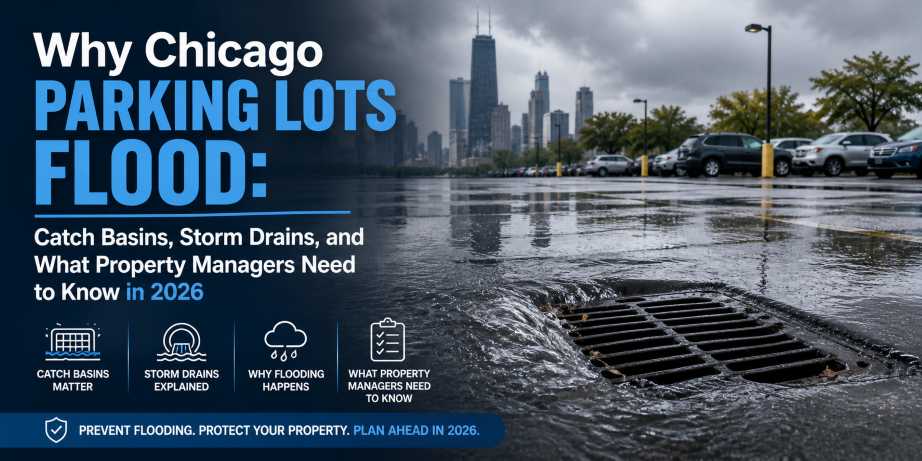
The Complete Guide for Chicago-Area Commercial Property Managers, HOAs, and Business Owners Who Are Tired of Standing Water, Liability Exposure, and Drainage Failures That Keep Coming Back
A flooded parking lot in Chicago isn’t just an eyesore. It’s a slip-and-fall liability waiting to happen. It’s accelerated pavement deterioration that moves your next resurfacing project years closer. It’s a tenant complaint that calls your management competence into question. And in many cases, it’s a stormwater compliance issue that puts your property in technical violation of Chicago or suburban municipal codes.
The cause of most Chicago parking lot flooding is also the most frequently neglected piece of commercial property infrastructure: the catch basin. That grated drain in the corner of your lot, probably invisible under a layer of leaves and sediment for the last 18 months, is the front line of your property’s stormwater management system. When it works, nobody notices it. When it fails — and in Chicago’s storm environment, a neglected catch basin fails reliably — everyone notices.
This guide covers everything commercial property managers, HOA boards, strip mall owners, and business owners need to understand about parking lot drainage in Chicago: why lots flood, what catch basins and storm drains actually do and why they fail, what Chicago and suburban municipalities require from property owners, what maintenance looks like and what it costs, and how to put a program in place that prevents flooding before it becomes a liability event.
Why Chicago Parking Lots Are Particularly Vulnerable to Flooding
Before getting into solutions, it’s worth understanding why Chicago commercial properties face drainage challenges at the rate they do — because this isn’t simply a maintenance problem. The geography, geology, and infrastructure of the Chicago region create flooding conditions that are worse than most markets in the country.
Impervious Surfaces and the Runoff Equation
A commercial parking lot is, from a stormwater management perspective, as bad as it gets. Asphalt and concrete are completely impermeable — every drop of rain that falls on the surface has to go somewhere, and none of it is absorbed. A 50,000-square-foot parking lot receiving two inches of rain generates roughly 60,000 gallons of runoff that needs to be collected and discharged within a short window.
That runoff volume has to pass through the catch basins on the property, through the underground storm drain pipes connecting them, and into the city’s storm sewer system — all before the water level rises enough to cause pooling and flooding. The City of Chicago’s Sewer Construction and Stormwater Management Requirements establishes minimum slope requirements for parking lot pavement — 1.0% minimum — specifically to ensure surface runoff reaches catch basins efficiently. When pavement settles, grades change, or catch basins fill with sediment and lose capacity, even a properly designed drainage system fails to perform.
Chicago’s Combined Sewer System
Chicago and most of its inner-ring suburbs operate on a combined sewer system — the same underground pipes carry both stormwater runoff and sanitary sewage. Under normal conditions this works. Under the heavy rain conditions that Chicago experiences regularly — particularly the multi-inch, short-duration events that have become more frequent in recent years — the combined system surcharges. When the system is full, stormwater from parking lots has nowhere to drain. Catch basins that are functioning perfectly simply can’t discharge because the storm sewer they connect to is already at capacity.
This creates a compounding effect: even a perfectly maintained catch basin in a well-designed parking lot can experience surface flooding during a major surcharge event. But a neglected catch basin that’s already at half capacity due to sediment accumulation will flood during events that a well-maintained basin handles without issue. Maintenance doesn’t eliminate flooding risk during extreme events — but it dramatically raises the threshold at which flooding occurs.
Flat Topography and Clay Soil
Much of the Chicago metro area — particularly in the suburban DuPage and Cook County communities that saw rapid commercial development from the 1980s through the 2000s — was built on flat former farmland with clay-heavy soil. Clay soil drains poorly, which means subsurface drainage is minimal. All surface runoff stays on the surface until it finds a drain inlet. Flat topography means there’s no natural grade to move water quickly toward those inlets. The combination creates pooling conditions that persist long after the rain has stopped. The DuPage County Stormwater Management program maintains 17 flood control facilities and 22 rain gauges across the county specifically because these conditions create stormwater management challenges that require active infrastructure management rather than passive drainage.
Aging Commercial Infrastructure
Chicago’s commercial building stock includes a significant volume of strip malls, office parks, and commercial corridors built in the 1960s through 1980s — properties where the original catch basins and storm drain infrastructure is now 40 to 60 years old. Concrete catch basin walls crack and deteriorate. Outlet pipes corrode or offset at joints. Connections to the city storm sewer loosen and separate. In many of these older commercial properties, the drainage infrastructure has never been camera-inspected — property owners don’t know what condition the pipes are in until a flooding event makes it obvious. For a deeper look at how seasonal freeze–thaw cycles accelerate this exact type of deterioration, see how Chicago’s winters destroy catch basins.
What a Catch Basin Actually Does — and Why It Fails
Most property managers understand that a catch basin collects water. Few understand the mechanism well enough to know why the basin stops working — which makes it hard to maintain correctly or diagnose when something goes wrong.
How It Works
A catch basin is an underground concrete or brick structure with a grated inlet at surface level. Surface water flows through the grate into the basin below. Inside the basin, the design does two things: heavy debris — sediment, gravel, sand, organic material — sinks to the bottom of the basin’s sump, and relatively clean water exits through an outlet pipe connected to the storm sewer system. The basin acts as a settling chamber and a pre-treatment stage before stormwater enters the underground pipe network.
The sump at the bottom of the basin is the key feature. It provides storage volume for accumulated debris, keeping that material out of the outlet pipe and the downstream storm sewer. But that sump is finite. As debris accumulates over months and years, the available sump volume decreases — and eventually the accumulated material reaches the level of the outlet pipe, at which point it begins to restrict flow and eventually block discharge entirely.
A catch basin that’s half-full of sediment has half the drainage capacity it was designed for. A catch basin that’s full to the outlet pipe has essentially no settling function — debris passes directly into the storm drain, causing downstream problems in addition to the surface flooding the full basin creates.
The Four Ways Catch Basins Fail in Chicago Commercial Properties
Sediment accumulation. The most common and most preventable failure mode. Over time, the sump fills with accumulated debris from parking lot runoff — sand tracked in from surrounding roads, organic material from landscaping, vehicle fluids, road salt residue, and general sediment. Regular pumping removes this material before it reaches a capacity that compromises performance. Most commercial catch basins in Chicago need annual service at minimum — high-traffic lots exposed to heavy sediment loading may need service twice a year.
Structural deterioration. Concrete catch basin walls crack under the freeze-thaw cycling that Chicago’s winters impose. Mortar joints loosen and fail. The basin frame settles, creating gaps between the frame and the surrounding pavement that allow water to bypass the basin entirely. Structural deterioration is a separate problem from sediment accumulation — a clean basin with cracked walls still fails under load. Our catch basin repair services address structural deterioration with targeted repair rather than full replacement where possible.
Outlet pipe failure. The pipe connecting the catch basin to the storm sewer system can fail independently of the basin itself — root intrusion from nearby landscaping, pipe joint offset from settlement, corrosion in older cast iron pipe, or debris accumulation in a pipe that hasn’t been cleared in years. A catch basin that’s been recently cleaned but still drains slowly often has an outlet pipe problem rather than a basin problem. Camera inspection of the outlet pipe is the diagnostic tool that distinguishes basin-level problems from pipe-level problems.
Grate clogging. The surface grate that allows water to enter the basin can block with leaves, trash, debris, and sediment packed onto the grate from foot and vehicle traffic. A clogged grate prevents water from entering the basin entirely — the lot floods even if the basin itself is clean and the outlet pipe is clear. Grate inspection and clearing is a simple maintenance task that should happen at every service visit and can be done between professional service calls by on-site property staff.
Storm Drains: The Pipe Network Connecting It All
The catch basins in your parking lot don’t operate in isolation. They connect through underground pipe runs — storm drain lines — to the city’s storm sewer system. Understanding this underground network is important for property managers because failures can occur anywhere in the system, not just at the basin itself.
How the Storm Drain System Works
Each catch basin in your parking lot discharges through an outlet pipe into a connecting storm drain line. Multiple basins on a property typically connect to a shared collector pipe that routes to a single connection point at the city storm sewer in the adjacent street. The flow path is: surface water → catch basin grate → basin sump → outlet pipe → storm drain collector → city storm sewer → MWRD treatment system or direct waterway discharge.
Failures at any point in this chain affect the entire system downstream. A collapsed pipe section in the storm drain collector affects every basin connected to it. A root intrusion 30 feet from the nearest basin causes a blockage that presents as flooding at the basin surface — and is impossible to diagnose without a camera inspection of the underground pipe.
When Storm Drains Need Service
Storm drain pipes require periodic service beyond what catch basin cleaning addresses. Our storm drain cleaning services include high-pressure hydro jetting of storm drain collector pipes — the same high-pressure water technology used for commercial drain cleaning — to remove accumulated sediment, debris, and biological growth from the pipe interior. For commercial properties in Chicago, storm drain pipe cleaning every two to three years alongside annual catch basin service maintains the full system at design capacity.
Camera inspection of storm drain pipes — using the same equipment used for sewer line inspection — identifies structural issues, root intrusion, joint separations, and collapsed sections that aren’t visible from the surface and can’t be diagnosed by probing the basin alone. For commercial properties that have never had their storm drain pipes camera-inspected, this service provides a baseline assessment of system condition that supports capital planning and protects against liability from flooding events caused by infrastructure failures that weren’t known.
Property Manager’s Guide to Catch Basin and Storm Drain Maintenance in Chicago
Who Is Responsible for What
The boundary between property owner responsibility and municipal responsibility for drainage infrastructure is a frequent source of confusion — and a significant source of liability exposure when that boundary isn’t understood clearly.
Property owner responsibility: All catch basins on private property, the storm drain pipes connecting those basins within the property boundary, and the connection from the private storm drain system to the city storm sewer in the street or parkway. The property owner is responsible for maintaining this infrastructure in functional condition.
Municipal responsibility: The public storm sewer system in the street right-of-way, including public catch basins in the street or parkway and the main storm sewer pipes serving the street. Chicago’s Department of Water Management maintains approximately 25,000 catch basins throughout the city — but those are public basins in the public right-of-way, not the private basins on your property.
The liability implication: When a flooding event on your property causes property damage or a slip-and-fall injury, the first question is whether the flooding resulted from a failure of your private drainage infrastructure or from a capacity issue in the public system. If your catch basins were full of sediment and functioning below design capacity at the time of the flooding event, the private infrastructure failure is your liability exposure regardless of whether the public system was also contributing to the problem. Documented regular maintenance creates the paper trail that demonstrates your infrastructure was properly maintained.
Maintenance Frequency by Property Type
High-traffic commercial parking lots (retail, restaurant, grocery anchored strip centers): Catch basin cleaning annually at minimum. High-traffic lots with significant vehicle turnover and adjacent landscaping may need twice-annual service. Storm drain camera inspection every three to five years or after any flooding event.
Office park and suburban commercial properties: Catch basin cleaning annually. Storm drain inspection every three to five years.
Industrial and warehouse properties: Catch basin cleaning annually. Floor-area-to-impervious-surface ratio is often high, and industrial activities may contribute contaminants to catch basin sediment that require special disposal. Storm drain inspection every two to three years.
HOA-maintained common areas and private roads: Catch basin cleaning annually before spring rain season. Grate inspection and clearing before and after major storm events. Storm drain camera inspection every three to five years.
Multi-tenant commercial properties: Catch basin cleaning annually per basin. Storm drain collector pipe service every two to three years. Document service per basin for liability purposes.
What Professional Catch Basin Service Actually Involves
A proper catch basin service call — the kind that actually maintains your drainage infrastructure rather than checking a compliance box — involves more than running a vacuum hose into the basin.
Grate inspection and clearing. The grate is examined for structural integrity, confirmed free of debris, and checked for proper seating in the frame.
Sump measurement before cleaning. The depth of accumulated material is measured before extraction. This data tells you how fast your basins are accumulating debris — which informs the correct service interval — and documents the condition at time of service for your records.
Complete material extraction. Using a vacuum pump truck — also called a vac truck or hydro-vac unit — all accumulated sediment, debris, and water are extracted from the basin. Material is transported to a licensed disposal facility. Catch basin sediment is classified as regulated waste in Illinois and cannot be disposed of on site.
Basin interior inspection. With the basin empty, walls, floor, inlet, outlet, and baffle condition are inspected. Cracks, joint failures, and deteriorating mortar are documented. Outlet pipe accessibility and flow condition are verified.
Service documentation. A written service record including basin location, sump depth before cleaning, material volume removed, condition findings, and recommended next service date. This documentation is your liability protection and your maintenance history.
For a complete breakdown of what catch basin cleaning costs in the Chicago market across different property types and basin configurations, see our complete catch basin cleaning cost guide for Chicago.
The Liability Picture: Why Flooded Parking Lots Are a Property Manager’s Problem
The legal and financial exposure from a flooded commercial parking lot in Chicago is broader than most property managers appreciate until they’ve been through a claim.
Slip-and-Fall Liability
Standing water in a commercial parking lot creates slip-and-fall conditions — particularly in winter when pooled water freezes into ice. Property owners and managers have a duty to maintain their premises in reasonably safe condition for invitees. A parking lot that floods regularly due to neglected catch basins is not in reasonably safe condition, and that can be established by any plaintiff’s attorney who subpoenas your maintenance records and finds no documented catch basin service.
The standard of care in Illinois commercial property liability cases for drainage maintenance includes regular inspection and cleaning of catch basins. The specific interval that satisfies reasonable maintenance varies by property type and usage — but “never cleaned in the past five years” definitively doesn’t meet it.
Pavement Deterioration and Capital Cost Acceleration
Standing water in a parking lot doesn’t just create immediate safety hazards. It accelerates pavement failure in ways that directly increase capital expenditure over the property’s ownership cycle.
Water penetrating asphalt through surface cracks freezes in Chicago’s winters, expanding and widening cracks — the mechanism behind pothole formation. Saturated sub-base under asphalt loses structural integrity, causing soft spots, depressions, and eventually complete pavement failure in affected areas. A parking lot that drains within 30 minutes of a rain event will last significantly longer than one that sits under an inch of water for six hours after every storm. The cost of properly maintaining catch basins annually is a fraction of the cost of accelerated pavement resurfacing.
Tenant Relations and Lease Compliance
In multi-tenant commercial properties, parking lot flooding affects every tenant on the property — customer access, delivery logistics, staff safety, and the general appearance of the commercial environment. Tenants in retail and restaurant spaces lose customers during and after flooding events. Tenants in office buildings field complaints from their own employees about the lot condition.
Most commercial leases include a landlord obligation to maintain common areas in good condition. A persistently flooded parking lot may give tenants grounds for a lease dispute — and at minimum creates the kind of chronic tenant relations problem that affects lease renewals and property reputation.
Warning Signs Your Chicago Parking Lot Drainage System Needs Immediate Attention
Water pools in the same areas after every rain and takes more than 2 hours to drain. This is the primary indicator of a drainage system operating below capacity. Occasional slow drainage during extreme events is expected. Consistent slow drainage after ordinary rain events indicates sediment accumulation, outlet pipe restriction, or structural failure.
Grates are visibly covered with debris. A grate that’s covered with leaves, sediment, or trash can’t collect water. This is the simplest and most visible maintenance failure — and the easiest to prevent with regular inspection.
Sinkholes or depressions forming near catch basin locations. Subsurface erosion around a catch basin with a cracked wall or failed joint can create sinkholes in the surrounding pavement. This is a structural emergency — the basin needs immediate assessment and repair.
Ice formation in the same locations every winter. Persistent ice patches in a parking lot are a direct indicator of drainage system failure — water is pooling in those locations because it has nowhere to drain, then freezing overnight. Beyond the liability exposure, this is a clear signal that catch basin service is overdue.
Visible sediment or standing water inside the basin when looking through the grate. If you can see the water level in the basin is near the grate surface, the basin sump is at or near capacity and needs immediate cleaning.
Recurring blockages in the same basin despite regular cleaning. Basins that fill faster than their service interval suggests are either undersized for the impervious area draining to them, receiving unusually high sediment loading from adjacent landscaping or pavement condition, or have an outlet restriction that’s causing material to back up rather than discharge.
What Commercial Catch Basin and Storm Drain Service Costs in Chicago in 2026
Standard catch basin cleaning (single basin, accessible location, reasonable accumulation): $200 to $400 per basin. This is the per-basin cost for routine annual service on a well-maintained property.
Catch basin cleaning (heavily accumulated, not serviced in multiple years): $400 to $700 per basin. Basins that haven’t been serviced in two or more years often have compacted material that requires more time and multiple vacuum passes to fully extract.
Multiple basin service (same property, same visit): Per-basin costs decrease when multiple basins are serviced in a single mobilization — typically $150 to $300 per basin for properties with four or more basins serviced at once. Scheduling all basins on a property for the same service visit is consistently the most cost-effective approach.
Emergency catch basin service (flooding event in progress or imminent): 25% to 50% above standard rates for emergency mobilization. Having an established service relationship with a contractor you can call for emergency response is significantly more cost-effective than searching for available service during an active flooding event.
Storm drain pipe hydro jetting (collector pipe cleaning): $500 to $1,500 depending on pipe diameter, length, and condition. Collector pipes that haven’t been cleaned in many years with significant sediment accumulation run toward the higher end.
Storm drain camera inspection: $300 to $600 for camera inspection of storm drain pipes with written and video documentation. One of the most valuable investments for commercial properties that have never assessed the condition of their underground storm drain infrastructure.
Catch basin repair (crack sealing, joint resealing, component replacement): $300 to $1,500 per basin depending on the extent of structural deterioration. Early repair of minor cracks is significantly less expensive than structural reconstruction after deterioration has progressed.
Building a Catch Basin Maintenance Program for Your Chicago Commercial Property
The commercial property managers in Chicago who never have parking lot flooding emergencies are the ones with a maintenance program in place — not the ones reacting to each flooding event after the fact. Here’s what a complete program looks like:
Step 1: Baseline assessment. If your property has never had a documented catch basin service or you don’t have records from the past two years, start with a full assessment — basin cleaning across all inlets, sump depth measurement, basin condition inspection, and camera inspection of storm drain collector pipes. This establishes your starting point.
Step 2: Set the right service interval. Based on the baseline assessment — specifically how much material had accumulated and how quickly — establish the appropriate annual service schedule. Most Chicago commercial properties need annual basin cleaning. High-traffic or high-sediment-loading properties need twice-annual service. For a deeper look at how industrial plumbing systems operate in heavy-use commercial zones, see our guide on commercial plumbing and drain cleaning in Bedford Park, IL.
Step 3: Document every service call. Maintain a service file per property with dated records of every catch basin cleaning, the material volumes removed, condition findings, and any repairs performed. This documentation is your liability protection and your maintenance history.
Step 4: Pre-storm season inspection. Schedule spring catch basin service before the heavy rain season — April or early May — to ensure the system enters the highest-demand period at full capacity.
Step 5: Post-storm event check. After major storm events, inspect grates visually to confirm they’re free of debris and assess whether any basins showed signs of reduced performance during the event. Address issues immediately rather than deferring to the next scheduled service.
Step 6: Integrate with pavement maintenance planning. Catch basin condition documentation feeds into pavement capital planning — basins that are showing structural deterioration are often in areas where pavement is also showing stress. Coordinating basin repair with pavement work reduces total mobilization cost.
Chicago and Suburbs: Communities We Serve for Catch Basin and Storm Drain Service
Our catch basin cleaning and pumping services and storm drain cleaning services cover the full Chicagoland commercial market — Chicago, Berwyn, Cicero, Oak Park, River Forest, Brookfield, LaGrange, Hinsdale, Downers Grove, Elmhurst, Lombard, Naperville, Westmont, Clarendon Hills, Burr Ridge, Darien, Willowbrook, Woodridge, Bolingbrook, Lemont, Orland Park, Tinley Park, Oak Lawn, and all surrounding Cook, DuPage, Will, and Kane County communities.
We service single-family properties with yard catch basins, commercial parking lots with multiple basins, multi-tenant strip centers, office parks, industrial facilities, HOA-maintained private roads and common areas, and municipal properties. Every property type gets the same assessment-first approach — we look at your specific drainage configuration before recommending scope of work.
Frequently Asked Questions: Parking Lot Drainage and Catch Basins in Chicago
How do I know how many catch basins my property has? For smaller properties, a visual inspection of the parking lot surface identifies the grated inlets. For larger or more complex properties, the original site engineering drawings — available from the property’s permit records at the city or municipality — show the drainage infrastructure layout. If drawings aren’t available, we can assess and document the basin count and locations as part of an initial service visit.
My catch basins were just cleaned last year and the lot is flooding again. What’s going on? Several possibilities. The outlet pipe connecting the basin to the storm sewer may have a restriction or failure independent of the basin itself — a camera inspection distinguishes basin-level problems from pipe-level problems. The basin may be undersized for the impervious area draining to it, particularly if recent landscaping, pavement, or building changes have increased the catchment area. The flooding may also be occurring during events that exceed the capacity of the public storm sewer system — in Chicago’s combined sewer environment, system surcharge during extreme events can cause flooding even at well-maintained properties.
Who do I call when my parking lot is flooding during an active storm? Call us — we offer 24/7 emergency catch basin and storm drain response throughout Chicago and the suburbs. Emergency service during an active flooding event focuses on immediate relief — grate clearing, emergency pumping where appropriate, and triage assessment of what’s causing the failure.
Can I clean catch basins myself instead of hiring a professional? The grate can be cleared of surface debris by property staff as a regular maintenance task — this is quick and easy and should happen whenever debris accumulates. The sump cleaning requires a vacuum pump truck because catch basin sediment is regulated waste in Illinois that must be disposed of through licensed facilities. It cannot be scooped out and disposed of on site.
Does my property need a stormwater management plan? Under Chicago’s Stormwater Management Ordinance, regulated developments of 15,000 square feet or more are required to have approved stormwater management plans. If your property has undergone significant renovation, expansion, or change of use, the current drainage infrastructure may need to be assessed for ordinance compliance. For most property managers maintaining an existing commercial property with no new construction, the obligation is to maintain existing approved drainage infrastructure — which means keeping catch basins functional.
Is catch basin sediment considered hazardous waste in Illinois? It depends on what’s in it. Catch basin sediment from a standard commercial parking lot is typically classified as a regulated non-hazardous waste that must be disposed of through licensed facilities — it can’t be dumped on site or put in standard dumpsters. Catch basins on properties with vehicle service, fueling, or industrial activity may have sediment with petroleum contamination or other regulated substances that require characterization and special handling. We transport all material to licensed disposal facilities and document disposal for your records.
Need Catch Basin or Storm Drain Service for Your Chicago Commercial Property?
Licensed, insured, and locally based in Brookfield since 1978. We service commercial parking lots, strip centers, office parks, HOA properties, and industrial facilities throughout Chicago and the suburbs — scheduled annual maintenance and 24/7 emergency response. Written quotes before we start, compliance documentation on every service call, and our own licensed technicians on every job. Send us a message and we’ll get back to you fast.
Or call us directly: 708-801-6530 | Open 24/7
—
Suburban Plumbing Sewer Line & Drain Cleaning Experts
Licensed & Insured | Open 24 Hours | Serving Chicago & Chicagoland
📞 Suburbs: 708-801-6530 | 📞 Chicago: 773-570-2191 | 🚨 Emergency: 708-518-7765