
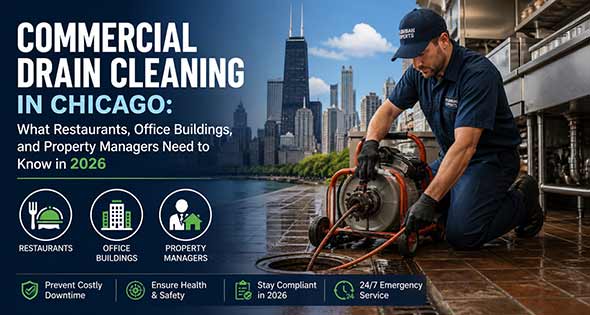
The Complete Guide for Chicago-Area Business Owners and Property Managers Who Can’t Afford a Drain Backup During Business Hours
A clogged drain in a Chicago home is an inconvenience. A clogged drain in a Chicago restaurant on a Friday night is a crisis. A backed-up floor drain in an office building or a grease line overflow in a commercial kitchen doesn’t just create a plumbing problem — it creates a health code violation, a potential closure notice, an insurance claim, and a customer experience that nobody forgets for the wrong reasons.
Commercial properties in Chicago face drainage challenges that are categorically different from anything a residential plumber deals with. The volume of water and waste moving through a commercial drain system is higher. The consequences of failure are faster and more expensive. The regulatory environment — particularly for food service establishments — is significantly more demanding. And the diversity of what goes down commercial drains — grease, food solids, paper products, cleaning chemicals, sediment — creates blockage conditions that standard drain cleaning equipment often can’t resolve.
This guide covers everything Chicago business owners, restaurant operators, and property managers need to know about commercial drain cleaning in 2026: what makes commercial drains different, what causes them to fail, what the cleaning methods actually do, how often each property type needs service, what it costs in the Chicago market, and what the regulatory picture looks like for food service establishments specifically. For a broader look at commercial plumbing systems, common challenges, and the services Chicago businesses rely on to keep their properties operating safely, see our complete commercial plumbing guide for Chicagoland businesses.
Why Commercial Drains Are a Completely Different Animal From Residential
The core difference between commercial and residential drain systems isn’t just size — it’s the nature of what flows through them and the tolerance for failure.
Volume. A busy Chicago restaurant might push 5,000 to 10,000 gallons of wastewater through its drain system on a busy Saturday. A residential home uses 50 to 100 gallons per person per day. The sheer volume of flow through commercial drain lines creates wear conditions, sediment buildup patterns, and blockage accumulation speeds that simply don’t apply in a residential context.
What’s in the water. Residential drains primarily handle soap, hair, and toilet waste. Commercial kitchen drains carry fats, oils, and grease — collectively called FOG — along with food particles, cleaning chemicals, and high-temperature water that opens pores in pipe walls and deposits grease in places it wouldn’t otherwise reach. Office building drains handle paper products, soap in quantities that create scale buildup, and in older buildings, whatever tenants put down the sinks despite posted instructions not to. Multi-unit residential buildings combine residential-level waste from dozens of units into shared drain stacks that behave more like commercial systems than single-family lines.
The regulatory dimension. Residential homeowners have no legal obligation to maintain their drain systems on any schedule. Food service businesses in Chicago operate under the city’s FOG ordinance, administered through the Department of Water Management, and under Illinois Administrative Code Section 890.510, which mandates grease interceptors for all commercial establishments where grease, fats, or culinary oils are wasted from kitchens. Non-compliance isn’t just a plumbing problem — it’s a health department problem, a business license problem, and a potential closure problem.
The cost of failure. A backed-up drain in a home delays a shower. A backed-up drain in a restaurant during dinner service costs thousands of dollars in lost revenue, potential food spoilage, and emergency service call premiums — before factoring in the health code exposure. Every hour of downtime in a commercial kitchen has a dollar value attached to it. The economics of commercial drain maintenance are fundamentally different: the cost of emergency service is almost always higher than the cost of preventing the emergency.
Chicago’s Commercial Drain Problem: Infrastructure Context
Before getting into solutions, it’s worth understanding why Chicago’s commercial properties face particular drainage challenges beyond what a newer city might experience.
Aging building stock. Chicago’s commercial building inventory includes millions of square feet of structures built before 1970, with original cast iron drain systems that are corroded, scaled, and in many cases partially collapsed. Restaurants operating in century-old Wicker Park buildings, office tenants in Loop high-rises built in the 1920s, and retail spaces in strip malls from the 1960s are all dealing with drain infrastructure that was designed for lower-volume, different-era commercial use patterns.
The combined sewer system. Chicago’s combined sewer — which carries both stormwater and sanitary waste in the same pipes — creates specific FOG accumulation problems. Tree root intrusion is another major contributor to sewer line failures across Chicago’s aging infrastructure, especially in commercial corridors with older clay and cast iron lines. We break down exactly how this happens, how fast it spreads, and how to stop it in our guide on tree roots and sewer line intrusion in Chicago. When commercial kitchen grease enters the combined sewer network, it coats pipe walls across entire city blocks, accumulating with contributions from dozens or hundreds of other commercial operations. The EPA’s FOG management program identifies FOG discharged from commercial establishments as the most common cause of sanitary sewer overflows nationwide — and Chicago’s combined infrastructure makes this particularly acute.
Hard water scale. Chicago’s municipal water supply carries significant mineral content that deposits scale inside drain pipes over time — narrowing effective diameter, creating surfaces that trap grease and debris, and accelerating blockage formation. Commercial drain lines that would stay clear for years in a soft-water environment require more frequent maintenance in Chicago’s water conditions.
Commercial Drain Cleaning by Property Type — What Each One Needs
Different commercial property types have different primary drainage challenges. Understanding what’s causing your drain problems is the first step to solving them correctly.
Restaurants and Food Service Establishments
Restaurants are the highest-maintenance commercial drain users and the most heavily regulated. Every commercial kitchen in Chicago that generates grease, fats, or culinary oil waste is legally required under Illinois Administrative Code Section 890.510 to have properly sized grease interceptors installed on all waste lines carrying FOG. The size of the interceptor must be adequate for the volume generated — an undersized trap is a compliance violation regardless of how frequently it’s cleaned.
The grease problem in detail. Grease doesn’t stay liquid in your drain lines. As hot kitchen wastewater cools during its journey through the drain system, dissolved fats and oils precipitate out of solution and adhere to pipe walls. Over time, these deposits build layer by layer, narrowing the effective pipe diameter until flow is restricted and eventually blocked. In a high-volume commercial kitchen with multiple fryers, a walk-in cooler drain, a dishwasher line, and a three-compartment sink all contributing FOG-laden wastewater, this process happens fast — weeks or months rather than years.
If you’re dealing with recurring drain clogs or repeat backups in Chicago commercial or residential systems, it’s critical to understand the real root cause behind grease buildup — and why standard rodding often fails to fix it long-term. Read our breakdown of the #1 cause of drain clogs in Chicago and how hydro jetting actually solves the problem.
What happens when grease trap maintenance is neglected. When a grease trap reaches capacity — typically defined as 25% of its liquid volume occupied by accumulated FOG and solids — grease bypasses the baffles and enters the sewer line downstream. From there it continues to accumulate inside your lateral, eventually causing a backup that surfaces through kitchen floor drains. At that point you’re dealing with an emergency service call at premium rates, a potential health code violation if the backup reaches food preparation areas, and in some cases a temporary closure while the situation is remediated.
Frequency requirements for Chicago restaurants. Most Chicago restaurant grease traps require service every 30 to 90 days depending on kitchen volume, trap size, and the types of food being prepared. High-volume operations — full-service restaurants, fried food concepts, cafeteria-style operations — typically need monthly service. Lower-volume operations like coffee shops and delis may maintain compliance on a quarterly schedule. The only way to know your correct interval is professional assessment of your specific trap size and kitchen output. Our complete grease trap cleaning guide for Chicago restaurants covers the full compliance picture including what the city requires, what happens during an inspection, and how to document service for your records.
Beyond the grease trap: floor drains and kitchen lines. Grease trap maintenance keeps the trap functional, but it doesn’t clean the drain lines between your kitchen fixtures and the trap, or the lines downstream of the trap toward the city main. High-pressure hydro jetting of kitchen drain lines — separate from grease trap pumping — is the appropriate service for removing grease deposits from the pipe walls of the drain system itself. For busy restaurants, annual hydro jetting of the kitchen drain lines in addition to regular grease trap service is standard practice. Hydro jetting also eliminates the organic biofilm that drain flies breed in — a health code concern for Chicago commercial kitchens. Our complete Chicago drain flies guide covers why drain flies are a plumbing problem rather than a pest control problem, and why professional drain cleaning is the permanent solution.
Office Buildings and Multi-Tenant Commercial Properties
Office buildings face a different primary drain challenge: the cumulative effect of dozens or hundreds of tenants using bathrooms, break rooms, and sink facilities in ways that individually seem inconsequential but collectively create significant buildup.
Paper products and soap scale. The single most common drain issue in office building bathrooms is partial blockage from paper towels, excessive toilet paper, and the soap scum scale that builds up in sink drain lines over time. Unlike restaurant grease, which causes acute blockages, office drain buildup tends to create progressive restriction — drains slow down over months rather than failing suddenly. The practical effect is that many building managers don’t address the problem until a toilet overflows or a sink becomes essentially non-functional.
Multi-tenant drain stack management. In multi-story office buildings, individual tenant drain lines connect to shared vertical stacks that carry waste to the building’s main drain lateral. When one tenant’s line contributes heavy buildup — a restaurant or café on the ground floor, a medical office with specific waste streams, a salon with hair and chemical waste — it can affect the entire stack’s performance. Building managers often discover stack problems only when upper-floor tenants report slow drains that have nothing to do with anything in their own space.
Preventive maintenance scheduling. Commercial property managers with maintenance obligations for office buildings typically benefit from annual main drain camera inspection and hydro jetting — catching buildup before it becomes restriction and restriction before it becomes emergency. The cost of planned annual maintenance is consistently less than the cost of emergency response, and the disruption to tenants is far more controllable when service is scheduled in advance.
Retail Spaces and Strip Malls
Retail drain needs vary dramatically based on what’s in the space. A clothing boutique has minimal drain use and virtually no maintenance requirements beyond routine inspection. A nail salon has a chemical waste stream that creates specific pipe corrosion and clog patterns. A food court or fast-casual restaurant cluster in a strip mall has essentially the same grease management requirements as a standalone restaurant — with the added complication that the drain infrastructure serving multiple tenants is often shared and maintained by the landlord rather than individual tenants.
The floor drain issue in retail. Many Chicago retail spaces — particularly in older commercial buildings — have floor drains that were regularly used when the space was a different type of business and are now largely ignored. Neglected floor drains develop P-trap evaporation, allowing sewer gases to enter the commercial space, and can accumulate debris that creates partial blockages in the drain line below. Regular floor drain maintenance — keeping traps primed and lines clear — is one of the most commonly overlooked commercial maintenance items.
Catch basins in parking areas. Strip malls and commercial properties with parking lots typically have catch basins that collect surface runoff. These basins accumulate sediment, debris, and in areas near food service, grease and food waste from customers. Clogged catch basins cause parking lot flooding during rain events and — in Chicago’s freeze-thaw environment — can cause ice accumulation that creates liability exposure. Annual catch basin cleaning is standard practice for commercial property managers.
Multi-Unit Residential Buildings
Chicago’s two-flats, three-flats, and larger apartment buildings occupy a drainage category between residential and commercial. The drain systems are residential in design but commercial in the demands placed on them — multiple households contributing waste to shared drain stacks, building drain laterals, and in many older buildings, original cast iron drain stacks that are 60 to 80 years old.
Stack cleanouts and main lateral service. Multi-unit buildings benefit from periodic professional rodding or hydro jetting of the shared drain stack and main building lateral — the single pipe that carries all building waste to the city main. Blockages in the main lateral affect every unit simultaneously and almost always require emergency response at the worst possible moment. Annual or biennial main lateral service prevents this scenario.
Basement drain backup in multi-unit buildings. In Chicago’s older multi-unit buildings connected to combined sewers, basement drain backup from sewer surcharge during heavy rain is a recurring problem that affects the building owner’s liability exposure significantly. A backwater valve installation is the appropriate solution — but so is ensuring the main drain lateral is clear of root intrusion and debris accumulation that can accelerate surcharge backup conditions.
Hydro Jetting vs. Rodding: Which One Does Your Commercial Drain Actually Need?
The two primary methods for commercial drain cleaning are mechanical rodding and hydro jetting. They’re not interchangeable, and choosing the wrong one for the situation either fails to solve the problem or costs more than necessary.
Mechanical rodding uses a flexible steel cable with a cutting or clearing attachment to physically break up and push through blockages. It’s fast, effective for acute clogs caused by solid debris or root intrusion, and appropriate when the goal is clearing an existing blockage rather than cleaning the pipe walls. Rodding is often the right first response to an active backup situation — it restores flow quickly. Its limitation is that it doesn’t clean the pipe walls. Grease deposits that rodding pushes through remain on the pipe interior and continue to accumulate, which is why rodded lines often develop the same blockage again within months.
Hydro jetting uses high-pressure water — typically 3,000 to 4,000 PSI for commercial drain work — delivered through a specialized nozzle that simultaneously jets water forward to cut through blockages and backward through rotary jets that scour the pipe walls. The result is a pipe interior that’s as clean as it was when installed. Grease deposits, soap scale, mineral buildup, and compacted debris are all removed. Hydro jetting is the appropriate method for commercial kitchens with grease buildup, office building drain stacks with progressive restriction, and any commercial drain line where recurring blockages indicate that previous rodding only cleared the immediate obstruction without addressing the underlying buildup.
The right answer for most commercial properties: Rodding for acute emergencies where restoring flow immediately is the priority; hydro jetting for scheduled maintenance and for recurring blockage situations where the underlying buildup needs to be addressed rather than just cleared. Our commercial drain cleaning services include both methods — we assess the situation before recommending which one your specific drain actually needs.
How Often Does Each Commercial Property Type Need Service?
There is no universal answer that applies to all commercial properties — the right service interval depends on your property type, drain system condition, and usage patterns. Here are the ranges we see in practice across Chicago commercial properties:
Full-service restaurants and high-volume commercial kitchens: Grease trap service every 30 to 60 days. Kitchen drain line hydro jetting annually. Main sewer lateral camera inspection every two to three years.
Coffee shops, delis, and lower-volume food service: Grease trap service every 60 to 90 days. Kitchen drain line service annually or as needed based on inspection findings.
Office buildings (multi-tenant): Main drain lateral service — rodding or hydro jetting — every one to two years. Stack inspection annually for buildings over three stories. Catch basin cleaning annually.
Retail spaces without food service: Drain inspection every two to three years. Floor drain maintenance as needed to keep traps primed. Catch basin cleaning annually where applicable.
Multi-unit residential buildings: Main building lateral service every one to two years. Stack cleanout as needed based on tenant complaints or inspection findings. Backwater valve inspection annually if installed.
Industrial and warehouse facilities: Depends heavily on operations. Floor drain maintenance quarterly to annually. Storm drain and catch basin service annually or after significant weather events. Similar conditions are found in nearby Cook County logistics hubs such as McCook, Illinois, where warehouse and distribution facilities place continuous demand on floor drains, storm systems, and catch basin infrastructure.
Warning Signs Your Chicago Commercial Drain Needs Immediate Attention
Every one of the following conditions warrants a service call — not a wait-and-see approach:
Multiple slow drains simultaneously. When one drain is slow, the problem is usually localized. When several drains on the same floor or in the same area are slow simultaneously, the problem is in the shared drain line downstream of all of them. This condition progresses to a full backup if not addressed.
Gurgling sounds from floor drains when fixtures are used. Gurgling indicates that air is being displaced by rising water in a drain line — a backup is building. In a restaurant, this is a 24-to-48-hour warning before the drain surges.
Sewage odors in the kitchen or throughout the building. Odors from drain lines indicate either a dry trap (common in floor drains that aren’t used regularly) or a partial blockage allowing sewer gases to bypass the trap. In a food service establishment, sewer odors are a potential health code violation.
Grease visible on floor drain surfaces in the kitchen. Grease appearing on the floor drain surface or in the drain channel indicates that the drain line is backing up FOG rather than moving it downstream. The line needs immediate hydro jetting.
Drain backup surfacing through floor drains. This is the emergency condition — the drain system is at or past capacity and is backing up into the commercial space. At this point, stop using water-producing fixtures, contact us immediately, and document the condition for insurance purposes.
Recurring blockages in the same location. If the same drain has been rodded three times in the past year, rodding isn’t solving the problem — it’s temporarily clearing a blockage that rebuilds from persistent wall deposits. Hydro jetting to clean the pipe walls is the appropriate next step.
What Commercial Drain Cleaning Costs in Chicago in 2026
Commercial drain cleaning pricing in Chicago varies based on property type, drain system configuration, which service method is required, and whether the call is scheduled maintenance or emergency response.
Commercial hydro jetting — kitchen drain lines: $300 to $800 for a standard restaurant kitchen drain system. Larger systems with more linear footage or more complex configurations run higher.
Grease trap pumping and cleaning: $350 to $500 for standard restaurant grease trap service. Larger interceptors or traps with excessive accumulation from infrequent service run higher. Our grease trap cleaning service covers all trap sizes across the full Chicagoland area.
Main building drain lateral rodding (multi-unit or commercial): $250 to $600 depending on lateral length and access conditions.
Commercial hydro jetting — main drain lateral: $400 to $1,200 depending on pipe diameter, length, and condition. Severely scaled or grease-coated lines requiring multiple passes run toward the higher end.
Catch basin cleaning: $300 to $500 per basin for standard commercial catch basin service.
Emergency service call premium: 25% to 50% above standard rates for after-hours, weekend, or holiday emergency response. Given that commercial emergencies frequently happen during peak business hours or on weekends, establishing a service relationship with a contractor before the emergency is strongly advisable. Our commercial plumbing services team is available 24/7 for emergency commercial drain response throughout Chicago and the suburbs.
Preventive maintenance contracts: Many Chicago commercial property managers and restaurant groups opt for scheduled service agreements that establish service intervals, priority response times, and documented service records for compliance purposes. Contracted rates are typically 10% to 20% below standard call rates and eliminate the friction of scheduling each service individually. For property managers overseeing multiple commercial buildings, our complete Chicago property manager’s plumbing playbook covers how to build a portfolio-level maintenance program — by property type, documentation requirements, and how to choose the right commercial plumbing partner.
Chicago Regulatory Compliance: What Food Service Operators Need to Know
Food service businesses in Chicago face the most specific and most enforced drain maintenance requirements of any commercial property type. For industrial-heavy areas like Bedford Park, these requirements are even more critical due to the scale of commercial plumbing and drainage demand. Here’s the compliance picture:
Illinois Administrative Code Section 890.510 establishes the state-level requirement for grease interceptors in all commercial establishments where FOG is wasted from kitchens or food processing areas. This is not optional and not subject to exemption for smaller operations — every food service establishment needs a properly sized interceptor.
Chicago’s Department of Water Management enforces FOG regulations under the city’s Sewer Use Ordinance. The key requirements: grease interceptors must be sized for the volume of wastewater generated, maintained regularly to remain below 25% FOG capacity, and cleaned by a licensed service provider. Enzyme treatments and biological additives are specifically prohibited as substitutes for mechanical cleaning — they temporarily mask the problem while allowing FOG to bypass the trap and enter the sewer system downstream.
Recordkeeping requirements. Chicago food service operators are required to maintain documentation of grease trap service — dates, service provider, volumes removed, and disposal manifest. These records must be available for inspection by the Department of Water Management and the Chicago Department of Public Health. Operators who cannot produce service records during an inspection are treated as non-compliant regardless of the actual condition of their trap.
Consequences of non-compliance. A grease trap violation can result in fines, a compliance order requiring immediate corrective action, and in repeat violation situations, business license suspension. The health department and the water department share enforcement jurisdiction, and a complaint from a neighbor about sewer odors can trigger an inspection that surfaces a grease trap violation the operator didn’t know was coming.
For a complete breakdown of what Chicago’s grease trap ordinance requires, how cleaning frequency is determined for your specific operation, and what a compliant service and documentation program looks like, see our grease trap cleaning guide for Chicago restaurants.
The Soldier Field Standard — What Large-Scale Commercial Drain Service Looks Like
We’ve had the opportunity to provide grease trap and commercial drain service for some of Chicago’s most demanding commercial environments — including grease trap pumping and maintenance at Soldier Field during active season operations. At a venue serving tens of thousands of guests across dozens of food service points, drain maintenance isn’t a convenience — it’s a game-day operational requirement. The logistical coordination, equipment scale, and service documentation requirements of large commercial accounts are different in kind from a single restaurant, not just in degree. Whether we’re servicing a 12-seat neighborhood restaurant or a stadium-scale operation, the core principle is the same: the drain system doesn’t get to fail during service hours.
Frequently Asked Questions: Commercial Drain Cleaning in Chicago
How is commercial drain cleaning different from what a regular plumber does? Commercial drain cleaning requires larger-capacity equipment — commercial hydro jetters operate at significantly higher pressure and flow rates than residential units, and the cable machines used for commercial rodding are heavier duty to handle larger pipe diameters. Our commercial drain cleaning team carries dedicated commercial equipment, not residential gear pressed into commercial service.
Can I just use chemical drain cleaners in a commercial kitchen? No — and for food service establishments specifically, it’s inadvisable for multiple reasons. Chemical drain cleaners don’t remove grease deposits — they may temporarily open flow by dissolving the surface layer of a blockage while leaving the underlying buildup intact. They can damage older cast iron drain systems. And introducing certain chemicals into a grease trap can disrupt the bacterial action that the trap depends on to separate FOG. Mechanical cleaning is the only method that actually removes the buildup from commercial kitchen drain lines.
My restaurant’s floor drain backs up only during dinner service. Why? Peak-volume flow during dinner service is overwhelming a partially restricted drain line. The restriction has been building for some time but only becomes apparent when flow demand reaches its daily peak. This is a warning sign that emergency backup is coming — the restriction will continue to tighten until flow fails even at lower volumes. Schedule hydro jetting service immediately rather than waiting for a complete failure during a busy service.
Who is responsible for drain maintenance in a leased commercial space — the landlord or the tenant? This varies by lease agreement and requires reading the specific lease language carefully. Most commercial leases assign responsibility for interior plumbing maintenance to the tenant, while the landlord maintains responsibility for building infrastructure including the main drain lateral and shared systems. In practice, the line between tenant and landlord responsibility for drain issues is frequently disputed — which is why documenting regular maintenance and having a clear paper trail of service history matters.
How do I know if my grease trap is the right size for my operation? Grease trap sizing is based on the volume of wastewater generated per meal and the number of meals served — a formula established in the Illinois Plumbing Code. If your trap requires service more frequently than every 30 days to stay below the 25% capacity threshold, it may be undersized for your current operation. We assess trap sizing as part of our commercial service and can advise on whether an upgrade is warranted.
Can you service commercial drains on a schedule that doesn’t disrupt our business hours? Yes. We offer early morning, late night, and weekend scheduling for commercial drain maintenance specifically to avoid disruption during operating hours. Emergency response is available 24 hours a day, seven days a week.
Do you provide service documentation for health department and water department compliance? Yes. Every commercial drain cleaning service call generates a documented service record including date, service performed, volumes removed (for grease trap service), and technician sign-off. We provide copies formatted for compliance recordkeeping.
Need Commercial Drain Cleaning in Chicago? Let’s Talk.
Licensed, insured, and locally based in Brookfield since 1978. We serve restaurants, office buildings, retail spaces, multi-unit properties, and industrial facilities throughout Chicago and the suburbs — scheduled maintenance and 24/7 emergency response. Written quotes before we start, compliance documentation on every service call, and our own licensed technicians on every job. Send us a message and we’ll get back to you fast.
Or call us directly: 708-801-6530 | Open 24/7
—
Suburban Plumbing Sewer Line & Drain Cleaning Experts
Licensed & Insured | Open 24 Hours | Serving Chicago & Chicagoland
📞 Suburbs: 708-801-6530 | 📞 Chicago: 773-570-2191 | 🚨 Emergency: 708-518-7765