
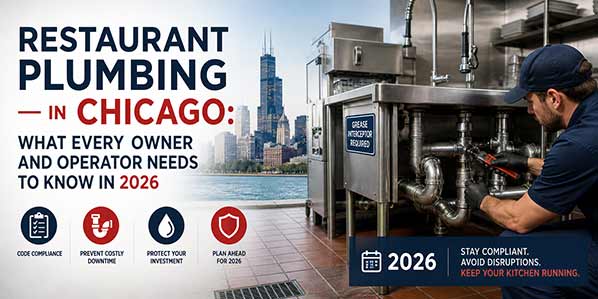
The Complete Guide to Plumbing Compliance, Maintenance, and Emergency Response for Chicago Food Service Establishments
Opening a restaurant in Chicago is one of the most demanding business endeavors in one of the most competitive food cities in the country. The menu, the concept, the location, the staffing — every piece gets obsessed over. And then somewhere in the middle of buildout, the plumbing gets handed off to whoever was cheapest or fastest, and nobody thinks about it again until a drain backs up during Saturday dinner service or a health inspector walks in and finds a grease trap that hasn’t been serviced in eight months.
Plumbing is the infrastructure that everything else in a commercial kitchen depends on. Water supply for cooking, washing, and sanitation. Drainage for the volume of wastewater a busy kitchen generates every shift. Grease management to keep your FOG out of Chicago’s sewer system and your operation in compliance with the city’s health code. Backflow prevention to protect your potable water supply. Hot water availability at every hand sink — a specific requirement that Chicago health inspectors check on every visit. Get any one of these wrong and you’re not just dealing with a plumbing problem. You’re dealing with a health code problem, a license problem, or a reputation problem.
This guide covers everything Chicago restaurant owners and operators need to understand about their plumbing systems: what the city actually requires, what the most common failure points are, what a complete plumbing maintenance program looks like, what things cost in 2026, and how to think about plumbing before a problem forces you to think about it.
What Chicago Law Actually Requires for Restaurant Plumbing
Chicago’s restaurant plumbing requirements come from multiple regulatory sources that overlap and interact — and navigating them is one of the first things a new restaurant operator needs to understand before opening or renovating a space.
The Chicago Department of Public Health is the primary enforcement authority for food service establishments in the city. The CDPH Food Protection Division conducts inspections for new businesses before a license is issued and periodically thereafter — with frequency based on the risk level assigned to your operation. Risk 1 establishments are inspected twice per year. Risk 2 once per year. Risk 3 every other year. High-volume full-service restaurants typically land at Risk 1 — meaning you can expect two unannounced inspections annually on top of any complaint-driven visits.
What health inspectors check in terms of plumbing:
Chicago health inspectors assess plumbing as part of every inspection. The specific items that generate citations most frequently from a plumbing standpoint include:
Grease trap condition and maintenance documentation — is the trap being serviced at the required frequency and are records available on site? This is one of the most common plumbing-related citations in Chicago restaurant inspections.
Hot water availability at hand sinks — every hand sink in the food preparation and service areas must have hot water available. A water heater failure that takes out hot water at hand sinks is a priority violation that can result in immediate closure.
Floor drain function — slow or backed-up floor drains in food preparation areas are both a sanitation issue and a plumbing code issue. Inspectors look at whether drains are functioning, properly trapped, and free of sewage backup.
Backflow prevention device compliance — commercial kitchens require properly installed and tested backflow preventers on potable water supply lines. Absent or non-functional backflow prevention is a code violation.
Three-compartment sink drainage — the three-compartment sink is a required piece of equipment in most Chicago food service establishments, and its drain connections must be properly trapped and vented per the Chicago Plumbing Code.
The Chicago Plumbing Code governs the technical requirements for all plumbing installations in the city — pipe sizing, venting, trap requirements, grease interceptor sizing, and backflow prevention specifications. All plumbing work in a Chicago restaurant requires permits and must be performed by a licensed plumber. Unpermitted plumbing work discovered during a buildout inspection or health inspection creates compliance liability that can delay your opening or result in a stop-work order mid-renovation.
Illinois Administrative Code Section 890.510 establishes the state-level grease interceptor requirement — every commercial establishment where grease, fats, or culinary oils are wasted from kitchens must have properly sized interceptors on all affected drain lines. This is a state law requirement that exists independently of Chicago’s city ordinances and is enforced through both the health department and the Illinois EPA’s pretreatment program.
The Most Common Plumbing Problems Chicago Restaurants Face — and What Causes Each One
Understanding what typically goes wrong — and why — is the foundation of a maintenance program that actually prevents problems rather than just responding to them.
1. Grease Trap Backup and Overflow
The single most common plumbing emergency in Chicago commercial kitchens. A grease trap that hasn’t been serviced on the right schedule reaches capacity — defined as 25% of its total liquid volume occupied by accumulated FOG and solids — and grease begins bypassing the baffles entirely, traveling downstream and coating the interior of your drain lines. Eventually the drain lines restrict, then block, and wastewater backs up through kitchen floor drains.
This is not a sudden failure. It builds over weeks or months, and the warning signs — slow floor drains during peak service, occasional gurgling, mild sewer odor near the trap — are there before the emergency occurs. Operators who miss those signs or defer service end up with an emergency call at the worst possible time.
What drives it: Too-infrequent service intervals, undersized traps for the kitchen’s actual FOG output, staff pouring cooking oil directly into drains rather than into waste containers, and use of enzyme or biological additives that temporarily reduce odor while allowing grease to bypass the trap and accumulate downstream. Drain environments like this can also attract pests such as drain flies when organic buildup is present in traps and lines.
The prevention: A professionally set service schedule based on your kitchen’s actual output — not a generic “every 90 days” recommendation that may or may not match your operation. Our grease trap cleaning service covers restaurants of all sizes throughout Chicago and the suburbs with same-day and emergency response. For the full compliance picture including how service frequency is determined and what Chicago’s recordkeeping requirements look like, see our complete grease trap cleaning guide for Chicago restaurants.
2. Floor Drain Backups During Service
Floor drains in commercial kitchens handle high-temperature wastewater, food particles, cleaning chemicals, and residual FOG from floor washing. Over time the drain lines accumulate buildup that creates progressive restriction — drains slow down gradually, and the problem becomes acute during the peak flow periods of active service when volume overwhelms the restricted line.
What drives it: In older Chicago commercial spaces, original cast iron drain lines may be 40 to 60 years old with significant interior corrosion and scale accumulation. Newer spaces with improper slope on floor drain lines trap sediment. Drain lines between fixtures and the grease trap accumulate grease independently of the trap itself — a common misconception is that a clean grease trap means clean drain lines, which isn’t true.
The prevention: Annual hydro jetting of kitchen drain lines — separate from grease trap service — removes wall deposits and restores full pipe diameter. Our Chicago commercial hydro jetting service is available throughout Chicagoland with same-day and emergency response. High-pressure water jetting at up to 4,000 PSI scours the interior of kitchen drain lines completely — something that rodding simply can’t accomplish.
3. Hot Water Failure
A water heater failure in a commercial kitchen isn’t just an inconvenience — it’s potentially a health code violation and a forced closure. Chicago health code requires hot water at all hand sinks and at the three-compartment sink for proper sanitization. A water heater that fails during service hours puts you in an immediate compliance situation.
What drives it: Commercial water heaters in restaurant environments run under high-demand conditions — constant draw from multiple fixtures throughout a full service day. Water heaters that aren’t sized correctly for the kitchen’s demand run continuously without adequate recovery time, accelerating wear. Sediment accumulation from Chicago’s hard water reduces efficiency and shortens the service life of tank-based water heaters significantly.
The prevention: Annual water heater inspection and flushing to remove sediment. Correct sizing assessment when replacing a unit. Knowing the age of your water heater — commercial units typically last 8 to 12 years — and planning replacement before failure rather than after. Our restaurant plumbing services include water heater assessment as part of every commercial plumbing evaluation.
4. Sewer Backup Through Floor Drains — The Sewer Surcharge Problem
In older Chicagoland communities and in Chicago proper, where the combined sewer system carries both stormwater and sanitary waste in the same pipes, restaurants face a flooding risk that has nothing to do with their own plumbing’s condition. When a significant rain event overwhelms the city’s combined sewer capacity, pressure builds in the mains and travels backward through every lateral connected to the main — including your restaurant’s. The result is sewage coming up through the floor drain, not from your kitchen’s own waste, but from the city system traveling backward under pressure.
This happens to restaurants in good building condition with well-maintained plumbing. It’s a city infrastructure problem, not a maintenance failure — but the restaurant bears the cost of cleanup and the compliance exposure if it affects food preparation areas.
The solution: A backwater valve installed in the main sewer lateral physically prevents city sewer pressure from entering your building’s drain system during a surcharge event. Our sewer backflow prevention services handle the full installation including all required permits.
5. Burst Pipes During Chicago Winters
Commercial kitchen pipes in exterior walls, in unheated storage areas, or near loading dock areas are vulnerable to freezing during Chicago’s sustained cold spells. A pipe that freezes and bursts during or before a service period creates an immediate emergency — water damage, potential food safety exposure, and forced closure until repairs are complete.
What drives it: Pipes in poorly insulated exterior walls, water supply lines that run through unheated spaces, and pipes near loading docks or walk-in cooler areas where temperature management is inconsistent. Older Chicago commercial buildings often have original galvanized supply lines with thin walls that are more vulnerable to freeze damage than modern materials.
The prevention: Pipe insulation in vulnerable areas before the cold season. Knowing where your shutoff valves are — every restaurant operator and key staff member should know the location of the main water shutoff so that a burst pipe doesn’t flood the kitchen for an hour before someone figures out how to stop it. When a pipe does fail, call us immediately — we offer 24/7 emergency commercial plumbing response throughout Chicago and the suburbs.
6. Three-Compartment Sink Drainage Issues
The three-compartment sink is the workhorse of Chicago restaurant dishwashing operations, and its drainage system handles some of the highest-volume, highest-temperature wastewater in the kitchen. The drain lines from three-compartment sinks are particularly prone to grease accumulation because hot wash water carries significant FOG that cools and deposits in the drain lines downstream of the sink.
What drives it: High-volume ware washing through a single drain outlet, inadequate trap sizing for the flow volume, and drain lines that haven’t been jetted as part of a regular maintenance program.
The prevention: Including three-compartment sink drain lines in the annual kitchen drain hydro jetting scope. Confirming that the drain trap and vent configuration meets Chicago plumbing code — improperly vented three-compartment sink drains develop slow drainage conditions that worsen progressively.
Opening a New Restaurant in Chicago: What You Need to Get Right Before the Health Inspector Arrives
New restaurant buildouts in Chicago involve more plumbing complexity than most operators anticipate — particularly operators coming from smaller markets or from front-of-house backgrounds who haven’t been through a commercial kitchen buildout before.
Grease interceptor installation and sizing. This is not optional and not something that can be added after the fact without significant disruption. The interceptor must be sized for the volume of FOG your specific kitchen configuration will generate, installed on the correct drain lines, and approved before the health department will issue your license. Getting this wrong requires excavating finished concrete floors to correct — an expensive problem that delays your opening. The interceptor sizing calculation depends on your equipment list, which is why the plumber needs to be involved before you finalize your kitchen equipment plan.
Three-compartment sink configuration. The three-compartment sink must be properly sized, properly trapped, and properly vented per the Chicago Plumbing Code. In a new buildout, the plumber designs this correctly from the start. In a takeover of an existing space, the configuration the previous tenant used may or may not comply with current code — which is why a compliance assessment of the existing plumbing before you sign a lease is valuable.
Hand sink placement and hot water availability. Chicago health code requires hand sinks in specific locations relative to food preparation areas and at the entrance to the kitchen. Each must have hot water available. The plumber needs to understand the health code requirements — not just the mechanical requirements — to locate and connect hand sinks correctly.
Backflow prevention. Commercial kitchens in Chicago require properly installed backflow preventers on potable water supply connections. This is a code requirement that must be addressed in the permit drawings and installed before the health inspection. Missing or non-functional backflow prevention is a citation on the first inspection and a repair requirement before your license is issued.
Permits and plan review. All plumbing work in a Chicago restaurant requires permits. The plan review process for a new restaurant or significant renovation involves submitting plumbing plans to the Department of Buildings — and those plans must reflect compliance with the Chicago Plumbing Code. We handle all permitting as part of every restaurant plumbing installation — permit fees are included in our quoted price and we manage the submission and inspection process from start to finish.
The Soldier Field Standard: What Large-Scale Restaurant Plumbing Service Actually Looks Like
The scale of commercial kitchen plumbing service we provide ranges from single-unit neighborhood restaurants to some of the largest venue operations in Chicago. We’ve provided grease trap pumping and maintenance for over 70 commercial grease traps at Soldier Field during active season operations — a job that requires coordinating service across dozens of food service points, managing documentation for a facility of that scale, and delivering results that support uninterrupted game-day operations. Read the full story on our Soldier Field featured service page.
Whether we’re servicing a 12-seat neighborhood restaurant or a stadium-scale operation, the core principle is the same: the drain system doesn’t get to fail during service hours. The planning, documentation, and execution that goes into a Soldier Field service call is the same approach we bring to every commercial kitchen we work in.
The Complete Restaurant Plumbing Maintenance Program — What Chicago Operators Should Be Doing and When
The restaurants in Chicago that never have plumbing emergencies during service hours are almost always the ones on a maintenance schedule. Here’s what a complete program looks like:
Monthly (high-volume operations): Grease trap inspection and service if approaching the 25% capacity threshold. Floor drain inspection — check for slow drainage, odors, or visible buildup at drain openings. Water heater temperature verification — commercial water heaters should maintain proper output temperature consistently throughout a full service day.
Every 1–2 months (full-service restaurants with heavy fry operations): Grease trap pumping and cleaning. This is the most important recurring maintenance task for any Chicago restaurant with a commercial kitchen producing significant FOG output.
Quarterly (all food service establishments): Grease trap service for lower-volume operations. Backflow preventer testing where required by your specific permit conditions.
Annually: Kitchen drain line hydro jetting — this is the service most operators skip and most frequently regret. Annual hydro jetting of the lines between fixtures and the trap, and downstream of the trap, removes wall deposits before they create restriction. Grease trap inspection for baffles, inlet/outlet condition, and structural integrity. Water heater inspection and flushing to remove sediment accumulation. Sewer camera inspection for restaurants in older Chicago buildings with original clay tile or cast iron laterals.
Every 2–3 years: Full sewer lateral camera inspection to assess root intrusion, pipe condition, and whether any sections are approaching failure. This is especially important for restaurants in pre-1970 Chicago buildings where the original lateral may never have been camera-inspected.
What Restaurant Plumbing Services Cost in Chicago in 2026
Understanding what things cost before you need them under emergency conditions is the foundation of good commercial plumbing budgeting. Here’s what to expect across the services most relevant to Chicago restaurant operators:
Grease trap cleaning: $350 to $500 for standard restaurant grease trap service. Larger interceptors, traps with excessive buildup from infrequent service, and emergency calls outside business hours run higher.
Kitchen drain line hydro jetting: $300 to $800 for a standard restaurant kitchen drain system including multiple fixture lines and the main kitchen drain run. More complex systems or those with significant grease accumulation requiring multiple passes run toward the higher end.
Backwater valve installation: $2,500 to $5,500 installed including permits. Essential for older Chicago restaurants in combined sewer service areas.
Commercial water heater replacement: $1,500 to $4,500 installed depending on unit capacity, fuel type, and access conditions. High-demand tankless commercial units run higher. For restaurants that depend on continuous hot water availability through multiple service periods, sizing correctly the first time is significantly more cost-effective than replacing an undersized unit after failure.
Sewer camera inspection: $250 to $500 for a restaurant lateral camera inspection. One of the highest-value diagnostic investments available to a Chicago restaurant operator — knowing the condition of your lateral before a failure occurs allows planned repair rather than emergency excavation.
Three-compartment sink installation: $1,500 to $3,500 installed including all rough plumbing, trap, vent, and connection to the grease interceptor. New construction pricing; existing space takeover costs vary based on what infrastructure is already in place.
Emergency service call premium: 25% to 50% above standard rates for after-hours and weekend emergency response. The gap between the cost of scheduled maintenance and the cost of a 2am emergency call during a busy weekend is the most compelling argument for a maintenance program.
Chicago-Specific Factors Every Restaurant Operator Should Understand
The combined sewer system affects you even if your plumbing is perfect. Chicago and many inner-ring suburbs run combined storm and sanitary sewer infrastructure. A heavy rain event can surcharge the system regardless of your maintenance history. If your restaurant is in an older Chicago neighborhood and you’ve never had a backwater valve installed, you’re one major storm event away from a sewage backup in your kitchen.
Chicago’s hard water accelerates scale buildup. Municipal water in the Chicago metro area has significant mineral content that deposits scale inside pipes, water heaters, and commercial kitchen equipment faster than in softer-water markets. Commercial water heaters in Chicago restaurants need more frequent maintenance than the manufacturer’s recommendation — which is typically written for average water quality conditions, not Chicago’s specific environment.
Older Chicago commercial buildings have aging infrastructure. A restaurant operating in a 1920s Wicker Park building, a 1950s Logan Square storefront, or a 1960s suburban strip mall is working with drain infrastructure that may be 60 to 100 years old. Original cast iron drain stacks that have corroded rough on the interior accumulate grease and debris faster than modern pipe. Clay tile laterals in older buildings are vulnerable to root intrusion and offset joints. Knowing the condition of your building’s plumbing before you sign a long-term lease is significantly more valuable than discovering problems after you’ve invested in a buildout.
The health inspection connection. The Chicago Department of Public Health publishes its inspection requirements including the specific plumbing-related items that generate citations. Restaurant operators who understand these requirements and maintain their plumbing proactively don’t get surprised by inspections. Operators who treat plumbing as a reactive expense get surprised regularly.
Pre-Opening Checklist: What Your Restaurant’s Plumbing Should Have Before Your First Health Inspection
Use this as a starting point before your first health inspection — whether you’re opening a new restaurant or taking over an existing space:
Grease interceptor — properly sized for your equipment list, installed on all FOG-producing drain lines, and documented with service contract in place.
Three-compartment sink — properly sized, trapped, and vented per Chicago Plumbing Code. Drain connection verified compliant.
Hand sinks — present in all required locations per health code, with hot and cold water available at each.
Backflow prevention — properly installed on potable water supply connections. Current test documentation available if required.
Floor drains — functional, properly trapped, no sewage odors, no visible backup.
Water heater — sized for peak demand, operational, set to correct temperature, current inspection documentation available.
Grease trap service records — available on site for health inspector review. If taking over an existing space, obtain service records from the previous tenant or schedule immediate service to establish a clean baseline.
Sewer lateral condition — if the building is pre-1970 or if the prior tenant had drain problems, a camera inspection before opening establishes what you’re working with and protects you from liability for pre-existing conditions.
Frequently Asked Questions: Restaurant Plumbing in Chicago
We’re signing a lease on an existing restaurant space. What plumbing should we check before committing? At minimum: confirm the grease interceptor is properly sized for your intended menu and equipment, get the service history, run a sewer camera on the lateral to see what you’re inheriting, verify the water heater is sized for your expected demand, and confirm all backflow prevention is in place and current. A pre-lease plumbing assessment by a licensed commercial plumber costs a few hundred dollars and can reveal six-figure problems before you’re locked into a lease. For property owners who lease to restaurant tenants — and want to understand their obligations vs the tenant’s obligations and how to protect themselves from grease management failures — our Chicago property manager’s plumbing playbook covers exactly where that line is.
How do I know what size grease trap my restaurant needs? The sizing calculation is based on your kitchen’s wastewater flow rate — which depends on the number and type of fixtures producing FOG waste. A high-volume kitchen with multiple fryers, a commercial dishwasher, and a three-compartment sink has very different interceptor requirements than a small café. A licensed plumber calculates the correct size based on your equipment list. Installing an undersized trap is a violation from day one — and replacing it requires cutting a finished concrete floor.
My floor drains have been slow for weeks. Can I just pour drain cleaner down them? No — and for two reasons. First, chemical drain cleaners don’t remove grease deposits — they may temporarily open a partially restricted line but leave the underlying buildup intact, which means the drain slows again within weeks. Second, introducing certain chemicals into a grease trap disrupts the bacterial action the trap relies on, which can actually accelerate compliance problems. The right fix is hydro jetting to remove the wall deposits creating the restriction.
What plumbing items do Chicago health inspectors most commonly cite? From our experience across hundreds of restaurant service calls, the most commonly cited plumbing items are grease trap condition and documentation, floor drain function, hot water availability at hand sinks, and backflow prevention compliance. A pre-inspection walkthrough by a licensed commercial plumber identifies and corrects these before the inspector arrives.
Our restaurant is in a 1950s building. What plumbing issues should we be aware of? Original galvanized steel water supply lines that are likely past their reliable service life — expect low pressure and discolored water if they haven’t been replaced. Cast iron drain lines with interior corrosion that accumulates grease faster than modern pipe. A clay tile sewer lateral that may have root intrusion or offset joints. Water heater infrastructure that may be undersized or poorly vented by modern standards. A camera inspection of the lateral and a plumber’s assessment of the supply lines gives you a clear picture before you commit to a buildout.
Can you help us set up a maintenance schedule so we don’t have to think about this? Yes — and this is one of the most valuable things we do for restaurant clients. We assess your kitchen’s output, your trap size, your drain system configuration, and your building’s age, and we set a service schedule that covers everything on a recurring basis. Grease trap service on the right interval, kitchen drain hydro jetting annually, water heater inspection, and sewer camera on a longer cycle. You get reminders, we show up, and your plumbing stops being a source of emergency calls. Reach out through the form below and we’ll get it set up.
Need a Restaurant Plumber in Chicago You Can Actually Count On?
Licensed, insured, and locally based in Brookfield since 1978. We’ve served Soldier Field, Goodman Theatre, Panda Express, and hundreds of independent Chicago restaurants — from grease trap maintenance to emergency drain response to full plumbing buildouts. Written quotes before we start, permits pulled on every job, and our own licensed technicians on every call. Send us a message and we’ll get back to you fast.
Or call us directly: 708-801-6530 | Open 24/7
—
Suburban Plumbing Sewer Line & Drain Cleaning Experts
Licensed & Insured | Open 24 Hours | Serving Chicago & Chicagoland
📞 Suburbs: 708-801-6530 | 📞 Chicago: 773-570-2191 | 🚨 Emergency: 708-518-7765