
What It Is, How It Works, Whether You Need One, and What It Costs
If you’ve lived in Chicago or the surrounding suburbs for any length of time, you’ve probably heard the term “overhead sewer” — from a neighbor, a plumber, a real estate agent, or someone whose basement flooded during a storm. But for most Chicagoland homeowners, the full picture of what an overhead sewer actually is, how it differs from a traditional system, and whether it makes sense for their home remains unclear.
That’s not surprising. Overhead sewers are largely a Chicago-area phenomenon — a solution developed specifically for the unique combination of aging infrastructure, a combined sewer system, flat terrain, and a heavy storm season that makes basement sewage backups one of the most common and costly home disasters in the region. Most plumbing guides written for a national audience don’t cover them at all.
This guide covers everything Chicagoland homeowners need to know — from the basics of how overhead sewers work to cost estimates, signs your home could benefit from one, and what the installation process actually involves.
Why Chicago Has a Unique Flooding Problem
To understand why overhead sewers exist, you first need to understand the fundamental challenge Chicago homeowners face that homeowners in most other cities don’t.
Chicago’s sewer system was built before 1930 and uses what’s called a combined sewer system — meaning stormwater runoff and sanitary sewage flow through the same underground pipes. As the City of Chicago explains on its water management pages, Chicago is effectively built on a swamp, with a high water table and very little green space to absorb heavy rain. During an intense storm, the combined system can reach capacity within hours — and when it does, the water has nowhere to go but back up through the lowest openings in connected homes.
That lowest opening is almost always in the basement — a floor drain, a basement toilet, a laundry sink. When the city’s sewer system backs up under pressure, contaminated sewage flows backward through private sewer laterals and up through those basement fixtures. It happens fast, it’s disgusting, it’s a genuine health hazard, and the cleanup and repair costs can easily reach tens of thousands of dollars.
According to WBEZ’s deep investigation into Chicago’s basement flooding crisis, most of Chicago’s sewer infrastructure was designed to handle storms of a specific magnitude — and increasingly intense weather events regularly exceed that capacity. The 1997 flood alone affected 35,000 Chicago residents. This is not a fringe problem. It’s a structural reality of living in Chicagoland.
An overhead sewer is the most comprehensive solution available to individual homeowners who want to protect their property from this problem permanently.
What Is an Overhead Sewer System?
A traditional gravity-fed sewer system works exactly as the name implies — waste flows downhill by gravity from every fixture in the home, through the lateral, and into the city’s main. The problem is that basement fixtures — floor drains, basement bathrooms, laundry sinks — are below the level of the street sewer main. When that main backs up under pressure, contaminated water flows backward and rises up through those below-grade fixtures into the basement. There’s nothing to stop it.
An overhead sewer system changes the fundamental architecture of how your home’s plumbing connects to the city main. Here’s how it works:
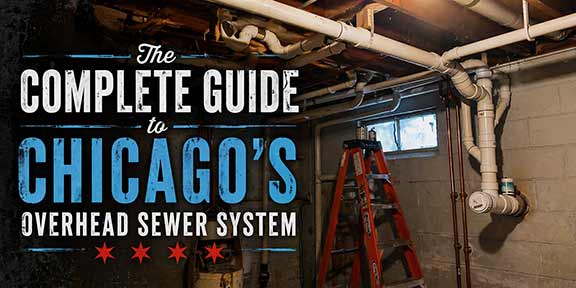
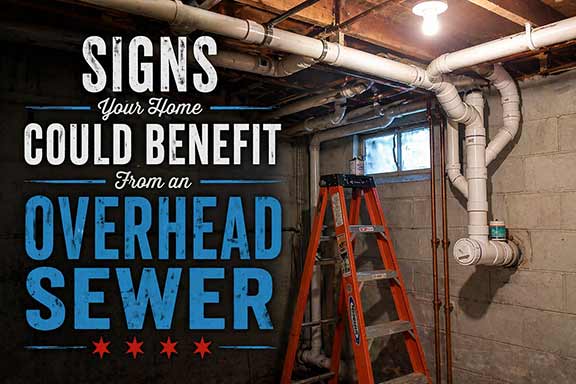
All above-grade fixtures — first floor sinks, toilets, showers, and everything on upper floors — continue to flow by gravity as before, but their drain lines are routed to exit the house at a point above the basement floor level, typically through the basement ceiling or the rim joist area. Because these lines exit the home above the city sewer main elevation, sewage backing up in the street main physically cannot reach the level of those fixtures.
Below-grade fixtures — basement floor drains, basement bathrooms, laundry tubs, and anything else in the basement — are disconnected from the gravity system and instead drain into a sealed ejector pit in the basement floor. A submersible ejector pump in that pit pumps waste up and out through a discharge line that connects to the overhead system, exiting the home at the elevated point above the main. When the ejector pump runs, waste is actively pumped up and out rather than flowing down toward the street.
The result is a system where sewage backup in the city main simply cannot reach your basement fixtures — because the exit point of your drain lines is physically above the backup level. The only way sewage could enter your home through an overhead system is if street flooding reached the elevation of your first-floor fixtures, which would require catastrophic flood conditions far beyond a typical Chicago storm event.
Overhead Sewer vs. Other Flood Control Options
Homeowners researching basement flood protection often encounter several options that get compared to overhead sewers. Here’s how they stack up honestly:
Backwater valve (backflow preventer) — a valve installed in your sewer lateral that allows waste to flow out but closes automatically when flow reverses, blocking sewage from backing up into the home. Backwater valves are significantly less expensive than overhead sewers and provide meaningful protection against moderate sewer backups. Their limitation is mechanical — the valve must function correctly when it matters most, and it can fail or become fouled with debris. They also don’t address seepage or other flooding sources.
Standpipe — a sealed PVC pipe installed over a floor drain that raises the effective drain opening above the sewer backup level. Standpipes are the most basic and least expensive option but also the least protective — they only address the specific drain they cover and do nothing about basement bathrooms or laundry connections.
Sump pump system — addresses groundwater seepage and surface water infiltration but does not protect against sewer backup. Many homeowners need both a sump pump and sewer backup protection. Our sump pump installation and service team handles both, and we frequently install them in combination with flood control upgrades.
Overhead sewer system — the most comprehensive and permanent solution available. It eliminates sewer backup risk at the source rather than managing it with mechanical devices. It’s the most expensive option upfront and the most protective long term. For homeowners who have experienced repeated sewer backups or who have significant basement finishing, the overhead sewer is almost always the right answer.
Signs Your Home Could Benefit From an Overhead Sewer
Not every Chicagoland home needs an overhead sewer — but certain situations make it worth a serious conversation with a licensed plumber:
You’ve had sewage back up into your basement. If it’s happened once, the conditions that caused it haven’t changed. It will almost certainly happen again, and each event carries thousands of dollars in cleanup and damage costs plus the health hazard of raw sewage in a living space.
Your home is in a neighborhood with a history of flooding. Certain Chicago neighborhoods and suburbs flood repeatedly because of their location relative to the combined sewer system, the terrain, or both. If your neighbors have dealt with repeated basement backups, you share that risk.
You have a finished basement with significant investments. A finished basement with a home office, media room, or guest suite represents a major financial investment. The math on overhead sewer installation changes significantly when the alternative is a potential $30,000 to $50,000 damage and remediation event.
More homeowners throughout Chicago and the surrounding suburbs are making the decision to install overhead sewer systems before another major flooding event occurs. Read Why Homeowners Are Installing Overhead Sewer Systems in Chicagoland to learn what’s driving the growing demand for permanent basement flood protection.
Your home has below-grade fixtures — a basement bathroom, laundry room, or floor drains. Any fixture below the street sewer main elevation is a potential entry point for sewage backup. The more below-grade fixtures you have, the greater your exposure.
You’re planning a basement renovation. If you’re about to invest in finishing or remodeling your basement, installing an overhead sewer before or during that project is the smart time to do it — both in terms of cost and in terms of protecting the investment you’re about to make.
You have an older home with aging sewer infrastructure. Homes built before 1960 often have deteriorating clay tile or cast iron sewer laterals that are more vulnerable to backup-related failures and have limited remaining service life. An overhead sewer installation combined with a lateral replacement gives you a complete, modern solution.
What the Installation Process Involves
Overhead sewer installation is a significant plumbing project and not a weekend DIY job. Here’s what a proper installation actually involves so you know what to expect:
Assessment and planning — a licensed plumber inspects your current plumbing configuration, identifies the path of your sewer lateral, determines the locations of all above-grade and below-grade fixtures, and plans how the new system will be routed. Every home is different, and overhead sewer design is customized to the specific property.
Rerouting above-grade drain lines — the drain lines from first floor and upper floor fixtures are rerouted to exit the home at the basement ceiling level or rim joist, above the main. This typically involves opening sections of wall or ceiling to access and reroute pipes.
Ejector pit installation — a sealed pit is cut into the basement floor to house the ejector pump that will handle below-grade waste. The size and location of the pit are determined by the fixtures it needs to serve.
Below-grade fixture connection — basement floor drains, basement bathroom fixtures, and laundry connections are rerouted to drain into the ejector pit rather than the main gravity line.
Ejector pump installation — a submersible ejector pump is installed in the sealed pit along with a check valve to prevent backflow and a vent line to handle gases safely.
Connection to overhead line — the ejector pump discharge connects to the overhead drain line that exits the home at the above-grade elevation.
Inspection and permitting — in Chicago and most suburbs, overhead sewer installation requires a permit and must be inspected by the municipality. Our team handles the permitting process and coordinates inspections as part of every overhead sewer installation.
The project typically takes two to three days for a standard single-family home, though more complex situations with extensive basement plumbing or difficult access can take longer.
What Does an Overhead Sewer Cost in Chicagoland?
Overhead sewer installation is a significant investment — we’re not going to sugarcoat that. But the range is wide depending on your home’s specific configuration, and the right framing is to compare it to the cost of repeated basement flooding events rather than other plumbing repairs.
For a typical Chicagoland single-family home, overhead sewer installation generally runs in the range of $8,000 to $18,000 depending on the complexity of the existing plumbing, the number of below-grade fixtures, access considerations, permit costs, and whether any lateral work is needed simultaneously.
Factors that push the cost higher include extensive basement plumbing, finished spaces that require careful work to avoid major damage, older homes with complex existing configurations, and situations where the sewer lateral itself needs repair or replacement at the same time.
For many homeowners the insurance conversation is worth having before or after installation. Some insurers offer reduced premiums for homes with overhead sewer systems because the flood risk profile is materially lower. It won’t offset the full cost, but it can meaningfully reduce the long-term financial picture. Brookfield homeowners near Salt Creek have a specific village flood mitigation program available — read our complete Brookfield plumbing guide for the full picture.
Frequently Asked Questions: Chicago Overhead Sewer Systems
Will an overhead sewer completely eliminate my risk of basement flooding?
It eliminates sewer backup as a flooding source — which is the most common and most damaging cause of basement flooding in Chicago. It doesn’t address seepage through foundation walls or surface water intrusion from poor grading or window wells. For comprehensive basement protection, many homes benefit from combining an overhead sewer with a sump pump system and addressing any foundation drainage issues.
Can I still have a functional basement bathroom with an overhead sewer?
Yes — and this is one of the things homeowners are often surprised to learn. Basement bathrooms, laundry facilities, and floor drains all continue to function normally with an overhead sewer. The ejector pump handles waste from below-grade fixtures just as it would in any system with a basement bathroom. You won’t notice a functional difference in day-to-day use.
How long does an overhead sewer system last?
The piping components of a properly installed overhead sewer system — PVC drain lines — have a functional lifespan of 50 or more years under normal conditions. The ejector pump is the mechanical component that requires periodic maintenance and eventual replacement, typically every 10 to 15 years depending on usage and the quality of the unit installed. We use commercial-grade pumps that are built for longevity and provide easy access for maintenance.
My neighbor has a backwater valve — is that enough or should I do an overhead sewer?
A backwater valve provides meaningful protection and is a much less expensive option. Whether it’s enough depends on your specific situation — how severe the backup risk is in your area, whether you’ve already experienced a backup, and how much you have invested in your basement. For homes in moderate-risk areas without finished basements, a backwater valve may be adequate. For homes with repeated backup history, significant basement finishing, or below-grade bathrooms, an overhead sewer provides a level of protection that a backwater valve simply can’t match. We’re happy to walk you through the honest comparison for your specific situation.
Does overhead sewer installation require tearing up the basement floor?
A small pit is cut for the ejector pump — typically 18 to 24 inches in diameter. Beyond that, most of the work happens at the ceiling level and in wall or ceiling cavities rather than in the floor. The footprint of disruption is much smaller than many homeowners expect. In finished basements, we work carefully to minimize damage to existing surfaces and discuss the access plan with you before we start.
How do I know if my home currently has an overhead sewer or a traditional system?
The clearest indicator is whether your basement drains connect to a visible ejector pit with a pump — that’s the signature of an overhead system. If your basement floor drains empty directly into the floor without a pump, you have a traditional gravity system. When we assess your home prior to any flood control work, we identify your current system configuration as part of the process. Call us and we can talk through what to look for.
Thinking About an Overhead Sewer? Let’s Talk.
Send us your info and we’ll follow up fast — free assessments available across Chicago and the suburbs. No pressure, just straight answers about what your home actually needs.
Or call us directly: 708-801-6530 | Open 24/7
—
Suburban Plumbing Sewer Line & Drain Cleaning Experts
Licensed & Insured | Open 24 Hours | Serving Chicago & the Suburbs Since 1978
📞 Suburbs: 708-801-6530
📞 West Suburbs: 630-749-9057
📞 Chicago: 773-570-2191
🚨 24/7 Emergency Line: 708-518-7765