
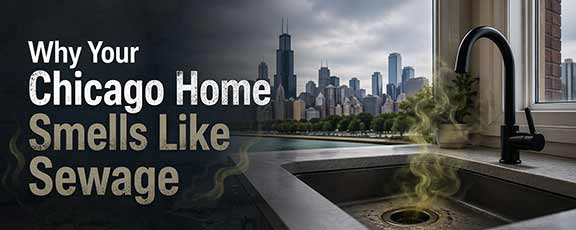
That Rotten Egg Smell Isn’t Going Away on Its Own — Here’s What It’s Telling You
You notice it first thing in the morning. Or maybe it hits you when you walk in the front door after work. A faint but unmistakable odor — somewhere between rotten eggs and something you can’t quite name — that doesn’t belong in your home. You check the garbage. You check under the sink. Nothing obvious. The smell comes and goes, or it stays, and nobody in the house can figure out where it’s coming from.
This is one of the most common calls we get at Suburban Plumbing Experts, and it’s one that homeowners consistently put off longer than they should. A sewage smell inside your home is not a minor inconvenience — it’s a warning sign from your plumbing system that something has gone wrong. And in many cases, what’s wrong is both fixable and serious enough to warrant prompt attention.
This guide walks you through every likely cause of a sewage smell in a Chicago-area home, how to systematically find the source yourself, when the fix is simple, and when you need a licensed plumber to get involved.
What Is That Smell, Exactly?
The odor most homeowners describe as “sewage” is primarily hydrogen sulfide — a toxic gas produced by the decomposition of organic waste in your drain and sewer system. Hydrogen sulfide has a distinctive rotten egg smell that’s detectable even at very low concentrations.
According to the Wisconsin Department of Health Services, sewer gas is a complex mixture of toxic and non-toxic gases including hydrogen sulfide, ammonia, methane, carbon dioxide, and sulfur dioxide. At low concentrations the primary symptoms are eye and respiratory irritation and headaches. At higher concentrations or with prolonged exposure, the health risks become significantly more serious — which is why a persistent sewage smell inside a home should never be ignored or simply masked with air freshener.
Methane — another component of sewer gas — is odorless on its own but highly flammable, which means a severe sewer gas leak in an enclosed space is not just a health concern but a potential fire and explosion hazard.
The good news is that in most Chicago-area homes the source of a sewage smell is an identifiable plumbing issue with a clear solution. Here’s how to find it.
Start With the Obvious: Dry P-Traps
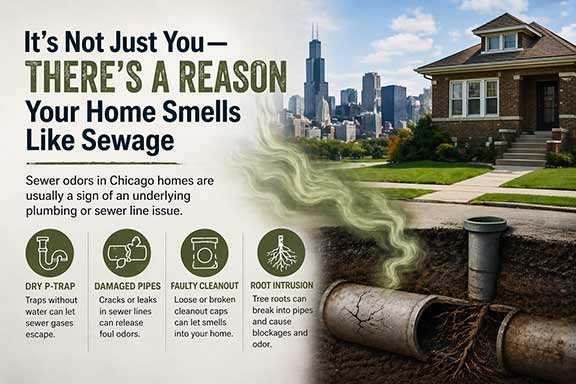
The single most common cause of a sewage smell in a home — and the easiest to fix — is a dry P-trap. If you’ve ever looked under a sink, you’ve seen a P-trap: the U-shaped curved section of pipe directly below the drain. That curve is designed to hold a small amount of standing water at all times, creating a water seal that physically blocks sewer gas from traveling up through the drain and into your living space.
When a drain isn’t used for an extended period — a basement floor drain, a guest bathroom sink, a shower that nobody uses regularly — the water in the P-trap simply evaporates. Once the water seal is gone, sewer gas has a direct, unobstructed path from your drain system into the room.
The fix is as simple as it sounds: run water down the unused drain for 30 to 60 seconds to refill the trap. If the smell disappears within a few hours, a dry P-trap was almost certainly the culprit. For floor drains that are particularly prone to drying out, pouring a cup of mineral oil after refilling will slow future evaporation and extend the time between refillings.
If the smell returns despite the P-trap being full, or if running water down the drain doesn’t help, keep reading — something more significant is going on.
Check Every Toilet in the House
Toilets are one of the most common hidden sources of sewage odor in Chicago-area homes, and the issue is almost always at the base of the toilet where it meets the floor. Every toilet sits on a wax ring — a soft wax gasket that creates a seal between the toilet flange and the drain opening below. When that wax ring fails — from age, from a rocking toilet, from an improper original installation — sewer gas escapes through the gap at the base every time the toilet is flushed or the bowl refills.
Check each toilet in your home. Get down close and smell at the base. Rock the toilet gently — if it moves at all, the wax ring has almost certainly failed. A rocking toilet is a broken seal. The fix is a wax ring replacement — a job a licensed plumber can complete in under an hour — but left unaddressed it will continue to allow sewer gas into your home indefinitely.
Also check the water supply line connections and the tank-to-bowl gasket on older toilets. Any point where the plumbing system is cracked or compromised can allow odors to escape.
Look for Blocked or Compromised Plumbing Vents
This is one of the most overlooked causes of sewage odor in Chicago homes and one of the hardest to diagnose without equipment. Every drain system requires proper venting — pipes that run vertically through your home and terminate above the roofline, allowing air into the drain system to equalize pressure and allowing sewer gas to escape harmlessly outside rather than backing up into the home.
When those vent pipes become blocked — by a bird’s nest, a dead animal, debris, ice in winter, or simply deterioration — the pressure balance in your drain system is disrupted. Sewer gas that should be venting outside gets pushed backward through the drain lines and finds its way into your living space. The symptom is often a sewage smell that seems to come from everywhere and nowhere — present throughout the house rather than concentrated near a specific fixture.
Blocked vents also cause gurgling drains and slow drainage throughout the home. If you’re hearing gurgling from multiple drains when you use any fixture, combined with a sewage smell, a blocked or damaged vent stack is a very likely cause. Our sewer odor detection services use sewer smoke testing specifically to identify vent failures — non-toxic smoke is introduced into the system and exits through any crack, gap, or failure point, making invisible problems visible.
Check the Ejector Pump and Pit
If your home has a basement bathroom, laundry room, or floor drain below the main sewer line — which is extremely common in Chicago-area homes — you have an ejector pump. The ejector pit that houses the pump must be sealed with a properly fitting lid at all times. Sewer gas accumulates in the ejector pit, and if the lid is cracked, missing, improperly seated, or if the vent on the pit is damaged or blocked, that gas escapes directly into your basement.
Walk down to your basement and check the ejector pit lid. If it’s cracked or doesn’t fit snugly, that’s a likely source. Also check whether the vent pipe on the pit is intact and properly connected. If you’re detecting the strongest odor concentration in your basement near the ejector pit, this is almost certainly your problem.
A damaged ejector pump that isn’t cycling properly can also allow sewage to sit in the pit longer than it should, intensifying odor issues. If your ejector pump is making unusual sounds or you suspect it isn’t functioning correctly, that needs to be addressed simultaneously. Our ejector pump services cover installation, repair, and emergency replacement throughout Chicagoland.
The Main Sewer Line — The Serious Possibility
If you’ve checked the P-traps, the toilets, the vents, and the ejector pit and haven’t found the source, or if the smell is accompanied by slow drains throughout the house or any drain backups, the source may be deeper in the system — specifically, a crack or failure in your main drain line or sewer lateral.
In Chicago’s aging housing stock, cracked cast iron drain lines and deteriorating clay tile sewer laterals are endemic. When a drain line develops a crack — from age, from root intrusion, from soil movement — sewer gas escapes through the crack and migrates through the surrounding soil and into the home through foundation penetrations, floor slab gaps, or any other available opening. You may smell sewage in the basement without any visible water intrusion because gas travels differently than liquid.
This is also the explanation for a sewage smell that appears or intensifies after heavy rain — when Chicago’s combined sewer system surcharges during a storm, increased pressure in the city main can push gas backward through a compromised lateral and into the home.
A sewer camera inspection for Chicagoland properties is the definitive diagnostic tool here. Running a camera through the main drain line and lateral shows us exactly what’s inside — cracks, root intrusion, collapsed sections, offset joints. If the source of your sewage smell is a compromised sewer line, you’ll know precisely where the problem is and what needs to be done to fix it.
Sewer Smoke Testing — When the Source Is Truly Hidden
Some sewage smells defy the obvious checks. The P-traps are full. The toilets are solid. The vents look intact from the ground. The drains flow fine. And yet the smell persists.
This is where sewer smoke testing becomes the most powerful diagnostic tool available. Our team introduces non-toxic, odorless smoke into your home’s drain system under slight positive pressure. The smoke travels through the entire system and exits wherever there is a crack, gap, failed seal, or open connection — even ones hidden inside walls, under slabs, or behind finished surfaces.
Within minutes we can pinpoint exactly where your drain system is compromised without opening a single wall unnecessarily. It’s the most efficient and cost-effective way to find a hidden sewer gas source, and it’s particularly effective for identifying problems that camera inspections can’t reach — small cracks in vent stacks, failed connections above floor level, and gaps at fixture connections hidden in finished spaces.
Our sewer smoke testing service covers Chicago and all surrounding Chicagoland suburbs and can typically be scheduled quickly when sewage odor is the presenting concern.
When It’s Not Your Plumbing — Outdoor Sources
One situation worth mentioning is a sewage smell that’s clearly coming from outside rather than inside the home. Chicago homeowners in certain neighborhoods occasionally experience sewer odor from the street — most often when the city’s combined sewer system is under stress, when nearby sewer work is being done, or when a neighbor’s lateral has a significant leak affecting the soil around multiple properties.
If the smell is strongest near your foundation perimeter, your yard, or near the street — and largely absent inside — it’s likely an external source rather than your home’s plumbing. That said, an external sewer gas source can still infiltrate the home through foundation cracks, window wells, and utility penetrations, so it’s worth having any persistent outdoor odor investigated.
What to Do Right Now
If you’re currently smelling sewage in your home, here’s your step-by-step approach:
First, run water down every drain in the house — every sink, every shower, every floor drain — to ensure all P-traps are full. Wait an hour and see if the smell improves.
Second, check every toilet for rocking and smell at the base of each one. If any toilet moves or smells strongly at the base, that’s your next call.
Third, check your ejector pit lid if you have one. If it’s damaged or loose, address it immediately.
If none of those steps resolve the smell, or if the smell is strong, widespread, or accompanied by headaches or respiratory symptoms, call a licensed plumber rather than continuing to investigate on your own. A strong, persistent sewage smell in an enclosed space should be treated as a health concern — open windows, ventilate the space, and get a professional involved.
Call us at 708-801-6530 and we’ll assess the situation, identify the source, and give you a clear picture of what needs to be done before we start any work.
Frequently Asked Questions: Sewage Smell in Chicago Homes
The smell is worst in my basement and it comes and goes. What’s most likely?
An intermittent smell concentrated in the basement almost always points to either a dry floor drain P-trap, a loose or cracked ejector pit lid, or a compromised main drain line. The fact that it comes and goes suggests a partial failure rather than a complete one — sewer gas is present but escaping intermittently based on pressure changes in the system. Start by running water down the basement floor drain and checking the ejector pit lid. If neither resolves it, schedule a camera inspection.
Could a sewage smell in my home be dangerous?
Yes, potentially. At low concentrations hydrogen sulfide — the primary odor component of sewer gas — causes eye and respiratory irritation and headaches. At higher concentrations or with prolonged exposure the health risks are significantly more serious. Methane, another sewer gas component, is flammable and creates explosion risk in enclosed spaces at sufficient concentrations. A persistent or strong sewage smell inside a home should be investigated promptly, not masked with air freshener and ignored.
My home smells like sewage only after it rains. Why?
Heavy rain increases pressure in Chicago’s combined sewer system as it handles both stormwater and sanitary flow simultaneously. That increased pressure can push sewer gas backward through compromised points in your drain system — particularly a cracked lateral, a failed P-trap, or a damaged vent — that might not cause problems under normal conditions. A sewage smell that appears specifically after rain is a strong indicator of a compromised sewer lateral or vent system that needs professional diagnosis.
I had the drain rodded and the smell went away, but it came back. Why?
Rodding clears physical blockages but doesn’t repair structural damage to the pipe. If your drain line has a crack, a root intrusion, or an offset joint, rodding will temporarily improve flow but won’t seal the gap where sewer gas is escaping. The recurring smell is telling you the underlying problem hasn’t been addressed. A camera inspection after rodding would have shown you the structural issue — and it’s worth doing before the next rodding to understand what you’re actually dealing with.
Can I fix a sewage smell myself?
For dry P-traps — yes, absolutely. Run water down unused drains and see if that resolves it. For a wobbly toilet — possibly, if you’re comfortable with basic plumbing repairs. For anything involving the main drain line, sewer lateral, vent stack, or ejector system, you need a licensed plumber. Attempting to locate and repair vent or lateral issues without proper diagnostic equipment typically leads to unnecessary damage and doesn’t reliably find the source.
How quickly can you respond if I have a sewage smell in my home?
For strong or persistent odors — particularly where gas concentration is a concern — we treat those as urgent situations. Call us at 708-801-6530 for standard service or our emergency line at 708-518-7765 for urgent situations and we’ll get someone out to you as quickly as possible.
Smell Sewage in Your Home? Let’s Find It Fast.
Send us your info and we’ll get back to you quickly — same-day odor detection and diagnosis available across Chicago and the suburbs.
Or call us directly: 708-801-6530 | Open 24/7
—
Suburban Plumbing Sewer Line & Drain Cleaning Experts
Licensed & Insured | Open 24 Hours | Serving Chicago & the Suburbs Since 1978
📞 Suburbs: 708-801-6530
📞 West Suburbs: 630-749-9057
📞 Chicago: 773-570-2191
🚨 24/7 Emergency Line: 708-518-7765