
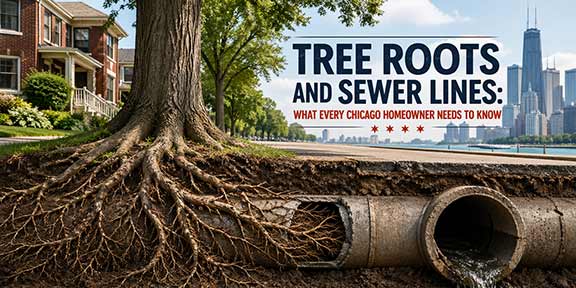
Your Trees Are Beautiful. Your Sewer Line Is Their Favorite Target.
One of the things that makes Chicago neighborhoods so distinctive is the canopy. Drive through Hinsdale, Oak Park, Riverside, La Grange, or almost any established suburb and the streets are lined with massive elms, oaks, silver maples, and willows that have been growing for 50, 80, even 100 years. Those trees are a genuine asset — they provide shade, clean the air, boost property values, and give Chicagoland its character.
They are also quietly destroying sewer lines across the region at this exact moment.
Tree root intrusion into residential sewer laterals is the single most common cause of sewer line failure in Chicago and the surrounding suburbs. It happens slowly, invisibly, and with almost no warning symptoms until the problem is already serious. By the time a homeowner notices a gurgling toilet, a slow drain, a wet spot in the yard, or — worst case — a sewage backup in the basement, the roots have often been growing inside the pipe for years.
This guide explains exactly how root intrusion happens, which homes are most at risk, what the warning signs are, how to fix it at every stage, and most importantly how to get ahead of it before it costs you a significant amount of money.
Why Sewer Lines and Tree Roots Are a Perfect Storm in Chicagoland
The root intrusion problem in Chicagoland is worse than in most other parts of the country because of a combination of factors that are unique to this region.
Aging pipe materials. A huge percentage of Chicago-area homes were built before 1970, and many before 1950. The sewer laterals in those homes were installed in clay tile or cast iron — materials that were perfectly adequate when new but that develop cracks, loose joints, and surface deterioration over decades. If your home still has original cast iron plumbing, our guide to whether cast iron pipes need to be replaced in Chicago explains how to recognize deterioration and when replacement may actually be necessary. A clay tile pipe that was installed in 1955 has been in the ground for 70 years. It doesn’t have to be dramatically cracked to be vulnerable — even a hairline gap at a joint is enough of an opening to attract roots.
Chicagoland’s clay-heavy soil. The soil throughout Cook and DuPage Counties has a high clay content, which means it shifts significantly with moisture changes and freeze-thaw cycles. Every Chicago winter puts underground pipes under stress as the ground freezes and heaves. Every spring thaw releases that stress. Over decades, this repeated movement widens joint gaps and creates exactly the kind of vulnerabilities that tree roots exploit.
The urban tree canopy. The City of Chicago’s Bureau of Forestry manages one of the largest urban tree canopies in the Midwest, and parkway trees line virtually every residential block across the city and suburbs. Many of these trees were planted 40 to 60 years ago and now have massive, expansive root systems that extend well beyond what’s visible above ground. A silver maple’s roots can extend two to three times the spread of its canopy. A willow’s root system actively seeks water sources from extraordinary distances. These trees were planted along the same parkways where your sewer lateral runs from your house to the city main beneath the street.
It’s not a coincidence. It’s a geographic reality that every Chicagoland homeowner with mature trees on or near their property needs to understand.
How Tree Root Intrusion Actually Works
Roots don’t smash through intact pipes. They find their way in through vulnerabilities that already exist — and then they make those vulnerabilities catastrophically worse.
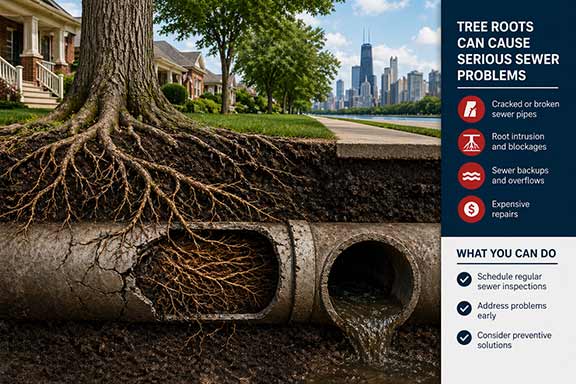
Here’s the progression. Your sewer lateral develops a small crack at a joint, or a section of clay tile begins to separate slightly due to soil movement. Moisture and warmth escape through that gap into the surrounding soil. Tree roots, which are constantly growing outward in search of water and nutrients, detect that moisture. A root tip — which can be almost microscopically thin at its growing end — finds the gap and works its way inside.
Once inside the pipe, the root encounters a warm, wet, nutrient-rich environment and grows aggressively. What entered as a hair-thin tendril thickens over months and years into a woody mass that fills and expands the pipe interior. That mass catches debris — grease, hair, toilet paper, food particles — and begins building into a blockage. Meanwhile, the expanding root is also exerting outward pressure on the pipe walls themselves, widening cracks, displacing joints, and accelerating structural damage.
The EPA estimates that tree roots cause close to 50 percent of sewer blockages in older neighborhoods — and in Chicago’s pre-1970 housing stock, that statistic rings entirely true from what our team sees every week across Chicagoland.
The Trees Most Likely to Cause Problems in Chicago Suburbs
Not all trees are equally aggressive toward sewer lines. The species most commonly associated with root intrusion problems in Chicagoland are the ones most commonly planted along parkways and in yards throughout the region:
Silver maple is arguably the most problematic tree for Chicago-area sewer lines. It grows fast, gets enormous, and produces an aggressive, shallow root system that spreads widely in search of water. Silver maples are planted throughout Chicagoland suburbs and are responsible for a significant share of the root intrusion calls we handle.
Willow varieties — weeping willow, pussy willow, black willow — have root systems specifically adapted to seek out moisture and will follow a water source from remarkable distances. If you have a willow within 50 feet of your sewer lateral, it warrants serious attention.
Cottonwood and poplar species grow quickly and develop extensive lateral root systems that are among the most aggressive at seeking out underground moisture sources.
American elm trees, while less commonly planted today, are abundant in established Chicago neighborhoods and have expansive root systems that cause significant sewer intrusion problems in older areas.
Oak trees are slower-growing and generally less aggressive than maples or willows, but a large established oak near your lateral still warrants monitoring — particularly if the pipe material is aging clay or cast iron.
If you have any of these species in your yard, along your parkway, or on neighboring properties within 30 to 40 feet of your home’s sewer line path, root intrusion is a realistic risk — not a remote possibility.
Warning Signs of Tree Root Intrusion in Your Sewer Line
Root intrusion is a slow, progressive problem, and it gives warning signs at each stage. The challenge is that many of these symptoms are easy to dismiss or attribute to other causes — a slow drain seems minor until it’s a full backup.
Multiple slow drains throughout the house — not just one fixture but several — often indicate a problem in the main sewer line rather than an individual drain. When a single drain is slow, the issue is usually in that drain’s trap or branch line. When multiple drains are slow simultaneously, look deeper.
Gurgling sounds from toilets and drains — particularly when running water elsewhere in the house — indicate air being displaced by a partial blockage or pressure issue in the main line. This is a classic early symptom of root intrusion that many homeowners live with for months before acting. If you’re seeing any of these warning signs, it’s important to understand how quickly tree roots can enter and spread inside your sewer line. We break down exactly how root intrusion starts, how fast it progresses, and what Chicago homeowners should expect in our complete guide to tree roots and sewer lines.
Recurring drain backups that keep coming back even after rodding. If you’ve had your drain rodded and the backup returns within a few months, roots are the almost certain explanation. Rodding cuts through the root mass temporarily but doesn’t address the underlying intrusion — the roots grow back, often thicker than before. When a backup starts affecting a shower or causes water to rise through the shower drain, it can be a sign that the blockage is farther down the sewer line. See our guide on why your shower may be overflowing and what sewer backups can have to do with it for more information.
Wet or unusually green patches in the yard — particularly along the path from your house toward the street — indicate sewage leaking from a damaged lateral into the surrounding soil. Plants directly above a leaking sewer line grow noticeably lusher because they’re being fed with nutrient-rich wastewater.
Sewer odors inside the home, in the basement, or in the yard. A properly functioning sewer line is sealed and odor-free. If you’re smelling sewage without an obvious source, something in the line is compromised.
A soft spot or depression in the yard along the path of your sewer lateral can indicate that a collapsed or severely damaged section of pipe is allowing soil to settle into the void.
What We Find When We Camera Inspect a Root-Invaded Line
A sewer camera inspection for Chicagoland homes is the only way to know for certain what’s happening inside your lateral. We thread a high-resolution camera through the line and get real-time video of exactly what’s there. Here’s what we typically see at different stages of intrusion:
Early stage — fine root tendrils entering through joint gaps, beginning to accumulate debris. The line is still largely functional but the intrusion is established and will progress.
Mid stage — a developed root mass filling a portion of the pipe diameter, visibly catching debris and restricting flow. Slow drains and occasional gurgling are typically occurring at this stage.
Advanced stage — root mass filling most or all of the pipe diameter, causing chronic backups. In many cases we also see displaced joints, cracks widened by root expansion, and sections of pipe that are structurally compromised.
Collapse — in the worst cases, particularly with aging clay tile, the pipe has failed structurally and sections have caved in. This requires replacement, not just root removal.
Seeing the actual condition of the pipe determines the right course of action. Without a camera inspection, you’re guessing — and the wrong guess is expensive.
What Can Be Done: Treatment Options at Every Stage
The treatment for root intrusion depends entirely on how far the problem has progressed and the condition of the pipe itself.
Mechanical root cutting — our plumbers run a mechanical cutter through the line to remove the root mass and restore flow, also known as sewer line rodding or rooter service. This is effective for clearing a blockage and buying time, but it does not prevent roots from returning. On a structurally sound pipe in good condition, root cutting combined with regular maintenance can manage the problem effectively for years.
Hydro jetting — high-pressure water jetting thoroughly clears root debris and flushes the line, leaving it cleaner than mechanical cutting alone. Our hydro jetting service for Chicagoland sewer lines is particularly effective after root cutting to clear residual debris and restore full flow capacity.
Chemical root treatment — applied after clearing, certain copper sulfate-based treatments slow root regrowth by creating an inhospitable zone around the pipe. This is a maintenance measure rather than a solution, and it needs to be repeated periodically.
Sewer line repair — when camera inspection reveals structural damage — cracked sections, displaced joints, collapsed areas — repair or spot replacement of the damaged sections addresses the root cause rather than just managing symptoms. Our sewer line repair and replacement specialists assess each situation individually and give you an honest recommendation on whether repair or full replacement is the right call.
Full sewer lateral replacement — when a line is extensively damaged, repeatedly failing, or made of clay tile or cast iron that has deteriorated beyond practical repair, replacement is the most cost-effective long-term solution. Modern PVC lateral installations are root-resistant, have smooth interiors that resist debris buildup, and carry a functional lifespan measured in decades.
How to Protect Your Sewer Line Going Forward
Once you’ve addressed an existing root intrusion problem — or if you’ve had a camera inspection and confirmed your line is currently clean — here’s how to stay ahead of it:
Get a camera inspection every two to three years if you have mature trees near your lateral. For most Chicagoland homeowners with older homes and established trees, this is the single most cost-effective maintenance investment available. Catching early-stage intrusion costs a fraction of dealing with a collapsed lateral.
Be thoughtful about new plantings. If you’re landscaping, choose tree species with less aggressive root systems and plant them away from the path of your sewer lateral. Ask your plumber where your lateral runs before you plant anything significant near the front of your property.
Don’t ignore recurring slow drains. If you’ve had a drain rodded more than once in two years, that’s a pattern that warrants a camera inspection rather than another rodding. You’re treating a symptom, not the problem.
Know where your sewer lateral runs. Most homeowners have no idea where their sewer line is underground. It typically runs in a relatively straight path from your foundation toward the street. Knowing the general path helps you understand which trees pose the most direct risk.
Frequently Asked Questions: Tree Roots and Sewer Lines in Chicago
How do I know if I have tree root intrusion?
The most reliable warning signs are multiple slow drains throughout the house, recurring backups that return after rodding, gurgling sounds from toilets, and unexplained wet patches in your yard. The only way to confirm root intrusion and assess its severity is a sewer camera inspection. Don’t guess — a camera inspection takes about an hour and gives you definitive answers.
Can I just cut down the tree to fix the problem?
Removing the tree helps prevent further intrusion but doesn’t solve the existing problem — and it doesn’t solve it immediately. Tree root systems remain biologically active for one to three years after a tree is removed, drawing on stored energy in the root mass. The existing roots already inside your pipe don’t disappear when you cut the tree. Removal is a smart long-term move for a severely offending tree, but it needs to be combined with proper pipe treatment or repair.
How much does sewer root removal cost compared to replacement?
Root cutting and clearing typically runs a few hundred dollars for a standard residential lateral. A full sewer lateral replacement in Chicagoland ranges from roughly $5,000 to $20,000 or more depending on depth, length, access, and whether street excavation is required. That cost difference is why catching root intrusion early — when cutting and maintenance can manage it — is so much more economical than waiting until the line fails completely.
Will my homeowner’s insurance cover tree root damage to my sewer line?
Generally, standard homeowner’s insurance does not cover gradual damage from tree root intrusion because it’s considered a maintenance issue rather than a sudden loss. If root damage causes a sudden pipe failure that results in interior flooding, portions of the interior damage may be covered depending on your policy. Review your policy language carefully and ask specifically about sewer backup coverage — it’s available as an add-on from most insurers and is worth carrying for any Chicagoland home with mature trees.
How often should I have my sewer line inspected?
For homes with mature trees near the lateral path, every two to three years is the right interval. For newer homes with PVC laterals and minimal tree exposure, every five years or before a real estate transaction is reasonable. If you’ve had a previous root intrusion issue, annual inspection for a few years after treatment is smart until you’ve confirmed the situation is stable.
Do you offer sewer camera inspections for homes with tree root concerns?
Yes — we perform professional sewer tree root removal and sewer camera inspections throughout Chicago and all surrounding suburbs. If you have mature trees, recurring drain issues, or just want to know what’s going on underground, call us and we’ll get out there and show you exactly what you’re dealing with. Same-day and next-day appointments available across Chicagoland.
Worried About Tree Roots in Your Sewer Line?
Send us your info and we’ll get back to you fast. Sewer camera inspections and root removal available same-day or next-day across Chicago and the suburbs.
Or call us directly: 708-801-6530 | Open 24/7
—
Suburban Plumbing Sewer Line & Drain Cleaning Experts
Licensed & Insured | Open 24 Hours | Serving Chicago & the Suburbs Since 1978
📞 Suburbs: 708-801-6530
📞 West Suburbs: 630-749-9057
📞 Chicago: 773-570-2191
🚨 24/7 Emergency Line: 708-518-7765