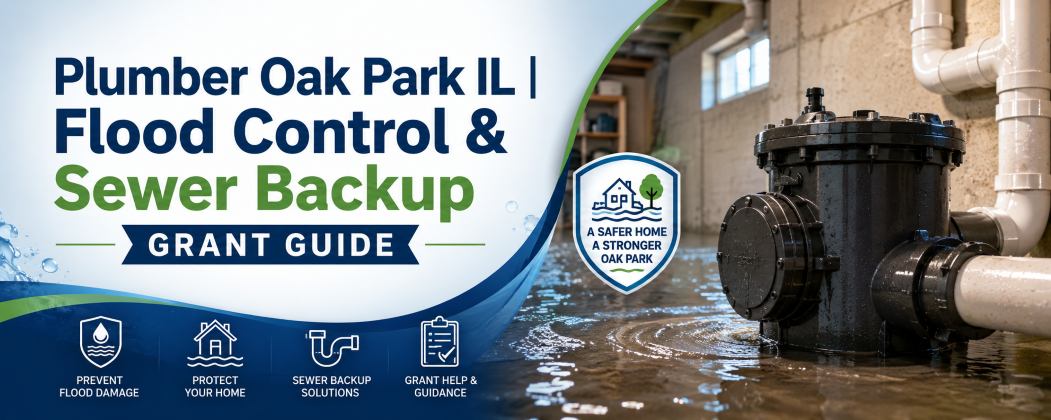
The Article That Finally Explains Why Oak Park Floods the Way It Does — And What the Village of Oak Park Is Paying Up to $3,500 to Help Fix
Oak Park is one of the most architecturally celebrated communities in the United States. Home to the largest concentration of Frank Lloyd Wright-designed buildings in the world, a National Historic Landmark District, and more than 100 years of meticulously preserved residential architecture, Oak Park attracts architects, historians, and homeowners who value what it means to live in a genuinely significant place. What those same homeowners learn — often during the first significant storm after moving in — is that the village’s architectural heritage comes with a plumbing reality that the real estate listing did not fully explain.
Oak Park sits on a combined sewer system. Almost every home in the village was built with a gravity sewer connection. The northeast quadrant of the village — bordered by Chicago Avenue, the Chicago city limits, and North Avenue — sits at the lowest elevation in the community. And the Village of Oak Park has an active grant program that pays up to $3,500 toward the cost of installing flood control protection — a program that most Oak Park homeowners do not know exists until after they have already paid for the work out of pocket.
This guide covers all of it. What Oak Park’s combined sewer system actually is and why it causes the flooding pattern it causes. What the northeast quadrant situation means if your home is in that area. What the Village’s Sewer Backup Protection Grant Program covers, who qualifies, and how to apply before signing any contractor agreement. And what Oak Park’s historic housing stock — homes built between 1890 and 1940 — means for the pipes running beneath them in 2026.
What Makes Oak Park’s Flooding Situation Genuinely Different From Newer Suburbs
The Combined Sewer System — What It Is and Why It Matters
Oak Park operates on a combined sewer system — the same infrastructure design used throughout Chicago and the older inner-ring suburbs that developed before the mid-20th century. A combined sewer carries both stormwater runoff and sanitary sewage in the same underground pipes. During dry weather, this works without issue: sewage flows to the treatment plant, and the pipes handle normal volumes. During heavy rain, those same pipes receive both the rainfall that enters through street drains and the sanitary flow from every home in the village simultaneously.
When that combined volume exceeds the system’s capacity — which happens during significant rain events — pressure reverses. The Metropolitan Water Reclamation District, which Oak Park’s sewer connects to directly, reaches its own capacity limit. When MWRD capacity is exceeded, the Oak Park system cannot discharge. When the Oak Park system cannot discharge, flow backs up through residential lateral connections. The result is what thousands of Oak Park homeowners have experienced: sewage-odored water entering through the basement floor drain during or after heavy rain.
This is not a malfunction. It is the system operating exactly as designed — the design just has a capacity ceiling that heavy rain can exceed. The Village of Oak Park has documented this clearly: the maximum capacity of the Village municipal sewer system is limited to the capacity of the MWRD system, and when rainfall exceeds that combined capacity, localized flooding and sewer backups are likely in susceptible homes throughout the community.
Understanding this is the foundational step that every Oak Park homeowner should take before calling any plumber, signing any flood control contract, or deciding between a backwater valve and an overhead sewer system. The flooding is coming from the street — not from a broken pipe in your home. The solution is a device or system that separates your home from that street-level pressure when it builds. Oak Park’s neighboring community of Berwyn faces an identical situation — and our complete Berwyn flood control guide explains how combined sewer surcharge plays out across the inner-ring suburbs Oak Park shares that infrastructure with. Homeowners interested in comparing flood control programs and sewer infrastructure across neighboring communities may also find our River Forest flood control guide helpful.
The Northeast Quadrant — Why One Part of Oak Park Floods More Than the Rest
The Village of Oak Park has publicly identified the northeast quadrant as the hardest-hit area for basement flooding. The reason is elevation: the northeast quadrant is the lowest point in the community. In a combined sewer system, water follows gravity — and when the system surcharges, the pressure is greatest and the backup risk is highest at the lowest elevations.
If your Oak Park home is in the northeast quadrant — generally the area north of Lake Street, east of Harlem Avenue, and bordering the Chicago city limits — your flooding risk during significant storm events is higher than in other parts of Oak Park. This is a geographic and hydraulic reality, not a maintenance problem. The appropriate response is a backwater valve or an overhead sewer conversion that physically prevents the surcharged street sewer from entering your home — and the Village will pay up to $3,500 toward that installation.
The Gravity Sewer Connection — What Almost Every Oak Park Home Has
Almost every home in Oak Park was built with a gravity sewer system. This means the house sewer lines run directly into the main sewer in the street at a lower elevation — relying on gravity to carry waste away. Many Oak Park homes also have internal drain lines from toilets, sinks, and other fixtures, as well as gutter downspouts, all connected into this same gravity system that empties into the combined street sewer.
A gravity sewer connection is the default condition in Oak Park — and it is the condition that creates vulnerability during combined sewer surcharge events. When the main sewer in the street fills beyond capacity, a gravity-connected home has no barrier between the pressurized street sewer and the lowest drain point in the house. That lowest drain point is typically the basement floor drain. That is where the backup appears.
Converting away from a gravity connection — either to an overhead sewer system or by installing a backwater valve on the lateral — is what the Village’s grant program was created to fund.
The Village of Oak Park Sewer Backup Protection Grant — What Most Homeowners Miss
This is the single most important piece of information in this guide for Oak Park homeowners who have experienced basement flooding or sewer backup:
The Village of Oak Park’s Sewer Backup Protection Grant Program pays 50% of the cost of qualifying flood control installations, up to a maximum of $3,500.
Confirmed directly from the Village of Oak Park Neighborhood Services Department: eligible homeowners qualify for a grant of 50 percent of the total cost of sewer backup prevention improvements, up to a maximum of $3,500, for installing either an overhead sewer system or a backflow prevention valve system. Applications are submitted through the Village’s online portal. The program is administered by the Neighborhood Services Department and can be reached at 708.358.5410 or housing@oak-park.us.
What the Grant Covers
Eligible work under the Oak Park Sewer Backup Protection Grant Program includes two categories of installation:
Overhead sewer system conversion: An overhead sewer raises the home’s original lowest drain — typically the basement floor drain — above the level of the street sewer. Because the floor drain and other basement fixtures are no longer connected below grade to the street sewer, pressure from a surcharged combined sewer cannot enter the home through those points. An overhead sewer conversion is the most comprehensive protection available against combined sewer backup. It is also the most involved installation — a properly executed overhead sewer conversion in an Oak Park home typically costs between $12,000 and $30,000 depending on the home’s plumbing configuration and the complexity of the conversion. The grant covers 50% up to $3,500.
Backflow prevention valve system: A backwater valve (also called a backflow preventer or check valve) is installed on the sewer lateral inside the home. During normal conditions, the valve remains open and allows waste to flow out normally. When the street sewer surcharges and flow reverses, the valve automatically closes — preventing the backup from entering the home. Backwater valve installation in an Oak Park home typically costs between $2,500 and $6,000 depending on lateral access and the specific installation configuration. The grant covers 50% up to $3,500.
What the Grant Does Not Cover — Important to Understand Before Applying
The grant does not cover restoration of finishes or replacement of property damaged by previous flooding events. Carpet, drywall, flooring, furniture — none of that is eligible. Only the installation of the system that prevents future backups qualifies. Permit fees are also not waived under the Oak Park program — all applicable permit fees are the property owner’s responsibility. This is different from Cook County’s program, which does waive permit fees for qualifying installations.
Who Is Eligible
The program is open to owner-occupied single-family homes susceptible to sewer backup through a gravity sewer connection. Single-family is defined broadly to include traditional single-family homes and multi-family residences of one to four units where the owner occupies at least one unit. There are no income limits — the program is available to any qualifying homeowner regardless of income. Work completed after January 1, 2010 is eligible if permits were obtained and inspections were passed. You do not need to complete the work before submitting an application — but you do need a licensed plumber to determine the scope of work before applying.
How to Apply — The Exact Process
Applications are submitted online through the Village of Oak Park’s portal. All applications must go through the online portal — emailed applications are no longer accepted. Before applying, you need a licensed plumber to assess your home and determine the scope of work. Once the scope is determined, submit your application with the required supporting documents. Applications are processed in the order received. After approval, the work is completed, permits are obtained, inspections are passed, and documentation is submitted for reimbursement. For questions: Neighborhood Services Department at 708.358.5410 or housing@oak-park.us.
Critical: Contact the Village and submit your application before signing any contractor agreement. The reimbursement process requires specific documentation and permitting. Beginning work without following the application process can disqualify the installation from grant eligibility. This call costs nothing. For a $12,000 to $30,000 overhead sewer conversion, it can save $3,500.
The RainReady Program — Oak Park’s Nature-Based Flood Mitigation Option
Beyond the Sewer Backup Protection Grant, Oak Park has participated in the RainReady program — a flood prevention initiative created by the Center for Neighborhood Technology that takes a different approach to flood risk. Where the Sewer Backup Protection Grant focuses on preventing the street sewer from backing up into homes, RainReady focuses on reducing the volume of stormwater that enters the sewer system in the first place.
RainReady measures include rain gardens, backflow valves, cisterns, downspout disconnection, and other site modifications that capture, slow, or redirect stormwater before it reaches the combined sewer. The program has been successful enough in Oak Park that it developed a waitlist — a demonstration of both the demand and the program’s effectiveness in the community. For Oak Park homeowners interested in supplementing a backwater valve or overhead sewer with nature-based stormwater management, our French drain and yard drainage services represent the complementary private-side approach to surface water management.
For current availability and enrollment information for the RainReady program in Oak Park, contact the Village’s Office of Sustainability and Resilience or the Center for Neighborhood Technology directly.
The MWRD Tunnel and Reservoir Plan — Why Chicago-Area Flooding Is Being Addressed at the Regional Level
Oak Park homeowners should understand the context of the regional infrastructure effort that affects their flooding risk. The Metropolitan Water Reclamation District’s Tunnel and Reservoir Plan — known as TARP or the “Deep Tunnel” — is a massive ongoing infrastructure project designed to capture combined sewer overflow and stormwater in deep limestone tunnels and surface reservoirs rather than allowing it to overflow into waterways or back up into homes.
TARP has been under construction for decades and continues to expand capacity. As TARP tunnel and reservoir capacity increases, the MWRD system can absorb more combined flow during major rain events before reaching the surcharge threshold that produces backup conditions in Oak Park homes. This regional infrastructure improvement benefits Oak Park over time — but it does not eliminate the risk for gravity-connected homes during events that exceed current TARP capacity, which significant storm events still can. Private flood control installation remains the appropriate protection for Oak Park homeowners who cannot afford to wait for regional infrastructure to reach sufficient capacity. Our complete guide to the true cost of basement flooding in Chicagoland breaks down what a single flood event actually costs a homeowner — and why flood control installation is one of the highest-return investments available to owners of older Chicago-area homes.
Oak Park’s Historic Housing Stock — What It Means for Pipes in 2026
Oak Park developed primarily between 1890 and 1940 — the same era that produced the Frank Lloyd Wright Prairie Style homes in the Frank Lloyd Wright Historic District, the Arts and Crafts bungalows, the Georgian colonials, and the American Foursquares that define the village’s residential character. The architectural preservation that makes Oak Park exceptional also means that a significant portion of the village’s housing stock is now 85 to 135 years old. The pipes beneath those homes were installed when the homes were built. Our complete decade-by-decade Chicago home age plumbing guide covers what every construction era means for the specific pipes, laterals, and drain systems running beneath homes built from the 1890s through today.
Pre-1940 Oak Park Homes: What the Pipes Look Like Now
Sewer laterals: Homes built before 1940 in Oak Park almost universally have clay tile sewer laterals — the standard lateral material of that era. A clay tile lateral now 85 to 135 years old has been subject to freeze-thaw cycling, root intrusion from the mature trees that characterize Oak Park’s established neighborhoods, and in many cases ground settlement that displaces the bell-and-spigot joints that hold clay tile sections together. Sewer camera inspection of a pre-1940 Oak Park clay tile lateral routinely finds root intrusion at every joint, joint displacement, partial collapses, and pipe bellies — low points where solids accumulate and create recurring blockage conditions. These laterals cannot be assumed to be in serviceable condition without camera inspection confirming it.
Supply lines: The oldest Oak Park homes may still have original lead supply lines — a particular concern in a community with the level of historic preservation that discourages wholesale renovation. The Village of Oak Park has published information on lead and drinking water for residents. Oak Park homeowners in pre-1940 homes who have not confirmed the material of their supply line should do so — lead service line replacement is an active infrastructure priority throughout Cook County.
Cast iron drain lines: Interior cast iron drain lines in pre-1940 Oak Park homes are now approaching or past 100 years old. Cast iron does not fail suddenly — it fails through progressive corrosion and pitting, typically manifesting first as slow drains, then as recurring blockages, then as visible corrosion or leaking at joints. Our guide to why Chicago’s cast iron pipes are failing right now covers the specific failure patterns, timelines, and warning signs that pre-1940 Oak Park homeowners should know — and what camera inspection inside the home’s drain lines reveals in this housing vintage.
1940s–1970s Oak Park Homes: The Transition Generation
Homes built in Oak Park between 1940 and 1975 may have either clay tile or early PVC laterals depending on the specific construction date. Interior copper supply lines from this era are now approaching 50 to 80 years old — the age range where Chicago’s hard water begins to accelerate pitting corrosion on copper. Sump pump installations from this era, where they exist, are now well past their 10-to-15-year service life and should be assessed and replaced if they have not been recently. Galvanized supply lines may appear in homes from the 1940s and 1950s that have not had supply line updates — galvanized steel corrodes from the inside out and produces reduced flow, rust-colored water, and eventual pinhole failures.
Post-1975 Construction: Generally Better but Not Exempt
Oak Park homes built after 1975 are more likely to have PVC laterals and modern copper or PEX supply lines in generally good condition. Sump pump installations from the 1990s are approaching the age threshold for replacement. For these homes, the primary concern is the combined sewer backup risk that applies throughout the village — not the pipe condition issues that dominate the older housing stock.
The Three Flooding Types in Oak Park — What Each Requires
Type 1: Combined Sewer Surcharge Backup
This is the defining flooding type for Oak Park — the direct consequence of the combined sewer system and gravity connections that characterize almost every home in the village. During significant rain events, combined sewer capacity is exceeded, pressure reverses through residential laterals, and sewage-odored water enters through the basement floor drain.
Diagnostic signature: Water with sewage odor entering through the basement floor drain during or after heavy rain. The odor is the distinguishing characteristic — it confirms the water is coming from the sewer system, not from groundwater intrusion. Occurs during or immediately after significant rain events, not during dry weather or gradual wet periods.
What works: Backwater valve installation or overhead sewer conversion — funded up to $3,500 by the Village of Oak Park’s Sewer Backup Protection Grant Program for qualifying homeowners. Our sewer backup services cover all of Oak Park with all required permits included and full documentation for grant reimbursement.
Type 2: Groundwater Intrusion
A separate and distinct flooding type from sewer backup, groundwater intrusion occurs when the water table rises during sustained rain or snowmelt events and hydrostatic pressure forces water through foundation cracks, the wall-floor joint, or directly through the floor slab. Groundwater intrusion has no sewage odor — that is the key diagnostic distinction.
Diagnostic signature: Water entering without sewage odor. Gradual appearance during or after sustained rain or snowmelt. Entry through the floor slab, wall-floor joint, or sump pit. Correlates with extended wet periods rather than specific storm intensity peaks. Does not respond to backwater valve installation because it is not coming from the sewer system.
What works: A properly functioning sump pump with battery backup is the primary defense against groundwater intrusion. Battery backup is not optional in Oak Park — power outages frequently accompany the severe storms that produce the worst flooding events, and a sump pump without battery backup provides no protection during an outage. Our sump pump solutions for Oak Park homeowners guide cover 24/7 emergency response and battery backup installation.
Type 3: Overland Flooding
In the northeast quadrant specifically, and in properties with inadequate grade or drainage, overland flooding — water entering from the surface level rather than through the sewer system or foundation — can occur during extreme rain events. Overland flooding typically requires grading corrections, yard drainage improvements, and in some cases French drain installation to redirect surface water away from the foundation before it finds entry points.
What works: Yard drainage assessment, grading corrections, downspout extension and disconnection from the sewer system, and in some cases French drain installation. The Village’s Climate Ready Rainscapes program may fund nature-based approaches to surface water management. Our yard drainage services cover Oak Park with assessment and written scope before any work begins.
What Oak Park Homeowners Should Do Right Now — In Order of Priority
Step 1: Determine whether your home has a gravity sewer connection and whether you have experienced sewage-odored water in your basement during rain events. If yes to both: contact the Village of Oak Park’s Neighborhood Services Department at 708.358.5410 or housing@oak-park.us about the Sewer Backup Protection Grant before calling any plumber. The application process requires documentation that begins before work is performed. This call costs nothing and may save $3,500.
Step 2: Assess your sump pump. Every Oak Park home should have a functioning sump pump with battery backup. If the pump is more than 7 years old, has never been serviced, or has no battery backup — address it before the next significant storm season. The storm that takes out your power is frequently the same storm that fills your sump pit.
Step 3 (Pre-1940 homes): Schedule a sewer camera inspection. An 85-to-135-year-old clay tile lateral in an established Oak Park neighborhood with mature trees has been under a combination of root pressure, freeze-thaw cycling, and ground movement for its entire service life. Camera inspection is the only way to know what condition that lateral is in. The findings determine whether professional drain cleaning is the right ongoing maintenance approach or whether targeted repair or relining is warranted.
Step 4: Confirm your lead service line status. If your Oak Park home was built before 1950 and you have not confirmed your supply line material, contact the Village’s water service department. Lead service line replacement is an active infrastructure priority in Cook County — and knowing your supply line material is the first step to accessing any available replacement programs.
Step 5: Disconnect gutter downspouts from the sewer system. A one-inch rainfall on a 1,000-square-foot roof produces approximately 600 gallons of water. Downspouts connected to the combined sewer send all of that directly into the system during a rain event — exactly when the system is already approaching capacity. Downspout disconnection is required under the Oak Park Sewer Backup Protection Grant Program (with waivers available where disconnection would create a drainage problem for a neighboring property). It is also one of the simplest steps an Oak Park homeowner can take to reduce backup risk at no cost.
Frequently Asked Questions: Plumbing and Flood Control in Oak Park
My Oak Park basement floods every time we get a significant storm. My neighbor’s doesn’t. Why?
Elevation and connection. The backup risk in Oak Park’s combined sewer system is highest at the lowest elevations — which is why the northeast quadrant is the hardest-hit area in the village. If your home is at a lower point in the drainage network, it reaches backup conditions before higher-elevation homes on the same system. Additionally, if your neighbor has already installed a backwater valve or overhead sewer, they have a physical barrier that you do not. That barrier is what the Village’s grant program helps fund.
What’s the difference between a backwater valve and an overhead sewer? Which one do I need?
A backwater valve is installed on the sewer lateral inside your home — it allows normal outflow but automatically closes when pressure reverses from the street. It is the less expensive option and protects against sewer backup effectively when installed correctly. An overhead sewer conversion physically raises the home’s lowest drain above the street sewer level, providing protection against both backup and overland flooding in severe events. An overhead sewer is more comprehensive and more expensive. Both are covered by the Village’s grant program. A licensed plumber should assess your home’s specific configuration and the nature of your flooding events to recommend the appropriate solution — that assessment is part of what we provide before any work is proposed.
My Oak Park home was built in 1922. I’ve never had the sewer lateral camera-inspected. Is that urgent?
Yes — for a 1922 Oak Park home, the clay tile lateral is now over 100 years old. Oak Park’s mature tree canopy — one of the things that makes the village beautiful — is also one of the things that puts persistent root pressure on every lateral joint in the older neighborhoods. Camera inspection is the only diagnostic tool that tells you what is actually happening inside that lateral. The findings are the foundation of every decision about drain maintenance, lateral repair, and whether relining is an option before full replacement becomes necessary.
Does the Village’s grant program require the work to be done before I apply?
No — and in fact, completing the work before applying is a common mistake that can create documentation problems. You need a licensed plumber to determine the scope of work before submitting your application. Submit the application first, receive guidance on the documentation requirements, then have the work performed with the proper permits. Applications that follow this sequence have the cleanest path to reimbursement.
I’m in the northeast quadrant. What specifically should I do first?
Contact the Village’s Neighborhood Services Department about the grant program before signing any contract — that is step one regardless of location, and it is especially important in the northeast quadrant where backup risk is highest and where flood control investment is most warranted. Then have a licensed plumber assess your specific home for the appropriate installation type. In the northeast quadrant, the combination of lowest-elevation positioning and gravity sewer connection means that sewer backup is not a one-time bad luck event — it is what happens during every significant storm until a physical barrier is installed.
Need Plumbing or Flood Control in Oak Park? Let’s Help You Access the Grant and Get the Right Solution.
Licensed, insured, and serving Oak Park since 1978. We perform backwater valve installation, overhead sewer conversion, sump pump service, sewer camera inspection, drain cleaning, and complete plumbing service throughout Oak Park — understanding the combined sewer system, the northeast quadrant flooding pattern, the Village’s Sewer Backup Protection Grant, and the historic housing stock that defines this community’s specific plumbing challenges. Written quotes before we start, permits on every job, full documentation for Village grant reimbursement, our own plumbers in Oak Park on every call. Send us a message and we’ll get back to you fast.
Or call us directly: 708-801-6530 | Open 24/7
Suburban Plumbing Sewer Line & Drain Cleaning Experts
Licensed & Insured | Open 24 Hours | Serving Oak Park & the Greater Chicagoland Area Since 1978
📞 Suburbs: 708-801-6530 | 📞 Chicago: 773-570-2191 | 🚨 Emergency: 708-518-7765