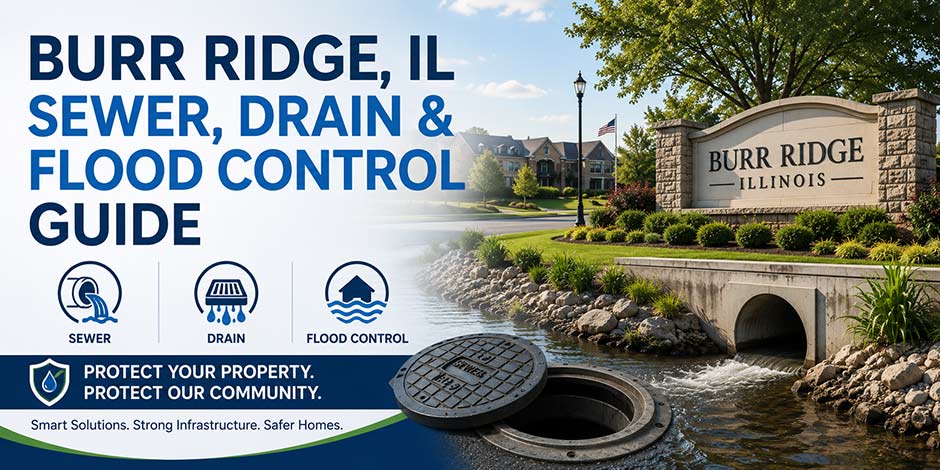
Three Sewer Districts. DuPage County Clay Soil. Salt Creek and Flagg Creek Watersheds. Luxury Homes Built Over 60 Years of Different Infrastructure Standards. Here’s What Every Burr Ridge Homeowner Actually Needs to Know.
Burr Ridge is one of the most affluent communities in the Chicago metropolitan area — a village of custom homes, estate lots, and meticulously maintained properties that consistently rank among the highest-value residential real estate in DuPage County. It is also a community with a plumbing and sewer infrastructure situation that is more complex than almost any other village its size in the region — and one that virtually no plumbing guide has ever explained properly.
Here is the fundamental fact that every Burr Ridge homeowner should know before anything else: your sanitary sewer service is not provided by a single utility. Depending on where your home sits within the village, your sewer is maintained by one of three completely separate authorities — the Village of Burr Ridge itself, DuPage County Public Works, or the Flagg Creek Water Reclamation District. Each operates different infrastructure, has different contact numbers, responds differently to backup events, and has different jurisdiction over the sewer main that your private lateral connects to.
Burr Ridge is a unique example of how suburban plumbing conditions vary within the Chicago area. Unlike many generic service-area descriptions, this community includes multiple sewer districts, variable soil conditions influenced by nearby waterways like Flagg Creek and Salt Creek, and custom homes built across several decades of different construction standards. These combined factors create highly variable underground plumbing conditions that can change significantly from one property to the next, even within the same neighborhood.
This guide does.
Burr Ridge’s Three Sewer Districts — The Most Important Thing to Know Before Any Sewer Call
Why Three Districts and Not One
Burr Ridge incorporated incrementally across several decades, absorbing areas that had already been committed to different regional sewer authorities as DuPage County developed. The result is a village divided — by County Line Road and Interstate 55 — into three separate sewer service zones, each with its own infrastructure, its own maintenance responsibility, and its own point of contact when something goes wrong.
This matters practically in a way that cannot be overstated: when your basement backs up, the first call you make determines whether you pay anything at all. The Village of Burr Ridge Public Works Department advises all residents to call them first — at 630-654-8181 during business hours, or 9-1-1 after hours — before calling any plumber. If the blockage is in the public sewer main, the appropriate authority clears it at no cost to you. If the main is clear and the problem is in your private lateral, that’s when a plumber’s involvement is warranted. Calling a plumber first — without knowing your sewer district and whether the public main has been checked — is how Burr Ridge homeowners pay for private lateral rodding when the problem was actually a surcharging municipal main.
District 1: The Village of Burr Ridge Sanitary Sewer System
Residents east of County Line Road are served by the Village of Burr Ridge’s own sanitary sewer system. All questions, backup calls, and permit coordination for this area go to the Village of Burr Ridge Public Works Department at 630-654-8181.
The Village maintains this infrastructure directly and has invested in ongoing maintenance and rehabilitation of aging sewer mains in this zone. The Village uses Advanced Metering Infrastructure (AMI) technology for water usage monitoring, and the sewer system in this area is a separate system — stormwater and sanitary waste travel in separate pipes, which means the combined sewer surcharge backups common in Chicago and the inner-ring suburbs are not the primary flooding mechanism here. The primary sewer concern in this zone is private lateral condition — aging clay tile joints in neighborhoods developed in the 1960s and 1970s under the pressure of DuPage County’s expansive clay soil.
District 2: DuPage County Public Works
Residents west of County Line Road and south of Interstate 55 — including the Babson Park area — are served by DuPage County Public Works for sanitary sewer. Contact: 630-964-7503.
DuPage County Public Works operates and maintains the sewer mains in this area. When a backup occurs in a home in this zone, DuPage County is the authority to contact for a main line check before any private lateral work is initiated. DuPage County also operates a Residential Drainage Assistance Program that offers up to $5,000 for qualifying private drainage projects affecting primary structures — a program that most Burr Ridge homeowners in this zone have never heard of.
District 3: Flagg Creek Water Reclamation District
Residents north of Interstate 55 and west of County Line Road — except Babson Park and businesses on Brush Hill Road — are served by the Flagg Creek Water Reclamation District. Contact: 630-323-3299. The FCWRD treatment plant is located in Burr Ridge itself, at 7001 N. Frontage Road.
The Flagg Creek Water Reclamation District, formerly known as the Hinsdale Sanitary District, serves approximately 11 communities across roughly 24 square miles, operating 22 lift stations and approximately 300 miles of sewer mains. It budgets $400,000 annually for rehabilitation of aged and deteriorated sewer mains — a significant infrastructure commitment that reflects the age of the collection system in this zone. When a backup occurs in a home served by FCWRD, call 630-323-3299 before calling any plumber. FCWRD explicitly instructs residents to contact them first to determine whether the issue involves the main sewer line before a private plumber is dispatched.
FCWRD also maintains a list of qualified, permitted plumbers who frequently work in their service area — and any sewer repair or lateral work in FCWRD territory requires an FCWRD inspection after completion. This is a specific permit and inspection requirement that not every plumber serving Burr Ridge is familiar with or properly equipped to handle.
How to Confirm Your District Right Now
Your district is determined by your location relative to County Line Road and Interstate 55. The Village of Burr Ridge’s Sewer Division page at burr-ridge.gov has the current district boundary map and contact numbers for each authority. Confirming your district before any sewer emergency takes three minutes and may save you hundreds of dollars in unnecessary private plumbing calls.
The Cook County vs. DuPage County Split — Why It Affects More Than Just Your Sewer Bill
Burr Ridge spans both Cook County and DuPage County, which creates more than just a jurisdictional boundary. The split often means different sewer systems, differing inspection standards, and variations in soil composition and drainage behavior depending on the exact location of the property. For homeowners, this can directly influence how quickly sewer laterals wear, how basement drainage performs during heavy rain, and what type of maintenance is most effective over time.
The eastern portion of Burr Ridge — properties east of County Line Road — falls within Cook County. The western portion falls within DuPage County. This boundary determines which county-level financial assistance programs apply to your property, which infrastructure programs govern your area, and which regulatory frameworks cover permit and inspection requirements for plumbing and sewer work.
Cook County-side Burr Ridge homeowners may have access to Cook County’s Sewer Backup Prevention Program — which provides up to $5,000 in reimbursement for qualifying backwater valve or overhead sewer installations, with permit fees waived. DuPage County-side Burr Ridge homeowners access DuPage County’s Residential Drainage Assistance Program instead — up to $5,000 for qualifying private drainage projects. These are two completely different programs administered by two completely different county agencies, and knowing which county your property falls in is the first step to accessing whichever one applies. Your property tax bill identifies your county. For Cook County program inquiries, contact Cook County’s stormwater management programs directly. For DuPage County, contact DuPage County Stormwater Management at 630-407-6800. Neither program requires you to start with a contractor — both programs should be contacted before any flood control contract is signed.
DuPage County Clay Soil — What It Does to Sewer Laterals in Burr Ridge
The Soil Condition That Defines Lateral Lifespan Here
DuPage County sits on expansive clay soil — a soil type that shrinks and expands with moisture content more aggressively than almost any other residential soil environment in the Chicago area. In dry conditions, clay soil contracts. In wet conditions, it expands. The freeze-thaw cycling that Chicago winters impose on the soil surface compounds this movement through the full frost depth — approximately 36 inches in DuPage County.
The practical consequence for a Burr Ridge home’s sewer lateral: the clay tile pipe joints that were installed level and properly aligned in 1968 have been moving with the soil for nearly 60 years. Bell-and-spigot clay tile joints that shift even a fraction of an inch create an offset — a misalignment that traps solids, creates root entry points, and eventually produces the partial collapse or complete joint separation that a camera inspection documents and a rodding call cannot fix permanently.
Burr Ridge’s mature landscaping — the estate-sized lots with established trees that give the village its character — contributes actively to this process. Tree roots in DuPage County’s moist clay soil grow aggressively toward the moisture and nutrients inside lateral joints. A clay tile lateral under a Burr Ridge property with mature trees within 20 feet of the pipe’s path is under consistent, year-round root pressure at every joint it has. Camera inspection of pre-1980 clay tile laterals in Burr Ridge almost always finds root intrusion at multiple points — not because the homeowner has done anything wrong, but because the combination of DuPage County clay soil movement and mature tree root systems produces this condition reliably over a 40-to-60-year timeline.
Why Recurring Rodding Is a Signal, Not a Solution
A significant number of Burr Ridge homeowners rod their sewer laterals on an annual or twice-annual schedule and accept recurring slow drains as a fact of life in an older home. This is the most expensive approach to a lateral condition problem available — not because individual rodding calls are expensive, but because recurring rodding at $250 to $500 per call over a 10-to-15-year period costs $2,500 to $7,500 in maintenance spending on a lateral that a single camera inspection and targeted repair or relining would have addressed permanently for a comparable or lower total cost.
The signal that rodding has become the wrong tool for the problem: a lateral that requires rodding more than once per year, a lateral that backs up within 3 to 6 months of clearing, or a rodding call that produces root material — actual root fragments in the cable — rather than grease and soft organic material. Any of these patterns indicates a structural condition in the lateral that camera inspection will document and that ongoing rodding is only temporarily managing. Our sewer camera inspection service covers all of Burr Ridge with same-day scheduling.
Salt Creek, Flagg Creek, and Flooding in Burr Ridge
The Two Waterways That Define Burr Ridge’s Flood Geography
Burr Ridge sits within two significant watershed drainage systems. Salt Creek — which forms part of the village’s eastern border and drains eastward through the Cook County Forest Preserves — is a primary flooding waterway for properties in eastern Burr Ridge near the creek corridor. Flagg Creek, which flows southward through the western DuPage County communities before discharging to the Des Plaines River near Willow Springs, drains the western portions of the village’s watershed.
The Salt Creek watershed has a documented flooding history that goes back decades — significant flood events along the creek corridor have affected eastern Burr Ridge properties during major rain events. FEMA flood zone designations apply to properties in the Salt Creek flood plain; homeowners near the creek should confirm their flood zone status at the FEMA Flood Map Service Center using their specific address. Properties in FEMA Special Flood Hazard Areas with federally backed mortgages are required to carry flood insurance — a requirement that catches homeowners off guard during refinancing if their flood zone status has changed.
Burr Ridge’s Separate Sewer System and What It Means for Flooding
Unlike Chicago and the inner-ring Cook County suburbs, Burr Ridge operates on a separate sewer system — stormwater and sanitary waste travel in different pipes. This is a significant advantage: the combined sewer surcharge backups that produce sewage-odored water in Chicago basements during heavy rain events are not a feature of Burr Ridge’s sewer infrastructure in the same way.
What Burr Ridge homeowners do experience during significant rain events is groundwater intrusion — the DuPage County clay soil, when saturated, can reach near-grade water table levels that put hydrostatic pressure against basement foundations. In homes with aging or undersized sump systems, this manifests as clean-water basement flooding with no sewage odor — distinctly different from a combined sewer backup, and requiring a different solution. A properly sized sump pump with battery backup is the primary defense against groundwater intrusion in Burr Ridge’s clay soil environment. Our sump pump services cover all of Burr Ridge with 24/7 emergency response and battery backup installation.
Burr Ridge’s Housing Stock — Six Decades of Custom Construction
What Burr Ridge Homes Actually Look Like — And Why It Matters for Plumbing
Burr Ridge developed primarily from the 1960s through the 2000s — a span of four decades during which construction standards, pipe materials, and plumbing code requirements changed significantly. The village does not have the homogeneous housing stock of a subdivision community. It has custom and semi-custom homes built across a wide range of construction eras, often on large lots with unique site conditions, at price points that attract owners who expect their homes’ systems to perform at a level consistent with the property’s value.
1960s and 1970s Burr Ridge homes: These are the highest-risk homes in the village from a sewer and plumbing standpoint. Clay tile sewer laterals now 50 to 65 years old in DuPage County clay soil, under mature trees that have had five to six decades to work into every lateral joint. Galvanized steel supply lines in the oldest of these homes. Cast iron drain stacks approaching the corrosion stage. Water heaters that have cycled through multiple replacements but may be running on supply lines that have never been assessed. These homes should be camera-inspected — lateral and interior drain lines — on a regular maintenance schedule.
1980s and 1990s construction: Early PVC laterals that are generally in better condition but are now approaching the age where joint integrity and root intrusion become relevant. Copper supply lines from this era are now 30 to 45 years old — within the range where Chicago-area hard water begins to accelerate pitting corrosion in the absence of water treatment. Sump pumps installed during original construction are now 25 to 40 years old — well past their service life. Any original sump pump from an 1980s Burr Ridge home that has not been replaced is an open risk before the next significant storm season.
2000s and newer construction: Modern PVC laterals and supply systems generally in good condition. The primary concern in these homes is the sump pump — units installed at construction are now 15 to 25 years old, at or past the replacement threshold. For homes with finished basements, the ejector pump system should be assessed for condition and code compliance. Our complete guide to what your home’s age tells you about its plumbing covers the full construction-era breakdown for every pipe material and system in Chicagoland homes.
Custom Home Plumbing — What Makes Burr Ridge Different From a Subdivision
Custom homes in Burr Ridge frequently have plumbing configurations that are significantly more complex than standard suburban construction: multiple bathrooms across multiple floors, finished basement spaces with ejector pump systems, irrigation systems connected to the water supply, outdoor plumbing features, whole-home water filtration and softener systems, and in many cases radiant heat systems that share infrastructure with the domestic plumbing. This complexity means that a plumber who is comfortable with standard residential work may not have the diagnostic or installation experience to work effectively in a Burr Ridge custom home.
The most common custom home plumbing issue we encounter in Burr Ridge is not a dramatic failure — it is an ejector pump system in a finished basement that was installed without proper permits when the basement was finished, that has a pump sized for a smaller fixture load than the current bathroom configuration requires, and that has never been inspected since installation. This combination — undersized pump, missing gastight basin cover, absent vent connection — produces sewer gas entry into the finished space and eventual pump failure under load. Our ejector pump services cover assessment, code compliance verification, and replacement throughout Burr Ridge.
The Three Most Common Plumbing Calls in Burr Ridge — What Causes Each
Call 1: Recurring Sewer Backup or Slow Drain
The most common sewer service call in Burr Ridge is a recurring drain backup in a home that has been rodded multiple times. As described above, this pattern almost always indicates a lateral condition — root intrusion at clay tile joints in DuPage County clay soil — that rodding is managing rather than resolving. The correct diagnostic step after a second or third rodding call in a short period is camera inspection, not another rodding call. Camera inspection identifies the exact location, type, and severity of the condition, determines whether relining is an option or whether targeted replacement is warranted, and provides documentation for a repair decision that is based on actual pipe condition rather than inference from symptoms.
Before calling any plumber for a sewer backup in Burr Ridge: confirm your sewer district and call the appropriate authority to verify the public main is clear. Village residents: 630-654-8181. DuPage County zone: 630-964-7503. Flagg Creek zone: 630-323-3299.
Call 2: Basement Flooding — Clean Water, No Odor
Groundwater intrusion during or after significant rain events is the second most common call in Burr Ridge. The diagnostic signature is clean water — no sewage odor — entering through the floor slab, the wall-floor joint, or accumulating in the sump pit. In DuPage County clay soil, the water table rises quickly during sustained rain events and the saturated clay holds that moisture level for extended periods — putting persistent hydrostatic pressure against basement foundations throughout the event and for days afterward.
The solution is a properly sized sump pump with battery backup rated for sustained operation. In Burr Ridge’s clay soil environment, a single-battery backup system that provides 8 to 10 hours of pump operation under normal conditions may be taxed to its limit during a multi-day rain event when the water table remains elevated continuously. Battery backup sizing and testing before storm season is particularly important in Burr Ridge. Our basement flooding services include full sump system assessment, pump sizing, and battery backup installation throughout the village.
Call 3: Water Heater Failure or Reduced Hot Water Output
Water heater calls in Burr Ridge’s custom homes are disproportionately complex compared to standard residential replacements. Large homes with multiple bathrooms and high hot water demand often have undersized water heaters — a 50-gallon unit that was appropriate for a family of three becomes inadequate as the household grows or usage patterns change. Tankless water heater installations are increasingly common in Burr Ridge’s high-value homes, but without appropriate water treatment for DuPage County’s hard water, tankless heat exchangers scale aggressively within 3 to 5 years. Our complete Chicago hard water and water heater guide covers exactly what DuPage County’s water does to water heater lifespan and what the ROI on water treatment actually looks like in this market.
What Burr Ridge Homeowners Should Do Right Now — In Order of Priority
Step 1: Confirm your sewer district. Take three minutes to check the Village of Burr Ridge sewer district map and write down the correct contact number for your zone. Post it somewhere you can find it during an emergency. Village zone: 630-654-8181. DuPage County zone: 630-964-7503. Flagg Creek zone: 630-323-3299. This single step determines the correct sequence of calls for every sewer emergency your home will ever have.
Step 2: Assess your sump pump. If your Burr Ridge home was built before 2000 and has not had the sump pump replaced or professionally inspected in the past 5 years — assess it now. A pump more than 10 years old with no service history in DuPage County clay soil is an open risk before the next significant storm season. Battery backup is not optional; power outages accompany the storms that produce the worst groundwater intrusion events.
Step 3 (pre-1985 homes): Schedule a sewer camera inspection. A clay tile lateral in DuPage County clay soil under mature trees, now 40 to 65 years old, has been under continuous movement pressure for its entire life. Camera inspection is the only tool that tells you its actual condition. If you have been rodding more than once per year — or if you have never had the lateral inspected — a camera assessment is the foundation of every other lateral maintenance and repair decision.
Step 4: Confirm your flood zone status. If your property is near the Salt Creek corridor in eastern Burr Ridge, use FEMA’s Flood Map Service Center to confirm your flood zone designation. Properties in Special Flood Hazard Areas with federally backed mortgages require flood insurance. Confirming your status before a refinancing is far less costly than discovering a required insurance gap during the transaction.
Step 5 (DuPage County zone homeowners): Check DuPage County’s Residential Drainage Assistance Program. If your property is in the DuPage County sewer zone and you have experienced private drainage problems affecting your primary structure, DuPage County’s program offers up to $5,000 for qualifying projects. Contact DuPage County Stormwater Management at 630-407-6800 before signing any drainage contractor agreement.
Frequently Asked Questions: Plumbing and Sewer in Burr Ridge
My basement backed up during the last storm. I had it rodded but it’s happening again. What’s actually going on?
First — confirm your sewer district and call the appropriate authority to verify the public main was not the source. If the main was clear and the problem is in your private lateral, the recurring backup pattern in a Burr Ridge home with mature trees almost always means root intrusion at one or more clay tile joints. Rodding cuts through roots temporarily — they regrow within months from the same entry point. Camera inspection after this second event is the correct next step. It identifies the specific joint or joints that are allowing root entry, determines whether the section can be relined to eliminate the root entry point permanently, and gives you a repair decision based on actual pipe condition rather than a third rodding call.
Which sewer district am I in? My neighbor says she’s in a different district than I am.
This is entirely possible and more common in Burr Ridge than in any other community in the area. The district boundaries run along County Line Road and Interstate 55 — a neighborhood-level split that puts homes on the same street in different districts in some areas. Visit the Village of Burr Ridge Public Works sewer page at burr-ridge.gov or call the Village at 630-654-8181 with your address to get a definitive answer for your specific property.
I’m in the Flagg Creek zone. Do I need a Flagg Creek permit for lateral work?
Yes. Any sewer repair, lateral work, or rehabilitation in Flagg Creek Water Reclamation District territory requires an FCWRD construction permit and a post-completion inspection before the work is approved. FCWRD maintains a list of plumbers who are permitted and qualified to work in their territory. When getting quotes for any lateral work in the FCWRD zone, ask the contractor specifically: Are you permitted to work in Flagg Creek Water Reclamation District? Can you handle the FCWRD permit and inspection coordination? A contractor who is not familiar with FCWRD’s permit process will create inspection delays and potential compliance issues for the homeowner.
My Burr Ridge home was built in 1972. I’ve never had the sewer lateral inspected. Should I be concerned?
Yes — a 1972 Burr Ridge home has a clay tile lateral that is now 53 years old, installed in DuPage County’s expansive clay soil under whatever trees and landscaping have grown on the property in the intervening half-century. That lateral has been moving with every frost cycle, every drought, and every wet season for over five decades. Camera inspection tells you its actual condition — whether the joints are intact, whether roots have entered, whether there are offsets or bellies that explain slow drains, and whether the pipe is a candidate for relining as a proactive maintenance measure. This information is the foundation of every lateral decision going forward.
What makes Burr Ridge plumbing work different from a standard suburban plumbing call?
Three things. The three-district sewer situation means that the first call sequence matters — call the right authority before calling a plumber, or you risk paying for private work on a public main problem. DuPage County clay soil means that lateral conditions in older Burr Ridge homes develop faster and with less surface warning than in communities with more stable soil. And the custom home configurations common in Burr Ridge — complex multi-bathroom layouts, finished basement ejector systems, irrigation connections, whole-home water treatment — require a plumber with experience in high-value custom residential work, not just standard tract home service calls. We have been serving Burr Ridge since 1978 and understand all three of these factors before we arrive.
Need a Plumber in Burr Ridge? Let’s Make Sure You’re Calling the Right People in the Right Order.
Licensed, insured, and serving Burr Ridge since 1978. We handle sewer camera inspection, lateral repair and relining, sump pump service and battery backup, ejector pump replacement, drain cleaning, water heater service and replacement, and complete plumbing throughout Burr Ridge — understanding the three-district sewer situation, DuPage County clay soil, Salt Creek and Flagg Creek watersheds, and the custom home configurations that define this community. We know the FCWRD permit process. We know the DuPage County drainage assistance program. We know Burr Ridge. Written quotes before we start. Our own licensed plumbers in Burr Ridge on every call.
Or call us directly: 630-749-9057 | Emergency: 708-518-7765 | Open 24/7
—
Suburban Plumbing Sewer Line & Drain Cleaning Experts
Licensed & Insured | Open 24 Hours | Serving Burr Ridge Since 1978
📞 Burr Ridge: 630-749-9057 | 📞 Chicago: 773-570-2191 | 🚨 Emergency: 708-518-7765