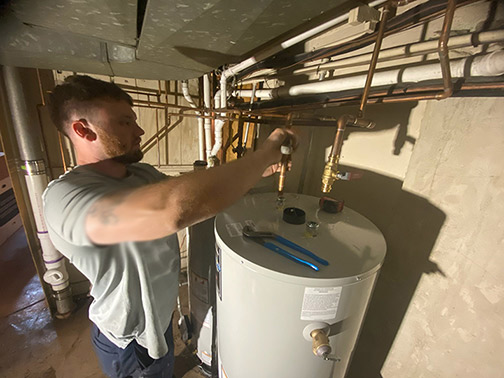
With an aging water heater, you may notice hot water running out faster than expected, along with steadily rising energy bills. As units get older, they lose efficiency and require more energy to produce the same level of performance, which drives up operating costs over time.
Traditional tank-style water heaters also keep a full tank of water heated around the clock. Because stored hot water naturally loses heat over time, the system must continuously reheat it throughout the day, resulting in unnecessary energy use and waste.
Beyond efficiency concerns, older water heaters can also pose additional risks. Internal corrosion may eventually lead to leaks that cause water damage inside your home. In some cases, rust buildup inside the tank can even affect water quality, leading to discoloration or the presence of unwanted metals in your hot water supply.
Many of these issues can be resolved by upgrading to a more energy-efficient water heater through a full replacement.. But what are the best options when upgrading, and how can a new system improve efficiency, reliability, and overall home performance?
Best water heater options for saving energy
The best water heater models for saving energy are:
Heat pump water heaters (hybrid water heater)
At the top of our list are heat water pumps, which, instead of using electricity to generate heat directly, use electricity to move heat from the air or ground to heat water. Heat water pumps work like a refrigerator in reverse, making them up to 3 times more efficient than traditional water heaters. The efficiency of a unit depends on its specifics, though.
Heat pumps can be standalone units with built-in water storage, or they can be retrofitted to work with an existing storage tank. A heat pump water heater can save your household up to $500 annually and $4500 over its lifetime. They are 4 times more efficient than standard electric models, using up to 70% less energy than traditional systems.
Heat pumps are best for homes with unconditioned basements, garages, and utility spaces, because they need lots of space for circulating air.
Tankless or on-demand water heaters
Unlike traditional tank models, tankless water heaters eliminate standby heat loss by heating water only when you need it — not storing it. Also called on-demand water heaters, they’re available in gas and electric models with varying efficiency levels depending on your household’s hot water usage.
Gas models deliver higher flow rates and greater heating power, making them the better fit for larger Burr Ridge homes with multiple bathrooms or high simultaneous demand. Electric models are more compact and easier to install but work best in smaller homes with lower hot water needs.
Efficiency gains depend on how much hot water your household uses. Smaller households can see energy savings of 24–34%, while larger homes still benefit with savings in the 8–14% range.
One important note for Burr Ridge homeowners: electric tankless water heaters perform best where groundwater stays around 70°F year-round. In the Burr Ridge area, groundwater temperatures run significantly colder — especially in winter — which reduces the efficiency of electric models and is why gas tankless water heaters are the more popular and practical choice for most Burr Ridge homes.
Solar water heaters
Theoretically, these should be the most energy-saving water heaters because they can generate energy from the sun at no cost. The efficiency of a solar water system depends on the area’s climate and a household’s hot water needs. Solar water heaters don’t work well or at all on cloudy days. They are unsuitable for low-sunlight climates.
For optimal efficiency, a solar water heater may be used to preheat water before it reaches a conventional water heater. This type of system lets you cut your home’s water heating bill by 40% – 80%, which is very significant. Hybrid solar water heater systems, which work alongside a heat pump that pulls heat from the surrounding air, offer the best energy savings.
High-efficiency storage water heaters
High-efficiency gas storage water heaters use the same technology as traditional gas storage water heaters, but because they have better insulation, standby heat loss from the tank is minimal. Also, because they are equipped with heat traps and more efficient burners, they use up to 8% less energy than standard models.
The energy-saving capabilities of a high-efficiency storage water tank is even higher if the system comes with a secondary heat exchanger. This allows it to capture additional heat from exhaust gases, further reducing the water heater’s energy consumption. A specific drawback of this is that the system needs venting via a vertical PVC pipe.
What are the things to consider when upgrading to an energy-saving water heater? Of course, you must think of your home’s hot water needs versus the system’s ability to meet those needs. You also want to look at the upfront cost of buying the water heater compared to the potential long-term energy savings.
The availability of different types of energy sources is a limiting factor, especially if you are looking to buy a solar- or propane-powered system. To make sure the system you want to buy will actually save you money, check out its UEF rating and ENERGY STAR certification. Lastly, think of your installation and maintenance costs.
—
Looking to upgrade your water heater in Burr Ridge, IL? We can help! Call our local Burr Ridge, IL plumbers today at 630-749-9057!