
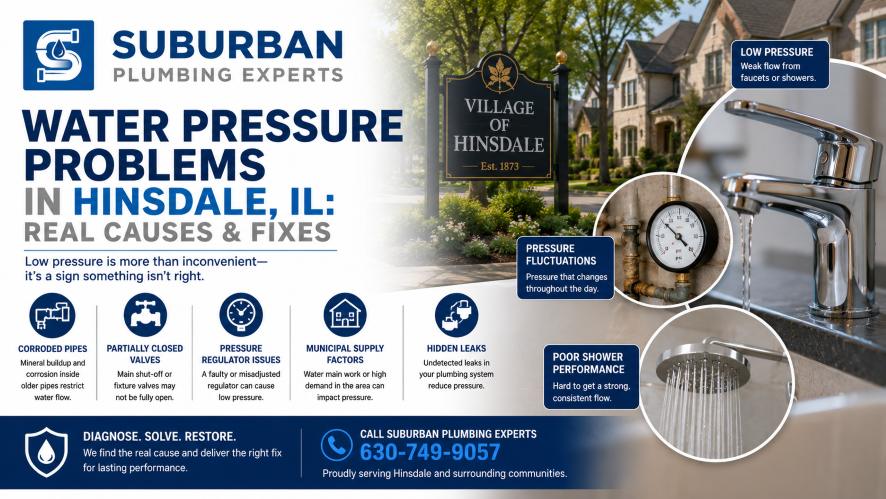
Low Water Pressure in Hinsdale Isn’t One Problem. It’s at Least Six, and They Don’t Fix the Same Way.
“My water pressure is bad” tells a plumber almost nothing. Weak flow at every fixture in the house points somewhere entirely different than weak flow at just the upstairs shower. A pressure problem that started gradually over months has a different cause than one that showed up overnight after a repair crew worked on your street. Guessing at the cause, and buying a fix for the wrong one, is how homeowners end up replacing a showerhead twice and still standing in a trickle.
This guide walks through how to actually diagnose low (and high) water pressure in a Hinsdale home, what each cause looks like in practice, and which fixes are a five-minute job versus which ones justify calling in a professional. If you’re evaluating a Hinsdale property before closing, pressure problems are also one of the issues a standard walkthrough tends to miss, worth a look at our guide on what a plumbing inspection should cover before buying a home in Hinsdale, IL.
Start Here: Whole-House or Single-Fixture?
Before troubleshooting anything, run one test. Turn on a few fixtures around the house, kitchen sink, bathroom sink, tub, and see whether the weak pressure shows up everywhere or just in one spot.
- Weak everywhere: the problem is upstream of your fixtures, at the main shutoff, the meter, the pressure regulator, or somewhere in your supply piping. That points to the causes in the next section.
- Weak at one fixture only: the problem is local to that fixture, almost always a clogged aerator or showerhead, sometimes a partially closed fixture shutoff valve. That’s a fast, cheap fix and doesn’t require a plumber.
That single test eliminates half the guesswork before you touch a wrench.
What’s Actually Causing Low Pressure Throughout the House
A valve that isn’t fully open. The main shutoff and the valve at the water meter both need to be all the way open to deliver full pressure. It’s a common oversight after plumbing work, a valve gets closed for the repair and someone forgets to reopen it fully. Check both before assuming anything more serious is wrong.
Mineral buildup narrowing the pipe. Scale and corrosion build up along the interior wall of a pipe over years, gradually shrinking the usable diameter and choking flow. This shows up most in older galvanized steel plumbing and in homes on harder water. A cleaning agent flushed through the system can clear light buildup; pipe interiors that are significantly narrowed need replacement, not cleaning.
A leak bleeding off pressure before it reaches your fixtures. An underground supply line leak is easy to miss because it doesn’t show up as a puddle indoors. Watch for a patch of yard that’s always damp regardless of weather, discolored water carrying sediment, or a hissing sound inside a wall. A water meter test settles it: shut off every fixture in the house, note the meter reading, wait an hour without using water, and check again. Any movement means water is escaping somewhere in the system. Our professional leak detection services can pinpoint the exact location without tearing out drywall or excavating your whole yard to find it.
Old pipe material that’s simply worn out. Galvanized steel, and in older Hinsdale homes occasionally clay or cast iron supply lines, corrode from the inside in a way that no cleaning treatment reverses. Once a system reaches that point, the only durable fix is whole-house repiping with copper or PEX, materials that don’t scale or corrode the way older piping does. It’s a bigger project, but it’s a one-time fix rather than a recurring one.
A pressure regulator that’s failed. Most homes on municipal water have a pressure-reducing valve (PRV) where the supply line enters the house, controlling how much of the street’s pressure actually reaches your fixtures. When the internal components wear out or the valve gets stuck, it can fail toward either extreme, choking pressure down too far or letting it run unregulated. A failed PRV is a targeted, inexpensive repair once it’s correctly diagnosed.
Why Some Hinsdale Homes Deal With the Opposite Problem: Pressure That’s Too High
High pressure gets less attention than low pressure because it doesn’t announce itself the same way, until a supply line finally gives out at a joint or a water heater connection. Municipal systems typically run higher pressure than any single home needs, both to reach upper floors reliably and to keep enough force in the system for fire hydrants. Hinsdale’s water is sourced from Lake Michigan and delivered through the DuPage Water Commission, and pressure at your specific address depends on your elevation and distance from the distribution system relative to your neighbors, not just what the utility puts out at the source.
Homes sitting at a lower point in the village can end up with meaningfully higher static pressure than a home a few blocks away on higher ground, even though both draw from the same supply. A pressure regulator is the standard fix in either direction, either installing one where there isn’t one, or replacing a unit that’s failed. What it isn’t optional on is the safety threshold: plumbing codes generally require a PRV once incoming pressure exceeds 80 psi, and according to the EPA’s WaterSense guidance on service water pressure, most residential plumbing codes require a PRV wherever supplied pressure runs above that 80 psi mark, with most homes performing best in the 40 to 60 psi range. Pressure above that threshold doesn’t just waste water, it shortens the life of your water heater, washing machine, and every supply line joint in the house through constant stress they weren’t built to handle.
Testing Your Own Pressure Before You Call Anyone
A hose-bib pressure gauge costs little and threads directly onto any outdoor spigot, giving you a real number instead of a guess. Attach it to a hose bibb with all fixtures inside the house turned off, and read the static pressure. Anywhere from 40 to 60 psi is the target range for most homes; below 40 starts to feel noticeably weak, and above 80 crosses into the range that actively damages plumbing over time. If your reading falls outside that window, that number is exactly what a plumber needs to know before setting foot in your house, it narrows the diagnosis before the visit even starts.
When It’s a Five-Minute Fix vs. When It’s Time to Call a Plumber
Clogged aerators and mineral-fouled showerheads are legitimate DIY fixes: unscrew the aerator, clear the mesh screen, or soak a showerhead in a vinegar solution overnight. Confirming a shutoff valve is fully open takes seconds. Everything past that point, a suspected underground leak, a failed or missing pressure regulator, pipe material that’s reached the end of its service life, is worth a professional diagnosis before you spend money on a fix that might be treating the wrong cause. A licensed Hinsdale, IL plumber can run a proper pressure test, isolate whether the issue is regulator, supply line, or interior piping, and tell you honestly which repairs are worth doing now versus which can wait.
Frequently Asked Questions
What water pressure is considered normal for a home?
Most homes perform best between 40 and 60 psi. Pressure below 30 psi is generally considered too low for comfortable use, and most plumbing codes require a pressure-reducing valve once incoming pressure exceeds 80 psi.
Can I test my home’s water pressure myself?
Yes. A hose-bib pressure gauge, sold at most hardware stores, threads onto any outdoor spigot and gives a direct static-pressure reading with the rest of the house’s fixtures turned off.
Why did my water pressure drop suddenly instead of gradually?
A sudden drop points toward a valve that got closed (often after nearby repair work), a new leak, or a pressure regulator that failed outright, rather than the slow mineral buildup that causes gradual pressure loss over months or years.
Does hard water make low pressure worse?
Yes. Mineral-heavy water accelerates scale buildup inside pipes and fixtures, narrowing the usable diameter faster than it would in a home with softer water, which is part of why the same-age plumbing performs differently from one house to the next.
Is high water pressure actually a problem, or just a low-pressure issue in reverse?
It’s arguably the more expensive problem long-term. Low pressure is inconvenient; high pressure actively stresses pipe joints, valves, and appliances until something fails, often as a leak inside a wall that goes unnoticed until real damage is done.
Licensed Water Pressure Diagnostics for Hinsdale Homes
Suburban Plumbing Experts has served Hinsdale and the surrounding suburbs since 1978. We hold Illinois Plumbing License #055-044116 and Sewer License #2565, and every technician on our team is a trained, background-checked employee, not a subcontractor. Whether your pressure problem is a five-minute fix or points to something bigger in your supply line, we’ll test it, diagnose it correctly, and tell you exactly what’s going on before any work begins.
Dealing With Water Pressure Problems in Your Hinsdale Home?
Licensed, insured, and serving Hinsdale and Chicagoland since 1978. We test your actual pressure first and diagnose the real cause — no guessing, no unnecessary parts.
West Suburbs: 630-749-9057 | Emergency: 708-518-7765 | Open 24/7
—
Suburban Plumbing Sewer Line & Drain Cleaning Experts
Licensed & Insured | Open 24 Hours | Serving Hinsdale & the West Suburbs Since 1978
📞 West Suburbs: 630-749-9057 | 🚨 Emergency: 708-518-7765