
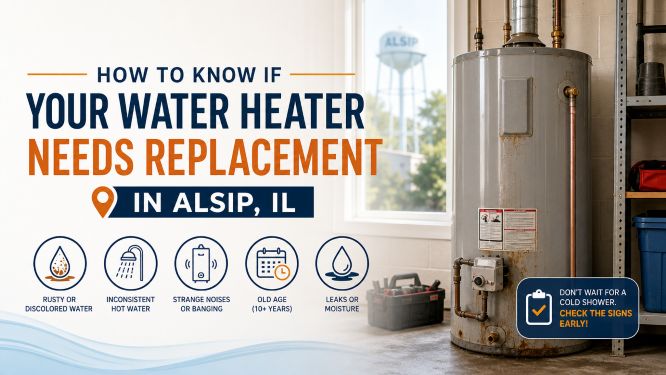
Alsip’s Water Comes Straight From Lake Michigan, Purchased From the City of Chicago and Treated Through the Village’s Own System Since 1965. That Source Matters More Than Most Homeowners Realize When It Comes to How Long a Tank Actually Lasts — and When It’s Telling You It’s Done.
Every water heater eventually fails — that part’s universal. What’s specific to Alsip is the water running through it every day. The Village of Alsip Water Department draws its supply from Lake Michigan, purchased from the City of Chicago, then treats it through a three-step process before it ever reaches your tank. That’s a different mineral and sediment profile than a home relying on well water or a harder groundwater source, and it changes what “normal wear” looks like inside a tank that’s been running for a decade. As part of our broader Alsip plumbing services, we’ve done this work directly in the village — replacing a leaking 50-gallon unit with a new Bradford White tank, including new electric unions and modified copper piping to match the updated connections, and separately handling water heater repair and diagnostics alongside a basement toilet valve replacement in another Alsip home. Here’s how to actually tell where your own unit stands.
At a Glance
- Typical lifespan: 8–12 years for a conventional tank-style gas or electric water heater; up to 20 years for tankless units.
- The clearest sign: Age alone — if your unit is approaching or past the 10-year mark, start planning for replacement even without an active problem.
- The most overlooked sign: Rumbling, popping, or banging noises, which mean sediment has built up at the bottom of the tank and is now being trapped and reheated with every cycle.
- The most urgent sign: Any pooling water or moisture at the base of the tank — this points to internal tank failure, not a fixable component.
- Maintenance that actually extends life: Per A.O. Smith’s own manufacturer maintenance guidance, annual maintenance should include testing the temperature and pressure relief valve, inspecting and replacing the anode rod when deteriorated, and flushing the tank to remove sediment buildup.
Understanding Your Water Heater’s Lifespan
A conventional tank-style water heater — gas or electric — typically lasts 8 to 12 years. Tankless units can run up to 20 years, largely because they don’t store standing water and avoid the constant sediment exposure a tank endures. Where a specific unit falls in that range depends heavily on maintenance history, household usage, and water quality — which is exactly where Alsip’s specific water source becomes relevant. Lake Michigan water treated and delivered through the Village’s system carries a different mineral load than groundwater-sourced supplies common elsewhere in the region, but “different” doesn’t mean “sediment-free” — municipal treatment settles out the majority of particulates before delivery, not all of them, and a tank still accumulates its own scale and sediment over years of heating cycles regardless of source water quality.
Signs Your Water Heater Might Need Replacement
Age of the Water Heater
The single most reliable predictor of water heater failure is age. If your unit is approaching or has already passed the 8-to-12-year mark, it’s worth planning for replacement proactively — even before you’ve noticed a specific symptom. Waiting for an obvious failure usually means dealing with it as an emergency rather than on your own schedule.
Inadequate Hot Water
A noticeable drop in hot water volume, or running out faster than you used to, is a common sign of sediment buildup reducing the tank’s effective heating capacity. As sediment accumulates at the bottom of the tank, it insulates the water from the heat source, forcing the unit to work harder for less output.
Rusty or Discolored Water
Consistent rust-colored or discolored hot water points to corrosion inside the tank itself — usually a sign the tank lining and anode rod have both broken down enough that the steel tank wall is now exposed to corrosion directly. At this stage, replacement is almost always the right call rather than repair.
Leaks or Moisture Around the Unit
Standing water or dampness at the base of a water heater indicates internal tank failure, not a fixable fitting in most cases. A tank that’s actually cracked or corroded through will only get worse, and catching it early is the difference between a planned replacement and emergency water damage cleanup.
Strange Noises
Rumbling, popping, or banging sounds during heating cycles are sediment doing exactly what sediment does — trapping small pockets of water beneath the buildup, which then boil and create the noise you’re hearing. Some early-stage sediment noise can be resolved with a professional flush, but persistent noise in an older unit is usually a sign the buildup has already reduced the tank’s practical service life.
The Cost-Benefit Reality
Replacing a water heater before it fails outright is rarely just about avoiding an inconvenience — it’s a real financial decision. Newer units are meaningfully more energy-efficient than a tank from a decade or more ago, which shows up directly in your utility bill over time. Planned replacement also means choosing the right unit and installer on your own timeline, rather than making a rushed decision during a no-hot-water emergency or dealing with water damage from a tank that failed while you were away. For a full breakdown of what actual installed costs look like across Chicago and the suburbs — unit, labor, permits, and old unit disposal — see our complete water heater replacement cost guide.
Choosing What Actually Replaces It
Not every replacement should be a like-for-like swap. If your current unit is an older conventional tank, replacement is a natural point to evaluate whether a tankless system makes sense for your household — higher upfront cost, but no standing tank to accumulate sediment over years and a meaningfully longer service life. For most Alsip households, a properly sized conventional tank replacement is still the more cost-effective choice, but the right call depends on household size, hot water demand, and how long you plan to stay in the home. Our water heater replacement service walks through that decision with you rather than defaulting to the same unit type you already had.
What Actually Happens During a Professional Installation
A proper water heater installation is more than swapping one tank for another, and the difference shows up years later, not on install day. A thorough water heater installation includes confirming the new unit is correctly sized for your household’s actual usage, updating any connections or fittings that don’t meet current code — old dielectric unions, outdated shutoff valves, or venting that was adequate for an older, less efficient unit but not for a new one — and pressure-testing the finished connections before the job is considered complete. This is also where a permit matters: an inspector confirms the venting and gas or electrical connections meet current safety code, which protects you if there’s ever a question about the installation down the road, whether that’s an insurance claim or a future home sale.
Water Heater Types Common in Alsip Homes
Alsip’s housing stock includes a mix of construction eras, and the water heater setup in a given home often reflects when it was built or last renovated. Older homes more frequently have standard 40 or 50-gallon gas tank units, often original to a prior renovation rather than the home’s construction date, given how many times a typical water heater is replaced over a home’s lifespan. Newer construction and recently updated homes are more likely to have higher-efficiency gas units or, less commonly, electric tank or tankless systems. None of these setups changes the fundamental signs covered above — age, sediment noise, discoloration, and leaks all apply regardless of fuel type — but it does affect what a replacement actually involves, since gas-to-electric conversions or a switch to tankless require additional work beyond a simple tank swap.
Frequently Asked Questions
My water heater is only 6 years old but making noise. Does it still need replacement?
Not necessarily. Noise well before the typical 8-to-12-year lifespan is often sediment that can be addressed with a professional flush rather than a sign of end-of-life failure. The exception is if the noise is accompanied by other signs — reduced hot water, discoloration, or any moisture at the base of the tank — which together suggest something more advanced than routine sediment buildup.
Does Alsip’s water supply affect how often I need to flush my tank?
Lake Michigan-sourced water, like Alsip’s, generally carries a different mineral profile than harder groundwater sources, but every municipal water supply still deposits some sediment in a tank over years of use — the Department of Energy’s standard recommendation of flushing a quart of water from the tank every three months applies regardless of source water hardness. If you’ve never flushed your tank and it’s more than a few years old, that’s worth doing before assuming a noise or performance issue means full replacement.
Should I repair or replace my water heater?
It depends on the unit’s age and what’s actually wrong. A straightforward component failure — a thermostat or heating element — in a unit under 8 years old usually makes more sense to repair. A tank showing corrosion, discoloration, or actual leaking, especially in a unit already past the 8-to-12-year mark, is a much stronger case for replacement rather than putting money into a tank that’s failing from the inside regardless of what specific part triggered the symptom.
Is a permit required to replace a water heater in Alsip?
Most Cook County municipalities, including Alsip, require a permit for water heater replacement to ensure the installation meets current venting, gas line, and safety code requirements. We handle all required permitting as part of every installation, so it’s not something you need to navigate yourself.
How long does a typical water heater replacement take?
Most standard tank-to-tank replacements are completed in 2 to 4 hours from arrival, including removal of the old unit, installation, and testing. A conversion — switching fuel types, moving to tankless, or updating venting to meet current code — takes longer, since it involves more than a direct swap. We’ll give you a realistic timeframe based on your specific setup before work begins, not after.
Can I just wait until my water heater completely fails before replacing it?
You can, but it’s rarely the better outcome. A tank that fails outright, rather than being replaced proactively, often means water damage to the surrounding area, an emergency service call rather than one scheduled on your timeline, and sometimes days without hot water while parts or a replacement unit are sourced. Replacing a unit that’s clearly near the end of its life — even before an active failure — is almost always the lower-stress and lower-cost path.
Water Heater Replacement & Repair in Alsip, IL
Licensed, insured, and serving Alsip and the surrounding south suburbs since 1978. Same-day and next-day water heater replacement available, with all permitting handled as part of every installation. Emergency line answered 24 hours a day.
Emergency: 708-518-7765 | Alsip: 708-801-6530 | Open 24/7
—
Suburban Plumbing Sewer Line & Drain Cleaning Experts
Licensed & Insured | Open 24 Hours | Serving Alsip & the Suburbs Since 1978
📞 Alsip: 708-801-6530 | 🚨 Emergency: 708-518-7765