
Before You Call a Plumber, Know Whether This Is Even Your Pipe
A water line emergency in Orland Park splits into two entirely different situations, and figuring out which one you’re in comes before anything else. If the problem is in the Village’s main line, the large pipe running under the street that serves your whole neighborhood, that’s the Village’s responsibility, not yours. According to the Village of Orland Park’s own guidance, a suspected water main break should be reported to Public Works at (708) 403-6350 during business hours, or the non-emergency police line at (708) 349-4111 after hours. If the problem is in your private service line, the pipe running from that main into your specific home, it’s yours to handle, and that’s when you call a plumber.
How to Tell the Difference in the First Minute
A Village main break typically shows up as water surfacing in the street or parkway, an unexplained soft or sunken area in the road or yard, or a sudden, unexplained pressure drop affecting multiple homes on your block at once, not just yours. A private service line problem is usually isolated to your property specifically: water inside your home, a wet spot in your own yard that isn’t near the street, or a pressure or supply issue affecting only your address while neighbors seem fine. If you’re not sure which one you’re looking at, call the Village number above first, they can tell you quickly whether it’s a main issue, and if it isn’t, you’ve lost only a couple of minutes before calling a plumber.
Why Orland Park’s Water System Is More Robust Than It Might Seem, and Why Private Lines Still Fail Anyway
Orland Park switched from well water to Lake Michigan water in 1985, delivered through a 36-inch main from Oak Lawn known as Spur 1, serving Orland Park and twelve other southwest suburban communities. The Village has since built in real redundancy: two underground reservoirs, seven elevated water towers, backup generators at pump stations, and a second redundant transmission line called Spur 2, completed as part of a regional infrastructure investment exceeding $22 million. That’s a genuinely well-engineered public system. None of it, however, protects the private line running from the Village’s main into your specific home, that pipe is yours, it ages on its own timeline, and its condition has nothing to do with how much redundancy exists upstream of it.
The First Ten Minutes: What Actually Stops the Damage
- Shut off the water. Locate the dedicated shutoff valve for the affected pipe if one exists, often near where it enters a wall or floor, or your home’s main shutoff valve, commonly near the water meter in a basement, crawlspace, or utility room. Close it before doing anything else.
- Cut power to the affected area. If water is anywhere near outlets, switches, or wiring, shut off power to that area, or the whole house if flooding is significant, from the breaker panel. Never touch standing water that might be in contact with electricity, and if you must wade through water to reach the panel, wear rubber boots and gloves regardless.
- Protect what you can before the water spreads further. Move important documents to waterproof storage first, then furniture and electronics to a dry area, elevating anything too large to move fully out of the way.
- Call a licensed plumber. Once the immediate danger is addressed, get a professional assessment rather than relying on a temporary fix to hold indefinitely.
What’s Genuinely Safe as a Temporary Measure
For a small crack or pinhole leak, epoxy putty applied to a cleaned, dried section of pipe can hold temporarily, though it doesn’t work well on plastic pipe. For a larger leak, a repair clamp or compression clamp with a rubber gasket is the more reliable stopgap. If the break traces back to a frozen section, gentle heat from a hair dryer, an electric heating pad, or towels soaked in hot water can thaw it safely, never apply direct heat to plastic pipe, and never use an open flame on any pipe material. All of these are genuinely temporary. None of them address why the pipe failed in the first place, and a proper water line repair is what actually resolves it rather than buying time until the next failure.
Confirming Where the Problem Actually Is Before Anyone Digs
If your private line is the issue and the fix requires excavation, professional leak detection confirms the exact location before any digging starts, avoiding guesswork on where to open up your yard. Illinois law also requires calling JULIE at 811 at least two business days before any excavation project to have buried utility lines marked, covered in more detail in our guide to why your Chicago-area plumber should always call JULIE before they dig.
Repair or Replace: What Actually Determines the Right Call
A single, isolated break in an otherwise sound line is usually a straightforward repair. A line that’s failed more than once, or one that’s old enough that the current break is unlikely to be its last, often makes more sense to replace outright rather than repair piecemeal. Our guide to the real cost of water line repair versus replacement breaks down exactly how that decision gets made and what each option actually costs.
Frequently Asked Questions
How do I know if a water line problem is my responsibility or the Village’s?
If it’s in the main line under the street, it’s the Village’s, reportable to Public Works at (708) 403-6350 during business hours or the non-emergency police line at (708) 349-4111 after hours. If it’s in the line running from that main into your home, it’s your responsibility to repair.
What are the signs of a Village water main break rather than a private line issue?
Water surfacing in the street or parkway, an unexplained sunken area in the road, or a sudden pressure drop affecting multiple homes on your block at once all point to a main break rather than an issue isolated to your property.
Is a temporary fix like epoxy putty or a repair clamp actually safe to rely on?
Only as a short-term measure to reduce damage until a professional repair happens. Neither fixes why the pipe failed, and a line patched this way should still be assessed and properly repaired promptly.
Do I need to call JULIE before repairing my own water line?
Yes, if the repair requires digging. Illinois law requires a JULIE call at least two business days beforehand for any excavation project, regardless of size.
How do I know if I need a repair or a full water line replacement?
A single, isolated break in an otherwise sound line usually calls for repair. A line with a history of repeat failures, or one old enough that another failure is likely soon, often makes more sense to replace outright.
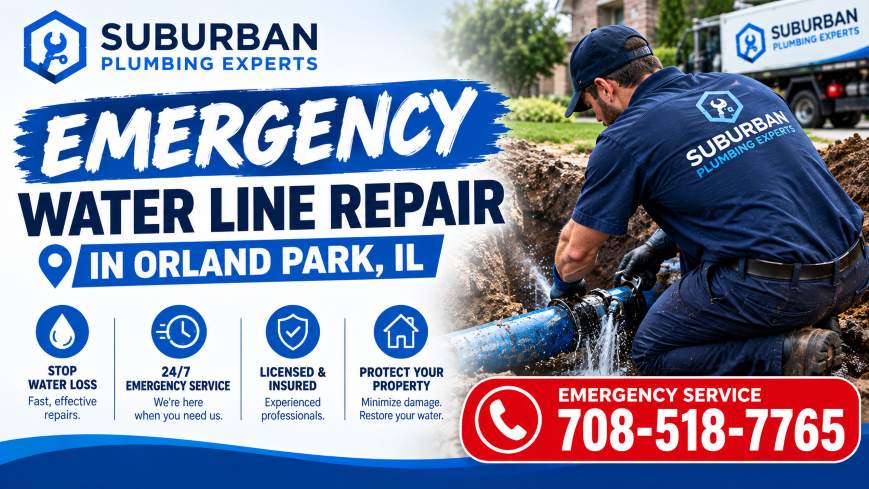
Emergency Water Line Repair for Orland Park, IL
Suburban Plumbing Experts has served Orland Park and the surrounding suburbs since 1978. We hold Illinois Plumbing License #055-044116 and Sewer License #2565, and every technician on our team is a trained, background-checked employee, not a subcontractor. Whether it’s a fast diagnosis on a private line break or a full repair once the immediate danger is handled, our Orland Park, IL plumbers answer the phone around the clock.
Dealing With a Water Line Emergency in Orland Park?
Licensed, insured, and answering the phone 24/7 across Orland Park and the southwest suburbs. Shut off your main water valve, then reach out below or call us directly.
Suburbs: 708-801-6530 | Emergency: 708-518-7765 | Open 24/7
—
Suburban Plumbing Sewer Line & Drain Cleaning Experts
Licensed & Insured | Open 24 Hours | Serving Orland Park & the Suburbs Since 1978
📞 Orland Park: 708-801-6530 | 🚨 Emergency: 708-518-7765