
The Complete Guide for Chicago Condo Owners Who Want to Know Exactly Who Pays for What — Before the Water Is Already Coming Through the Ceiling
The moment a pipe fails in a Chicago condo building, two things happen simultaneously. Water starts flowing somewhere it shouldn’t. And the question of who is responsible for fixing it — and who pays for the damage it caused — immediately becomes the most contested issue in the building.
The unit owner below says the water came from the unit above. The unit owner above says the pipe is inside the wall and that’s the association’s problem. The association says the pipe is on the unit owner’s side of the wall. The property manager is fielding calls from three units at once. Nobody’s declaration and bylaws are immediately accessible. The plumber is standing there with a quote while two unit owners and a board member argue about whose insurance should respond.
This scenario plays out in Chicago condo buildings dozens of times every week — and it plays out so often because most Chicago condo owners don’t understand the plumbing responsibility framework until they’re standing in a wet room trying to figure it out under pressure.
This guide gives you that understanding before the emergency, and if you want a deeper breakdown of how plumbing behaves specifically in high-rise buildings and loft-style units, see our guide on Chicago South Loop condo plumbing and high-rise systems.
The Foundation: The Illinois Condominium Property Act
Every condo in Illinois operates under the Illinois Condominium Property Act (765 ILCS 605) — the state law that governs how condominiums are created, operated, and managed throughout the state. The ICPA establishes the baseline framework for responsibility — what’s a common element, what’s a unit, and what the association is obligated to maintain.
Under the ICPA, the declaration — the founding document of your specific condominium association — is the primary source of authority for what your association is responsible for and what you as a unit owner are responsible for. The ICPA establishes the minimum framework; your declaration defines the specifics. If your declaration says something different from the general ICPA framework, your declaration governs — as long as it doesn’t violate the ICPA’s mandatory provisions.
The most important practical implication: Before any plumbing dispute in a Chicago condo becomes a conflict, the right first step is reading the declaration. The declaration defines where the unit ends and the common elements begin — and that boundary determines who owns every pipe, every drain, and every fixture in question.
The Fundamental Divide — Unit vs Common Element
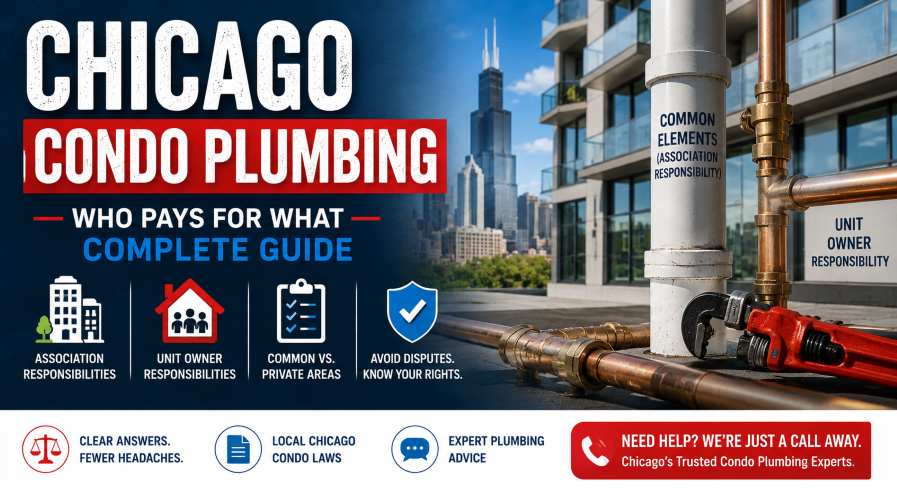
In a typical condominium association, all domestic plumbing contained within the walls (risers) belongs to the association. Conversely, the owner’s responsibility is on their side (or inside) of that wall.
This is the general rule — but understanding what it means in practice requires understanding what “inside the wall” means for different types of pipes.
The Riser Stack — The Association’s Core Responsibility
A riser is the vertical pipe that runs from the building’s basement or mechanical room upward through each floor of the building. In Chicago’s high-rise and mid-rise condo buildings, a single riser serves multiple units stacked vertically. The riser carries water supply upward to each floor and carries waste from each floor downward to the building drain. The riser passes through each unit’s floor and ceiling — but the riser is not inside any individual unit’s exclusive space. It’s inside the wall or building structure, serving multiple units simultaneously.
The riser is a common element. The association is responsible for maintaining, repairing, and replacing it. If the riser supplying your unit develops a leak inside the wall, the association’s responsibility includes the repair of that pipe and restoration of the wall to the condition it was in before the repair required opening it.
What this means practically: if water is coming through your wall from a riser, the association addresses the pipe. What happens to the drywall, flooring, and finishes within your unit after the repair is made depends on your association’s specific declaration language — the “bare wall provision” question discussed below.
The Branch Lines — Where Unit Responsibility Begins
Your water supply enters your unit through branch lines — the horizontal pipes that break off from the riser at your floor level and run to your kitchen, bathrooms, and laundry. Your waste exits through drain connections that tie into the building’s vertical drain stack. When trying to visualize how all of these shared and individual systems actually come together inside a condo building, it helps to see a full breakdown of how the plumbing is structured from the risers to each unit’s fixtures. We explain this step-by-step in our guide to understanding the plumbing system in your condo, including how water lines, drain stacks, and shared connections are typically arranged in Chicago condo buildings.
The branch lines within your unit’s plat boundary — the pipes running from where they enter your unit’s defined space to your fixtures — are typically your responsibility. The connection point where the branch line meets the riser, however, is a gray area that declarations define differently across buildings.
The Fixture — Clearly the Unit Owner’s Responsibility
Every fixture within your unit — the toilet, sink, tub, shower, dishwasher, washing machine, water heater if present, garbage disposal — is your responsibility as the unit owner. Maintenance, repair, and replacement of fixtures is on you. A running toilet in your unit is your expense. A dripping faucet is your expense. A garbage disposal that fails is your expense.
The Unit Water Heater — A Common Confusion Point
Owners are typically responsible for the interior of their unit — the wall, ceiling and floor coverings, a hot water heater or an air handler, their appliances, the plumbing and electrical panel.
If your unit has its own water heater — common in many Chicago mid-rise condos and suburban condo developments — that water heater is your responsibility. Maintenance, repair, and replacement. If the water heater fails and causes water damage within your unit, your homeowners insurance (HO-6 policy) is the appropriate first response. For the complete guide to water heater warning signs — the symptoms that tell you a unit water heater is approaching failure before it fails — see our complete Chicago water heater warning signs guide.
Buildings with central water heaters serving multiple units have a different ownership profile — the central system is typically a common element maintained by the association. Check your declaration to confirm which configuration your building uses.
The Gray Areas — Where Most Chicago Condo Plumbing Disputes Actually Live
The “Inside the Wall” Question
The general rule — pipes inside the walls are the association’s — sounds clear until you’re looking at a specific situation. Here’s where it gets complicated:
Scenario: A drain pipe that runs from your kitchen sink, through a cabinet, through a wall, and then through the building structure to the main drain stack develops a leak at the section inside the wall. The leak is damaging the unit below yours.
The pipe inside the wall is theoretically the association’s. But the pipe that runs from your sink to the wall — the section inside your unit — is yours. The question is where exactly the leak is and whether the failure originated from the association’s section or from a blockage or failure that originated in your section.
In practice, most Chicago condominium declarations draw this line at the point where a pipe exits the exclusive space of a unit and enters the common structure — walls, floors, ceilings, and building mechanical spaces. The point of entry into the wall is typically the ownership boundary.
The Plat Line Standard
Condos have plat lines. These are diagrams that show individual units, and those lines could include parts of interior walls and hallways that surround the unit. If the leaking pipe is located within the individual unit’s plat line, the owner may be responsible for the repairs.
Your condominium’s plat — filed with the county recorder — defines the geometric boundary of your unit. Pipes that exist within that geometric boundary, even if they’re inside a wall, may be your responsibility under your declaration’s specific language. Pipes outside that boundary are common elements.
This is why reading your declaration — not relying on the general rule — is essential before any plumbing dispute.
The Bare Wall Provision
If the HOA has a bare wall provision, the affected unit owners would be responsible for repairing finishes, flooring, damaged ceiling tiles and any furnishings, cabinets or other features within the unit that were damaged by the water leak.
This is one of the most consequential — and most commonly misunderstood — provisions in Chicago condo declarations. A “bare wall” or “unfinished wall” standard means the association’s responsibility for restoration after a common element repair ends at the bare structural components. Drywall finishing, paint, flooring, tile, cabinets, and any personal property are the unit owner’s responsibility.
Under a bare wall provision: the association fixes the pipe inside the wall and patches the wall opening to a bare, unfinished state. The unit owner’s HO-6 insurance — or the unit owner directly — handles the finishing restoration.
Some buildings use an “original condition” or “finished wall” standard instead — meaning the association restores to original condition, not just bare structure. The difference is significant in a scenario where a riser repair required opening a tile-covered bathroom wall.
Chicago Condo Building Types — How Plumbing Responsibility Varies
Chicago’s condo market includes dramatically different building types, and the plumbing configuration — and therefore the responsibility framework — varies accordingly.
High-Rise and Mid-Rise Tower Condos
In Chicago’s high-rise and mid-rise buildings — the 10-to-60-story residential towers throughout the Loop, Streeterville, River North, Lincoln Park, and the lakefront neighborhoods — the building infrastructure is heavily centralized. Riser stacks service dozens of units. Central mechanical rooms handle water supply, heating, and in many buildings hot water. The building’s systems are sophisticated and maintained by building engineering staff.
Unit owners in high-rise buildings typically have responsibility for a relatively narrow set of plumbing items — the fixtures in their unit, the branch lines serving those fixtures within the unit’s boundaries, and their unit water heater if present. The extensive building infrastructure — risers, building drain stacks, mechanical room equipment — is the association’s domain.
The high-rise-specific concern: horizontal drain lines that run between your unit and the building drain stack pass through areas that may affect adjacent units when they fail. A blocked unit drain that backs up into the floor can cause water damage to the unit below — a scenario where the question of whether the blockage originated in the unit owner’s drain or in a shared building drain is consequential.
Vintage Chicago Two-Flat and Three-Flat Condos
Chicago has tens of thousands of converted vintage buildings — the two-flats, three-flats, greystones, and coach houses that were converted to condominiums over the past several decades. These buildings have fundamentally different plumbing infrastructure from purpose-built condo towers — the original plumbing was designed for a rental building with one owner, not for a condominium structure with individual unit ownership and shared maintenance responsibilities.
In vintage condo conversions, the plumbing infrastructure is typically original to the building — cast iron drain stacks and branch lines from the early-to-mid 20th century, original supply lines, shared systems that were designed without any consideration for the unit ownership boundaries that were later imposed by the condominium conversion.
The result: vintage condo conversions frequently have declaration language that’s imprecise about the exact boundary between unit plumbing and building plumbing, aging common element infrastructure that the association may not have adequately budgeted for in its reserves, and disputes that arise specifically because the physical plumbing doesn’t follow a clear boundary that the declaration can point to.
Buyers of converted vintage Chicago condos should read the association’s reserve study — the document that assesses the building’s infrastructure condition and the association’s financial preparation for major repairs. A vintage building with aging cast iron drain stacks and an association that hasn’t budgeted for their replacement is a building where unit owners may face special assessments when those stacks eventually require major work.
Suburban Condo Developments
Suburban condo developments — townhouse-style condos, garden condos, and mid-rise suburban buildings throughout the Chicago suburbs — typically have more clearly defined unit plumbing responsibilities because each unit often has its own mechanical equipment, more independent plumbing, and less shared infrastructure than urban high-rises.
In many suburban condo units, the water heater, furnace, and air handler are within the unit’s exclusive space — unit owner responsibility. Drain lines run from the unit to a shared building drain connection. Supply lines run from a main building connection into the unit. The boundary between unit plumbing and common element plumbing is often more physically distinct in these configurations.
The Most Common Chicago Condo Plumbing Problems — Who Handles Each
Slow or Clogged Drain — Clearly Unit Owner
A slow bathroom sink drain, a slow kitchen drain, a shower that pools water during use — these are within the unit and clearly the unit owner’s responsibility. Professional drain cleaning within the unit is a unit owner expense. Our drain cleaning services handle unit-level drain cleaning throughout Chicago condo buildings — same-day scheduling, no disruption to adjacent units.
Building Drain Stack Backup Affecting Multiple Units
When a drain stack backup simultaneously affects multiple units — floor drains backing up on multiple floors at the same time, multiple units experiencing drain problems simultaneously — the backup is in the common element building drain infrastructure. This is the association’s responsibility to address. The association should contact a commercial plumbing contractor to camera inspect and clear the building drain stack.
The complication: A building drain stack backup that’s caused by material flushed from a specific unit — wipes, grease, foreign objects — may trigger a subrogation claim from the association against that unit owner’s HO-6 insurance after the association’s insurance or reserves cover the initial repair. Declarations often include provisions allowing the association to recover costs from unit owners whose actions caused common element damage.
Water Heater Failure — Typically Unit Owner
A unit water heater that fails, leaks, or produces inadequate hot water is typically the unit owner’s responsibility — both the appliance replacement and any resulting water damage within the unit. If a water heater failure causes water damage to the unit below, the unit owner’s HO-6 insurance is the appropriate first response. Our water heater services include emergency water heater replacement throughout Chicago condo buildings with same-day response.
Water Leak Coming From an Unknown Source — Diagnosis First
Water appearing in a Chicago condo unit — staining on the ceiling, water pooling at the base of a wall, wet flooring near a wall — where the source isn’t immediately identifiable is one of the most common and most contentious situations in Chicago condo buildings. The water is coming from somewhere but nobody knows exactly where.
This is a situation where professional leak detection — thermal imaging specifically — is the right diagnostic tool before any walls are opened, before any insurance claims are filed, and before any dispute about responsibility begins. Thermal imaging of the affected area identifies exactly where moisture is present within the wall and ceiling structure — whether it’s originating from the unit above, from a building riser, from a roof drainage issue, or from within the unit itself.
Knowing the leak source before any remediation begins is the most important protection a unit owner has in a multi-unit water damage situation. Our thermal imaging leak detection and leak detection services identify the source before any finger-pointing or insurance involvement makes it harder to get objective answers.
Sewer Smell in the Unit — Could Be Either
A sewer gas smell in a Chicago condo unit is one of the most disruptive plumbing complaints because the source can be within the unit (a dry P-trap, a failed appliance connection), within the building’s common plumbing (a building drain vent failure, a shared drain stack issue), or from outside the building entirely. Diagnosis before any remediation is essential — and the right diagnostic tool is sewer smoke testing, which introduces non-toxic smoke into the drain system and visually identifies every leak point.
The Association’s Obligations Under Illinois Law
The Illinois Condominium Property Act is not purely permissive — it establishes specific obligations for associations that cannot be contracted away in the declaration.
Under Illinois’s Condominium Property Act (765 ILCS 605/18(j)), associations are allowed access to units when it’s necessary to maintain, repair, or replace common elements — or to handle an emergency.
This access right is significant in both directions. The association can enter your unit to repair a common element pipe, but it must do so with proper notice (except in emergencies) and must restore the unit to its original condition as defined by the declaration’s standard (bare wall or finished).
The association’s maintenance obligations under the ICPA include maintaining the common elements in good repair — which includes the building’s plumbing infrastructure. An association that defers maintenance on aging common element plumbing, leading to a failure that damages unit owners’ property, may face liability for that deferred maintenance.
Practical implication for unit owners: If you’ve been reporting a building plumbing issue to your association — a slow building drain, a recurring wet area near a shared wall, an odor from the building drain system — and the association has not acted, document those reports. Written communication creates a record of deferred maintenance that’s relevant if a subsequent failure causes property damage.
What Unit Owners Need to Know About Their HO-6 Insurance
Every Chicago condo unit owner should carry HO-6 insurance — the homeowners policy designed specifically for condominium unit owners. Understanding what your HO-6 covers — and what it doesn’t — is directly relevant to plumbing-related water damage.
What HO-6 typically covers:
- Water damage from a sudden and accidental discharge within your unit (burst pipe, appliance failure, overflow)
- Your personal property damaged by a covered water event
- Loss assessment charges levied by the association against unit owners for a common element repair
- Your improvements and betterments — the upgrades you made to the unit above the building’s standard finish
What HO-6 typically does NOT cover:
- Gradual water damage from a slow leak that developed over time (maintenance failure exclusion)
- Flooding (requires separate flood coverage)
- Sewer backup (requires specific endorsement)
- Water damage to the unit caused by association common element failures covered by the master policy
The master policy gap: The condominium association carries a master insurance policy covering the building’s common elements. The master policy typically does not cover improvements or personal property within individual units. The gap between what the master policy covers and what the unit owner needs to protect is exactly what HO-6 fills.
For Chicago condo unit owners in buildings served by combined sewer systems — most of the city — a sewer backup endorsement on the HO-6 is specifically relevant. Sewer backup into a ground-floor or garden-level condo unit is a documented risk in Chicago’s combined sewer neighborhoods, and standard HO-6 policies exclude it without a specific endorsement.
Chicago Condo Plumbing Maintenance — What Every Unit Owner Should Do
Annual inspection of unit plumbing fixtures. Once a year, visually inspect the plumbing under every sink — supply line condition, drain connection integrity, P-trap condition, cabinet floor for any moisture signs. Inspect around every toilet base for any movement or moisture. Check the water heater for any rust staining, moisture at the base, or T&P valve dripping.
Never flush wipes. In a condo building where your drain connects to a shared building drain stack, what you flush affects your neighbors. Wipes — even those labeled “flushable” — don’t break down in drain systems and accumulate in shared building drain lines. In buildings where multiple units contribute to a shared drain stack, wipe accumulation from any unit affects all units connected to that stack.
Report building plumbing issues in writing. If you notice a shared building plumbing concern — an odor from the building drain, a wet spot near a shared wall, water staining on a ceiling that might indicate a building riser issue — report it to your property manager or board in writing (email is fine). Written reports create a maintenance record that protects you if the issue later worsens and becomes a damage dispute.
Know where your unit shutoff valves are. Every unit has shutoff valves — the quarter-turn valves on the supply lines to each fixture. Every unit owner should know where every shutoff valve is and confirm they operate freely. In a water emergency, being able to shut off the supply to an overflowing toilet within 30 seconds is the difference between a minor cleanup and a flood that affects the unit below yours.
What to Do When a Plumbing Problem Occurs in Your Chicago Condo
Step 1: Stop the water. Use the fixture shutoff valve or the unit main shutoff to stop active water flow. If you can’t locate or operate a shutoff, call building management for assistance.
Step 2: Document everything. Take photos and video of all visible water damage, the apparent source location, and the affected areas before any cleanup begins. This documentation is essential for both insurance purposes and any responsibility dispute.
Step 3: Notify building management. For any plumbing event that involves or potentially involves a building common element — water coming from above, water coming from a shared wall, a building drain backup — notify your property manager immediately in writing.
Step 4: Get professional diagnosis before extensive remediation. Before walls are opened, before floors are pulled up, and before any party begins extensive restoration work — professional leak detection to confirm the source is the most important step. Thermal imaging identifies moisture location within wall and ceiling cavities. Knowing exactly where the leak originates before remediation begins protects everyone’s insurance and legal positions.
Step 5: Coordinate, don’t escalate. Most Chicago condo plumbing problems that become major disputes started as situations where someone acted unilaterally — opened a wall before getting agreement on responsibility, began remediation before insurance was notified, or made accusations before diagnosis confirmed the source. Coordinated diagnosis and coordinated response produces better outcomes than unilateral action followed by a dispute.
Frequently Asked Questions: Chicago Condo Plumbing
Water is coming through my ceiling from the unit above. Who is responsible? Diagnosis first. The source may be a unit plumbing failure in the unit above (their responsibility and their insurance), a building riser in the wall between floors (association responsibility), or a condensation issue from a building mechanical system. Thermal imaging of your ceiling and the floor of the unit above identifies the source before any responsibility assertion is made. Once the source is confirmed, the appropriate party — unit owner above or association — addresses the pipe, and insurance coordinates on damage remediation.
My association says the drain pipe that clogged is in my unit. The plumber says it’s in the wall. How do I resolve this? Request a camera inspection of the drain line with video documentation, run from the building’s cleanout. The camera shows exactly where the blockage is located and whether it’s within your unit’s plat boundary or inside the building structure. Camera documentation eliminates the “he said/she said” about pipe location and gives both parties an objective reference for the responsibility question.
My building hasn’t replaced the cast iron drain stack in a pre-war conversion and I’m worried about a failure. What can I do? Raise the issue with your board in writing. Request a reserve study review that specifically addresses the drain stack condition and timeline for replacement or lining. Attend the annual meeting and ask about the reserve funding for major plumbing infrastructure. If the association has insufficient reserves for known aging infrastructure, that’s a material concern for the value and insurability of every unit in the building.
The association fixed a common element pipe in my wall but only patched it with bare drywall. I had tile there. Who pays to restore the tile? This depends entirely on your declaration’s standard — bare wall or original condition. Under a bare wall standard, the association’s obligation ends at the bare patch. Under an original condition standard, the association must restore to original condition including tile. Request a copy of your declaration and locate the provision that describes the association’s restoration standard after a common element repair. If it’s not clear, the board should be able to cite the specific provision they’re relying on.
Chicago Condo Plumbing Problem? Let’s Diagnose It Right Before the Dispute Starts.
Licensed, insured, and locally based in Brookfield since 1978. We serve Chicago condo unit owners and condo associations throughout the city and suburbs — drain cleaning, leak detection, thermal imaging, water heater service, and building drain stack clearing. Written quotes before we start, our own licensed plumbers on every call. Send us a message and we’ll get back to you fast.
Or call us directly: 708-801-6530 | Open 24/7
—
Suburban Plumbing Sewer Line & Drain Cleaning Experts
Licensed & Insured | Open 24 Hours | Serving Chicago & Suburbs
📞 Suburbs: 708-801-6530 | 📞 Chicago: 773-570-2191 | 🚨 Emergency: 708-518-7765