
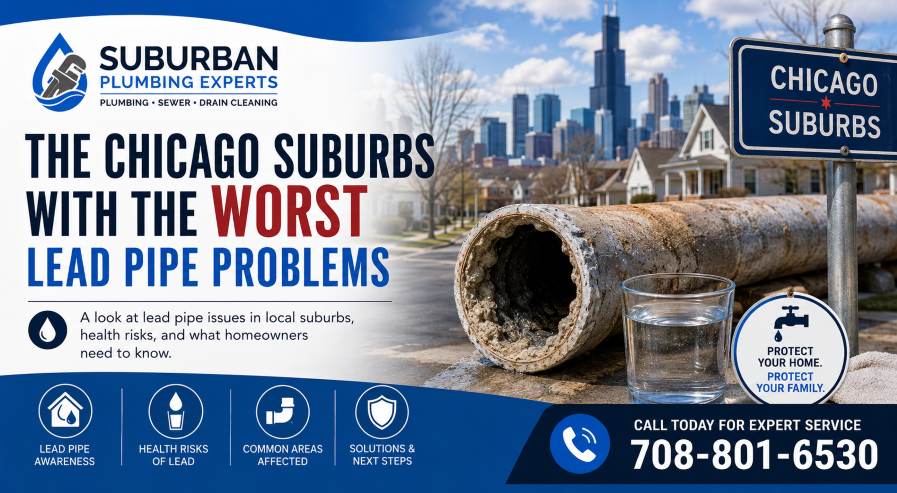
Every Older Chicago Suburb Has Lead Service Lines Somewhere in Its System. But the Actual Severity Varies Wildly From Town to Town — From a Village Running a $25 Million Program With Real Homeowner Reimbursements, to a Neighboring Village That’s Too Wealthy to Qualify for Almost Any Outside Help at All. Here’s the Real Data, Suburb by Suburb.
If you’re trying to figure out how worried to be about lead pipes in your specific Chicago suburb, the honest answer is: it depends enormously on which suburb. We’ve spent this year digging into the actual municipal records, board meeting coverage, and IEPA filings for more than a dozen Chicagoland communities, and the range is genuinely wide — from villages just starting multi-decade replacement plans to villages already in the final stretch. This guide ranks and summarizes what we found, town by town, with links to our full deep-dive on each. If you’re in Chicago proper rather than the suburbs, our companion breakdown of Chicago’s lead pipes by neighborhood covers the city itself. If you’re looking for how to recognize a failing water line or decide between repair and replacement, our companion guide to warning signs your Chicago suburb water line is failing covers that in full — this guide is about the town-level picture, not the individual symptoms.
The Worst of the Worst: Oak Park’s $300-400 Million Problem
No Chicagoland suburb we’ve researched comes close to Oak Park’s numbers. The village has more than 8,700 water service lines needing replacement, plus another 2,845 still needing verification, with a total compliance cost estimated between $318 million and $400 million+. What makes it worse is that Oak Park’s median household income — $103,264 — is high enough to disqualify the village from most of the state and federal assistance programs that help other communities cover this cost. The village’s compliance plan is due to the Illinois EPA by April 15, 2027. Our full breakdown, including neighboring River Forest’s very different situation, is in our guide to Oak Park and River Forest’s lead pipe crisis.
The Highest Percentage: River Forest at 80%
River Forest is smaller than Oak Park, but proportionally its lead numbers are more extreme: 2,559 of its 3,184 total water services — roughly 80% — contain lead in some capacity. Unlike Oak Park, River Forest already has a working resident assistance program: the village covers 100% of the public-side replacement cost up to $5,000, and 50% of the private-side cost up to $2,500. That’s a meaningfully better position for homeowners than being stuck without any reimbursement option at all.
The Village With Its Own Working Reimbursement Program: Riverside
Riverside has identified roughly $25 million in lead service lines needing replacement, funded through a $4 million IEPA zero-interest loan approved in October 2024 and an additional $12 million loan application, with construction underway since February 2025. What sets Riverside apart is a genuinely useful reimbursement option: homeowners who replace their line ahead of the village’s schedule can get reimbursed up to $5,000 or $7,500, depending on which side of the street their home sits on relative to the water main. Neighboring North Riverside runs a different system entirely, based on where a leak actually occurs relative to the buffalo box. Full details are in our guide to Riverside and North Riverside’s lead pipe programs.
Just Starting the Clock: Franklin Park and a Contrast Next Door in Schiller Park
Franklin Park is early in this process — the EPA partnered with the village in November 2024 on a door-to-door lead line identification campaign, and the village’s own draft replacement plan, dated April 2026, lays out a 17-year timeline running through 2044. Schiller Park, right next door, is in a completely different position: the state’s own tracking data describes Schiller Park as being in the final stage of its lead pipe replacement program. Two neighboring villages, two very different points in the same process — the full comparison is in our guide to Franklin Park and Schiller Park’s lead pipe timelines.
Multi-Village Corridor: Bellwood, Broadview, and Maywood
This three-village corridor sits inside a larger MWRD sewer infrastructure project, and each village is handling lead service lines somewhat differently. Maywood is notably active, having submitted its service line inventory to the Illinois EPA in 2024 and already replacing service lines as part of a 2025 street improvement project, with a stated target of full completion by 2037. Our full breakdown covers what’s happening in each of the three villages specifically in our guide to Bellwood, Broadview, and Maywood’s infrastructure programs.
Melrose Park and Elmwood Park: One Village With No Grant, One With Its Own Program
These two neighboring villages illustrate exactly why it’s dangerous to assume a “typical” Cook County program applies everywhere. As of our research, Melrose Park did not appear to have an active flood or lead-related grant program at all, while Elmwood Park runs its own separate rebate program and has an active Lead Service Line Replacement Program already underway, including a documented Phase I effort. Assuming your suburb has “the same deal as the next town over” is exactly the kind of assumption that leads to budgeting mistakes — see our full guide to Melrose Park and Elmwood Park’s very different programs.
The Village Built on a Water Tower Story: Western Springs
Western Springs has identified $13,391,078 in required lead service line replacement work over a fifteen-year period beginning fall 2024, with Phase 1 already underway — 42 lines funded through a $1,040,891 zero-interest IEPA loan. The village has somewhere between 400 and 440 known lead service lines total, meaning it’s required to replace at least 6% of them, roughly 42 lines, every year for the next decade-plus. Our full guide, including the genuinely strange story of why the village’s famous water tower exists in the first place, covers Western Springs’ full lead pipe program.
Close to Home: Brookfield’s One-in-Three Odds
Closer to our own front door — we’re headquartered in Brookfield — the village’s own records show roughly 2,200 of its 6,800 total water service lines are lead, meaning close to a third of Brookfield properties are connected through a lead line right now.
The Free Program: Elmhurst
Elmhurst stands out for offering something genuinely rare: a completely free public-side replacement. Under the City of Elmhurst’s own voluntary lead service line program, the city will replace the lead service line from the water main to the valve in the public right-of-way at no cost to the resident who opts in. The private-side portion — from that valve into the home — remains the homeowner’s responsibility, same as everywhere else, but a fully free public-side replacement is a meaningfully better deal than most Chicagoland suburbs are currently offering.
Deciding Who Pays, in Real Time: Downers Grove
Downers Grove completed its lead service line inventory in April 2024 and has been actively surveying residents since October 2023 to identify unknown service line materials — but as of this writing, the village hasn’t yet decided who pays for the private-side replacement, and the program itself won’t begin until after November 15, 2027. Estimated homeowner cost, if the private side ends up falling to residents, runs $7,000 to $10,000. If you’re a Downers Grove homeowner who’s received a “RESPONSE NEEDED” door hanger, completing that survey is worth the ten minutes it takes — it’s currently the only way the village can identify your line without an in-home inspection.
The Town With the Biggest Bill: La Grange and La Grange Park
La Grange has one of the largest lead pipe problems of any Chicagoland suburb we’ve researched, in both absolute cost and underlying infrastructure stress. Roughly two-thirds of the village’s 5,154 water service lines contain lead, and the total replacement cost is now estimated at $67.5 million — a number village engineers have said will only climb once nationwide demand increases in 2027. Perhaps more telling than the dollar figure: La Grange sees about 25 water main breaks a year, well above the 15-break average for a water system its size, a sign the underlying infrastructure problem extends beyond just the lead service lines themselves. After debating who should cover the cost, trustees settled on a $5,000 resident share for the customer-side portion of the line, with the village covering the connection to the main. Per the Village of La Grange’s own official guidance, the federal deadline for full replacement is 2042, requiring the village to complete roughly 214 lines every year for 17 straight years.
Neighboring La Grange Park faces a smaller but still serious version of the same problem: an estimated $23.5 million to replace all of its lead service lines over 17 years, funded through a new Lead Service Line Fee the village board approved in November 2024 and implemented in May 2025 — a direct water rate increase specifically earmarked for this work.
The Highest Per-Home Cost We’ve Found: Hinsdale
Hinsdale reports more than 3,500 lead service lines needing replacement, with an average estimated cost per home of $20,000 — the highest individual-home figure we’ve come across in any Chicagoland suburb. The village has committed to replacing 30 lines annually over the next decade under the state’s 2036 deadline, and hired Burke Engineering for $168,000 to manage the project. However, as of the most recent public reporting, trustees hadn’t yet decided how much of that $20,000 per-home cost residents will actually be asked to cover. If you’re a Hinsdale homeowner, that undecided cost-share question is worth watching closely — our full breakdown of the Hinsdale lead pipe replacement debate explains why the final decision could have a major impact on what homeowners ultimately pay.
Where This Leaves You, Whichever Suburb You’re In
Here’s the pattern across every single one of these towns, without exception: the timeline for full village-wide replacement is measured in years to decades, not months, and no two villages are handling it exactly the same way. Some have generous reimbursement programs. Some have none at all. Some are barely getting started; others are nearly done. What doesn’t change from town to town is this: if your home was built before 1986 and you haven’t confirmed your own specific service line material, you’re guessing rather than knowing — and a village-wide statistic, however good or bad, doesn’t tell you what’s actually connected to your house.
The One Thing You Can Control Immediately: Filtration
Whichever suburb you’re in, and whatever your village’s timeline looks like, a properly certified filtration system reduces lead exposure at your tap starting the day it’s installed — it doesn’t require waiting on a village board’s funding cycle or an IEPA loan approval. Our water filtration installation service starts every job with a free test of your actual water, not a townwide assumption, and covers households throughout every suburb named in this guide. Look for NSF/ANSI 53 or 58 certification specifically — the standards that actually verify lead reduction performance, not just a general filtration claim on the packaging. For homes dealing with hard water on top of lead concerns, which describes a large share of the older housing stock across these same suburbs, our dedicated water softener installation service addresses mineral scale and buildup as part of the same conversation, rather than as a separate problem requiring a separate visit.
Frequently Asked Questions
Which suburb has the highest cost per home, and why does that matter?
Hinsdale’s estimated $20,000 average per-home cost is the highest we’ve found in any Chicagoland suburb researched so far — well above the $7,000 to $15,000 range more typical elsewhere. That gap usually comes down to a mix of local labor and permitting costs, how the village has structured its cost-share (or hasn’t decided yet), and how much of the work is being bundled with other infrastructure projects versus done as standalone replacements. A high village-wide average is a reason to confirm your own cost-share situation early, not a reason to assume your specific bill will match it exactly.
My suburb wasn’t listed here. Does that mean it doesn’t have a lead pipe problem?
No — it most likely means we haven’t published a dedicated deep-dive on it yet, not that the risk isn’t there. Lead service lines exist throughout nearly every Chicago-area suburb with housing built before 1986. Contact your village’s public works department directly, or reach out to us for an assessment specific to your address.
Which suburb has it worst — Oak Park or River Forest?
It depends how you measure it. Oak Park has the larger total cost and the larger absolute number of affected lines, driven partly by its own ineligibility for outside funding. River Forest has a higher percentage of its total system affected, but a meaningfully better reimbursement program already in place. “Worst” really depends on whether total dollars, percentage of homes affected, or available assistance matters most to your own situation.
If my suburb doesn’t have a reimbursement program, is filtration my only option?
No, but it’s the fastest one. You can still pursue full private-side replacement without waiting on a municipal program — it just means covering more of the cost yourself. Filtration is worth doing either way as an immediate step, since even a scheduled replacement can be months or years out. Homeowners should also consider other water quality factors beyond lead, especially in areas where hard water contributes to scale buildup, appliance wear, and plumbing issues. Our guide to Chicago suburbs’ hard water levels explains how mineral content varies across the region.
Can I clear a recurring clogged drain myself with a store-bought chemical cleaner?
That’s a separate issue from lead service lines, but since it comes up often: no, not effectively or safely long-term. Chemical drain cleaners dissolve the soft leading edge of a clog temporarily but don’t reach deposits embedded in an older pipe wall, and repeated use accelerates corrosion.
Worried About Lead in Your Suburb’s Water?
Licensed, insured, and serving Chicago and the surrounding suburbs since 1978. We start every water filtration consultation with a free test of your actual water — not a townwide average — and we’ll give you a straight answer on filtration versus full lead service line replacement based on your specific situation and suburb.
Suburbs: 708-801-6530 | Chicago: 773-570-2191 | Open 24/7
—
Suburban Plumbing Sewer Line & Drain Cleaning Experts
Licensed & Insured | Open 24 Hours | Serving Chicago & Chicagoland Since 1978
📞 Suburbs: 708-801-6530 | 📞 Chicago: 773-570-2191