
The Honest Guide for Chicago Homeowners Who Want to Understand What They’re Being Sold Before They Sign Anything
The waterproofing salesperson who came to your house last week quoted you $11,000 for an interior perimeter drain system. The drainage contractor who came the week before quoted you $3,500 for a French drain in the yard. Both say their system solves your wet basement. Both are describing completely different products that work in completely different ways. And neither one explained — clearly, honestly, without sales pressure — that their system only works for a specific type of water problem, and that if your problem is the other type, their system won’t help you at all. If you’re still learning the basics of how these systems work, our French Drains 101 guide breaks down the fundamentals of French drain systems, drainage mechanics, common installation mistakes, and when these systems actually make sense for Chicago-area homes.
This is the most common and most expensive misunderstanding in the Chicago basement waterproofing market. Interior perimeter drain systems and exterior French drain systems are not interchangeable solutions for the same problem. They address different water sources, work through different mechanisms, and are appropriate for completely different situations. A homeowner who installs an interior system for a problem that requires an exterior solution — or vice versa — spends $5,000 to $15,000 on a system that doesn’t fix their specific flooding condition.
This guide gives you the honest, complete picture before any contractor arrives with a quote. What each system actually does. What problem each one solves. What problem each one can’t solve. Why Chicago’s specific conditions make this distinction particularly important. And exactly how to determine which one — or which combination — your specific home actually needs.
The Terminology Problem — Why This Is So Confusing
Before getting into how each system works, it’s worth acknowledging why this topic confuses nearly every Chicago homeowner who tries to research it: the terminology is a mess.
“French drain” can mean a shallow yard drain that redirects surface water. It can also mean a deep perimeter drain installed around a foundation exterior. It can also refer to an interior perimeter drain tile system installed under the basement floor. “Drain tile” is sometimes used for the perforated pipe inside any of these systems and sometimes used specifically for the interior basement product. “Weeping tile” is another term for the same perforated pipe. “Perimeter drain” describes both the exterior foundation drain and the interior basement system.
Waterproofing companies deliberately blur these distinctions — marketing interior systems as “French drains” and “drain tile” to benefit from the established credibility of those terms while selling a different product. Add to that the fact that different contractors use different terminology for the same thing, and a Chicago homeowner researching their options can read ten articles and come away more confused than when they started.
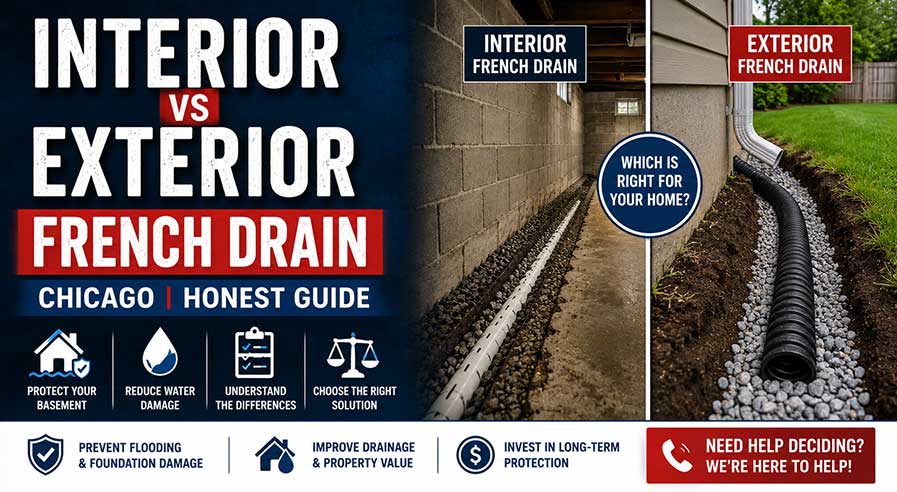
For this guide: exterior French drain means any perforated pipe system installed outside, in the ground, that intercepts water before it reaches the foundation. Interior perimeter drain system means a perforated pipe system installed under the basement floor along the interior perimeter that collects water after it has entered the foundation structure. These are fundamentally different systems solving fundamentally different problems.
Exterior French Drain Systems — What They Actually Do
An exterior French drain is a gravity-powered water interception system. A trench is excavated at a strategic location relative to the foundation — along the perimeter, in the yard, or along the property line — to the depth needed to intercept the water source. The trench is filled with clean stone and a perforated pipe, wrapped in filter fabric to prevent soil from clogging the system. Water moving through the soil reaches the trench, enters the pipe through perforations, and flows by gravity to a discharge point away from the foundation.
The key word is interception. An exterior French drain doesn’t remove water that’s already in the basement or already at the foundation. It intercepts water before it reaches the foundation by providing a lower-resistance path that water follows instead of continuing toward your house. The water never reaches the foundation wall because there’s a more attractive drainage path nearby.
What Exterior French Drains Solve
Surface water accumulation. A yard that pools after rain — standing water that sits for hours or days on flat clay lots throughout Chicago’s western suburbs — is surface water that has no effective drainage path. An exterior French drain in the yard intercepts that pooling water and routes it to a discharge point before it can saturate the soil against the foundation or find its way through above-grade openings.
Lateral groundwater movement. On sloped lots or lots where groundwater moves laterally through the soil toward the foundation from adjacent higher ground, a French drain installed upslope of the foundation intercepts that lateral movement before it reaches the foundation wall. This is the “curtain drain” application — a drain that cuts across the path of groundwater flow to capture it before it arrives.
Surface runoff directed toward the foundation. When a neighbor’s yard, a driveway, or a slope directs surface runoff toward your foundation, an exterior French drain intercepts that flow before it saturates the soil against your foundation walls.
The discharge requirement. Every exterior French drain discharges somewhere — a storm sewer connection, a dry well, a lower area of the property, or a swale. In Chicago and most Chicago suburbs, the discharge point must comply with municipal drainage regulations. Water cannot be discharged to a neighboring property, and in most municipalities it cannot be discharged to the sanitary sewer. Our French drain installation service designs discharge paths that meet the specific requirements of each Chicago-area municipality.
What Exterior French Drains Do NOT Solve
Rising water table from below. When groundwater rises vertically — when the water table elevation reaches or exceeds the basement floor level and pushes water upward through the slab and floor-wall joint — an exterior French drain in the yard does not address this mechanism. The water isn’t moving laterally through the soil past a drain you could intercept. It’s pushing upward from below through hydrostatic pressure. An exterior drain cannot counteract upward hydrostatic pressure from a water table that’s above your basement floor.
Water seeping through foundation walls from direct hydrostatic pressure. When the soil directly against the exterior of your foundation wall is saturated and the weight of that saturated soil pushes water through cracks and pores in the foundation wall, an exterior French drain can help by removing the water from the soil adjacent to the wall — but only if it’s installed at footer depth along the foundation perimeter, which requires significant excavation. A yard French drain 10 feet away from the foundation doesn’t relieve the hydrostatic pressure of the soil directly against the wall.
Interior Perimeter Drain Systems — What They Actually Do
An interior perimeter drain system is not a water prevention system. This is the most important thing to understand about it — and the thing waterproofing companies most consistently fail to say clearly.
An interior perimeter drain system does not stop water from entering your foundation. It manages water after it has already entered.
The installation process: the basement floor is cut along the interior perimeter — typically a 6 to 12 inch strip cut with a concrete saw. The concrete is removed, a trench is excavated to the footer level, perforated pipe is laid in the trench on a gravel bed, and new concrete is poured over the top. The pipe collects water that enters the foundation — through wall cracks, through the wall-floor joint, through floor slab cracks — and routes it to a sump pit where a sump pump discharges it out of the house.
The key phrase: collects water that has already entered. The interior system doesn’t keep water out. It manages the water that comes in.
What Interior Perimeter Drain Systems Solve
Rising groundwater from below — the false water table problem. When the water table rises above the basement floor level, water pushes upward through the slab and floor-wall joint regardless of what’s happening at the exterior foundation wall. An exterior French drain cannot address this because the water isn’t moving through soil that a drain can intercept — it’s coming up from below through hydrostatic pressure. An interior perimeter drain collects this water at the wall-floor joint where it enters, routes it to the sump pit, and the sump pump removes it. The basement stays dry because the water is managed after entry rather than prevented from entering.
Seepage through foundation wall cracks on flat sites. In Chicago’s flat terrain where an exterior foundation perimeter drain would have no natural gravity discharge path, an interior system is sometimes the more practical solution. If there’s no lower elevation to discharge to — if the site is flat enough that an exterior drain’s discharge would require pumping regardless — the interior system’s integration with the sump pump handles the discharge requirement that an exterior drain can’t solve on flat ground.
Active wall seepage in finished basements. When foundation wall cracks are allowing water seepage in a finished basement where excavation of the exterior isn’t practical — finished landscaping, driveway, or structure directly against the foundation — an interior system can manage the seepage without the excavation that exterior work would require.
Year-round installation regardless of weather. Unlike exterior drainage work that’s limited by ground conditions, interior system installation can proceed during any season — including Chicago’s winters when exterior excavation isn’t practical.
What Interior Perimeter Drain Systems Do NOT Solve
Surface water accumulation in the yard. An interior system has no connection to yard drainage. A yard that pools after rain, a slope that directs surface runoff toward the house, a neighbor’s drainage that crosses your property — none of these are addressed by an interior perimeter system. The yard still floods. The surface water still accumulates. The foundation soil is still being saturated by surface water — the interior system simply manages the water that makes it through.
The root cause of foundation water entry. An interior system manages consequences. It doesn’t repair foundation cracks, seal foundation wall failures, or stop water from entering through deteriorated wall materials. The water continues to enter through the same failure points — the system simply catches it before it accumulates on the floor. A homeowner who installs an interior system for a foundation with significant crack failures still has a foundation with significant crack failures. The cracks continue to widen, the water entry points continue to expand, and the interior system simply manages the ongoing entry rather than addressing its progression.
The Waterproofing Company Sales Approach — What to Watch For
The interior perimeter drain system market in Chicago is heavily populated by specialized waterproofing companies — national franchise networks and regional contractors who sell and install only interior systems. These companies market their services aggressively and use sales techniques that Chicago homeowners should understand before inviting them in for a “free inspection.”
The high-pressure estimate timeline. Many waterproofing companies use “today only” pricing or limited-time discounts that disappear if you don’t sign during the initial appointment. This pressure is designed to prevent you from getting competing quotes, doing your own research, or speaking with an honest Chicago area plumber who might tell you an exterior solution is more appropriate. Another issue many homeowners don’t realize is that not every contractor advertising drainage work is legally qualified to perform the entire installation. In Illinois, French drain projects often involve sump pump connections, foundation drainage systems, and plumbing code requirements that go well beyond basic excavation. Before hiring anyone, read our guide explaining why you should hire a licensed plumber instead of a landscaper for French drain installation.
Presenting interior systems as universally superior. The search results for this article include a major national waterproofing franchise that describes exterior systems as “difficult and expensive” while presenting their interior system as “easier” and “more affordable.” This framing is not honest — it presents the advantages of their product without acknowledging the fundamental difference in what problems each system addresses. An exterior drain that actually solves a surface water problem is better than an interior drain that manages water that continues to enter.
“Lifetime warranties” on managed water entry. Interior system warranties cover the system’s performance — the drain collecting and routing water to the sump pump. They don’t warrant that water won’t continue to enter your foundation. A warranty on a system designed to manage ongoing water entry is not the same as a warranty that your basement will stay dry if the system is removed or fails.
What to ask any contractor selling an interior system:
- What is the specific source of the water you’re proposing to manage?
- Would an exterior drain intercept that water source before it reaches the foundation?
- If yes, why is an interior system more appropriate than an exterior one for my specific site?
- If the answer is discharge — the site is too flat for exterior drainage — is the sump pump that will handle the interior system’s discharge adequately sized and backed up for power outages?
The Chicago-Specific Decision Framework
Chicago’s flat terrain, clay-heavy soil, and mix of older and newer housing stock create specific conditions that affect which system is appropriate for each situation.
On Chicago’s Flat Lots — The Discharge Challenge
Chicago and most Chicago suburbs are flat. Flat enough that exterior French drains often can’t discharge by gravity — there’s no lower elevation to route water to without pumping. This is a genuine limitation of exterior drainage on Chicago’s flat terrain, and it’s one of the honest reasons interior systems are frequently appropriate for Chicago basements.
When an exterior French drain’s discharge would require pumping anyway, the comparison between interior and exterior becomes more complex — both systems need pumping on flat sites. The question becomes whether the exterior drain’s interception of water before it reaches the foundation provides enough benefit over the interior system’s management of water after it enters to justify the additional cost of exterior excavation.
On Chicago’s flattest lots with no natural discharge path and groundwater that rises from below, an interior perimeter drain with a properly sized sump pump and battery backup is frequently the appropriate solution. Our sump pump services include battery backup installation that makes interior drain systems reliable during the storm power outages that occur precisely when they’re needed most.
On Chicago’s Clay Soil — The Exterior Drain Clogging Risk
Chicago’s clay-heavy soil is a legitimate challenge for exterior French drains. Clay particles are small enough to migrate through filter fabric over time, progressively clogging the gravel and pipe and reducing the system’s effectiveness. Exterior French drains in Chicago’s clay soil require higher-quality filter fabric, properly sized gravel, and periodic maintenance to prevent clogging — conditions that a properly installed exterior system addresses but that a poorly installed system doesn’t.
Even a properly installed French drain requires periodic inspection and maintenance to continue performing effectively in Chicago’s clay-heavy soils. Over time, sediment migration, root intrusion, and organic debris accumulation can reduce drainage capacity. Our guide on French drain cleaning and maintenance in Chicagoland explains how these systems fail, what maintenance involves, and when cleaning or repairs may be necessary.
Interior systems installed in the “clear zone” inside the foundation are not subject to the clay soil clogging risk because they’re installed in the basement, not in the soil.
For Chicago’s Pre-1960 Homes with Original Foundation Walls
Chicago’s older housing stock — the bungalows, two-flats, and mid-century homes that define the city and inner-ring suburbs — has foundation walls that range from poured concrete to brick to concrete block, with varying degrees of deterioration after 60 to 100 years of service. Original foundation walls in these homes may have multiple crack locations, deteriorating mortar joints, and water entry points throughout the wall face that exterior drainage at the perimeter can’t individually address.
For these homes, the combination approach — exterior drainage to reduce soil saturation pressure against the wall, plus an interior system to manage seepage through existing wall deterioration — is sometimes the most complete solution. The exterior work reduces the volume of water reaching the wall; the interior system manages what gets through anyway.
The EPA WaterSense Home Maintenance Baseline
The EPA’s WaterSense program’s home maintenance guidance emphasizes assessing the specific source of water problems before implementing solutions — a principle that applies directly to the interior vs exterior drainage decision. Knowing whether your water source is surface runoff, lateral groundwater movement, rising water table, or wall seepage from direct hydrostatic pressure determines which system addresses the actual mechanism rather than its consequences.
The Complete Decision Matrix for Chicago Homeowners
| Water Problem | Exterior French Drain | Interior Perimeter Drain |
|---|---|---|
| Yard pooling after rain on flat clay lot | ✅ Primary solution | ❌ Doesn’t address yard |
| Lateral groundwater from upslope | ✅ Curtain drain intercepts it | ❌ Manages what gets through |
| Rising water table from below | ❌ Can’t intercept upward pressure | ✅ Manages water at entry point |
| Foundation wall seepage on flat site | Depends on discharge options | ✅ Manages ongoing seepage |
| Surface runoff directed toward foundation | ✅ Intercepts before arrival | ❌ Manages what gets through |
| Finished basement — no exterior access | Impractical | ✅ Interior-only option |
| Winter installation needed | ❌ Ground conditions | ✅ Year-round installation |
| Multiple entry points throughout walls | Partial help at exterior | ✅ Catches all interior entry |
What Each System Costs in Chicago in 2026
Exterior French drain (yard drain, 20-50 linear feet): $1,500 to $4,000. For surface water interception and lateral groundwater management on flat to gently sloped Chicago-area lots.
Exterior perimeter foundation drain (at footer depth, full perimeter): $8,000 to $20,000+. Requires full excavation around the foundation perimeter — significant disruption to landscaping, hardscape, and any structures against the foundation. Provides the most comprehensive exterior water management but at significant cost and disruption.
Interior perimeter drain system (full basement perimeter): $4,000 to $12,000 depending on basement size, concrete cutting requirements, and sump pump sizing. Less disruptive to install than exterior perimeter drainage but addresses water after entry rather than before.
Combined exterior yard drain + interior perimeter system: $6,000 to $15,000 for homes where both surface water management and rising groundwater management are needed. The combination addresses multiple water sources with appropriate solutions for each.
The cost comparison matters but it’s less important than the mechanism match. A $2,500 exterior French drain that correctly addresses your surface water source is a better investment than an $8,000 interior system that manages water from a source the exterior drain would have intercepted for $2,500. Get the diagnosis right first.
Getting the Diagnosis Right Before Any Contractor Shows Up
The most important step in any drainage decision for a Chicago home is confirming the specific water source before any contractor arrives with a solution. Here’s how to do it yourself:
Watch where the water enters. During or immediately after a significant rain event, watch your basement floor and walls actively. Does water appear first at the wall-floor joint and spread inward? That’s a rising water table signature — interior system territory. Does water appear first at wall cracks, high on the wall, and run down? That’s hydrostatic pressure from saturated exterior soil — potentially addressable by exterior drainage or interior management. Does water appear at window wells or come in from above-grade openings? That’s surface water — exterior French drain territory.
Check the yard during rain. Is water pooling in the yard before any basement entry occurs? Is surface runoff from a neighboring property or slope running toward your foundation? These surface observations point to exterior drainage solutions.
Correlate with events. Does flooding occur specifically during peak storm intensity (surface water indicator) or hours after rain stops as the water table rises (groundwater indicator)? The timing tells you the mechanism.
Use the sump pit. If your home has a sump pit, watch it during rain events. If the pit fills rapidly from water entering through the basement floor and walls, the water table is rising — interior system territory. If the pit fills slowly and the basement stays dry, the sump system is working effectively for your current water volume.
For a complete framework on diagnosing your specific flooding type and matching the right solution to each mechanism, see our complete guide to Chicago flood control systems that actually work.
Our basement flooding services include a complete diagnostic assessment before any system recommendation — we identify the water source first and recommend the system that addresses that specific source, not the system that’s easiest for us to sell.
Frequently Asked Questions
A waterproofing company told me my only option is an interior system because my yard is too flat for an exterior drain. Is that true? Flat sites do limit gravity discharge options for exterior drains — this is a genuine constraint. However, an exterior yard French drain that discharges to a sump pit (which then pumps out) is a viable option on flat sites where the flooding source is surface water or lateral groundwater. The question is whether your specific flooding source is better addressed by intercepting water before it reaches the foundation (exterior) or managing it after entry (interior). A flat site doesn’t automatically mean exterior drainage is impossible — it means discharge planning requires a sump component.
Can I have both an interior and exterior system? Yes — and in some Chicago homes, the combination is the right approach. Exterior yard drainage addresses surface water and lateral groundwater movement. An interior perimeter system manages rising water table that the exterior drain can’t intercept. The combination addresses multiple water sources with the appropriate mechanism for each. The combined cost is higher but the combined protection is more comprehensive for homes with multiple flooding mechanisms.
The interior system company offers a “lifetime warranty.” The exterior drain company doesn’t. Does that mean the interior system is better? The warranty covers different things. An interior system warranty covers the system’s performance — the drain pipe collecting water and routing it to the sump. It doesn’t warrant that water won’t continue to enter your foundation through the same failure points the system is managing. An exterior drain that correctly intercepts your water source may not need a lifetime warranty because it eliminates the water source rather than managing it indefinitely.
My basement has both wet walls and pooling on the floor during heavy rain. Which system addresses both? Wet walls from hydrostatic pressure and floor pooling from a rising water table are both interior-system-appropriate problems — both involve water that’s entered or is entering through the foundation structure rather than surface water that an exterior system would intercept. An interior perimeter drain installed at footer level collects water at the wall-floor joint and manages both wet wall seepage and floor water entry simultaneously.
Not Sure Which Drainage System Your Chicago Home Actually Needs? Let’s Figure It Out Together.
Licensed, insured, and locally based in Brookfield since 1978. We diagnose your specific water source before recommending any system — exterior French drain, interior perimeter drain, sump pump, or a combination. No high-pressure sales, no same-day signature required, no system recommended until we understand your specific flooding mechanism. Written quotes before we start, our own licensed plumbers on every call. Send us a message and we’ll get back to you fast.
Or call us directly: 708-801-6530 | Open 24/7
—
Suburban Plumbing Sewer Line & Drain Cleaning Experts
Licensed & Insured | Open 24 Hours | Serving Chicago & Suburbs Since 1978
📞 Suburbs: 708-801-6530 | 📞 Chicago: 773-570-2191 | 🚨 Emergency: 708-518-7765