
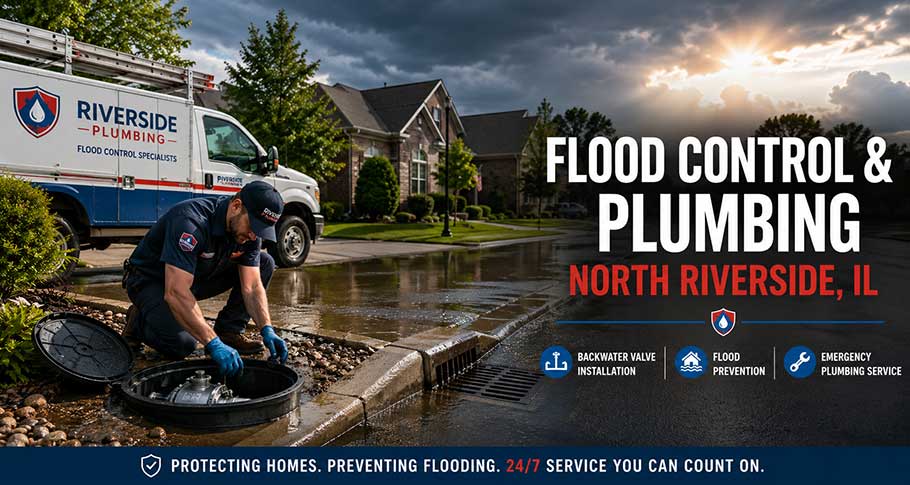
The Complete Guide for North Riverside Homeowners Who Want to Understand What’s Happening Underground Before the Next Heavy Rain
North Riverside calls itself “The Small Community With A Big Heart” — and the description fits. At just over 6,600 residents packed into one of Cook County’s most densely developed communities, North Riverside has the character of a Chicago neighborhood compressed into a standalone village. It borders Riverside to the west, Brookfield to the north and east, and Berwyn to the east — a tight geographic cluster of established communities sharing the same vintage infrastructure, the same combined sewer challenges, and increasingly, the same basement flooding concerns that are driving millions of dollars in public investment throughout this entire corridor.
Here’s what that means for North Riverside homeowners: the neighboring communities surrounding North Riverside on all sides are spending significant public dollars specifically because their underground plumbing infrastructure is aging and failing. Riverside is issuing $11 million in bonds to fund water main replacement and storm sewer separation because extreme rain events and basement flooding have become more frequent. Brookfield — where Suburban Plumbing Experts has been based since 1978 — approved a $63.9 million budget with $16.6 million specifically dedicated to infrastructure projects including a $4 million lead service line replacement project. Homeowners who want a deeper understanding of Brookfield’s infrastructure projects, lead service line replacement program, flood mitigation opportunities, and Salt Creek flooding risks can read our Complete Plumbing & Flood Control Guide for Brookfield, IL.
These aren’t unrelated events. North Riverside’s housing stock, its underground infrastructure, and its position in the combined sewer system that serves this entire Cook County corridor all date from the same era as the infrastructure its neighbors are now replacing. The public side of that infrastructure is being addressed by municipal investment. The private side — the sewer lateral from your home to the main, the water service line, the drain pipes inside your walls — remains your responsibility, and it’s the same age as what the neighboring villages are fixing.
Our team has already installed flood control systems in North Riverside — we know this community, its housing stock, and its underground conditions. This guide covers everything North Riverside homeowners need to know, and our North Riverside plumbing services are available here if you need help locally.
What Makes North Riverside’s Underground Plumbing Challenge Unique
Dense, Older Housing Stock in a Small Geographic Footprint
North Riverside is one of the smallest incorporated villages in Cook County by area — and one of the most densely developed. The housing stock that fills this small footprint is predominantly mid-20th century construction — the ranches, bungalows, and split-levels that were built when the community developed in the post-war decades. This means the majority of North Riverside homes have:
- Clay tile sewer laterals installed 55 to 70 years ago
- Cast iron drain lines with decades of interior accumulation
- Copper supply lines approaching or entering the age range where Chicago’s hard water produces pinhole failures
- Potential lead service lines or lead connector joints — the same issue that’s driving Brookfield’s $4 million replacement project next door
In a small, dense community like North Riverside, these aging pipe conditions aren’t isolated to a few older homes. They’re characteristic of the entire village’s residential infrastructure.
The Cook County Combined Sewer System
North Riverside is served by Cook County’s combined sewer infrastructure — the same system that serves Chicago and the inner-ring communities throughout this corridor. For a breakdown of how stormwater enters and moves through local drainage systems — including catch basins that collect street runoff before it enters the sewer — see our Catch Basin Cleaning, Pumping & Repair Guide for Riverside & North Riverside. As the MWRD’s Understanding Your Sewer resource explains, Chicago’s combined sewer system carries both stormwater and sanitary waste in the same pipes. During heavy rain events that overwhelm system capacity, pressure reverses through residential laterals — producing the floor drain backup that North Riverside homeowners experience during significant storms.
The Riverside infrastructure investment being made right next door specifically acknowledges this mechanism. Riverside’s $11 million bond project includes a major storm sewer separation project along Longcommon Road — separating storm and sanitary waste into separate pipes to reduce flooding. The reason this investment is needed: extreme rain events and basement flooding have become more frequent in this corridor. The combined sewer system that served the community adequately for decades is under increasing pressure from more intense storm events.
That pressure doesn’t respect municipal boundaries. What Riverside homeowners experience during a major storm event, North Riverside homeowners experience too — because the combined sewer infrastructure they connect to serves the same system. Homeowners in both communities face many of the same plumbing challenges, from aging sewer laterals and drain issues to basement flooding concerns and flood protection needs. Our Riverside & North Riverside, IL: Plumbing & Drain Guide covers these shared issues in more detail.
Your Neighbor’s Infrastructure Investment Is a Signal About Your Home
The $11 million Riverside investment and the $4 million Brookfield lead service line project aren’t just news about neighboring communities. They’re signals about the condition of infrastructure throughout this corridor.
When a neighboring municipality identifies that its water mains need replacement, that its combined sewers need separation, and that its lead service lines need replacement — it’s identifying conditions that reflect the age of infrastructure throughout the area. North Riverside’s homes were built in the same decades, connected to infrastructure from the same era, in the same Cook County combined sewer environment.
The Village of North Riverside provides excellent community services and maintains its public infrastructure — but as in every community, the private-side plumbing of individual homes is the homeowner’s responsibility. The public investment happening around North Riverside improves the shared infrastructure. The water service line from the main to your house, the sewer lateral from your house to the main, and the drain and supply lines inside your home remain yours.
The Three Flooding Types in North Riverside — What Each One Requires
Type 1: Combined Sewer Surcharge Backup
The most common and most damaging flooding event in North Riverside — sewage-odored water backing up through the basement floor drain during or after heavy rain. This is the combined sewer surcharge mechanism: the system’s capacity is overwhelmed, pressure reverses through residential laterals, and the floor drain is the lowest available exit point.
The diagnostic signature: Water with sewage odor. Appears during or after heavy rain. Comes up through floor drain openings. The sump pump may be running perfectly at the same time — it’s irrelevant, because the backup is entering through the drain system, not through groundwater pathways.
What doesn’t work: A sump pump cannot stop sewer surcharge backup. The sump pump has no connection to your sewer lateral. For the complete explanation of why this is one of Chicago’s most common and most expensive flood control mistakes, see our complete guide to Chicago flood control systems that actually work.
What works: A backwater valve — installed in the main sewer lateral in the basement floor — physically prevents combined sewer pressure from entering your home’s drain system during a surcharge event. Our team has installed flood control systems in North Riverside homes specifically for this mechanism. Our sewer backflow prevention services handle backwater valve installation throughout North Riverside with all permits included.
For homeowners who have experienced repeated severe sewer backup or who want permanent protection rather than mechanical protection, an overhead sewer conversion eliminates the below-grade connection entirely — making sewer backup physically impossible regardless of what happens in the combined sewer main. Our overhead sewer services cover the full conversion process throughout the North Riverside area.
Type 2: Groundwater Intrusion
Water entering gradually through the basement floor slab, floor-wall joints, or accumulating in the sump pit during sustained rain events. The source is a rising water table in Cook County’s clay-heavy soil — hydrostatic pressure pushing upward against the foundation.
The diagnostic signature: Water with no sewage odor. Enters gradually during or after sustained rain. Appears through the floor or at the wall-floor joint. The sump pump activates or should be activating.
What works: A properly functioning sump pump with battery backup is the primary defense. For North Riverside’s finished basements specifically — and a significant percentage of North Riverside homes have finished basements — the combination of groundwater intrusion risk and the cost of finished basement damage makes battery backup not optional but essential. Our sump pump services cover North Riverside with same-day and 24/7 emergency response.
Type 3: Both Simultaneously
Many North Riverside homes with older clay tile laterals in the Cook County combined sewer environment face both sewer surcharge backup AND groundwater intrusion during significant storm events. The two mechanisms are distinct — different water sources, different entry points, different solutions — but they can occur in the same storm. Complete flood protection in these homes requires solutions for both: a backwater valve or overhead conversion for the sewer surcharge, and a properly functioning sump pump with battery backup for the groundwater.
The Lead Service Line Question in North Riverside
With Brookfield — directly adjacent to North Riverside — actively spending $4 million to replace lead service lines, every North Riverside homeowner who hasn’t confirmed their service line material should do so. The same housing era that produced Brookfield’s lead service line inventory produced North Riverside’s. The same Illinois mandatory replacement requirements that are driving Brookfield’s investment apply equally to private-side service lines in North Riverside.
How to confirm: Find the pipe where it enters your home at the water meter or foundation wall. Scratch the surface with a key. Lead is bright, shiny silver underneath and soft enough to dent with pressure. Copper is copper-colored. Galvanized is gray and harder.
What the approaching April 2027 Illinois deadline means: Illinois mandatory replacement timelines are actively approaching. Private-side lead service lines are the homeowner’s responsibility — the Brookfield project addresses public-side infrastructure. If you have a private-side lead service line, the decision timeline for replacement is now rather than later. For the complete guide on what’s involved and what it costs, see our lead service line replacement service.
The Sewer Lateral Picture in North Riverside
For North Riverside homes built between the 1940s and 1970s — which describes most of the village’s residential stock — the clay tile sewer lateral is now 50 to 80 years old. In the dense, mature-tree residential streets of North Riverside, those laterals have been under root pressure from established trees for decades.
A sewer camera inspection of a North Riverside clay tile lateral almost always reveals some degree of root intrusion at joint gaps — exactly the condition that the mature neighborhood tree canopy produces. The question isn’t whether root intrusion exists; it’s how advanced it is and whether it’s at a level that warrants targeted repair or continued maintenance cleaning.
What to do: Schedule a sewer camera inspection of the private lateral if you’re in an older North Riverside home that hasn’t had one in the current ownership period. The camera provides the specific information that makes every subsequent decision — how often to clean, whether repairs are warranted, whether a backwater valve is appropriate — accurate rather than speculative. For a complete guide to every warning sign a sewer lateral sends, see our complete Chicago sewer line warning signs guide. Our sewer camera inspection service is available throughout North Riverside with same-day scheduling.
North Riverside’s Housing Age and What It Means for Your Drains
North Riverside’s post-war housing stock has cast iron drain lines inside the home — the same material that accumulates the calcium-reinforced grease matrix described in our complete guide to the #1 cause of drain clogs in Chicago homes. In North Riverside’s compact kitchen layouts characteristic of mid-century ranches and bungalows, the kitchen drain branch typically runs through cast iron drain lines that are now 50 to 70 years old.
Annual hot water hydro jetting of kitchen drain lines in these homes removes the grease-mineral wall deposits that rodding compresses but never removes — breaking the recurring 6-to-8-week clog cycle that North Riverside homeowners with older homes often accept as normal. For the complete drain cleaning service including camera inspection and hydro jetting, see our drain cleaning services.
What Flood Control and Plumbing Services Cost in North Riverside in 2026
Backwater valve installation (with permits): $2,500 to $5,500. The targeted solution for combined sewer surcharge backup in North Riverside’s Cook County combined sewer environment.
Overhead sewer conversion: $12,000 to $30,000. Permanent protection for homeowners who have experienced repeated severe flooding or who want structural rather than mechanical protection.
Sump pump replacement with battery backup: $700 to $1,500 installed. The highest-value groundwater protection upgrade for North Riverside homes with existing sump systems.
Sewer camera inspection: $200 to $450. The diagnostic investment that confirms lateral condition and makes every flood control and repair decision accurate.
Hot water hydro jetting (kitchen drain): $350 to $600. The complete pipe wall cleaning service for North Riverside’s older cast iron kitchen drain lines.
Lead service line replacement: $3,500 to $8,000 for most North Riverside residential situations.
Our basement flooding services and flood control systems include a complete flood type assessment before any installation is recommended.
What North Riverside Homeowners Should Do Right Now
If you’ve experienced floor drain backup during heavy rain: The source is almost certainly combined sewer surcharge. A backwater valve assessment is the appropriate next step before the next storm season — not after it.
If your home was built before 1970 and hasn’t had a sewer camera inspection: Schedule one. A 50-to-70-year-old clay tile lateral in Cook County under mature trees has had enough freeze-thaw and root pressure cycles to develop joint conditions worth knowing about before an emergency makes them urgent.
If your sump pump is more than 7 years old: Have it assessed. Add battery backup if not present. North Riverside’s finished basements deserve better protection than an aging pump without backup during a storm that may knock out power.
If you haven’t confirmed your service line material: Do the scratch test. With Brookfield next door spending $4 million specifically on lead service line replacement, the question is worth answering before the mandatory replacement deadline approaches.
Frequently Asked Questions: North Riverside Plumbing and Flood Control
My floor drain backed up during last summer’s storm but it’s been dry since. Does that mean it won’t happen again? No. A single combined sewer surcharge backup event confirms your home’s floor drain connection is exposed to combined sewer pressure during peak storm events. The absence of subsequent backups reflects the absence of subsequent storms of sufficient intensity — not a resolved condition. The next storm of sufficient intensity will produce the same result without a backwater valve installed.
My neighbor had a backwater valve installed but still flooded during a major storm. Do they really work? A properly installed, properly maintained backwater valve stops combined sewer surcharge backup — the mechanism it’s designed to prevent. If flooding occurred after installation, either the flooding was from a different mechanism (groundwater, surface drainage) that the valve doesn’t address, or the valve experienced a mechanical issue. Valve maintenance and the occasional groundwater flooding that occurs simultaneously with sewer events are both worth assessing after any post-installation flood event.
Does the Riverside infrastructure project affect North Riverside? The Riverside project improves public infrastructure on the Riverside side of the municipal boundary. North Riverside connects to its own municipal infrastructure. However, both communities are served by the Cook County combined sewer infrastructure — improvements to combined sewer capacity in adjacent communities benefit the overall system that North Riverside connects to. What the Riverside project doesn’t address is the private-side infrastructure in North Riverside homes.
Need Flood Control or Plumbing Service in North Riverside? We’re Right Next Door.
Licensed, insured, and based in Brookfield since 1978 — directly adjacent to North Riverside. We’ve installed flood control systems in North Riverside homes and serve the entire surrounding corridor. Backwater valves, overhead sewer, sump pump service, sewer camera inspection, and drain cleaning — all with written quotes before we start, permits on every job, our own licensed plumbers on every call. Send us a message and we’ll get back to you fast.
Or call us directly: 708-801-6530 | Open 24/7
—
Suburban Plumbing Sewer Line & Drain Cleaning Experts
Licensed & Insured | Open 24 Hours | Serving North Riverside & Cook County Since 1978
📞 North Riverside: 708-801-6530
🚨 Emergency: 708-518-7765