
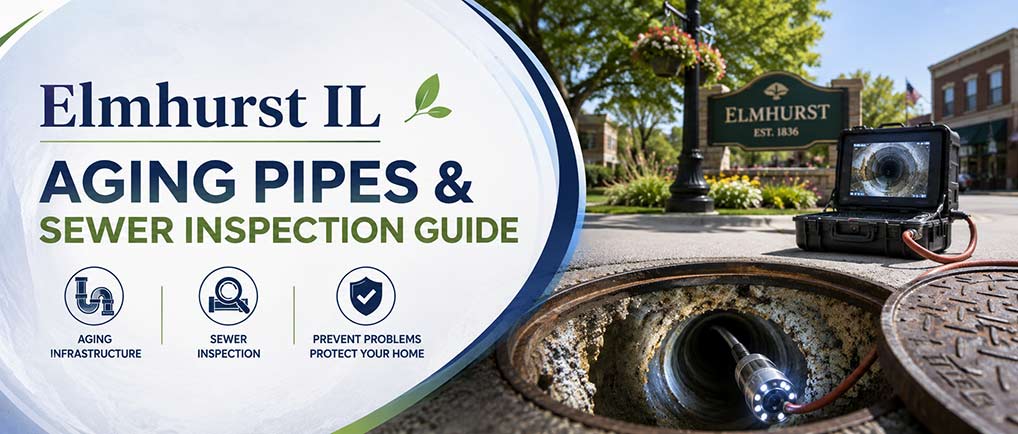
41% of Elmhurst Homes Were Built Between 1940 and 1960. Here’s What’s Actually Running Through Their Walls — and What Every Owner Needs to Know Before Something Forces the Issue.
Elmhurst is, at its core, a postwar city. A full 41 percent of its housing stock was built between the 1940s and the 1960s — the capes, ranches, split-levels, and brick colonials that define block after block of the city’s residential character. Those homes were built well. Many have been lovingly maintained and passed between generations. But the plumbing systems inside them were installed in a different era, with materials that have finite lifespans — and for a significant portion of Elmhurst’s housing stock, those lifespans are now expired, approaching expiration, or already producing the symptoms that homeowners are treating as routine maintenance rather than infrastructure signals.
This guide is not about flooding or rebate programs — that is covered in depth in our complete Elmhurst flood control and rebate guide. This guide is about the pipes themselves — what materials were used in each construction era, what those materials look like after 60 to 80 years in DuPage County’s freeze-thaw environment, what the warning signs of each failure mode are, and what the City of Elmhurst’s illegal connection rules mean for homes that have never been assessed. It is the guide for the Elmhurst homeowner who wants to understand what is actually running through the walls and under the yard before something forces the issue at the worst possible time.
Elmhurst’s Construction Eras — What Each One Means for Pipes
Pre-1940: The Historic Downtown and Cottage Hill Stock
The streets immediately surrounding downtown Elmhurst, Elmhurst University, and the original Cottage Hill settlement contain the city’s oldest housing stock — a meaningful percentage of homes that predate World War II, with some dating to the late 1800s and early 1900s. These are Elmhurst’s most architecturally significant residential properties, and they carry the most complex pipe history.
Original cast iron drain systems in pre-1940 Elmhurst homes are now 85 to 130 years old. Cast iron at this age has been through the full progression of internal corrosion — from the early surface oxidation that begins within years of installation, through the mid-life scaling that progressively narrows internal diameter, to the late-stage pitting and perforation that produces sewer gas entry into wall cavities and slow structural seepage. A pre-1940 Elmhurst home that has had recurring slow drains, gurgling fixtures, or drain odors that come and go is exhibiting the specific symptom pattern of late-stage cast iron degradation — not a clog problem, but a pipe condition problem that recurring drain cleaning is managing rather than resolving.
Original galvanized steel supply lines in these homes — where they have not been replaced — are similarly at or past end of life. These older plumbing systems are also far more vulnerable to winter freeze damage, making it worthwhile to review our guide to frozen and burst pipes in Elmhurst before the next cold snap. A pre-1940 Elmhurst home with original galvanized supply lines delivering reduced pressure, brown-tinged first-draw water, or intermittent discoloration is showing the late-stage galvanized failure pattern. The only repair is replacement — typically with copper or PEX, which requires permit and inspection from the City of Elmhurst.
1940s–1960s: The Heart of Elmhurst’s Housing Stock
This is the dominant construction era for Elmhurst — the postwar boom that produced the majority of the city’s single-family homes. These properties carry three specific pipe material concerns that are now reaching or past their design service life simultaneously.
Nearby DuPage County communities with similar postwar development patterns face many of the same plumbing challenges. Villa Park, like Elmhurst, has a large concentration of mid-century homes with aging sewer laterals, older supply lines, mature tree canopies, and plumbing systems now entering critical maintenance years. Our complete guide to plumbing, sewer, and flood control in Villa Park explains the infrastructure issues local homeowners should understand and the solutions available to protect their homes.
Clay tile sewer laterals: Homes built in this era almost universally have clay tile — terracotta bell-and-spigot sections — as their sewer lateral material. Clay tile laterals from the 1940s through 1960s are now 60 to 85 years old. In DuPage County’s freeze-thaw soil environment, under Elmhurst’s mature elm, oak, and silver maple canopy — the trees that give the city its character and its name — those lateral joints have been under continuous root pressure and soil movement pressure for their entire service life. Clay tile pipes have a design life of 50 to 60 years. A significant share of Elmhurst’s 1940s–1960s laterals are operating beyond that design life today.
Orangeburg pipe: This is the pipe material that surprises most Elmhurst homeowners when a camera inspection reveals it. Orangeburg — a composite material made from layers of wood pulp and pitch — was widely used for sewer laterals between approximately 1945 and 1975 as a cheaper alternative to clay tile. It was never a long-term material. Orangeburg has a rated service life of 30 to 50 years, meaning every Orangeburg lateral still in the ground in Elmhurst is operating well beyond its intended lifespan. Orangeburg does not fail the way clay tile fails — it does not crack or develop root intrusion at joints. It deforms. The pipe walls soften over time from groundwater contact, and the round pipe gradually collapses into an oval and eventually a flat cross-section that restricts and eventually stops flow entirely. A camera inspection of an Orangeburg lateral shows a pipe that looks like a flattened oval — sometimes a pipe that has partially or completely closed. No amount of rodding addresses Orangeburg deformation. Once it is deforming, replacement is the only solution. If your Elmhurst home was built between 1945 and 1975 and has never had the lateral camera inspected, Orangeburg is a real possibility.
Galvanized supply lines: Mid-century Elmhurst construction used galvanized steel for supply lines throughout — the same material as the pre-1940 stock, now at a slightly younger but still fully depleted service age. A 1955 Elmhurst home with original galvanized supply has pipes that are now 70 years old. The zinc coating on galvanized steel depletes over 20 to 50 years depending on water chemistry. At 70 years, the coating is long gone and the bare steel interior has been oxidizing for decades. The result is progressive pressure reduction throughout the home — particularly noticeable at upper-floor fixtures — rust-colored water first thing in the morning, and eventually pinhole failures at corroded sections.
1970s–1980s: The Transition Generation
Homes built in Elmhurst between 1970 and 1985 represent the transition from legacy materials to modern ones — but that transition was not clean or uniform. A 1972 Elmhurst home may have a clay tile lateral or an early PVC lateral depending on the specific contractor and when in the year it was built. Interior drain lines from this era are typically cast iron — still used through the mid-1980s — now 40 to 55 years old, approaching the early-middle stage of internal scaling.
Copper supply lines from the 1970s and 1980s are now 40 to 55 years old. In DuPage County’s hard water environment — 8 to 10 grains per gallon from the Lake Michigan supply system — copper at this age is entering the pitting corrosion stage. Pitting corrosion in copper produces pinhole leaks that appear behind cabinets, inside walls, and under slabs without warning. A 1970s Elmhurst home that has had unexplained moisture in walls, ceiling stains from no obvious source, or water meter readings inconsistent with usage may have pinhole copper failures that have been leaking slowly before detection.
Sump pumps installed in finished basements during 1970s and 1980s construction are now 35 to 50 years old — well past the 10-to-15-year service life of a residential sump pump. Any original sump pump from this era still in service is operating on borrowed time.
Post-1985: Generally Sound but Not Exempt
Post-1985 Elmhurst construction uses PVC laterals and supply systems that are structurally sound. The primary concerns in this housing vintage are age-related mechanical failures — sump pumps and ejector pumps from the 1990s and early 2000s are now 25 to 35 years old, and water heaters from the same period have long since been replaced at least once. For finished basements in post-1985 homes, the ejector pump system should be assessed for current code compliance — many installations from this era are missing required components that create sewer gas risk.
The Orangeburg Problem — What Elmhurst Homeowners Need to Know
Why Camera Inspection Is the Only Way to Know
Orangeburg pipe produces almost no surface symptoms until it is in advanced deformation — and by the time symptoms appear, the pipe is typically already partially collapsed and requiring replacement. A home with Orangeburg pipe may have completely normal drain performance right up until a section closes enough to trap solids and create a blockage — at which point the first symptom is a complete backup, not a gradual slowdown.
This is the critical reason camera inspection is not optional in pre-1975 Elmhurst homes that have never had the lateral assessed: without a camera, there is no way to know whether the lateral is clay tile, Orangeburg, early PVC, or a combination of materials. Orangeburg cannot be identified from the surface, cannot be confirmed by drain performance, and cannot be treated by any maintenance approach short of replacement. Our sewer camera inspection service covers all of Elmhurst with same-day scheduling and produces a complete video record of lateral condition from foundation to main.
What Orangeburg Replacement Involves
When camera inspection confirms Orangeburg pipe, the repair path is straightforward: full replacement of the deformed sections with PVC. In Elmhurst, lateral work requires a City of Elmhurst permit and inspection. The City of Elmhurst also maintains an illegal connection ordinance — meaning any lateral work that is performed also requires confirming that no illegal connections exist and correcting them if they do. Understanding the illegal connection rules before any lateral work begins prevents compliance surprises mid-project.
Elmhurst’s Illegal Connection Rules — What They Are and Why They Matter
What an Illegal Connection Is
The City of Elmhurst’s sanitary sewer is a separate system — it carries sanitary waste only, not stormwater. An illegal connection is any connection that allows stormwater to enter the sanitary sewer. The City of Elmhurst defines illegal connections to include: downspout connections to the house sewer line, sump pump discharge connections to the house sewer line, area drain connections to the sanitary sewer, and defective house sewer lines that allow groundwater to enter the sanitary system through cracks or joint failures.
This matters for Elmhurst homeowners in two specific situations. First: if your sump pump currently discharges into the floor drain or a drain line rather than outside the building or to a dedicated drywell, that is an illegal connection under City of Elmhurst ordinance. Second: if your downspouts connect to underground drain lines that tie into the sanitary sewer rather than the storm sewer or the ground surface, those are illegal connections. Neither of these conditions is immediately visible without knowing specifically what each discharge point connects to.
Why This Matters Specifically During Lateral Work or Permit Applications
When a homeowner in Elmhurst pulls a permit for lateral repair, overhead sewer installation, or check valve installation — including under the City’s cost-sharing rebate programs — the City requires that illegal connections be identified and corrected as part of the permitted work. A homeowner who applies for the overhead sewer rebate, begins the project, and discovers mid-work that their sump pump has been illegally connected to the sanitary sewer faces an expanded project scope and additional cost that was not in the original contractor’s quote.
Identifying illegal connections before applying for any permit — as part of a pre-project assessment rather than during the permitted work — is the correct sequence. It allows the full scope of required corrections to be included in the contractor quote and the rebate application from the start. Our sewer camera inspection service includes assessment of visible discharge connections and drain configurations as part of the full lateral assessment.
The Pre-Purchase Sewer Inspection — Why It Matters in Elmhurst Specifically
What a Home Inspector Misses
Standard home inspections in Illinois do not include sewer lateral inspection. The inspector examines accessible components — visible drain lines in the basement, the water heater, the sump pump — but does not camera-inspect the underground lateral from the foundation to the public main. This is not a deficiency in the inspection — it requires specialized equipment and is outside standard inspection scope. It is, however, a significant gap for a buyer purchasing a pre-1975 Elmhurst home where Orangeburg pipe is a real possibility and clay tile lateral condition is unknown.
The cost of a pre-purchase sewer camera inspection in Elmhurst — typically $175 to $350 — is one of the highest-return investments available to a home buyer. The findings either provide confidence that the lateral is in serviceable condition, identify maintenance items to negotiate into the purchase price, or reveal a lateral condition requiring replacement at $8,000 to $25,000 that fundamentally changes the economics of the transaction. Discovering a collapsed Orangeburg lateral three months after closing — when the first significant backup occurs — produces a repair bill that no home warranty covers and no seller is available to discuss.
For any Elmhurst home built before 1980 being purchased, our strong recommendation is a dedicated pre-purchase sewer camera inspection separate from and in addition to the standard home inspection. The camera goes in the cleanout at the foundation and travels the full lateral to the main — showing joint condition, pipe material, root intrusion, deformation, and any offset sections that represent near-term failure risk. We provide same-day scheduling and a written report with video that can be shared with the buyer’s attorney and used in purchase negotiations.
Cast Iron Interior Drain Lines — The System Inside the Walls
What Cast Iron Looks Like After 60 to 80 Years
The sewer lateral gets most of the attention in older Elmhurst homes — but the cast iron drain stack and horizontal drain lines inside the building carry the same age and face the same progressive degradation. In a 1955 Elmhurst home, the interior cast iron is now 70 years old. In a 1940 home, it is 85 years old.
Cast iron drain line failure follows a predictable internal progression. In the early decades, the pipe performs normally — cast iron is robust and the internal surface remains sound. By mid-life, mineral scale from water chemistry begins accumulating on interior surfaces, and early surface oxidation begins on horizontal sections where waste pools between uses. By late life — where many of Elmhurst’s oldest homes now are — the scale has progressively narrowed the pipe’s effective internal diameter, horizontal sections show significant pitting corrosion, and hub joints have developed gaps where pipe sections have pulled apart over decades of thermal cycling and building movement.
The surface symptom of late-stage cast iron interior drain degradation is a specific pattern: slow drains throughout multiple fixtures simultaneously, gurgling sounds from one fixture when another drains, and recurring drain cleaning calls that provide decreasing intervals of relief. This pattern means the drain system’s capacity has been reduced by scale accumulation — not by a discrete blockage that cleaning removes, but by progressive narrowing that cleaning temporarily relieves before scale rebuilds. Our complete guide to why Chicago-area cast iron pipes are failing right now covers the full failure progression and what camera inspection reveals at each stage.
Pipe Relining as the Alternative to Full Replacement
Full replacement of cast iron interior drain lines in an occupied Elmhurst home is a significant project — opening walls in multiple rooms, coordinating access across the full height of the building, and a multi-day service interruption. For cast iron in the mid-to-late stage of internal corrosion that retains structural integrity — no perforations, no joint separations beyond minor gaps — cured-in-place pipe lining (CIPP) is the less disruptive alternative. A resin-saturated liner inserted into the existing cast iron and cured in place creates a new pipe surface inside the old one without opening walls. The result is a smooth, root-resistant interior that restores flow capacity and has a rated service life of 50 or more years.
CIPP relining is not appropriate for every cast iron condition. Perforated sections, severely displaced joints, and collapsed areas require physical access and repair before lining can be effective. Camera inspection of the interior drain system — not just the lateral — determines which sections are candidates for relining and which require replacement, and produces the scoping information needed for an accurate contractor quote.
What Elmhurst Homeowners Should Do Right Now — In Order of Priority
Step 1 (pre-1975 homes): Schedule a sewer camera inspection if you have never had one. The lateral condition question — clay tile, Orangeburg, or early PVC — cannot be answered any other way. If you have been rodding annually, if you have had a backup in the past two years, or if your home predates 1975 and has never been assessed, this is the foundational diagnostic step for every other decision about your sewer system. Our camera inspection service covers Elmhurst with same-day scheduling.
Step 2 (pre-1960 homes): Assess your supply lines. If your home was built before 1960 and has never had supply line replacement — or if you have reduced pressure on upper floors, brown first-draw water, or intermittent discoloration — have the supply line material confirmed. Galvanized supply lines past their service life need replacement, not temporary fixes. Our home repiping service covers the full supply line assessment and replacement process throughout Elmhurst.
Step 3: Assess your sump pump age and battery backup. Any sump pump more than 10 years old without a documented service history should be inspected. Any sump pump without battery backup in an Elmhurst home is a basement-flooding risk during the storms that also knock out power. Battery backup is not optional — it is the protection that functions precisely when the grid does not.
Step 4: Confirm your sump pump and downspout discharge points. Check where your sump pump discharges — if it discharges into a floor drain or a drain line rather than outside the building, that is an illegal connection under City of Elmhurst ordinance. Check whether downspouts connect to underground drains — if those drains tie into the sanitary sewer rather than the storm sewer or the surface, those are illegal connections. Identifying and correcting these before a permit application prevents mid-project scope surprises.
Step 5 (buying a home): Add a pre-purchase sewer camera inspection. For any Elmhurst home built before 1980, a dedicated lateral camera inspection before closing is the single most valuable add-on to any standard home inspection. Orangeburg and aged clay tile do not announce their condition — they wait for the first significant backup to reveal it. The inspection costs a fraction of the repair and gives you negotiating information before you close.
Frequently Asked Questions: Elmhurst Aging Pipes and Sewer Laterals
My Elmhurst home was built in 1958. I’ve been rodding the main drain once a year for the past five years. Is that normal?
Annual rodding on a 1958 Elmhurst home is a signal, not a maintenance routine. A lateral that requires rodding every 12 months almost always has one of three underlying conditions: root intrusion at clay tile joints that regrows from the same entry point after every clearing, Orangeburg deformation that traps solids at the narrowed cross-section regardless of how thoroughly the line is cleared, or scale accumulation inside cast iron interior drain lines that rebuilds quickly after clearing. Camera inspection after this pattern of service calls is the correct diagnostic step — it identifies which of these three conditions is actually present and determines whether the lateral can be relined or requires replacement. Continuing annual rodding without a camera assessment is the most expensive long-term approach to a structural pipe condition.
What exactly is Orangeburg pipe and how do I know if I have it?
Orangeburg is a composite sewer pipe material made from compressed wood pulp and pitch, manufactured primarily between 1945 and 1975. It was widely used in postwar construction as a cheaper alternative to clay tile and was installed in thousands of Elmhurst homes built during that period. It cannot be identified from the surface, cannot be confirmed by drain behavior, and the only way to know definitively whether your lateral contains Orangeburg is camera inspection. If your home was built between 1945 and 1975 and has never been camera inspected, Orangeburg is a genuine possibility that warrants confirmation before the next significant drain issue forces the question under emergency conditions.
My sump pump currently discharges into the basement floor drain. Is that a problem?
Yes — under City of Elmhurst ordinance, a sump pump that discharges into the floor drain or any connection to the sanitary sewer is an illegal connection. The sanitary sewer is designed to carry sanitary waste only; sump pump discharge during a rain event adds significant clean water volume to the sanitary system at exactly the moment it is already near capacity. The correct discharge configuration is either outside the building to grade — with the discharge point directed away from the foundation — or to a dedicated drywell that allows the water to percolate into the ground. Correcting this configuration is typically a straightforward plumbing modification. It is also required as part of any permitted lateral or flood control work in Elmhurst.
I’m buying a 1962 Elmhurst home. The home inspector didn’t find any plumbing issues. Should I still get a sewer camera inspection?
Yes — without question. A standard home inspector does not camera-inspect the underground lateral. They inspect accessible, visible components. A 1962 Elmhurst home has a sewer lateral that is now 63 years old — clay tile or potentially Orangeburg — that has been in DuPage County soil under the property’s trees for its entire life. The home inspector’s clean report tells you nothing about the lateral’s condition. A pre-purchase camera inspection is the only tool that does. If the lateral is in serviceable condition, you close with confidence. If it shows Orangeburg deformation, advanced root intrusion, or a belly — you have specific, documented findings to negotiate with the seller before the problem becomes your problem after closing.
Can cast iron drain lines be relined rather than replaced?
In many cases, yes — cured-in-place pipe lining is a viable alternative to full replacement for cast iron that retains structural integrity. The prerequisite is camera inspection to determine whether the existing cast iron is a suitable host for the liner: the pipe must be free of perforations, severe joint separations, and collapsed sections before lining. Scale and corrosion alone do not disqualify a pipe from relining — the lining process addresses the interior surface condition. For occupied Elmhurst homes where opening walls in multiple rooms would be highly disruptive, relining is often the preferred solution when the cast iron’s condition makes it a candidate. Camera inspection is the first step that determines whether relining is appropriate or whether physical replacement of specific sections is required first.
Concerned About What’s Running Through Your Elmhurst Home’s Pipes? Let’s Find Out Before Something Forces the Issue.
Licensed, insured, and serving Elmhurst since 1978. We handle sewer camera inspection, Orangeburg and clay tile lateral replacement, cast iron stack assessment and relining, galvanized supply line replacement, pre-purchase sewer inspections, illegal connection identification and correction, and complete plumbing service throughout Elmhurst. We know the City’s permit process, the cost-sharing program documentation requirements, and what 60-to-80-year-old pipe systems look like in DuPage County’s soil. Written quotes before we start. Our own licensed plumbers in Elmhurst on every call.
Or call us directly: 630-749-9057 | Emergency: 708-518-7765 | Open 24/7
—
Suburban Plumbing Sewer Line & Drain Cleaning Experts
Licensed & Insured | Open 24 Hours | Serving Elmhurst Since 1978
📞 Elmhurst: 630-749-9057 | 🚨 Emergency: 708-518-7765