
Romeoville Sits on Quarried Limestone Bedrock That Literally Built the Illinois State Capitol, Hosts a 1,100-Acre Oil Refinery Inside Village Limits, and Is Mid-Construction on a $1.4 Billion Project to Replace Its Failing Well Water With Lake Michigan Water for the First Time in Village History. Here’s What All of That Actually Means for Your Pipes.
Romeoville doesn’t have the century-old housing stock or the lead pipe crisis that defines so many older Chicago suburbs — most of the village didn’t exist until well after 1950. What it has instead is a genuinely unusual combination: a foundation of quarried limestone bedrock that built one of the most famous buildings in Illinois, a massive petrochemical refinery embedded inside a mostly residential village, and a water supply crisis unfolding right now that most residents have never heard about. This guide covers the real plumbing, sewer, and drain picture for Romeoville — what makes this village’s underground infrastructure genuinely different from its neighbors, and the actual work involved in keeping a home running here.
Plumbing, Sewer & Drain Services We Provide Throughout Romeoville
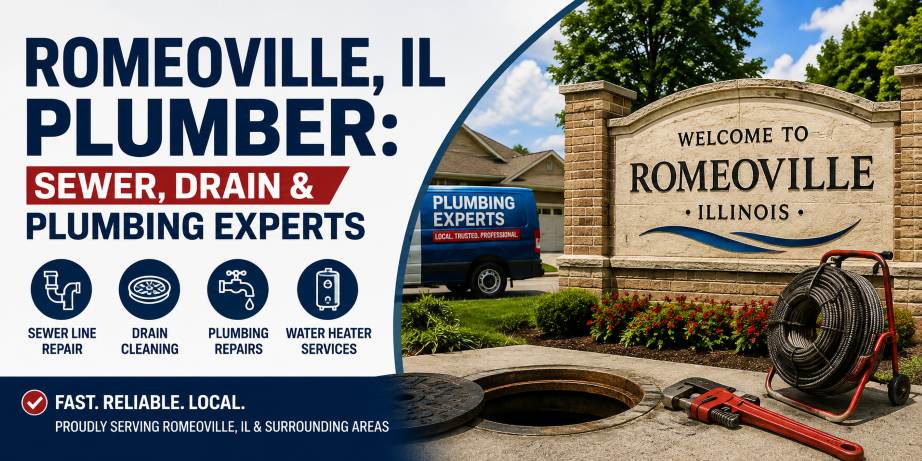
We’re a licensed, insured plumbing company serving Romeoville and the surrounding Will County area directly — not a national franchise dispatching whoever’s closest. Here’s what we handle for Romeoville homeowners and businesses:
Sewer and drain service: emergency sewer rodding for active backups, hydro jetting for recurring clogs and root intrusion, and full sewer camera inspection to diagnose the actual cause of a problem before recommending a repair.
Sump pumps and basement drainage: repair and replacement for failed or aging sump pumps as part of our sump pump services, with same-day response for active flooding.
Water heaters: repair, replacement, and installation for tank and tankless systems through our water heater services, sized appropriately for Romeoville’s hard well water.
General residential plumbing: fixture repair and replacement, leak detection, water line service, and the everyday plumbing work every Romeoville home eventually needs.
If you’re dealing with an active issue right now, skip ahead to the contact form below or call us directly. If you want the full local picture — what’s actually different about plumbing in Romeoville and why — keep reading.
Stone City: What Sits Beneath Romeoville’s Streets
Romeoville earned its original nickname honestly. In the late 1880s, three quarries — Bruce, Santa Fe, and Consumer — began pulling Silurian-age dolomite limestone out of the ground here in such volume that two full trainloads left the village every single morning. That stone built the Illinois State Capitol in Springfield, unveiled in 1888 and constructed entirely from Romeoville limestone, along with countless buildings in Lockport, Lemont, and Joliet. The village and its neighbor Joliet both carried the nickname “Stone City” for decades because of it.
That geology is still directly underfoot today, and it matters for anyone doing underground plumbing work here. Dolomite bedrock sits close to the surface throughout much of Romeoville, which means sewer line excavation, water service work, and any project requiring significant digging can encounter solid rock at a shallower depth than in the clay-soil suburbs common elsewhere in Chicagoland. It’s a genuinely different excavation environment, and it’s worth knowing about before assuming a repair will go exactly like it would in a typical clay-based suburb.
The $1.4 Billion Water Story Most Residents Don’t Know
Here’s the part of Romeoville’s infrastructure story that’s actually unfolding right now, in real time. Unlike most of its Chicago-area neighbors, Romeoville has never been on Lake Michigan water. The village draws its entire supply from groundwater — five deep wells reaching 900 to 1,200 feet into a sandstone aquifer, and seven shallow wells drawing from a dolomite aquifer closer to the surface, all managed by the Village of Romeoville Water Department, part of Public Works.
Both of those aquifers are in documented trouble. In 2019, Romeoville and a group of neighboring communities commissioned the Illinois State Water Survey to model the long-term viability of the deep sandstone aquifer serving the region. The results were stark: portions of the aquifer could begin dewatering as soon as 2030, and withdrawals at current rates are not sustainable through 2040 to 2070. The shallower dolomite aquifer has its own separate problem — while it recharges quickly from rainfall, that same quality makes it vulnerable to surface contamination, and the village has documented steadily rising chloride levels from road salt and deicing operations seeping into it over time.
In response, Romeoville joined five other municipalities — Joliet, Crest Hill, Channahon, Minooka, and Shorewood — to form the Grand Prairie Water Commission, and construction has genuinely begun on a $1.4 billion pipeline bringing treated Lake Michigan water to all six communities, an infrastructure project expected to eventually serve up to half a million residents. Romeoville’s own mayor, John Noak, has publicly called it proof of what local governments can accomplish by working together. Once complete, treated Lake Michigan water reaching Romeoville through Chicago’s system is expected to be soft enough that water softeners become largely unnecessary for many households — a real signal about just how mineral-heavy the current well water actually is.
Until that pipeline reaches Romeoville homes, residents are living on well water that’s meaningfully harder than the Lake Michigan water most of Chicagoland takes for granted, drawn from bedrock that’s literally made of limestone. That’s not a coincidence — it’s the direct, physical explanation for why hard water symptoms tend to be a bigger deal here than in neighboring Lake Michigan-supplied suburbs.
A Village of Genuinely Different Neighborhoods, Built in Different Decades
As recently as 1950, Romeoville had only 46 homes and 147 residents total. Nearly everything standing today was built after that, which means understanding which decade your specific neighborhood belongs to matters more here than in most Chicago suburbs.
The Lewis University area, built in the late 1950s and early 1960s around the university and its airport, holds some of the village’s oldest housing — ranch-style homes now approaching 70 years old, old enough that original supply lines and early drain-waste-vent systems are a real consideration, not a theoretical one.
Hampton Park, in the village’s northeastern section, carries mid-to-late 20th century ranch and split-level construction — a middle-aged housing stock old enough for original fixtures and water heaters to be well past due for replacement in many homes, but generally younger than Lewis University’s.
The genuine turn-of-the-21st-century boom shows up specifically in the western and southwestern subdivisions — Fieldstone-Mistwood, Westglen, Weslake — where New Traditional-style homes went up during Romeoville’s fastest growth period following the I-55 expansion. Grand Haven, a gated 55+ community, and Carillon’s townhomes both reflect that same era. Big Run, with its Tudor Revival architecture, is a further variation within that newer construction wave.
The practical takeaway: a plumbing issue in a Lewis University ranch home calls for checking original supply line material and drain age first. The same issue in a Fieldstone-Mistwood or Westglen home, built decades later, is far more likely to be wear-and-tear on PVC or copper lines now entering their second or third decade, or a fixture that was builder-grade from day one. Our team accounts for which era we’re walking into before we ever pick up a tool.
The Refinery Next Door
Romeoville is home to one of the largest employers in the region: a 1,100-acre oil refinery, commissioned in 1922 and expanded dramatically in 1965 through a $200 million investment, with roughly 80% of that expansion occurring within village limits. It’s easy to drive through Romeoville’s residential streets and never register that a major petrochemical facility sits inside the same village boundary — but it’s a real, significant piece of the local economy and a reminder that Romeoville’s infrastructure serves both a growing residential population and serious industrial demand side by side.
Drain Cleaning and Sewer Line Service in Romeoville
Whatever your home’s construction era, drain and sewer issues here follow familiar patterns: a technician working a steel cable and cutting head through your cleanout — sewer rodding — clears an active blockage and restores flow fast, the right call for a sudden backup. A full interior scouring using pressurized water at up to 4,000 PSI — hydro jetting — removes wall buildup and root intrusion that rodding just pushes past, which matters more as Romeoville’s older Lewis University and Hampton Park-era homes continue to age and mature trees planted decades ago have had time to find their way into pipe joints. Where a backup keeps recurring without an obvious cause, a full sewer camera inspection is what actually identifies root intrusion, a shifted joint, or — given the bedrock underfoot — settlement issues distinct from what shows up in clay-soil suburbs.
Real Work We’ve Already Done in Romeoville
Our crews have replaced a failed sump pump in a Romeoville home after the original unit stopped working and water began backing up into the basement, installing a new unit to restore proper drainage and prevent a repeat flood as part of our sump pump services. That’s the kind of real, on-the-ground work that matters more than a generic service-area claim — a sump pump failure during a storm is exactly the scenario where fast, reliable response makes the difference between an inconvenience and serious basement damage.
Water Heaters and Romeoville’s Hard Well Water
Given that Romeoville’s entire water supply currently comes from wells drawing through limestone and sandstone bedrock, hardness here runs higher than in neighboring Lake Michigan-supplied suburbs — and hard water is measurably harder on a water heater than soft water is. Dissolved calcium and magnesium precipitate out as mineral scale on a water heater’s heating element and tank floor every time it fires, and that buildup accelerates both energy costs and the timeline to failure. A rumbling or popping sound from your tank is scale superheating at the burner chamber floor — worth acting on before the unit fails outright, particularly while Romeoville homes are still years away from the pipeline project’s softer Lake Michigan water reaching the tap. Our water heater services cover repair, replacement, and installation for both tank and tankless systems throughout the village.
Frequently Asked Questions
Is Romeoville’s well water actually unsafe to drink right now?
The Village of Romeoville is required to test and report water quality annually under the Safe Drinking Water Act, and current supply meets regulatory standards. The concern driving the Grand Prairie Water Commission pipeline project is long-term sustainability of the aquifer and rising chloride levels from surface contamination over time — not an immediate safety failure today.
When will Romeoville actually get Lake Michigan water?
The Grand Prairie Water Commission’s pipeline is a multi-year, multi-phase project already under construction, expected to be built out over roughly five years across the six member communities. Exact timing for when it reaches individual Romeoville neighborhoods depends on how the project phases are sequenced — check directly with the Village of Romeoville Water Department for the current schedule affecting your specific area.
Does Romeoville’s newer housing stock mean I don’t need to worry about my pipes at all?
It meaningfully lowers lead service line risk compared to older Chicago suburbs, since most Romeoville homes were built after the 1986 lead pipe ban. It doesn’t eliminate other issues — hard water scale buildup, aging PVC or copper supply lines now entering their second or third decade, and normal wear on drain and sewer lines are all still real considerations regardless of a home’s relatively newer construction.
Can I clear a recurring clogged drain myself with a store-bought chemical cleaner?
Not effectively, and not safely long-term. Chemical drain cleaners dissolve the soft leading edge of a clog temporarily but don’t reach deposits embedded in the pipe wall, and repeated use accelerates the interior corrosion that makes the pipe rougher and more clog-prone over time.
Plumbing, Sewer, or Drain Problems in Romeoville?
Licensed, insured, and serving Romeoville and the surrounding Will County area. We handle sewer rodding, hydro jetting, sewer camera inspection, sump pump repair and replacement, water heater service, and full residential plumbing — with real, on-the-ground experience in the village, not just a service-area listing.
Suburbs: 630-749-9057 | Emergency: 708-518-7765 | Open 24/7
—
Suburban Plumbing Sewer Line & Drain Cleaning Experts
Licensed & Insured | Open 24 Hours | Serving Romeoville & Chicagoland Since 1978
📞 Romeoville: 630-749-9057 | 🚨 Emergency: 708-518-7765