Most “Aging in Place” Advice Stops at Grab Bars. The Real Work, and the Real Cost, Is in the Plumbing: Curbless Showers, Comfort-Height Fixtures, and Anti-Scald Protection. Here’s What It Actually Involves, and Illinois Programs That Can Help Pay for It.
It usually starts with a moment, not a plan. A parent takes a hard fall stepping over the tub wall, or an adult child watching their dad grip the towel bar a little too hard just to steady himself getting out of the shower, and suddenly “someday we’ll look into that” becomes “we need to figure this out now.” More Chicago-area families are choosing to modify a home for an aging parent or grandparent rather than move them into assisted living, and the reasons are usually a mix of cost, comfort, and simply not wanting to leave a house someone has lived in for decades.
Most of the advice out there for making a home accessible focuses on the easy, visible stuff: a grab bar here, a shower chair there. The real work, and the real cost, is in the bathroom itself, and it’s almost entirely a plumbing problem before it’s a design one. Our bathroom plumbing services team handles this kind of work regularly, and this page covers what an accessible bathroom actually requires below the surface, what tends to surprise families about the process, and real Illinois assistance programs that can cover a meaningful share of the cost.
What “Accessible” Actually Means at the Plumbing Level
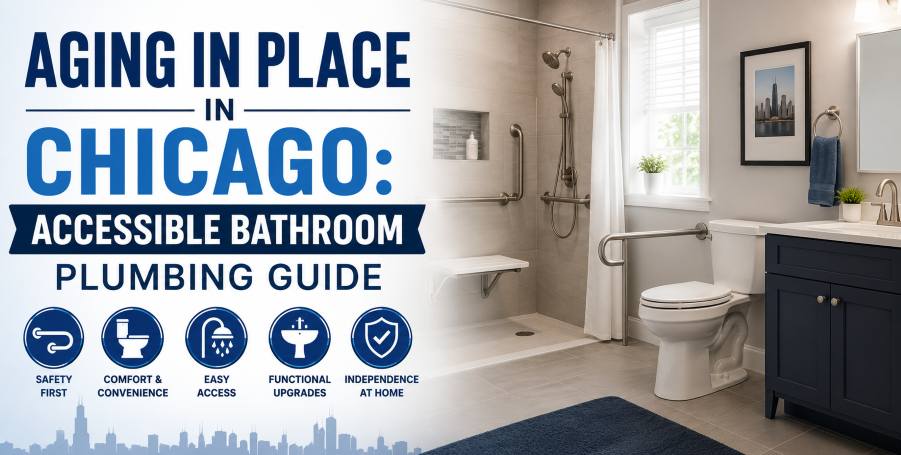
A genuinely accessible bathroom involves more than swapping fixtures. A curbless, zero-threshold shower replaces a standard shower pan or tub with a floor that’s flush with the rest of the bathroom, which requires reworking the subfloor and drain placement, not just installing a different door.
A comfort-height toilet sits two to three inches taller than a standard toilet, easier to sit down on and stand back up from without straining a knee or hip, and that sometimes means relocating the drain flange rather than simply swapping the fixture. Relocating a drain is also a natural point to address any chronic clogging the old toilet was masking; our guide to why your toilet keeps clogging covers how to tell whether the problem is the fixture itself or something further down the line, which is worth knowing before it’s sealed back up behind a new floor. If the existing toilet has been a recurring headache anyway, running slow, clogging more than it should, this is usually the right moment to deal with both at once rather than patch an old fixture and revisit the whole bathroom again in a year. Our toilet repair and installation services team can tell you honestly whether the existing toilet is worth keeping or whether a comfort-height replacement solves two problems instead of one.
Lever-style faucet handles replace twist knobs, since a lever is far easier to operate for someone with arthritis or limited grip strength, and that can mean replacing the valve body behind the wall, not just the handle. None of these are cosmetic swaps. Each one touches the rough plumbing behind the wall or under the floor, which is exactly why this work needs a licensed plumber involved from the planning stage, not brought in after a contractor has already framed the space.
The Curbless Shower Is the Hardest Part, and the Most Worth Doing Right
A curbless shower is the single most requested accessibility feature, and it’s also the most technically demanding. Removing the curb means the shower floor and the surrounding bathroom floor need to be at the same level, which typically requires either recessing the shower area into the subfloor or building up the rest of the bathroom floor to meet it, along with a linear drain running the full width of the shower entrance rather than a single center drain. The floor needs a precise slope toward that drain, generally a quarter inch of fall per foot, and a fully sealed waterproofing membrane underneath the finished surface, since without a curb there’s nothing physically stopping water from reaching the rest of the bathroom if the slope or membrane isn’t done correctly.
Getting this wrong doesn’t just mean an inconvenience; it means water finding its way into the subfloor or the ceiling below, which is a far more expensive problem than the shower itself. This is worth planning with a plumber and a qualified installer together rather than treating it as a tile job with a plumbing afterthought.
Walk-In Tubs: The Trade-Off Almost Nobody Mentions
Walk-in tubs get marketed heavily to seniors, and they solve a real problem, stepping over a high tub wall is a genuine fall risk, but there’s a practical issue that rarely comes up in the advertising: fill and drain time. A standard walk-in tub can take several minutes to fill before it’s usable and several more to drain before the door can safely reopen, which means the person using it is sitting in a cold, empty or nearly empty tub during both windows unless the plumbing is set up specifically to address it.
A rough-in built for a walk-in tub should include a fast-fill valve and a properly sized drain to minimize both windows, and some models benefit from a hand-held or overhead fixture that lets the user begin rinsing before the tub is even full. This is a case where the plumbing decisions made during installation directly affect whether the fixture is comfortable to use daily or becomes something that gets avoided, and a tub someone’s afraid to use every morning isn’t really solving the problem it was installed to solve.
Anti-Scald Protection Matters More Here Than in a Typical Remodel
Older skin is thinner and slower to register heat, which means a water temperature that would just feel briefly too hot to a younger person can cause a real burn to someone older before they’re even able to react. A pressure-balancing or thermostatic mixing valve, certified to ASSE 1016, holds water temperature steady even if pressure elsewhere in the house changes suddenly, like a toilet flushing or a washing machine filling, which is exactly the kind of temperature spike that causes scalding injuries. This is a relatively small line item in the context of a full bathroom renovation, and it’s one of the most directly safety-relevant upgrades available.
Real Illinois Programs That Can Help Pay for This
This is the part that surprises most families: a meaningful share of this work may not have to come out of pocket. The Illinois Housing Development Authority’s Home Modification Program provides grants, structured as forgivable loans that don’t need to be repaid if the homeowner stays in the home for the required period, of up to $25,000 in urban areas for accessibility improvements including bathroom modifications, for income-eligible seniors and people with disabilities.
Chicago residents specifically have additional options: the city’s Small Accessible Repairs for Seniors program covers grab bars, lever faucets, and related bathroom safety modifications for residents 60 and older at or below 80% of the area median income, and the Mayor’s Office for People with Disabilities runs a separate HomeMod program for Chicago residents with disabilities. Illinois’s broader Home Accessibility Program has offered grants as high as $45,000 in recent years for accessibility work including walk-in showers and accessible bathroom modifications.
Eligibility and current funding levels vary by program and by year, so the right first step is contacting your local Area Agency on Aging or the Illinois Department of Human Services directly to find out what’s currently available and whether your household qualifies, before assuming the full cost is on you.
Permits Still Apply
An accessible bathroom renovation almost always involves new rough-in work, relocating a toilet, adding a curbless shower drain, changing valve bodies behind the wall, and that kind of work requires a licensed plumber and a permit in Chicago and throughout the surrounding suburbs, regardless of how the project is being funded. Our guide to why Chicago plumbing permits matter covers what happens when this step gets skipped, which becomes especially relevant if the project is being partially funded through a public program, since most of these programs require the work to be done to code with proper permits and inspection sign-off as a condition of the funding.
Getting the Plumbing Right From the Start
An accessible bathroom that actually works day to day comes down to decisions made before the tile goes down: where the drain sits, how the floor slopes, what valve is behind the wall, and whether the fixtures were chosen for how they’ll actually be used rather than how they look in a showroom.
This isn’t a project to hand to whoever’s cheapest or fastest to schedule; our guide to finding a good plumber in Chicago and spotting a bad one is worth a read before you commit to anyone, since a rushed or poorly planned accessible bathroom is exactly the kind of project that’s expensive and disruptive to redo. And if the house is old enough that this renovation is turning up other aging plumbing nearby, galvanized supply lines, a water heater that’s seen better days, our complete guide to Chicago home repiping covers how to think about tackling that at the same time rather than opening the same walls twice.
Our shower and tub services team handles this kind of accessibility-focused rough-in and fixture work directly, and we’re glad to walk through what a specific space can support, and what a specific family actually needs, before any renovation work starts.
Frequently Asked Questions
What’s the difference between a curbless shower and a regular walk-in shower?
A walk-in shower still typically has a small curb or lip at the entrance. A curbless, or zero-threshold, shower has a floor flush with the rest of the bathroom, with no barrier to step over at all, which requires a linear drain, precise floor slope, and a full waterproofing membrane to keep water contained without a physical curb.
Do I need a licensed plumber for grab bar installation, or is that a handyman job?
Grab bars themselves don’t require plumbing work, just secure blocking behind the wall to anchor into. But if grab bar installation is part of a larger accessible bathroom project involving a curbless shower, relocated fixtures, or a new valve, a licensed plumber should be involved in that broader project from the start.
How much of an accessible bathroom renovation can Illinois assistance programs actually cover?
It depends on the specific program and household eligibility, but Illinois programs have offered grants ranging from around $10,000 for smaller safety modifications up to $45,000 for more extensive accessibility work, often structured as forgivable loans for income-qualifying seniors and people with disabilities. Contacting your local Area Agency on Aging is the fastest way to find current program details and eligibility.
Are walk-in tubs actually a good option for elderly homeowners?
They solve a real problem, the fall risk of stepping over a standard tub wall, but the fill and drain time is a genuine trade-off that often gets left out of the marketing. Choosing a model with a fast-fill valve and properly sized drain, planned as part of the rough plumbing rather than added afterward, makes a real difference in whether the tub gets used comfortably every day.
Planning an Accessible Bathroom?
Licensed, insured, and serving Chicago and Chicagoland since 1978. We handle curbless showers, comfort-height fixture rough-in, anti-scald valves, and walk-in tub installation, planned right from the start.
Suburbs: 708-801-6530 | Chicago: 773-570-2191 | Emergency: 708-518-7765 | Open 24/7
—
Suburban Plumbing Sewer Line & Drain Cleaning Experts
Licensed & Insured | Open 24 Hours | Serving Chicago & Chicagoland Since 1978
📞 Suburbs: 708-801-6530 | 📞 Chicago: 773-570-2191 | 🚨 Emergency Hotline: 708-518-7765