
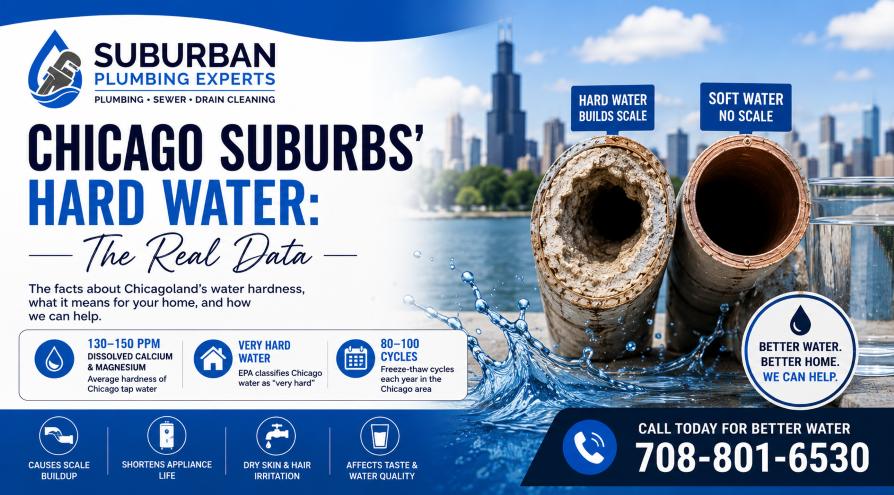
Search “how hard is my suburb’s water” and You’ll Find Confident-Sounding Numbers Everywhere — Often Contradicting Each Other for the Same Town. Naperville Switched Its Entire Water Supply Away From Wells in 1992, Along With Nearly 750,000 People Across DuPage County. Some Sites Still Rank These Towns Like It Never Happened. Here’s What’s Actually True, Suburb by Suburb.
If you’ve searched for how hard your water actually is, you’ve probably found a handful of water-treatment company websites confidently citing a specific grains-per-gallon number for your town. Here’s the problem: those numbers frequently contradict each other, and in at least one case we checked, the same company’s own website lists two different hardness figures for the same suburb on two separate pages. That’s not a data source — that’s a guess dressed up as one. This guide corrects the record using actual water utility sources, and covers a genuinely useful fact most of those sites have never mentioned: a single regional project in 1992 changed the water source for nearly 750,000 people across DuPage County at once, including several towns we’ve covered in depth elsewhere. If you want the full math on what hard water actually does to a water heater and whether a softener pays for itself, our companion guides cover Chicago hard water and water heater lifespan and how hard water damages plumbing generally in depth. This guide focuses specifically on which suburbs actually have which kind of water, and why.
The Simple Fact Most Online Rankings Skip: Where Your Water Actually Comes From
Hardness in this region comes down almost entirely to one variable: is your water from Lake Michigan, or is it from a well? Lake Michigan water, treated and delivered through the City of Chicago’s system and the DuPage Water Commission, consistently measures around 8 grains per gallon across every community that receives it — Chicago, Naperville, Brookfield, and dozens of other suburbs alike. Well water drawing from the deep sandstone aquifers under northern Illinois is a completely different story, typically running 13 to 28 grains per gallon depending on depth and location, classified as “hard” to “extremely hard.” That’s not a small gap — it’s roughly double to triple the mineral load, and it’s the entire explanation for why some suburbs report dramatically different numbers than others.
The complication is that plenty of communities you’d assume are still on well water switched to Lake Michigan water decades ago, and a lot of content online was written — or generated — without checking.
Case Study: Naperville Switched in 1992, and Some Sites Never Noticed
Naperville’s own Water Supply page is direct about this: the city purchases Lake Michigan water from the DuPage Water Commission, delivered through Chicago’s Jardine Water Purification Plant. Naperville drew its water from a network of 25 underground wells before that — some are still kept as emergency standby — but the primary supply has been treated lake water since 1992. Per Naperville’s own economic development materials, that means the city’s water should measure close to the standard 8 GPG Lake Michigan baseline, not the 11 to 13 GPG figures circulating on several water-treatment marketing sites. If you live in Naperville and have been quoted a softener sized for “extremely hard” water based on an online ranking, it’s worth getting your actual tap water tested before assuming that number applies to you.
The Real Story: One Regional Rollout Changed Nearly 750,000 People’s Water at Once
Naperville’s 1992 conversion wasn’t an isolated event — it was one town’s version of a much bigger regional story. The DuPage Water Commission’s own history confirms it began delivering Lake Michigan water in 1992, and it now supplies nearly 750,000 people across DuPage County through a wholesale arrangement with dozens of individual towns, several of which we’ve covered directly in other guides: Hinsdale, Clarendon Hills, and Western Springs among them. Before 1992, most of these communities were drawing from local wells, dealing with exactly the hardness and depletion problems that push a region toward a project like this in the first place. That means if your home in one of these towns predates the early 1990s, it’s worth knowing your water source itself changed at some point in your home’s lifetime — the well water your house may have originally been plumbed around isn’t necessarily what’s coming out of the tap today. If low pressure or discolored water suggests those original lines are still in place, our water line repair and replacement service addresses that directly.
The commission itself doesn’t bill residents directly — it wholesales lake water to each town’s own utility, which is why your water bill comes from your village, not from the commission. If you’re not sure whether your specific town is a DuPage Water Commission customer or still running its own separate well system, that’s a five-minute phone call to your public works department, and it’s the single most useful fact you can learn before assuming anything about your water’s hardness.
Aurora: The Blend That Doesn’t Fit a Simple Ranking
Aurora is a genuinely more complicated case than a single hardness number can capture. The city draws roughly 60% of its supply from the Fox River and the remaining share from a blend of shallow and deep wells, treated through a lime-softening process before distribution — and Aurora was recognized with the American Water Works Association’s Best Water in Illinois award in 2022. That combination of surface water, groundwater, and active treatment makes a single “Aurora is X grains per gallon” claim inherently oversimplified. If you’re an Aurora homeowner trying to size a softener, a direct water test is far more useful than any generic ranking, precisely because the source blend makes this one genuinely hard to generalize.
The Surprising Counter-Example: DuPage County’s Treated Well Water
Not every well-water system in the region is stuck with high hardness. The DuPage County Water Division operates a North Regional Water Facility that processes well water through nanofiltration — a membrane-based treatment specifically targeting the minerals that cause hardness — and delivers water to its customers at a genuinely low 3 to 5 grains per gallon, comparable to softened Lake Michigan water. It’s a useful reminder that “on a well” and “has hard water” aren’t automatically the same thing once real treatment infrastructure is involved.
How to Actually Know Your Water’s Hardness
Given how inconsistent the online numbers are, the only reliable way to know your specific hardness is to check it directly — either through your water utility’s published Consumer Confidence Report, which every public water system is required to publish annually, or through an actual test at your tap. A generic ranking can tell you whether your community draws from Lake Michigan or a well, which is genuinely useful context, but it can’t tell you the exact number flowing into your specific home, especially in blended systems like Aurora’s. Our team tests actual water hardness on-site before recommending any softener sizing, rather than working off a number pulled from a website.
Once you know your water’s hardness, the next question is what that mineral load is actually doing inside your plumbing and appliances. For homeowners concerned specifically about sediment and mineral buildup inside a tank water heater, our complete guide to water heater cleaning, why it matters, how it’s done, and when Chicago homeowners need it explains how professional cleaning addresses the buildup that hard water can create over time.
Hardness and Water Quality Are Two Different Problems
It’s worth being precise about the difference, since the two get conflated constantly. Hardness comes from dissolved calcium and magnesium — naturally occurring minerals that affect your plumbing, appliances, and water heater, but aren’t a health concern on their own. Contaminants like lead, chlorine byproducts, and other substances that can actually affect water safety are a completely separate issue, addressed by filtration rather than softening. For a complete overview of Chicagoland’s drinking water—including hardness, lead service lines, chlorine, filtration options, and common water quality concerns—read our Complete Guide to Chicagoland Tap Water. A softener removes hardness minerals through ion exchange; it doesn’t remove lead or improve taste and odor from chlorine treatment the way a certified filtration system does. Our water filtration installation service starts with a free test of your actual water covering both angles — hardness and contaminant concerns — so you know which problem, or both, you’re actually dealing with before choosing a system. Many homes in this region genuinely benefit from both a softener and a filtration system working together, addressing two entirely different things flowing through the same pipe.
Two More DuPage Water Commission Towns Worth Knowing About
Beyond Naperville, Hinsdale, Clarendon Hills, and Western Springs, the DuPage Water Commission’s 1992 rollout extended to Elmhurst and Downers Grove as well — both towns we’ve covered in other guides regarding their own infrastructure programs. Like their neighbors, both draw Lake Michigan water today rather than the well water their older housing stock was originally built around, putting them in the same “check before you assume” category as every other DuPage Water Commission member community. If you’re in either town and have been quoted softener sizing based on a generic well-water assumption, the same correction applies: confirm your actual source and hardness before assuming the highest end of the range.
Water Softener Installation, Sized to Your Actual Water
Once you know whether your home is on Lake Michigan water, well water, or a blended source like Aurora’s, sizing a softener correctly comes down to your household’s actual usage and your water’s actual hardness — not a number pulled from a ranking site. Our dedicated water softener installation service starts every job the same way our filtration consultations do: with a real, on-site test of your water, not an assumption based on your town’s general reputation. Whether you’re in a DuPage Water Commission community that switched decades ago, a blended system like Aurora’s, or still on an untreated private well, the right softener size depends on your specific numbers, not your zip code’s.
Frequently Asked Questions
Do I need a water softener, a filtration system, or both?
It depends on what’s actually in your water. A softener addresses hardness minerals — calcium and magnesium — which affect plumbing and appliances but aren’t a health concern. Filtration addresses contaminants like lead and chlorine byproducts, which are a water quality and safety question. Many homes in this region benefit from both, since they solve completely different problems. A real water test, not a guess, is what tells you which one (or both) your home actually needs.
Is the water softener installation service available now?
Yes — check our dedicated water softener installation page directly for current availability and to schedule a water test in your home.
Why do different websites give different hardness numbers for the same suburb?
Often because the information is outdated, generic, or simply inaccurate. Water-treatment marketing content sometimes cites well-water-era figures for communities that have since switched to Lake Michigan water, or applies a general regional estimate rather than an actual measurement for that specific system. When you see a suspiciously precise number with no source cited, treat it with real skepticism.
My suburb switched to Lake Michigan water years ago. Do I still need a water softener?
Lake Michigan water at roughly 8 GPG is still classified as “hard” by water quality standards, just meaningfully less hard than untreated well water. A softener is still worth the investment for water heater lifespan and appliance protection — see our companion guide on the actual ROI math, or our water heater services page if scale damage is already an active issue — but you’re not dealing with the extreme end of the hardness spectrum that some marketing content implies.
How do I find out if my community gets Lake Michigan water or well water?
Your water utility’s Consumer Confidence Report, published annually and usually available on your village or city’s website, will state the source directly. You can also simply call your public works department — it’s a straightforward question with a documented answer, not something you need to guess at from a ranking site.
Is well water automatically unsafe, even if it’s hard?
No. Hardness and safety are separate questions. Hard water is a plumbing and appliance concern, not a health concern — calcium and magnesium are essential minerals, not contaminants. Well water safety depends on separate factors like treatment quality and specific contaminant testing, which is a different conversation from hardness.
Not Sure How Hard Your Water Actually Is?
Licensed, insured, and serving Chicago and the surrounding suburbs since 1978. We test your actual water on-site rather than working off a generic online ranking, and we’ll give you a straight answer on whether a softener, a filtration system, or both make sense for your specific home and water source. See our water filtration installation page for full details on that service.
Suburbs: 708-801-6530 | Chicago: 773-570-2191 | Open 24/7
—
Suburban Plumbing Sewer Line & Drain Cleaning Experts
Licensed & Insured | Open 24 Hours | Serving Chicago & Chicagoland Since 1978
📞 Suburbs: 708-801-6530 | 📞 Chicago: 773-570-2191