
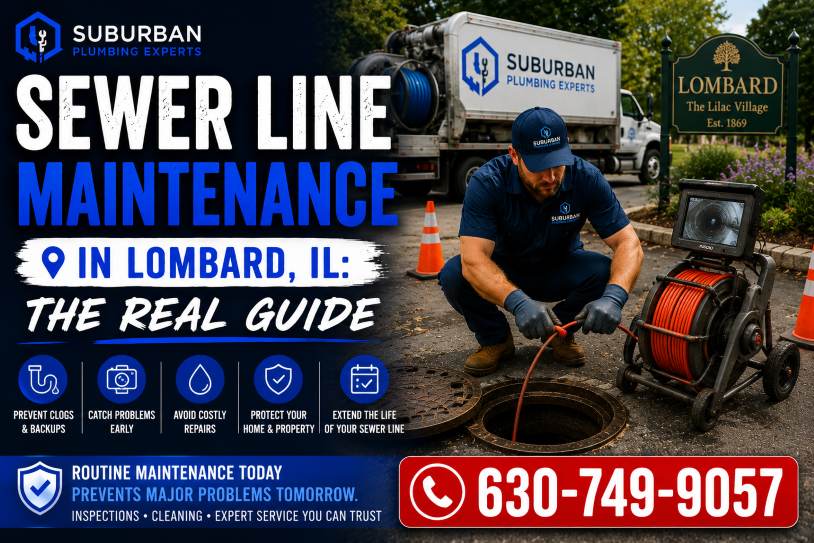
Everything Underground Eventually Tells On Itself. Here’s How to Read the Signs Before It’s a Backup.
A sewer lateral fails slowly, then all at once. Years of gradual root intrusion, scale buildup, or a slowly separating joint produce almost no symptoms until the line finally can’t keep up, and what looks like a sudden weekend emergency was usually years in the making. Lombard’s housing stock makes this more relevant than it might be elsewhere: the village was incorporated in 1869, and a real share of its residential sewer laterals predate modern plastic piping entirely, running on original clay tile or aging cast iron that behaves very differently underground than the PVC used in newer construction. This is a complete guide to what’s actually happening in an aging sewer line, how to catch it early, and what maintenance genuinely extends a line’s life versus what’s just noise.
What a Sewer Lateral Actually Does, and Why Its Age Matters More Than People Think
Your sewer lateral is the single pipe carrying every drain in your home, kitchen, bathrooms, laundry, floor drains, to the village main. Everything downstream of your fixtures eventually funnels through this one line, which is exactly why a problem in the lateral shows up as symptoms in multiple, seemingly unrelated fixtures rather than just one. Clay tile, the standard material for decades before plastic piping became common, is durable in some respects but has a structural weakness plastic doesn’t: it’s laid in short sections joined together, and every joint is a potential entry point for tree roots and a potential point of failure as soil shifts over decades. Cast iron, common in a different era of construction, corrodes from the inside over time, gradually narrowing the usable diameter of the pipe even without any external damage.
Root Intrusion: Why It Happens and Why It Gets Worse, Not Better
Tree and shrub roots grow toward moisture and nutrients, and a sewer line leaking even a small amount at a joint is exactly the kind of resource a root system will exploit. Once a root finds its way into a joint or crack, it doesn’t stop, it continues growing inside the pipe, catching debris and expanding the original opening further with each growing season. This is why root intrusion problems compound over time rather than staying static: a small intrusion this year is typically a larger one next year, and the compounding nature of the problem is exactly why catching it early, while it’s still a cleaning job, matters so much more than catching it after it’s caused a full blockage.
The Signs, and What Each One Actually Means
Slow drainage across more than one fixture points to a restriction in the shared lateral rather than a problem local to any single drain. Gurgling from a toilet or drain, especially triggered by another fixture running elsewhere in the house, happens because trapped air is being forced through standing water as it searches for the easiest exit path past a restriction. A persistent foul odor means wastewater or gas isn’t moving through the system the way it should, either because the line is too restricted to carry waste through cleanly or because a blockage is trapping gas that’s venting back through a fixture instead of outside as designed. An unusually lush, consistently damp patch of yard, especially one that tracks in a line from the house toward the street, is a classic sign of a leak feeding the soil above it. And a water bill that climbs without a corresponding increase in usage often means water is escaping the system somewhere it shouldn’t be.
None of these signs are dramatic on their own, which is exactly why they get ignored. A line that’s failing rarely announces itself with anything louder than a slow drain and an occasional smell, right up until it doesn’t.
A Simple Test You Can Run Yourself Before Calling Anyone
Run the kitchen sink at full flow for a minute or two while watching the basement floor drain. If water rises or backs up through the floor drain while the sink runs, the restriction is downstream of both fixtures, in the shared lateral rather than either fixture individually. A second version of the same test: run the kitchen sink and listen for the toilet. If it gurgles without being flushed, air displaced by the sink’s flow is finding the toilet bowl as its easiest exit path past a restriction elsewhere in the system. Neither test diagnoses the exact cause, but both confirm whether you’re dealing with a shared-line problem before a technician even arrives, which speeds up an accurate diagnosis considerably.
Why This Isn’t Just an Inconvenience
A sewage backup isn’t simply an unpleasant mess. According to the CDC’s guidance on handling human waste and sewage, even trained workers with protective equipment follow strict hygiene protocols when in contact with raw sewage, because it carries genuine pathogen risk. That’s the same material that ends up on a basement floor during a backup, without any of the protective measures a trained worker would use. Treating a slow drain as a minor annoyance ignores what the actual material involved becomes once it’s no longer contained.
Confirming What’s Actually Happening, Instead of Guessing
A sewer camera inspection remains the only way to see the interior condition of a lateral without digging, and it turns any of the signs above from a guess into an actual diagnosis. Professional inspections follow the framework established by NASSCO’s Pipeline Assessment Certification Program, the recognized North American standard for coding and documenting pipe conditions, which means findings are based on a consistent standard rather than one technician’s subjective impression. Our sewer camera inspection service uses this same standard for every inspection, giving you a documented, objective answer about your line’s actual condition.
Rodding, Jetting, and Why the Difference Actually Matters
Mechanical rodding clears an isolated blockage by breaking a path through it with a cable, a fast and cost-effective fix for a straightforward, one-time clog. Hydro jetting uses pressurized water to scour the entire interior wall of the pipe rather than just punching through the center. According to Cam Spray, an industrial jetter manufacturer, this works because two separate factors combine during jetting: PSI, the pressure that breaks buildup loose from the pipe wall, and GPM, the flow rate that actually carries that loosened material out of the line rather than letting it resettle further down. That combination is why a jetted line typically goes considerably longer before needing service again than a rodded one, since jetting addresses the coating itself rather than just clearing a path through it.
What Professional Maintenance Actually Costs
Pricing depends heavily on scope: a localized spot repair, replacing just the damaged section, runs considerably less than a full lateral replacement from house to street, and trenchless lining costs differently again depending on the line’s length and condition. Our complete breakdown of sewer line repair costs in the Chicago area covers real pricing by repair type, what drives cost up specifically in this region’s clay soil and frost-depth requirements, and how to evaluate a quote before signing anything. Set against those figures, routine rodding or jetting is the inexpensive side of the equation, generally a small fraction of what a spot repair or full replacement costs, and it’s the side that keeps a line from ever reaching the point where repair becomes necessary in the first place.
The Insurance Question Worth Asking Before You Need It
Standard homeowners insurance frequently does not cover sewer backup damage by default. According to Insurance.com’s coverage guide, water backing up through a drain or sewer is commonly excluded from a standard policy unless a separate water backup endorsement has been added, typically costing $50 to $250 a year for $5,000 to $25,000 in coverage per occurrence. Given that a single backup can mean flooring, drywall, and remediation costs well beyond the plumbing repair itself, it’s worth confirming this coverage is actually on your policy rather than assuming it’s included, ideally before a backup happens rather than while filing a claim afterward.
What This Means If You’re Buying or Selling in Lombard
A documented sewer camera inspection is one of the few ways to know a home’s actual sewer condition rather than relying on what a seller says or doesn’t say. Given the age of a real share of Lombard’s housing stock, a buyer skipping this step is taking on real, unknown risk that a standard home inspection typically doesn’t cover in detail. For a seller, a clean, documented inspection removes a question mark before a buyer’s inspector raises it first, which tends to go smoother for everyone at the negotiating table than an unpleasant surprise during due diligence.
A Maintenance Schedule That Actually Fits an Older Lombard Home
For a home on original clay tile or aging cast iron, a camera inspection every one to two years is a reasonable standard, more frequently if mature trees sit near the lateral’s path or if the home has any history of slow drains or clogs. Between inspections, keeping fats, oils, and grease out of drains entirely, using a drain screen to catch hair and debris, and never flushing wipes or other non-biodegradable products all reduce the rate at which buildup accumulates in the first place. None of this prevents root intrusion on its own, roots are drawn to any leak regardless of what goes down the drain, but it does slow the buildup that compounds whatever intrusion is already happening.
When Cleaning Isn’t Enough Anymore
A line with a collapsed section, significant structural cracking, or a joint that’s separated beyond what cleaning can address needs actual repair rather than another round of rodding or jetting. Frequent backups despite regular maintenance, extensive corrosion visible on camera, or repeated root intrusion in the same section year after year are all signs the underlying pipe, not just its contents, is the problem. At that point, targeted sewer line repair addressing the specific damaged section is the right call, and a full replacement is reserved for lines too extensively compromised for a section repair to be practical.
Choosing Who Actually Does This Work
Sewer line diagnosis and repair is specialized enough that general plumbing experience isn’t a substitute for real sewer-specific work. The general playbook for verifying any plumber, confirming an Illinois license, checking insurance, getting a written estimate, is covered in full in our complete guide to choosing a plumber in the Chicago suburbs. For sewer work specifically, it’s also worth asking directly whether a camera inspection is included before any cleaning or repair recommendation, and whether the company follows a documented inspection standard rather than relying on a technician’s informal read of the footage.
Before Any Digging Happens
If a repair does require excavation, Illinois law requires contacting JULIE at 811 at least two business days beforehand to have buried utility lines marked. We cover why this step is legally required and what can go wrong when it’s skipped in why your Chicago-area plumber should always call JULIE before they dig. A licensed plumber handles this as standard practice on any job involving excavation.
Frequently Asked Questions
How often should an older Lombard home get a sewer camera inspection?
Every one to two years is a reasonable standard for a home on original clay tile or cast iron, more often if mature trees sit near the lateral or the home has a history of slow drains.
Is rodding or hydro jetting the right choice for my line?
Rodding is typically the faster, less expensive fix for a single, isolated clog. Jetting is the better choice for a line with recurring buildup or root intrusion, since it cleans the full interior wall rather than just clearing a path through it.
What’s the actual health risk of a sewage backup?
Raw sewage carries real pathogen risk on contact, which is why trained workers handling human waste follow strict hygiene and protective equipment protocols. A backup in a basement involves the same material without any of those protections.
How do I know if my sewer problem needs repair instead of cleaning?
Frequent backups despite regular maintenance, visible structural damage on a camera inspection, or root intrusion recurring in the same section repeatedly are all signs the pipe itself, not just buildup inside it, needs attention.
Can I prevent tree root intrusion entirely?
Not entirely if mature trees already sit near the lateral, since roots are drawn to any existing leak regardless of maintenance habits. Root barriers and keeping new trees away from the lateral’s path reduce future risk, and regular inspection catches existing intrusion before it compounds further.
Can I test for a sewer line problem myself before calling a plumber?
Yes. Running the kitchen sink at full flow while watching the basement floor drain, or listening for the toilet to gurgle, gives you real information about whether the problem is in the shared lateral, which helps a plumber diagnose faster once they arrive.
Does homeowners insurance cover sewer backup damage?
Not automatically. Standard policies commonly exclude sewer backup unless a separate water backup endorsement has been added, typically $50 to $250 a year for $5,000 to $25,000 in coverage. It’s worth confirming this is on your policy before you need it.
Should I get a sewer camera inspection before buying an older Lombard home?
Yes, especially given the age of much of Lombard’s housing stock. A standard home inspection typically doesn’t include a detailed look at sewer line condition, and a camera inspection is the most reliable way to know what you’re actually buying into.
Licensed Sewer Line Maintenance for Lombard, IL
Suburban Plumbing Experts has served Lombard and the surrounding suburbs since 1978. We hold Illinois Plumbing License #055-044116 and Sewer License #2565, and every technician on our team is a trained, background-checked employee, not a subcontractor. From routine camera inspections to full sewer line repair, our Lombard, IL plumbing team can tell you honestly where your line actually stands.
Ready for a Sewer Line Checkup in Lombard?
Licensed, insured, and serving Lombard and Chicagoland since 1978. We run the camera first and give you a documented, honest answer about your line’s actual condition.
Lombard: 630-749-9057 | Emergency: 708-518-7765 | Open 24/7
—
Suburban Plumbing Sewer Line & Drain Cleaning Experts
Licensed & Insured | Open 24 Hours | Serving Lombard & the Suburbs Since 1978
📞 Lombard: 630-749-9057 | 🚨 Emergency: 708-518-7765