
In Chicago, a Frozen Sump Pump Discharge Line Leaves the Pump Nowhere to Send the Water. Here’s How to Thaw It and Keep It From Happening Again.
A sump pump can be new, correctly sized, and working perfectly, and still fail in January, because the part that fails is the pipe outside. When the discharge line ices over, the float keeps telling the pump to run, the pit keeps filling, and the pump has nowhere to push the water. In the Chicago area, where a hard freeze is often followed by a thaw, that failure tends to arrive right when the pit is filling fastest. This guide covers why discharge lines freeze, how to tell a frozen line from other pump problems, what to do if yours is frozen, and what to change so it doesn’t happen again.
Why the Line Freezes When the Pump Is Indoors
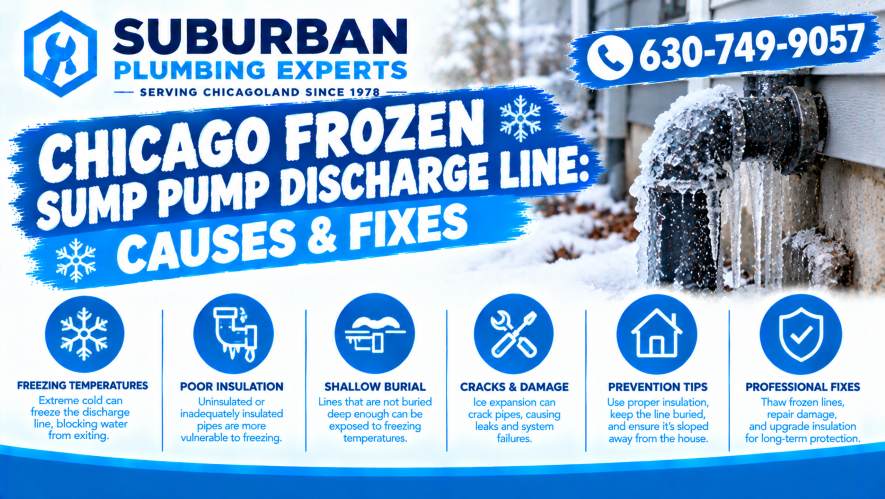
The pump sits in a warm basement pit. The line it feeds doesn’t stay warm. It leaves the house through the foundation wall or rim joist and runs through open air or shallow soil to wherever it discharges. After every cycle, some water is left in the pipe, and in freezing weather that leftover water can turn to ice, with each new cycle adding to it. The usual trouble spots are where the pipe passes through the wall, any low spot where water pools, and the outlet itself, where splash and leftover water can freeze into a plug that grows back into the pipe.
Installation matters here. Flexible corrugated hose tends to sag into low spots and its ridges hold water, so it freezes more readily than rigid pipe laid on a continuous slope. Zoeller’s installation instructions recommend rigid pipe and fittings. An outlet that empties onto flat ground, or onto a driveway, lets water pool and refreeze right at the end of the line.
Timing matters too. NOAA hydrology research notes that ice in soil reduces its permeability, and National Weather Service forecasters list frozen ground among the conditions that bring large increases in basement flooding when heavy rain or snowmelt arrives. In practice, a thaw or a rain-on-snow event can send a lot of water toward your foundation drains while the discharge line is still iced. That is the combination that floods basements.
Frozen Line or Failed Pump? How to Tell
Several problems look identical from the basement: the pump runs, but the water level in the pit doesn’t drop. Check the outside first. Go to the outlet while the pump is running. If water is flowing, the line isn’t frozen at the outlet and the problem is somewhere else. If nothing comes out, look for ice at the outlet, frost along the pipe, or a section that feels much colder than the rest.
If the line is clear but the pump still isn’t moving water, pump manufacturers’ troubleshooting guides list the usual suspects: a clogged intake or impeller, a check valve installed backwards or stuck closed, a shut-off valve in the discharge line that isn’t fully open, or trapped air. On that last one, Zoeller’s instructions call for a vent hole of about 3/16 inch in the discharge pipe, below the check valve, to purge trapped air. The same instructions say to check that hole periodically for clogs, and they note that a small stream of water will be visible from it while the pump runs. A clogged vent hole and a frozen outlet can look alike, and thawing the pipe won’t fix the first one.
What the Pump Is Doing While the Line Is Blocked
A pump running against a blocked line moves little or no water, runs hot, and strains its motor. Many submersible pumps include thermal overload protection that shuts the motor off when it overheats and restarts it automatically once it cools. Owner’s manuals for Simer sump pumps go further: they list a plugged or frozen discharge pipe among the causes of overload cycling, tell owners to disconnect power for 30 minutes if a pump starts and then stops right away, and warn that the pump may start without warning when the overload resets. The overload protects the motor, but it doesn’t fix anything. The pump keeps cycling against the ice, and while it’s off the pit keeps filling. A pump that restarts by itself isn’t necessarily a pump that’s fine.
If the Line Is Frozen Right Now
- Unplug the pump before you touch the pipe. Manufacturers warn that a pump can restart without warning when its thermal overload resets, and if nothing is coming out of the outlet, the pump isn’t moving water anyway. Keep the cord and outlet dry, and don’t stand in water near the pit.
- Watch the pit. If the water is rising toward the basement floor faster than you can fix the line, bail it into buckets and carry it outside or to a drain while someone works on the pipe.
- Find the ice. Check the outlet first, then where the pipe exits the house, then any low spot along the run.
- Thaw from the open end back toward the house, so meltwater has somewhere to go. Use gentle heat: a hair dryer, warm towels, or warm water poured over the pipe, and keep the heat moving. Don’t use an open flame, a torch, or boiling water, which can damage plastic pipe, and don’t pour automotive antifreeze into the line. It’s toxic to pets and wildlife.
- Once water flows, plug the pump back in and watch the outlet through a full cycle. Look along the pipe and at every fitting for cracks or leaks, because expanding ice can split pipe and joints. A split line is a repair, and our burst pipe services cover that.
- If you can’t locate or reach the ice, the line is buried, or you see a crack, call a plumber. Our pipe thawing service uses equipment built for the job, which is gentler on the pipe than improvised heat.
If water has already reached the basement floor, our basement flooding services can help with what comes after the line is clear.
Fixing the Cause So It Doesn’t Freeze Again
Slope and pipe type
The exterior line should fall continuously away from the house so it drains empty after every cycle. Walk it and look for sags. Replace flexible hose with rigid pipe, and don’t downsize the line: Zoeller’s instructions say the discharge pipe should be the same size as the pump’s discharge, or larger.
The outlet
Keep the outlet clear of leaves, debris, and piled snow, and make sure it empties onto ground that slopes away from the house so water doesn’t collect at the end and refreeze. Downspout extensions can freeze the same way, which our guide to gutter and downspout maintenance covers, and our guide to directing water away from your house covers grading and where discharge should end up.
A freeze relief path
Some discharge lines are built with a relief: a fitting near the house that gives the water a second way out if the main line ices up. The Village of Round Lake, in Lake County, goes as far as requiring that sump and gutter discharge connections be designed so water can still flow if the buried line freezes. The trade-off is that a relief outlet spills water near your foundation when it works, so it needs grading that carries the water away, and it should be designed by a plumber, not improvised by drilling a hole in the pipe.
Burying the line
Burying the line below the frost depth is the other classic fix, but the depth that counts is your local frost depth, and online sources disagree widely about how deep is deep enough, so ask your building department for the number your village uses. A buried line still has to slope to an outlet that drains, and some villages require a permit. Round Lake, for one, asks for a permit and a plat of survey to bury or connect a sump or gutter discharge line.
Heat cable and insulation
Insulation and self-regulating heat cable can protect exposed sections, but they supplement a proper slope rather than replace it, and a heat cable stops working when the power does.
Where the water goes
Don’t solve a freezing line by piping the discharge into a floor drain or the sanitary sewer. Chicago-area villages such as Schaumburg and St. Charles prohibit it. The Schaumburg village code, posted by MWRD, directs sump pump discharge to the storm sewer or onto the owner’s own property and treats a direct connection to the sanitary sewer as illegal. Clear water in the sanitary system raises the risk of backups for you and your neighbors. And don’t let the discharge cross a public sidewalk: in winter it becomes an ice sheet, and Round Lake’s requirements say the discharge may not cause a nuisance on the public sidewalk or right-of-way. Check your own village’s rules before you extend, bury, or redirect anything.
When It Fails Anyway: Power and Insurance
The storms that freeze a discharge line can also knock out electricity, and both the pump and a heat cable depend on it. If your pump has no battery backup, winter is when that gap matters. Our sump pump battery backup installation covers adding one, and our guide to sump pump sizing, backup power, and discharge routing explains how those pieces fit together when a pump is replaced.
It’s also worth checking your insurance before winter, not after a flood. Standard homeowners policies generally exclude damage from sump pump failure or overflow unless you’ve added a water backup endorsement, which some insurers call water backup and sump overflow coverage. Where it’s offered, that coverage typically pays for the damage, not for replacing the pump itself. Our breakdown of what homeowners insurance covers for sewer and drain backups explains how these endorsements differ, and your agent can tell you what your own policy includes.
A Ten-Minute Pre-Winter Check
- Walk the discharge line from the wall to the outlet. Look for sags, flexible hose, cracks, and loose fittings.
- Confirm the outlet is clear, drains away from the house, and doesn’t reach a public sidewalk.
- Pour a bucket of water into the pit and watch the outlet through a full cycle.
- Listen for the check valve closing after the pump stops. If the water falls back into the pit and the pump restarts right away, the check valve may be failing.
- Check that the small vent hole in the discharge pipe, if your pump has one, isn’t clogged.
- Confirm the pump is plugged directly into an outlet. Zoeller’s instructions say never to use an extension cord.
- Decide whether you want a relief path, heat cable, or battery backup, and save a plumber’s number where you can find it in the dark.
Our hard freeze countdown covers the rest of the house in the 48 hours before a cold snap.
Frequently Asked Questions
Can a frozen discharge line burn out my sump pump?
It can. A pump running against a blocked line moves little or no water and strains its motor. Many pumps shut off on thermal overload and restart once they cool, which protects the motor in the moment, but repeated overloads shorten its life. Thaw the line promptly rather than letting the pump cycle against the ice.
Should I unplug the pump if the line is frozen?
Unplug it before you touch the pipe, since a pump can restart without warning after a thermal overload. Don’t leave it grinding against a blocked line for hours, and watch the pit while you work. If the water is rising toward the floor, bail it out and get the line cleared or call a plumber.
Can I pour hot water on a frozen discharge pipe?
Warm water is fine. Avoid boiling water and open flame, which can damage plastic pipe, and never pour automotive antifreeze into the line.
How deep do I need to bury a sump pump discharge line?
It depends on your local frost depth, and sources disagree about how far below it to go, so ask your building department. Burial doesn’t replace a continuous slope, and some villages require a permit to bury or connect a discharge line.
Can I run the discharge into a floor drain or sanitary line to avoid freezing?
No. Chicago-area villages such as Schaumburg and St. Charles prohibit sump discharge into the sanitary sewer, and clear water in that system raises the risk of sewage backups for you and your neighbors.
Does heat cable solve the problem?
It helps on exposed sections, but it supplements a proper slope rather than replacing it, and it stops working when the power goes out.
Does homeowners insurance cover a basement flood from a failed sump pump?
Standard policies generally don’t. Coverage usually requires a water backup endorsement, sometimes called water backup and sump overflow coverage, and it typically pays for damage rather than the pump itself. Ask your agent what yours includes.
Fix the Slope Before the First Freeze, Not After the First Flood
A sump pump’s job ends at the outlet, so the outlet is where winter tests it. A continuous slope, rigid pipe, a clear outlet, a path for the water if the line ices over, and a plan for power outages cost little next to a flooded basement. If you’d like the line and the pump checked before the cold arrives, our sump pump services team will walk it with you.
Sump Pump Line Frozen or Not Draining Right Now?
Licensed, insured, and serving Chicago and the surrounding suburbs since 1978. Call now or fill out the form below and we’ll follow up fast to get you scheduled today.
Suburbs: 630-749-9057 / 708-801-6530 | Chicago: 773-570-2191 | Emergency: 708-518-7765 | Open 24/7
—
Suburban Plumbing Sewer Line & Drain Cleaning Experts
Licensed & Insured | Open 24 Hours | Serving Chicago & the Suburbs Since 1978