
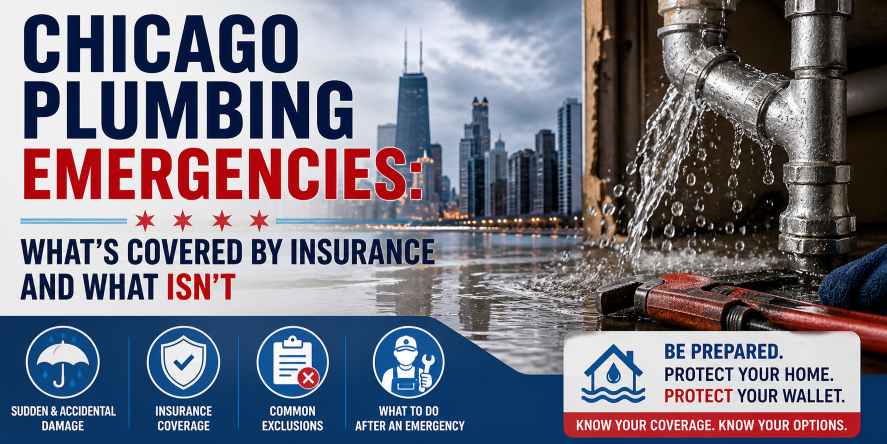
Most Chicago Homeowners Find Out What Their Policy Doesn’t Cover at the Worst Possible Moment. Here’s What You Need to Know Before That Moment Arrives.
It’s 11 o’clock on a Sunday night. You walk into your basement and find two inches of water on the floor. Or you come home from work to find that a pipe behind your kitchen wall has been leaking for hours. Or your water heater splits and floods your utility room before you even know it’s happening.
Your first call is to a plumber. Your second call — once you understand the scope of the damage — is to your insurance company. And that’s when many Chicago-area homeowners discover something nobody warned them about: the standard homeowners insurance policy covers far less plumbing damage than most people assume, and the specific types of water damage most common in Chicagoland — sewer backups, basement flooding from surcharge events, groundwater seepage — are among the most frequently excluded.
This guide tells you exactly what a standard Illinois homeowners policy covers when a plumbing emergency strikes, what it doesn’t cover, what endorsements and riders can fill the gaps, and what you should do in the first 24 hours of an emergency to protect both your home and your claim.
How Illinois Homeowners Insurance Handles Plumbing Damage: The Basic Framework
The fundamental principle that governs plumbing coverage in a standard homeowners policy is the distinction between sudden and accidental damage and gradual damage. This distinction determines more claim outcomes than any other single factor — and it’s not always intuitive.
Sudden and accidental damage — a pipe that bursts without warning, a water heater that fails catastrophically, a supply line that ruptures — is generally covered under the dwelling coverage portion of a standard HO-3 homeowners policy. The key word is sudden. The damage happened without warning, without an extended period of deterioration that the homeowner could have observed and addressed, and as a result of a covered peril.
Gradual damage — a slow leak that has been seeping behind a wall for months, a pipe that has been corroding and dripping into a cabinet, a toilet that has been running and creating moisture damage in the subfloor — is almost universally excluded. The insurer’s position is that gradual damage results from deferred maintenance and normal wear rather than from a covered peril, and that the homeowner had the opportunity to observe and address the problem before significant damage occurred.
According to the Illinois Department of Insurance’s homeowners insurance guidance, water damage from a home’s plumbing is typically covered — but the specific type of water damage, its source, and whether it was sudden or gradual all determine whether a particular claim is payable.
This framework means that the same end result — water damage in your basement — can be covered or not covered depending entirely on how the water got there and how quickly it arrived.
What IS Covered: The Scenarios That Typically Pay
Burst pipes are the most clearly covered plumbing emergency in a standard policy. When a pipe fails suddenly — from freezing, from pressure failure, from a manufacturing defect — the resulting water damage to your home’s structure and personal property is generally covered. Chicago’s winters make burst pipes a significant risk: when temperatures drop rapidly and pipes in exterior walls, crawlspaces, or unheated spaces freeze and expand, the resulting pipe failure is a sudden event that falls squarely within covered perils.
Important caveat: if an adjuster determines that you failed to maintain adequate heat in your home, that you left for an extended period without winterizing your pipes, or that you knew about a freeze risk and failed to act — the claim can be denied on the basis of negligence rather than a covered sudden loss. Document that you maintained heat and took reasonable precautions during cold weather events.
Sudden appliance failures — a water heater that catastrophically fails, a washing machine supply line that bursts, a dishwasher inlet valve that ruptures — are generally covered for the resulting water damage. The appliance itself is typically not covered for replacement (that’s the cost of the appliance, not the water damage), but the damage to flooring, drywall, cabinets, and personal property caused by the sudden water release usually is.
Accidental discharge from plumbing systems — an overflowing toilet that results from a sudden blockage rather than from an obviously neglected clogged drain, a tub that overflows due to a faulty shutoff — can be covered depending on how the event is characterized and documented.
Additional living expenses — if covered water damage makes your home temporarily uninhabitable, most HO-3 policies include loss of use coverage that pays for hotel, meals, and reasonable living expenses while your home is being repaired. This coverage is often overlooked but can be significant if remediation takes weeks.
What Is NOT Covered: The Gaps That Surprise Chicago Homeowners
Sewer backup and drain backup — this is the single most significant and most common coverage gap for Chicago-area homeowners, and it’s the one that blindsides the most people. As Illinois Legal Aid Online’s homeowners insurance guide confirms, sewer and drain water backups are generally not covered under standard policies — but can be added as extra coverage through a water backup endorsement. In many Chicago-area homes, sewer backup events are directly linked to hidden tree root intrusion in older sewer laterals. These blockages build gradually over time before causing sudden failure.
A standard HO-3 policy excludes damage caused by water that backs up through sewers or drains. In Chicago’s combined sewer environment — where heavy rain can overwhelm the system and push sewage backward through private laterals into basement floor drains and toilets — this exclusion affects an enormous number of homeowners. Every major storm event that causes widespread basement flooding in Cook County involves thousands of insurance claims that are denied because the homeowners didn’t have backup coverage.
Groundwater flooding and seepage — water that enters your basement through foundation walls, through the floor, or through window wells due to high water table or surface water accumulation is excluded from standard coverage. This requires either a water backup endorsement (which sometimes covers seepage depending on its language) or a separate flood insurance policy through the National Flood Insurance Program or a private insurer.
Flood damage — damage from rising surface water, overflowing bodies of water, storm surge, or any external flood event is specifically excluded from standard homeowners policies nationwide. In Chicago’s flat topography with its network of rivers, streams, and the lakefront, this exclusion matters. Flood insurance is purchased separately and is available through the NFIP or certain private insurers.
Gradual leaks and moisture damage — as discussed above, damage from a leak that developed gradually over time is almost universally excluded. If an adjuster determines that the pipe had been leaking slowly for weeks or months before the damage was discovered, the claim will likely be denied even if the total damage is significant.
The plumbing system itself — standard homeowners insurance covers the damage caused by a plumbing failure, not the cost of repairing or replacing the failed component. The burst pipe itself, the failed water heater, the cracked supply line — these are not covered. Coverage applies to the resulting water damage to your home and belongings.
Mold resulting from neglected water damage — if mold growth develops because a water damage situation wasn’t addressed promptly, mold remediation claims are frequently denied or significantly limited. Standard policies have very limited mold coverage, and mold that results from a homeowner’s failure to mitigate after discovering water damage is almost always excluded.
The Coverage You Need: Endorsements That Fill the Gaps
Water backup endorsement — this is the most important add-on for Chicago-area homeowners. A water backup endorsement — sometimes called a service line backup endorsement or sewer backup rider — specifically covers damage from water or sewage that backs up through drains, sewers, or sump pump overflow. It typically covers cleanup costs, structural repair, and personal property damage from a backup event.
Coverage limits are typically offered in tiers — $5,000, $10,000, $25,000 — and the premium is relatively modest, often $50 to $150 per year depending on coverage limit and insurer. For a homeowner with a finished basement valued at $50,000 or more, this endorsement is not optional — it’s essential.
Read the endorsement language carefully before assuming coverage. Some water backup endorsements cover sewer surcharge events but exclude groundwater seepage. Others cover both. Know what you have before a storm hits.
Service line coverage — a newer endorsement available from many insurers that covers the cost of repairing or replacing underground service lines — including your water service line and sewer lateral — when they fail due to deterioration, root intrusion, or other covered causes. In Chicago’s aging infrastructure environment, where clay tile laterals and aging water service lines fail with regularity, this endorsement can cover a repair that otherwise would cost $5,000 to $20,000 out of pocket.
Flood insurance — if your property is in or near a flood zone, a separate flood insurance policy is the only coverage that addresses surface water flooding. NFIP policies are available through your insurance agent. Private flood insurance options have expanded in recent years and may offer higher limits and broader coverage than NFIP.
The Critical Distinction: What the Plumber Does vs. What Insurance Covers
One of the most common misunderstandings after a plumbing emergency is the scope of what insurance covers versus what the plumber addresses.
The plumber’s job is to stop the source of the water damage, repair or replace the failed plumbing component, and restore the plumbing system to working condition. The burst pipe, the cracked lateral, the failed water heater — these are the plumber’s domain.
The insurance claim covers the resulting water damage — the structural damage to your home, the flooring, the drywall, the cabinetry, the personal property. Depending on your coverage, it may also cover the cost of water extraction, drying, and remediation — but it almost never covers the cost of the plumbing repair itself.
This means that in a typical covered water damage event, you’re paying the plumber out of pocket for the repair (subject to any service line coverage you may have) and filing an insurance claim for the resulting damage. Understanding this distinction before an emergency prevents confusion and conflict at the worst possible time.
For any plumbing emergency, our 24/7 emergency plumbing team responds across Chicagoland around the clock. We stop the source of the problem fast — which also protects your insurance claim by limiting the extent of the damage.
What to Do in the First 24 Hours to Protect Your Claim
How you respond in the immediate aftermath of a plumbing emergency directly affects your ability to file a successful claim. Here’s what to do:
Step 1 — Stop the water. Locate and shut off the water supply at the source — the shutoff valve behind the fixture, or the main shutoff if necessary. Stopping the flow immediately limits the damage and demonstrates to your insurer that you took reasonable mitigation steps.
Step 2 — Document everything before cleanup. Photograph and video the damage before moving anything, before extraction begins, and before any drying or repair work starts. Document water levels, affected areas, damaged belongings, and the source of the failure. Date-stamp all photos. This documentation is your evidence and it’s irreplaceable once cleanup begins.
Step 3 — Call your insurance company immediately. Report the event as soon as possible — even if you’re not certain what’s covered. Delays in reporting can complicate claims. Get a claim number and the name of your adjuster.
Step 4 — Call a licensed plumber to address the source. You need the plumbing failure stopped and documented before remediation work begins. A plumber’s written assessment of the failure — what failed, when, and why — is documentation your adjuster will want. Our residential plumbing services cover emergency assessment and repair across all of Chicagoland.
Step 5 — Begin mitigation promptly. Your policy requires you to take reasonable steps to prevent further damage. This means starting water extraction and drying as soon as possible after documenting. Failure to mitigate — leaving standing water for days, not extracting moisture from materials — can give the insurer grounds to deny or limit the portion of the claim attributable to damage that occurred after you had the opportunity to stop it.
Step 6 — Keep all receipts. Emergency service fees, extraction costs, temporary repairs, hotel stays if you were displaced — document and retain all receipts. These are part of your claim.
Sewer Backup Specifically: Chicago’s Most Common Uninsured Loss
Because sewer backup is so prevalent in Chicagoland and so frequently uninsured, it deserves specific attention. If your basement has taken on sewage — from a combined sewer surcharge during a storm, from a blocked sewer lateral that backed up through floor drains, or from any other sewer-related source — here’s what you’re facing:
Sewage water is classified as Category 3 contaminated water — the highest hazard level in the restoration industry. It contains pathogens including E. coli, hepatitis A, and other dangerous microorganisms. Professional remediation is required. Do not attempt cleanup yourself.
The remediation process — extraction, antimicrobial treatment, demo of affected materials, drying, and reconstruction — typically costs $8,000 to $30,000 or more in a finished Chicagoland basement depending on the extent of the contamination and the scope of the affected space.
Without a water backup endorsement, every dollar of that comes out of pocket. With one, you pay your deductible and your insurer covers the rest up to the endorsement limit.
If you’ve had a sewer backup, read our complete guide on what Chicagoland homeowners need to know about sewer backups and insurance for a full breakdown of coverage options and what to do after a backup event.
The permanent solution to prevent future sewer backup events is a flood control installation — a backwater valve, overhead sewer conversion, or comprehensive flood control system. Read our complete flood control system cost guide for Chicago homeowners to understand what protection options are available and what they cost.
What to Ask Your Insurance Agent Before the Next Emergency
Call your agent and ask these specific questions:
“Do I have water backup coverage, and what are my limits?” Don’t assume — verify. Many homeowners who think they have backup coverage discover at claim time that they never added the endorsement, or that their limits are too low to cover the actual damage.
“Does my water backup endorsement cover sewer surcharge events specifically?” In Chicago’s combined sewer environment, this distinction matters. Some endorsements are written narrowly and exclude sewer system surcharge events.
“Do I have service line coverage for my water line and sewer lateral?” If not, ask what it costs to add it. In Chicago’s aging infrastructure market, this is one of the most valuable endorsements available.
“What is my deductible for water damage claims?” Some policies have a separate, higher deductible for water damage. Know your out-of-pocket exposure before an emergency.
“Does my policy have any mold exclusions or limits?” Mold is a common outcome of water damage that isn’t addressed quickly enough. Know your coverage before it becomes relevant.
Frequently Asked Questions: Plumbing Emergencies and Insurance in Chicago
My basement flooded during a storm. Is that covered?
It depends on how the water got in. If sewage backed up through floor drains from the municipal sewer system, that’s a sewer backup — covered only if you have a water backup endorsement. If surface water entered through window wells or foundation seepage from a high water table, that’s groundwater intrusion — typically not covered by a standard policy or backup endorsement, requiring flood insurance. If a plumbing system failure caused the flooding — a burst pipe, a failed sump pump discharge line — that may be covered under your standard dwelling coverage. The source of the water determines the coverage.
My pipe burst while I was on vacation. Will insurance cover it?
Possibly — but this scenario is complicated. The burst itself may be a covered sudden loss. However, if the adjuster determines that the damage was exacerbated because you left the home unattended without adequate heat or winterization, coverage may be reduced or denied for the portion of damage attributable to the extended exposure. Always notify your insurer promptly and document what precautions you had taken before leaving.
Does homeowners insurance cover the cost of replacing my burst pipe?
No. Standard homeowners insurance covers the damage caused by a burst pipe — water damage to your home’s structure and contents. The cost of repairing or replacing the pipe itself is your responsibility. Service line coverage endorsements may help with underground line failures specifically, but interior pipe repairs are not covered.
My water heater failed and flooded my basement. What’s covered?
The water damage to your basement — flooring, drywall, personal property — is generally covered as sudden and accidental discharge from a plumbing appliance. The water heater itself is not covered for replacement. If you have personal property coverage, damaged items in the basement may be covered up to your policy limits.
How do I know if I have enough backup coverage?
Consider the value of what’s in your basement. A finished basement with flooring, drywall, furniture, electronics, and a bathroom can easily represent $50,000 to $100,000 in replacement value. Standard backup endorsements often default to $5,000 or $10,000 in coverage — far below the actual exposure for a finished space. Ask your agent to walk you through the math and make sure your limit reflects your actual risk.
Should I call my insurance company or a plumber first?
Call the plumber first to stop the active damage — then call your insurer. The insurer needs to be notified promptly, but stopping an active flood takes priority over making a phone call. Once the immediate emergency is under control, notify your insurer and begin the claims process.
Plumbing Emergency in Chicago or the Suburbs? Call Us First.
We respond 24 hours a day across Chicagoland — stopping the source of the damage fast protects both your home and your insurance claim. Send us a message or call now.
For emergencies call: 708-518-7765 | Open 24/7
—
Suburban Plumbing Sewer Line & Drain Cleaning Experts
Licensed & Insured | Open 24 Hours | Serving Chicago & the Suburbs Since 1978
📞 Suburbs: 708-801-6530
📞 West Suburbs: 630-749-9057
📞 Chicago: 773-570-2191
🚨 24/7 Emergency Line: 708-518-7765