
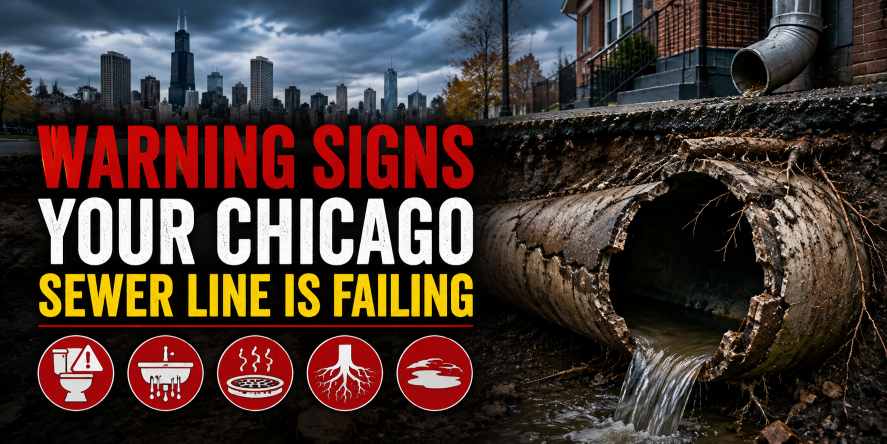
The Complete Symptom Decoder for Chicago and Chicagoland Homeowners Who Want to Catch the Problem Before It Catches Them
Of all the underground pipes serving a Chicago home, the sewer lateral is the one that causes the most damage when it fails — and the one that homeowners are least likely to think about until it does. It doesn’t drip. It doesn’t show up on a water bill. It doesn’t reduce your shower pressure. It just sits underground, doing its job quietly for 30, 40, 50, or 60 years — until the day it doesn’t.
When a sewer lateral fails in a Chicago home, the results are immediate and dramatic. Sewage backs up through basement floor drains. Multiple drains in the house slow or stop simultaneously. A wet, sunken area appears in the front yard over the pipe’s path. And the homeowner who has been using this pipe daily for years finds themselves scheduling emergency excavation at $15,000 to $25,000 — work that could have been planned and completed at a fraction of that cost if the warning signs had been recognized and acted on months or years earlier.
The warning signs were there. They always are. The sewer line doesn’t fail without warning — it communicates its condition through specific, identifiable symptoms for months or years before it fails completely. A toilet that gurgles when the bathroom sink drains. A recurring floor drain backup after heavy rain. A faint sewer smell in the basement on humid days. A strip of unusually green grass running across the front yard. Each of these is a message. This guide teaches you to read every one.
The Foundation: Who Owns Your Sewer Lateral
Before getting into warning signs, the ownership question needs to be answered clearly because it determines who’s responsible for every repair or replacement decision.
In Chicago and virtually all Chicagoland municipalities, the sewer lateral — the underground pipe from your home to the public sewer main in the street — is the homeowner’s responsibility from the foundation to the main connection point. The city or municipality maintains the public sewer main in the street. The lateral connecting your home to that main is yours: your maintenance obligation, your repair cost, your replacement project when the time comes.
Some Chicagoland municipalities maintain the lateral up to the property line, with the homeowner responsible for only the section between the foundation and the property line. Others place full responsibility for the entire lateral — from the foundation to the main connection — on the homeowner. The Chicago Water Management Office and most suburban public works departments can tell you exactly where the ownership boundary falls for your address.
The MWRD’s Understanding Your Sewer resource explains how Chicago’s combined sewer system works and what the relationship is between individual home laterals and the public sewer infrastructure they connect to. In Chicago and most inner-ring suburbs, storm and sanitary waste travel in the same pipes — which means that when that shared system surcharges during heavy rain, the pressure travels backward through your private lateral into your basement. Understanding your lateral’s condition is the foundation of managing that risk.
Homeowners concerned about sewer surcharge flooding, basement backups, and flood prevention strategies can also review our complete guide to flood control systems, backwater valves, overhead sewers, and basement flood protection in Orland Park.
The Chicago Sewer Lateral — What’s Actually Underground
Before getting into warning signs, understanding what material your sewer lateral is made of tells you what failure mode to expect and what warning signs to prioritize.
Clay Tile — The Most Common Material in Pre-1960 Chicago Homes
Clay tile was the standard sewer lateral material through most of the first half of the 20th century. It’s present in the majority of Chicago bungalows, two-flats, and inner-ring suburb homes built before 1960. Clay tile pipe itself is durable — the material doesn’t rust or corrode. The failure points are the joints between pipe sections, which were mortared or simply butted together. After 60 to 80 years of soil movement, freeze-thaw cycling, and tree root pressure, these joints offset, separate, and develop gaps.
Clay tile fails primarily through: Joint separation allowing root intrusion, joint offset from soil movement creating flow restriction, and crack formation from surface loading or soil pressure. A clay tile lateral can have dozens of joint gaps throughout its length — each one a root entry point and a soil infiltration point.
Cast Iron — 1940s Through 1970s Homes
Cast iron was used for sewer laterals in many Chicago-area homes built during the mid-20th century. Cast iron corrodes from the inside out over decades — the interior surface develops rough pitting and scale that catches debris, and eventually the wall thins sufficiently to develop holes and cracks. Cast iron failures are more likely to be pipe body failures (cracks, holes) than joint failures, distinguishing them from clay tile. If your Chicago home has an older cast iron sewer line, see our Chicago homeowner guide to cast iron pipe replacement to learn when deterioration can be repaired, when replacement makes more sense, and what homeowners should know before making a decision.
Orangeburg — The Most Concerning Material
Orangeburg pipe — a compressed wood pulp and pitch material used in the post-World War II housing boom from roughly 1945 to 1960 — was designed as a temporary material but installed in permanent applications throughout the Chicago suburbs. It has a design life of approximately 50 years. Homes with Orangeburg sewer laterals built in the 1950s are operating on pipes that are at or past their design life. Orangeburg deteriorates from inside — the pipe softens, compresses out-of-round, and eventually collapses. There is no repair for Orangeburg lateral failure. It requires replacement.
PVC and Modern Materials — Post-1970s New Construction and Replacement
PVC and ABS plastic pipe, which became the standard for residential sewer lateral work after the 1970s, have expected service lives of 50 to 100 years and are resistant to the corrosion and root intrusion that affect clay tile and cast iron. If your home was built after 1975 or if the lateral was replaced at any point in the last 40 years, you likely have modern plastic pipe with a far lower near-term failure risk.
The Warning Signs — Every Message Your Sewer Lateral Sends
Category 1: What Your Drains Are Telling You
Drain performance changes are the first and most reliable indicators of a developing sewer lateral problem. The key diagnostic principle: problems in the sewer lateral affect multiple fixtures simultaneously. Problems in individual fixture drains affect only that fixture.
🚨 Multiple Drains Slow or Backing Up at the Same Time
The single most important sewer lateral warning sign available. When your kitchen sink, bathroom sink, tub, and toilet are all draining slowly at the same time — or when backing up water in one drain correlates with symptoms in another — the problem is downstream of where all those drain lines connect. That downstream location is the sewer lateral.
What it means: The sewer lateral has developed a restriction — through root intrusion, accumulated debris, partial collapse, or joint offset — that’s slowing flow for every fixture in the house simultaneously. The restriction is significant enough to be impacting all connected drain lines at once. Homeowners often assume repeated drain cleaning will permanently solve these symptoms. In reality, when clogs continue returning after professional cleaning, the underlying problem is frequently a damaged sewer lateral, root intrusion, separated joints, or a deteriorating pipe. If you’ve had the same drain cleaned multiple times and the issue keeps returning, read our guide on why Chicago drains keep clogging after cleaning and the warning signs that the pipe itself may be failing.
The diagnostic test: Run water in the kitchen sink for two minutes and watch the basement floor drain. If water backs up through the floor drain as the kitchen sink runs, the restriction is in the main sewer lateral downstream of where both drain lines connect.
Urgency: High. Multiple-fixture simultaneous slowdown is one of the most reliable indicators that a professional sewer camera inspection is needed immediately. The restriction that’s producing this symptom will worsen.
Ignore it and: The restriction continues to develop. Within weeks to months, it progresses from slow drainage to complete backup — sewage entering the basement through the floor drain during normal household water use.
🚨 Recurring Floor Drain Backup During or After Heavy Rain
Water backing up through the basement floor drain specifically during or after heavy rain events — with or without a sewage odor — indicates the sewer lateral or the connected sewer system is under pressure that exceeds what it can handle.
If the backup has a sewage odor: This is sewer surcharge backup from Chicago’s combined sewer system. The city’s system is overwhelmed and pressure is traveling backward through your lateral. The sewer lateral is the pathway — its condition (root intrusion, joint gaps, deterioration) affects how easily surcharge pressure enters. A severely deteriorated lateral with multiple open joints allows surcharge far more readily than a sound lateral. The protection is a backwater valve — but lateral condition assessment is warranted first to understand whether deterioration is contributing.
If the backup is clear or slightly murky without odor: This is potentially groundwater infiltration — water entering the sewer lateral through open joints, cracks, or connection failures, adding volume to the system that the connected infrastructure can’t handle during peak rain conditions. This is a lateral condition issue — the joints or connections that are admitting groundwater need repair.
Urgency: High for odored backup — both a health concern and a lateral condition signal. Moderate to high for clear water infiltration — indicates open lateral joints that will continue admitting water and worsening over time.
🚨 Basement Sewer Backup During Normal Household Use
Sewage backing up through the basement floor drain or basement toilet during normal household water use — not during rain events, not from a specific overtaxed fixture, but from routine showering, dishwasher running, or laundry — indicates a lateral blockage severe enough to prevent normal household waste from flowing to the main.
What it means: The lateral has developed a restriction — through root mass, collapsed section, or significant offset — that’s preventing normal flow. Household waste is backing up because the lateral cannot accept the volume that normal use generates. This is beyond a slow-drain condition — it’s an active failure.
Urgency: Urgent. This is not a condition to wait on. Stop using water, call for emergency service, and schedule a sewer camera inspection as part of the service call to identify the nature of the blockage before rodding alone is attempted. A collapsed section that’s rodded without camera confirmation may be temporarily cleared but will block again at the same point within days.
Category 2: What Your Plumbing Sounds Are Telling You
🚨 Gurgling from the Toilet When Other Fixtures Drain
Run the kitchen sink at full flow for 30 seconds. If the toilet gurgles — a bubbling or percolating sound from the bowl — without being flushed, the sewer lateral has a restriction that’s creating air displacement in the connected drain system. As water flowing from the kitchen forces air through the lateral, that air finds the nearest available exit — which is the toilet bowl, creating the gurgling sound. It’s also worth noting that similar gurgling or air displacement symptoms can sometimes be caused by ventilation issues in the drain system itself, not just sewer lateral restrictions — here’s a detailed breakdown of how Chicago plumbing vent pipes work and what happens when they fail: Chicago Plumbing Vent Pipes Guide
What it means: A partial restriction in the sewer lateral is creating back-pressure in the drain system. The gurgling is air being displaced from the restricted section of the lateral back through the toilet — the least-resistant path for the trapped air to escape. This is an early-stage warning sign. The restriction isn’t yet severe enough to cause backup under normal use, but it’s significant enough to produce audible symptoms.
Urgency: Moderate. This symptom indicates a developing restriction that warrants camera inspection — not an emergency today, but a condition that will progress. In Chicago’s mature-tree neighborhoods where root intrusion is the most common cause of this symptom, the root mass continues growing regardless of whether it’s causing complete backup yet. Addressing it while it produces only gurgling is dramatically less expensive than addressing it after it produces backup.
🚨 Gurgling from the Shower or Tub When the Toilet Flushes
The reverse pattern — water in the shower or tub drain gurgles, percolates, or rises slightly when a toilet is flushed — indicates the same lateral restriction from a different direction. The high-volume flush pushes against the restriction and the pressure displaces water back up through the shower or tub drain. If water actually begins rising out of the shower drain or the shower starts overflowing when other fixtures are used, the problem may have progressed beyond an early warning sign into an active sewer backup. Our guide explains why a shower can overflow, what sewer backups have to do with it, and what Chicago homeowners should do next.
What it means: The restriction in the lateral is severe enough that a toilet flush — a significant single-event water volume — is temporarily exceeding the lateral’s capacity to accept it, backing pressure up through adjacent drain connections. This is a more advanced symptom than the kitchen-sink-to-toilet gurgle and warrants more urgent assessment.
🚨 Constant Dripping Sound in Walls Without a Visible Leak
A persistent dripping or trickling sound inside the walls near a drain pipe run — without any visible moisture at the surface — can indicate a sewer pipe that has developed a crack or hole and is leaking wastewater into the wall cavity. This symptom is less common than the drain-performance and gurgling symptoms but represents a more urgent situation when present.
What it means: Sewer pipe leakage inside a wall cavity introduces sewage-contaminated water into the building structure — a mold and structural concern beyond just the plumbing failure. Professional investigation including thermal imaging is the appropriate diagnostic step.
Category 3: What the Smells Are Telling You
🚨 Intermittent Sewer Gas Smell in the Basement
A faint sulfur or sewage smell in the basement that comes and goes — present on some days, absent on others, stronger in warm humid weather, noticeable near the floor drain or in the utility area — is one of the most common and most dismissed sewer lateral warning signs.
What it means: Sewer gas is entering the basement from the drain system. The intermittent nature is characteristic of sewer gas dynamics — gas accumulates when conditions are right (warm temperatures, low air pressure, minimal fresh air movement) and dissipates when conditions change. The sources can be: a dry P-trap in a floor drain (quarterly water refreshing addresses this), a cracked sewer lateral joint that allows gas to escape into the surrounding soil and migrate into the basement, or a lateral with open joints that allows gas to enter the building drain system.
The distinction between dry trap and lateral issue: Pour a gallon of water into the floor drain. If the smell resolves within 24 to 48 hours, a dry trap was the source. If the smell persists or recurs quickly despite a wet trap, the sewer lateral or its connections have gas-emitting failures that require professional investigation.
Urgency: Moderate. Sewer gas contains hydrogen sulfide and methane — health and safety concerns at elevated concentrations. The recurring smell warrants investigation rather than air freshener.
🚨 Sewer Smell Outside Near the Lateral Path
A sewage odor specifically noticeable outside in the yard or at the foundation — not inside the house — particularly over the path the sewer lateral runs from the house to the street, indicates a sewer lateral leak into the surrounding soil.
What it means: Sewage is escaping the lateral through a crack, open joint, or hole and contaminating the surrounding soil. The odor is the wastewater content releasing hydrogen sulfide into the soil and ambient air. This is both a plumbing failure and an environmental concern — raw sewage releasing into the yard soil.
Urgency: High. A lateral that’s actively leaking sewage into the yard requires professional assessment and repair to prevent soil contamination from spreading and to stop the ongoing release.
Category 4: What Your Yard Is Telling You
🚨 Wet Spot or Perpetually Soggy Area in the Yard Over the Lateral Path
A persistently wet or soggy area in the front yard or side yard — in the path between the house and the street where the sewer lateral runs — that doesn’t dry out after dry weather indicates an active lateral leak saturating the surrounding soil.
What it means: Wastewater is escaping the lateral continuously, saturating the surrounding soil. The lateral has a structural failure — crack, open joint, or hole — releasing flow into the ground rather than carrying it to the main.
The distinction from a water line leak: A sewer lateral leak produces an odor — even subtle — that distinguishes it from a water line leak. A water line leak produces neutral-smelling wet soil. A sewer lateral leak produces sewage-odored wet soil. If there’s any odor to the wet area, the sewer lateral is the source.
Urgency: High. An actively leaking sewer lateral is a progressive failure — the leak point enlarges over time as soil erodes around it. Schedule camera inspection and repair before the void formation affects the lateral structurally or reaches the foundation.
🚨 Unusually Lush or Green Grass in a Strip Across the Yard
A distinct band of grass that’s noticeably thicker, greener, or more lush than surrounding lawn — running in a line from the house toward the street — is one of the most reliable chronic leak indicators in a sewer lateral.
What it means: A slow, chronic sewer lateral leak has been releasing nutrient-rich wastewater into the surrounding soil over weeks or months, fertilizing and irrigating the grass directly above the pipe. This symptom typically indicates a smaller leak than the wet spot symptom — one that’s been running long enough to affect vegetation but isn’t saturating the surface.
Urgency: Moderate to high. The lush grass pattern indicates a leak that’s been active long enough to establish a fertility differential between the pipe zone and surrounding lawn — meaning it’s been running for at least several weeks. Professional inspection is warranted.
🚨 Sinkholes, Depressions, or Pavement Cracking Along the Lateral Path
Settlement depressions in the soil, soft spots in the lawn over the lateral path, or pavement cracking specifically along the line the lateral runs indicate subsurface void formation — the leaking lateral has been washing soil particles away from around the pipe, creating a void that the surface is beginning to follow downward.
What it means: An advanced lateral leak that has been running long enough to erode the surrounding soil structure. This is the precursor to a complete sinkhole — and in some cases, the lateral itself has suffered a partial or complete collapse that’s already creating the void.
Urgency: Urgent. Void formation around a sewer lateral indicates structural conditions that may progress rapidly. Same-day professional assessment is appropriate. The void formation process accelerates — what is a small settlement today can be a significant collapse within weeks.
Category 5: What Your Bill and Meter Are Telling You
🚨 Unexplained Increase in Water or Sewer Bills
A sewer lateral leak doesn’t register on the water meter — wastewater leaving through a crack in the lateral doesn’t generate a new meter reading because the water has already passed the meter going in. However, in some municipalities, sewer bills are calculated based on water consumption. An increasing water bill combined with other warning signs may indicate a water infiltration issue in the lateral that’s adding volume to the waste stream.
More directly: an unexplained increase in water consumption combined with sewer lateral warning signs can indicate cross-connections or infiltration — groundwater entering through open lateral joints and adding to the metered flow at points where meters track both in and out.
Chicago-Specific Factors That Accelerate Sewer Lateral Failure
The mature tree situation in Chicago’s established neighborhoods. The trees that make Chicago’s bungalow belt, Lincoln Square, Beverly, and similar neighborhoods beautiful are some of the most aggressive root systems in any American residential market. A 70-year-old elm or oak on a Chicago parkway has root systems that extend 30 to 50 feet from the trunk — reaching every lateral within that radius through the moisture gradient that a sewer pipe creates. A clay tile lateral in a 1940s Chicago bungalow neighborhood has been a root target for 80 years. The joints that have been absorbing root pressure for 80 seasons of growth have almost universally admitted some root intrusion. The question is degree — hairline rootlets or a root mass filling significant pipe diameter.
Freeze-thaw cycling reaches the lateral. Chicago’s 80 to 100 freeze-thaw cycles per winter stress every underground joint in the lateral. Water in open clay tile joints freezes, expands, and enlarges the gap. After six decades of this cycling, clay tile joints that were snug at installation may be significantly offset or separated. A lateral that runs in the upper few feet of soil — where freeze-thaw is most active — is particularly vulnerable.
The combined sewer surcharge dynamic. As the MWRD explains, Chicago’s combined sewer system carries storm and sanitary waste together. During surcharge events, pressure in the combined main travels backward through laterals. A lateral with multiple open joints or a compromised root section doesn’t just back up more readily than a sound lateral — it also admits storm infiltration more easily, adding volume to the system and potentially compounding the surcharge. The EPA’s WaterSense Home Maintenance program emphasizes that proper maintenance of the private drain lateral is a homeowner responsibility that affects both private property and the shared infrastructure it connects to.
Soil conditions create differential movement. Chicago’s clay-heavy soil expands when wet and contracts when dry — seasonal movement that continues throughout the life of the lateral. A clay tile lateral installed in 1950 has been through 75 years of this expansion and contraction, creating cumulative offset at every joint.
What a Camera Inspection Actually Reveals
Camera inspection of the sewer lateral — the diagnostic service that should follow any significant warning sign before any repair decision is made — provides specific, visual information about every condition in the pipe:
Root intrusion: The camera shows exactly where roots have entered, how dense the root mass is, and how much pipe diameter is occupied. This distinguishes a hairline root intrusion requiring periodic rodding from a root mass filling 80% of the pipe diameter requiring mechanical cutting followed by joint repair.
Joint offset and separation: Clay tile joints that have moved show clearly on camera — offset joints create ledges that catch toilet paper and debris, separated joints create open gaps visible as the camera passes.
Pipe belly or sag: Ground settlement creates low points in the lateral where water, waste, and debris pool rather than flowing to the main. A pipe belly is visible on camera as a standing water pool that the camera must navigate through.
Cracked or collapsed sections: Longitudinal cracks, circumferential fractures, and partial or complete collapses are visible. The distinction between a crack that allows root entry and a crack that indicates structural pipe failure determines whether spot repair, pipe lining, or full replacement is appropriate.
Scale and deposit buildup: Cast iron laterals accumulate internal scale and biological deposit that narrows effective pipe diameter. Camera inspection after hydro jetting shows the pipe condition under the accumulation.
Pipe material identification: Camera inspection confirms the lateral’s material — critical for identifying Orangeburg pipe, which has no repair option, and for establishing appropriate service intervals going forward.
For the complete guide to what professional drain and sewer inspection reveals, how to interpret each finding, and what the right response is for each condition, see our complete Chicago catch basin and sewer inspection guide.
If you’re evaluating whether a sewer lateral issue might affect a future sale or inspection outcome, see our complete Chicago home seller’s plumbing guide — what inspectors always find, what kills deals, and what to fix before listing in 2026.
Repair vs. Replacement vs. Lining — Making the Right Call
Not every failing sewer lateral requires full replacement. The right approach depends on what the camera reveals and the overall pipe condition.
Hydro jetting — when the issue is accumulation: Root masses, grease, scale, and debris that are restricting flow but not indicating structural pipe failure can be addressed with hydro jetting. This clears the obstruction but doesn’t address the underlying structural condition — open joints that allowed root entry will admit roots again. Hydro jetting on a confirmed structural sound pipe is a valid maintenance approach. Hydro jetting on a deteriorated pipe with widespread joint failures buys temporary relief while the pipe continues to deteriorate.
Spot repair — when the issue is localized: A single cracked section, a specific offset joint, or an isolated failure point that camera inspection confirms is the primary problem can be addressed with targeted excavation and repair at that specific location. Appropriate when the rest of the pipe is in sound condition and the failure is isolated.
Pipe lining (CIPP — cured-in-place pipe): A fiberglass or epoxy liner inserted into the existing pipe and cured in place creates a new pipe inside the old one. Appropriate for pipes that are structurally damaged across multiple sections but haven’t collapsed — the liner addresses widespread joint gaps and crack infiltration without full excavation. Not appropriate for pipes that have collapsed sections (the liner can’t navigate a collapse) or for pipes with significant offset joints that create flow restrictions.
Full replacement — when the pipe has failed systemically: When camera inspection reveals widespread joint failure, multiple crack locations, collapsed sections, or confirmed Orangeburg material, full replacement is the appropriate response. Repeated partial repairs on a systemically failing pipe address symptoms while the underlying deterioration continues. Our sewer line repair and replacement services include camera-confirmed diagnosis before any replacement recommendation. Learn more about overhead sewer conversion in Chicago (the permanent solution when sewer laterals repeatedly fail or flood basements)
The Cost Escalation Timeline — What Waiting Costs
Warning signs addressed at the gurgling stage: Hydro jetting to clear root accumulation, joint sealing at confirmed root entry points. Typically $400 to $900. The lowest cost point in the entire sewer lateral decision tree.
Warning signs addressed at the slow-drain/recurring-backup stage: Camera inspection plus hydro jetting or mechanical root cutting, lateral cleaning and assessment. $600 to $1,500 depending on extent. Still manageable and planned.
Spot repair at an identified failure point: Camera-confirmed localized excavation and repair. $1,500 to $4,000 depending on depth, access, and extent of repair needed.
Pipe lining for a deteriorated but intact lateral: $3,000 to $8,000 for most Chicago residential laterals depending on diameter and length. Trenchless — minimal excavation required.
Full lateral replacement — planned, not emergency: $5,000 to $15,000 depending on lateral length, depth, soil conditions, and whether driveway or sidewalk must be cut. Scheduled on your timeline at standard rates.
Emergency replacement after complete failure: Same scope as planned replacement but at emergency call rates, with the additional costs of interior sewage cleanup and any property damage the backup caused before the failure was discovered. $12,000 to $25,000+ depending on backup damage extent.
The cost difference between addressing the gurgling toilet in April and calling for emergency service in August of the same year can be $15,000 or more. The warning sign was the same pipe.
What to Do When You Notice a Warning Sign
Step 1: Determine whether it’s a lateral problem or a fixture/branch line problem. Run water in multiple fixtures simultaneously and observe whether the symptom intensifies when multiple fixtures are active. Symptoms that worsen with multiple-fixture use are lateral problems. Symptoms isolated to one fixture are that fixture’s drain branch.
Step 2: Perform the gurgling test. Run the kitchen sink at full flow for 30 seconds and listen for toilet gurgling. If you’re trying to verify or access the main sewer line during these tests, the sewer cleanout is the key access point that allows direct inspection, testing, and clearing of the lateral without using interior fixtures. A gurgling toilet confirms a lateral restriction downstream of where the kitchen and bathroom drains connect.
Step 3: Schedule camera inspection before any repair decision. A sewer lateral camera inspection shows exactly what’s happening inside the pipe — root intrusion degree, joint condition, pipe material, structural integrity. This information is the foundation of every correct repair decision. Our sewer camera inspection service is available throughout Chicago and the suburbs on same-day and next-day scheduling.
Step 4: Address the finding at the level appropriate to the condition. Not every camera finding requires full replacement. Not every blockage clearing requires full lateral assessment. Match the response to what the camera confirms.
For the complete guide to Chicago drain and sewer maintenance — how often each system needs service, what warning signs each produces, and what the right cleaning method is for each — see our complete Chicago drain cleaning guide.
Frequently Asked Questions
My toilet gurgles occasionally but drains fine every time. Is this worth calling about? Yes. An occasional gurgle that’s becoming more frequent is a lateral restriction in early development. The fact that the toilet drains fine means the restriction isn’t yet severe enough to cause backup under single-fixture use — but it’s severe enough to produce air displacement symptoms when multiple fixtures run. Addressing root intrusion at the gurgling stage costs a fraction of what it costs at the backup stage.
The city just did work on the main sewer in my street. Could that have damaged my lateral? Possibly. Main sewer work creates vibration and sometimes pressure changes that can affect the condition of clay tile laterals — particularly at the connection point where the lateral meets the main. If you started noticing any sewer symptoms shortly after city sewer work in your street, a camera inspection of the lateral including the connection point is warranted.
I had my lateral rodded last year and it’s already backing up again. What does that mean? Rodding clears material from the pipe but doesn’t address the underlying structural condition. If your lateral rods out and backs up within months, the underlying cause — most commonly root intrusion through open joints — wasn’t addressed. Camera inspection followed by root cutting and joint sealing at the root entry points, or pipe lining if the joints are widespread, is the appropriate next step.
My home is 15 years old. Do I need to worry about my sewer lateral? At 15 years with modern PVC or ABS plastic lateral, you have minimal near-term structural risk. The monitoring priority for a 15-year-old lateral is root intrusion if there are mature trees within 50 feet of the lateral path, and joint condition at the connection to the main. A camera inspection every 5 to 7 years is a reasonable preventive standard for a newer lateral in a mature-tree neighborhood.
How do I find where my sewer lateral runs? The building permit records for your home — available from your municipality — typically include a site plan showing the lateral location. Your sewer camera inspection report includes the camera’s tracked path, which can be located with standard sewer locating equipment. Knowing the lateral path is valuable before any landscaping, excavation, or construction on the property.
Noticing Any of These Sewer Line Warning Signs in Your Chicago Home?
Licensed, insured, and locally based in Brookfield since 1978. We camera-inspect, rod, hydro jet, line, and replace sewer laterals throughout Chicago and the suburbs. Written quotes before we start, permits pulled on every job, our own licensed plumbers on every call. Same-day camera inspection available. Send us a message and we’ll get back to you fast.
Or call us directly: 708-801-6530 | Open 24/7
—
Suburban Plumbing Sewer Line & Drain Cleaning Experts
Licensed & Insured | Open 24 Hours | Serving Chicago & Suburbs Since 1978
📞 Suburbs: 708-801-6530 | 📞 Chicago: 773-570-2191 | 🚨 Emergency: 708-518-7765