That Colored Smoke Coming Out of the Ground Isn’t an Emergency — But the Notice You Get Afterward Might Require Your Immediate Attention
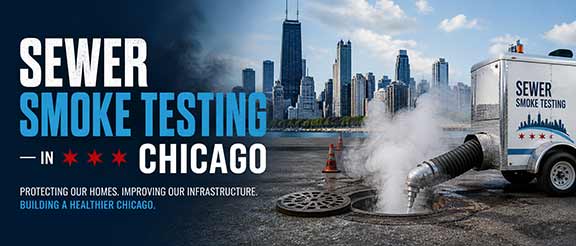
You’re walking to your car on a Tuesday morning and you notice it — smoke rising from the ground, from storm drains, from your neighbor’s yard. Workers in orange vests are moving through the block with equipment you’ve never seen before. A truck is idling at the corner with a large fan attached to a manhole cover.
Or maybe you didn’t see anything at all. You just received a letter from your village or the city that says something about a sewer defect on your property and a required repair within 30 days. You have no idea what it means, whether it’s serious, or what you’re supposed to do about it.
Both scenarios — witnessing a sewer smoke test and receiving a defect notice as a result of one — happen to Chicagoland homeowners and business owners regularly. And in both cases, most people’s first response is the same: confusion, followed by a frantic Google search.
This guide answers every question you have about sewer smoke testing in the Chicago area — what it is, why municipalities do it, what the smoke actually indicates, what happens when a defect is found on your property, what your legal obligations are, and how much repairs typically cost. If you just received a notice or you’re watching smoke come out of the ground on your block right now, this is where you start.
What Sewer Smoke Testing Actually Is
Sewer smoke testing is a diagnostic technique used by municipalities and sewer system operators to identify defects in underground sewer infrastructure — defects that allow water that isn’t supposed to be in the sanitary sewer system to enter it, and defects that allow sewer gas to escape into structures or the environment where it shouldn’t be.
The process works like this. A crew uses a high-powered blower — typically mounted on a truck — to force non-toxic, artificially generated white or gray smoke under pressure into a section of the sewer main through a manhole. The smoke travels through the pipe under pressure and escapes wherever there is an opening — a crack in the main, a defective lateral connection, an open cleanout cap, an illegal connection between a storm drain and a sanitary sewer, or any other point where the pipe system is compromised.
By watching where smoke appears on the surface — emerging from the ground, from storm drain inlets, from cleanout caps, from basement floor drains inside buildings, from window wells, from downspout connections — the crew can identify defects that would be invisible by any other surface-level method.
The smoke itself is completely non-toxic. It is produced by a smoke machine using a water-based or glycol-based solution that generates a visible white vapor. It has no odor, leaves no residue, and dissipates quickly. If smoke enters your home during a sewer smoke test it is not a health hazard — but it is a signal that there is a connection between the municipal sewer system and your home’s interior that should not exist.
Why Chicago and Chicagoland Municipalities Conduct Smoke Tests
Sewer smoke testing is not arbitrary — it is part of a systematic, legally mandated program to identify and control infiltration and inflow (I&I) in the regional sewer system.
Infiltration refers to groundwater that enters the sanitary sewer system through cracks, faulty joints, and other structural defects. Inflow refers to stormwater that enters the sanitary sewer through illegal connections — downspouts routed to floor drains, driveway drains connected to sanitary sewers, window well drains tied into the sanitary system.
Both infiltration and inflow are serious problems for Chicagoland’s sewer infrastructure. When excessive amounts of clear water enter the sanitary system during rain events, they compete for pipe capacity with actual sewage — reducing the system’s ability to handle wastewater flows, contributing to sanitary sewer overflows that pollute area waterways, and causing the basement backups that Chicago-area homeowners experience during heavy storms.
The Metropolitan Water Reclamation District of Greater Chicago (MWRD), which manages wastewater treatment and stormwater management for Cook County, operates an Infiltration/Inflow Control Program (IICP) under its Watershed Management Ordinance. This program requires municipal satellite entities — the villages and cities connected to the MWRD’s system — to conduct condition assessments of their sewer systems, identify I&I sources, and address deficiencies within specified timeframes. Smoke testing is one of the primary tools municipalities use to fulfill these IICP requirements.
The MWRD has also been actively investing in sewer condition assessment across Cook County. In October 2025, the MWRD launched a $5 million EPA-funded project to inspect and rehabilitate sanitary sewers in nine suburban communities — using closed-circuit television cameras, smoke testing, and other assessment methods to identify I&I sources and structural defects. This project is part of a broader regional effort to reduce basement backups and sewer overflows across Chicagoland.
When your municipality conducts a smoke test, they are fulfilling state and regional regulatory requirements designed to protect the sewer system — and ultimately to protect your neighborhood from basement flooding and waterway contamination.
What the Smoke Actually Indicates — and What It Doesn’t
When smoke appears during a sewer test, it reveals one of several specific conditions. Understanding what each means helps you interpret the process and any notice you receive afterward.
Smoke emerging from the ground surface — particularly from areas above the sewer main or lateral path — indicates a crack, break, or failed joint in the underground pipe where pressure from the blower is pushing smoke out through the soil. This can indicate a mainline defect (the municipality’s responsibility) or a lateral defect (typically the homeowner’s responsibility depending on where on the lateral the defect is located).
Smoke emerging from storm drain inlets, catch basins, or driveway drains — indicates a cross-connection between the storm sewer and the sanitary sewer. This is illegal in separate sewer systems and is one of the primary inflow sources municipalities are required to identify and eliminate. If the cross-connection is on private property — for example, a driveway drain that was illegally connected to the sanitary lateral — the property owner is responsible for correcting it.
Smoke emerging from downspout connections or window well drains — indicates those drainage points are connected directly to the sanitary sewer rather than to the storm system or to the surface. In separate sewer communities, this is an illegal inflow source and the property owner will typically receive a notice to disconnect and properly re-route those drains.
Smoke appearing inside a basement or building — typically from floor drains, basement toilets, or utility sink drains — indicates that the building’s interior is connected to the sewer system without adequate trap protection, or that a dry trap is allowing sewer gas (and in this case, smoke) to pass through. This can also indicate that water is no longer present in a floor drain trap due to infrequent use — a common condition in seldom-used basement floor drains. Running water into infrequently used drains will restore the water seal in the trap and prevent future sewer gas entry.
Smoke NOT appearing from your property does not mean your sewer lateral is in good condition. Smoke testing detects surface-level defects and inflow sources. It does not assess the structural condition of the pipe interior — that requires a sewer camera inspection. A lateral can have significant root intrusion, pipe belly, offset joints, and internal corrosion without any of those conditions producing a positive smoke test result.
What Happens When a Defect Is Found on Your Property
If the smoke test identifies a defect associated with your property — a failed lateral connection, an illegal downspout or drain connection, an open cleanout cap, or smoke entering your building — the municipality’s testing crew will document the location and type of defect. You will typically receive a written defect notice within days to weeks of the test.
The notice will identify the specific defect found, the location of the defect relative to your property, and the timeframe within which the defect must be corrected. When those notices involve sewer connection points or access issues, understanding your home’s sewer access system is critical — especially components like cleanouts that determine how easily inspections and repairs can be performed. Timeframes vary by municipality and by defect severity — some municipalities classify defects into priority tiers with different correction deadlines. The most urgent defects — illegal connections that represent significant inflow sources — are typically classified as one-year deficiencies requiring correction within 12 months. Less urgent structural defects may have longer correction windows.
You are responsible for understanding what the notice requires and complying with it within the stated timeframe. Ignoring a defect notice does not make the obligation go away — it typically results in follow-up notices, potential fines, and in some cases the municipality performing the repair itself and billing the property owner. The MWRD’s IICP framework creates binding compliance obligations on municipalities, and municipalities pass those obligations downstream to property owners when the defect is on private property.
Before assuming the worst, read the notice carefully. Not every defect notice requires major sewer work. An open cleanout cap is a five-minute fix. A disconnected downspout connection may require simple rerouting. Understanding exactly what was found and what the required corrective action is will determine whether you need a plumber, an electrician, a landscaper, or just a new cap for your cleanout.
The Most Common Defects Found During Chicago-Area Smoke Tests
Open or missing cleanout caps — Sewer cleanouts are the threaded access points installed in your lateral that allow for rodding and camera inspection. Cleanout caps can loosen, crack, or go missing over time, creating direct openings where surface water and debris can enter the sanitary system. This is one of the most common findings in smoke tests and one of the easiest to correct — a new cleanout cap costs a few dollars and takes minutes to install.
Downspout connections to the sanitary sewer — In separate sewer communities, downspouts must discharge to the storm system, to a surface area, or to an approved drainage system — not to the sanitary sewer. Older Chicago-area homes were sometimes constructed with downspout connections routed directly into the sanitary lateral, which was acceptable under older codes but is now an illegal inflow source. Correcting this requires disconnecting the downspout from the sanitary line and rerouting it to a proper discharge point.
Window well and area drain connections to the sanitary sewer — Same issue as downspout connections — these stormwater collection points should not be connected to the sanitary system. Disconnection and rerouting is the typical corrective action.
Failed lateral connections at the main — Where your private sewer lateral connects to the municipal main, the joint can fail over time — creating a defect that allows both I&I inflow and smoke to escape. Depending on where the failed connection is located — in the public way or on private property — responsibility for repair is divided between the municipality and the property owner. Your local public works department or the notice you receive should clarify which portion of the lateral is your responsibility.
Cracked or broken laterals — Smoke tests can reveal cracks or breaks in the lateral itself, particularly near the surface where soil movement and freeze-thaw cycling have compromised the pipe. Depending on the extent of the damage, repair options range from spot repair to partial or full lateral replacement.
Illegal cross-connections — A storm drain inlet, catch basin, or area drain on your property that is connected to your sanitary lateral rather than to the storm system is an illegal cross-connection. During a heavy rain, these connections dump stormwater directly into the sanitary sewer — a significant inflow source that municipalities are specifically required to eliminate under the MWRD’s IICP.
What Repairs Typically Cost in the Chicago Area
Cost depends entirely on what the defect notice requires. Here’s a realistic range:
Cleanout cap replacement — $25 to $100 including labor. The least expensive possible outcome from a smoke test defect notice.
Downspout disconnection and rerouting — $200 to $800 depending on how the downspout needs to be rerouted and whether any landscaping or concrete work is involved.
Lateral spot repair (cracked or broken section near the surface) — $1,500 to $4,000 for a localized repair at an accessible location.
Failed lateral-to-main connection repair — $2,000 to $6,000 depending on depth and whether the connection is in the parkway or on private property. This often requires coordination with the municipality and a permit.
Full lateral replacement — $6,000 to $20,000 depending on length, depth, and access conditions. Required when the lateral has multiple defects or the overall condition is too compromised for spot repair.
Illegal connection disconnection and correction — $500 to $2,500 depending on the scope of the disconnection and the rerouting required.
Our sewer line repair and replacement services cover all types of smoke test defect corrections across Chicago and the suburbs — from simple cap replacements to complex lateral repairs. We can assess the specific defect identified in your notice, explain exactly what work is required, and provide a written quote before any work begins.
What to Do If Smoke Enters Your Home During a Test
If smoke appears inside your basement or home during a sewer smoke test, do not panic — but do take note. The smoke itself is harmless. What it reveals is not necessarily urgent, but it is worth understanding.
Smoke entering through a floor drain almost always means the trap has dried out — the water seal that normally blocks sewer gases from entering the basement is gone. This is common in infrequently used basement floor drains and is easily resolved by running a gallon of water into the drain to restore the seal. If smoke continues to appear in the drain even after the water seal is restored, there may be a more significant issue with the trap or the drain connection that warrants a closer look.
Smoke entering through a toilet indicates either a toilet that isn’t properly seated or sealed, or in rare cases, a more significant venting issue in the drain system. A plumber can diagnose this quickly.
Smoke entering through walls or from unexpected locations — not from a drain or fixture — can indicate cracks in the foundation or in underground pipe connections that are allowing sewer gases to migrate toward the building. This is the scenario that warrants the most immediate attention and professional assessment.
If the municipality’s crew is still on the block when you notice smoke inside your home, flag them down immediately. They will document the finding and can tell you specifically what they observed from outside. That documentation is useful when you discuss the issue with a plumber.
If You Received a Defect Notice: Your Next Steps
Step 1: Read the notice carefully. Identify the specific defect, its location, and the deadline for correction. Note whether it refers to a defect on private property (your responsibility) or in the public way (may be the municipality’s responsibility depending on local ordinance).
Step 2: Contact your municipality if anything is unclear. Your local public works or engineering department administers the smoke test program and can clarify exactly what the notice requires and what standards the corrective work must meet. Don’t guess — call and ask.
Step 3: Get a professional assessment. Before spending any money, Have a licensed plumber assess the specific defect. Our sewer smoke testing service covers the full Chicagoland area — we can assess the defect, explain exactly what the notice requires, and give you a written quote before any work begins. In some cases what the notice describes as a “failed lateral connection” turns out to be a minor issue correctable without major excavation. In other cases it’s more significant. You can’t know without a professional looking at it.
Step 4: Get a written quote and permit the work properly. Any sewer lateral work in Chicago and most Chicagoland suburbs requires a permit. A reputable contractor will pull the permit as part of the job — don’t work with anyone who suggests skipping it.
Step 5: Document the completed repair. Keep your repair invoice and any inspection documentation. Your municipality may require proof of correction to close out the defect notice, and you’ll want records if any questions arise when you sell the property.
Our sewer camera inspection service is a smart starting point if you’ve received a smoke test defect notice and aren’t sure what you’re dealing with. We’ll run the camera through the line, show you exactly what’s there, and give you a clear picture of what the notice requires and what your options are before committing to any repair.
Frequently Asked Questions: Sewer Smoke Testing in Chicago
Is the smoke toxic? Is it safe to breathe?
Yes — completely safe. Sewer smoke testing uses non-toxic, water-based or glycol-based smoke that produces no harmful byproducts, has no odor, and leaves no residue. It is the same type of theatrical smoke used in stage productions and is entirely safe for humans and animals. Municipalities are required to notify residents before smoke testing begins specifically so people don’t call 911 thinking there’s a fire.
Why didn’t I get advance notice about the smoke test?
Municipalities are generally required to provide advance notice to residents in the area being tested — door hangers, robocalls, or mailings. If you missed the notification, contact your local public works department. They can confirm whether your block was tested and whether any defects were identified at your property.
I received a defect notice but I didn’t see any smoke test activity in my neighborhood. How is that possible?
Smoke testing is conducted block by block and a given section is tested for a relatively short period. It’s entirely possible to miss the testing activity even if it occurred on your block. The notice is generated from the field crew’s documentation — if you received one, your property was identified as having a defect during the test.
Am I responsible for repairs in the public parkway?
It depends on your municipality’s ordinance. In Chicago, property owners are generally responsible for their private sewer lateral from the building to the point of connection with the city main — which typically includes the portion running through the parkway to the main. Some suburban municipalities have different rules about where private responsibility ends and municipal responsibility begins. Your notice and your local public works department can clarify the specific division for your property.
Can I ignore the defect notice?
No — not without risk. Municipalities track defect notices and follow up on uncorrected defects. Depending on the municipality and the severity of the defect, ignoring a notice can result in escalating fines, the municipality performing the repair and billing you, or complications when you try to sell the property. Address it within the timeframe stated in the notice.
How much time do I have to make the repair?
Timeframes vary by municipality and defect severity. One-year deficiencies — typically illegal connections and significant inflow sources — must be corrected within 12 months. Less urgent structural defects may have longer windows. Your notice will specify the deadline. If you need more time for a legitimate reason — permitting delays, contractor scheduling — contact your municipality before the deadline passes and ask about an extension.
Received a Smoke Test Defect Notice? We Can Help.
We assess smoke test defects, perform sewer camera inspections, and handle all required repairs — with full permit handling and documentation for your municipality. Same-day and next-day scheduling available across Chicagoland.
Or call us directly: 708-801-6530 | Open 24/7
—
Suburban Plumbing Sewer Line & Drain Cleaning Experts
Licensed & Insured | Open 24 Hours | Serving Chicago & the Suburbs Since 1978
📞 Suburbs: 708-801-6530
📞 West Suburbs: 630-749-9057
📞 Chicago: 773-570-2191
🚨 24/7 Emergency Line: 708-518-7765