The CBS Chicago Story, Two Different Water Utilities, and the Complete Private-Side Plumbing Picture for One of Illinois’ Biggest Cities
In February 2025, CBS Chicago ran a story specifically about Bolingbrook. Not about the Promenade. Not about the schools or the parks. About water bills. A Bolingbrook resident who has lived in the city for 62 years was quoted on camera: “I’ve lived out here for 62 years, and this is just terrible.” Another resident received a bill from Illinois American Water for $713 — over $400 of which was fees on top of a $234 water usage charge that resulted from a hidden leak. A third went from $79 a month to $112 overnight. “You got too many people that are already teetering on the fine line already between making it and not making it,” Brandy Adcock told CBS Chicago. “And this is a death blow is really what it is.”
Illinois American Water responded with a statement explaining that new rates approved by the Illinois Commerce Commission in December 2024 covered $421 million in water system infrastructure improvements and $136 million in wastewater system improvements being made from January 2024 through December 2025. Rate increases to pay for infrastructure investment in the system that delivers water to Bolingbrook’s Will County section.
That context — $557 million in combined infrastructure investment — tells a Bolingbrook homeowner something important: the utility is spending real money on the public infrastructure that delivers water to your home. What that investment does not cover is the water heater that receives and heats that water once it arrives. The supply lines that distribute it through your home. The drain lines that carry waste away. The sewer lateral underground. The gas lines serving your appliances. The flood control devices in your basement. Those remain your responsibility regardless of what Illinois American Water spends on its infrastructure — and the story behind Bolingbrook’s utility situation makes that distinction more relevant here than almost anywhere else in our service territory.
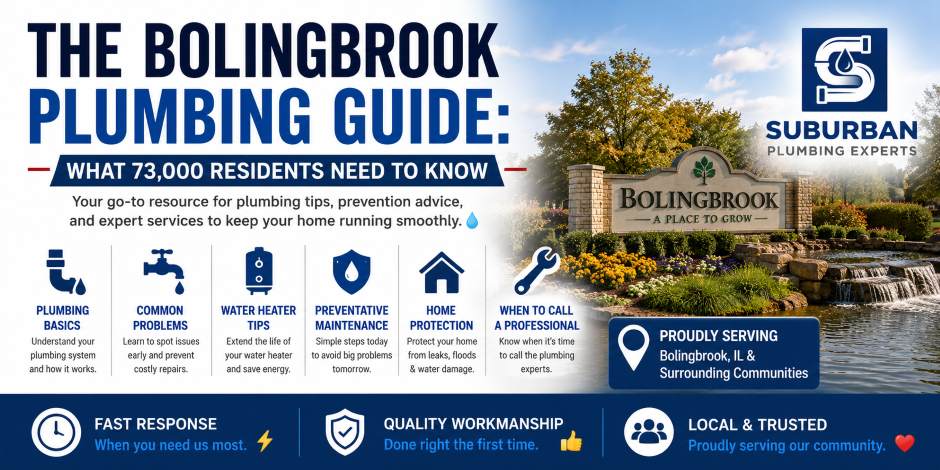
This is the complete guide to the private side of Bolingbrook plumbing — the sewer rodding, the hydro jetting, the water heaters, the gas lines, the repiping, and the flood control that 73,000 Bolingbrook residents need but that no utility company will ever address for you.
Bolingbrook’s Two-Utility Reality — Which One Serves Your Home
Most Chicago-area suburbs get their water from one source. Bolingbrook gets it from two — and which utility serves your specific address depends on which county your parcel falls in.
The Will County portion of Bolingbrook is served by Illinois American Water — the private, investor-owned utility that was the subject of the CBS Chicago billing story above. Illinois American Water delivers water and handles wastewater collection and treatment for Will County Bolingbrook residents. The rate controversy documented by CBS Chicago — and the Northern Will County Joint Action formed specifically by Bolingbrook, Homer Glen, Woodridge, Lemont, and Romeoville to contest Illinois American Water’s rates through the Illinois Commerce Commission — reflects a utility relationship that has been contentious for years and became national news in 2025.
The DuPage County portion of Bolingbrook is served by the DuPage Water Commission — a regional water authority that has been delivering Lake Michigan water to DuPage County communities since 1992, now serving more than one million customers. The DuPage Water Commission purchases water treated by the City of Chicago’s Department of Water Management and distributes it throughout its service area at rates generally considered more stable than Illinois American Water’s private utility pricing.
What this means practically for every Bolingbrook homeowner: Know which utility serves your address — your water bill or property tax records confirm it. The utility determines who to call for a water main break, a service line question, or a billing dispute. It does not determine who is responsible for your private-side plumbing — everything from the meter to the fixture, and every pipe in between, is yours regardless of which company delivers the water.
The $713 bill story is instructive here: that resident’s hidden leak ran up her water usage on the utility’s meter. The utility charged for the water used. The source of the problem — a failing fitting, a deteriorating supply connection, a slow pinhole leak — was private property, private responsibility, and something our leak detection services find and address before a hidden leak becomes a $713 surprise.
Bolingbrook’s Housing Stock — What Each Era Means for Your Pipes
Bolingbrook wasn’t really Bolingbrook until the 1960s. The city was incorporated in 1965 and developed rapidly through the 1970s, 1980s, and into the 1990s — a sustained suburban expansion that produced the subdivisions, townhome communities, and single-family neighborhoods that now house over 73,000 residents. That development timeline creates a specific pipe condition profile depending on when your home was built.
1960s-1970s Bolingbrook homes represent the city’s oldest residential stock. These homes have copper supply lines now 50 to 65 years old in Illinois’ hard water environment — approaching or entering the active pitting corrosion zone. Cast iron kitchen and bathroom drain lines with 50 to 65 years of mineral-reinforced grease accumulation on their interior surfaces. In the oldest sections of Bolingbrook near the original village core, galvanized steel supply lines may still be present. And original black iron gas distribution systems that have been in service for five to six decades.
1980s Bolingbrook homes represent the largest single cohort of the city’s housing stock — the decade of Bolingbrook’s most explosive growth. Copper supply lines now 35 to 45 years old. Original sump pump installations now 35 to 40 years old — dramatically past their service life. Water heaters that have been replaced at least once but whose current unit may be approaching the 10-to-15-year threshold. And the first generation of PVC drain lines that replaced cast iron in new construction, now in their 35th to 45th year of service.
1990s-2000s Bolingbrook homes have the most modern infrastructure — PEX or copper supply, PVC drain, PVC sewer lateral — but components aging toward their first major replacement cycles. Water heaters approaching or past 15 to 25 years old. Sump pumps approaching 20 to 35 years. Copper supply fittings in their second decade of hard water exposure.
For the complete decade-by-decade framework on what each construction era means for every pipe material, see our complete decade-by-decade Chicago home plumbing guide.
Sewer Rodding in Bolingbrook — When the Main Line Backs Up
When Bolingbrook’s drains slow simultaneously — multiple fixtures draining slowly at the same time, or a floor drain backing up during normal household use — the problem is almost always in the main sewer lateral rather than an individual fixture’s branch line. Bolingbrook’s tree-lined residential neighborhoods have had 30 to 60 years for root systems to find and exploit the joints in PVC and older lateral connections.
Our team has documented kitchen sink drain rodding and cleanout specifically in Bolingbrook — clearing buildup to restore normal water flow and prevent future blockages. That’s the job that actually describes what drain rodding does: mechanical cable cutting and clearing that breaks through root masses, grease blockages, and debris accumulations to restore flow.
When rodding is the right call: Active backup in the main line or a significant single-fixture blockage that needs immediate clearing. Rodding is the emergency response tool — fast, direct, and effective for the acute problem.
When rodding isn’t enough: If the same drain has been rodded more than twice in 18 months, the root entry joints or wall deposits causing the recurring cycle haven’t been addressed by the rod. That’s when hydro jetting — and camera inspection to find the specific entry points — becomes the right next step.
Our sewer rodding service covers Bolingbrook with same-day and 24/7 emergency response throughout the city.
Hydro Jetting — The Permanent Answer to Bolingbrook’s Recurring Drain Cycle
For Bolingbrook homeowners whose kitchen drain has been rodded repeatedly without lasting results — and for sewer laterals where root intrusion keeps rebuilding on the same annual schedule — hot water hydro jetting is the service that breaks the cycle rather than managing it.
What hydro jetting does that rodding can’t: At 2,500 to 4,000 PSI, high-pressure hot water scours the interior pipe wall surface — not just the center of the pipe, but the wall itself. The calcium-reinforced grease deposits that Lake Michigan’s hard water embeds on cast iron drain surfaces, the root filaments that remain after a rod cuts the main root mass, and the biological scale that accumulates on aging pipe walls are all removed at the surface level rather than temporarily compressed and pushed aside.
For Bolingbrook’s 1960s and 1970s homes with original cast iron kitchen drain branches — running whichever hard water source serves that section of the city — annual hot water hydro jetting is the maintenance standard that keeps those drains functioning without the recurring backup cycle that standard rodding alone perpetuates.
For Bolingbrook sewer laterals with confirmed root intrusion, the right sequence is: rod to clear the immediate blockage, camera inspect to identify the specific entry joint locations, hydro jet to flush all cut root material and scour the pipe wall clean, then consider targeted joint sealing to close the entry points that will otherwise keep admitting root growth.
Our hydro jetting service covers Bolingbrook with the industrial-grade equipment that residential hydro jetting requires — not the underspec’d consumer equipment that produces temporary results.
Water Heaters in Bolingbrook — What Hard Water Is Doing to Yours Right Now
Whether Illinois American Water or the DuPage Water Commission delivers water to your Bolingbrook home, the water chemistry is consistent: Lake Michigan water at 130 to 150 parts per million of dissolved calcium and magnesium. Moderately hard to hard water that has been flowing through your water heater since the day it was installed.
Here’s what that water chemistry does to your water heater over time: dissolved calcium and magnesium precipitate out of solution when heated, depositing as mineral scale on the heating element in electric units or on the burner chamber floor in gas units. Scale accumulation reduces heat transfer efficiency — the heater runs longer and works harder to produce the same hot water output. The popping, rumbling, or banging sound that some Bolingbrook homeowners notice from their water heater is mineral scale being superheated on the burner chamber floor — a signal that the unit has significant scale accumulation and is working at reduced efficiency.
The Bolingbrook water heater timeline: Annual flushing to remove sediment significantly extends service life. A water heater that has never been flushed in a 1985 Bolingbrook home has been accumulating scale since 1985. A water heater in a home served by Illinois American Water — where the company’s own infrastructure investment acknowledges significant system investment — is running through pipes that the utility is actively upgrading on the public side, while private-side fixtures and appliances manage whatever the water delivers.
For the complete guide to every warning sign your Bolingbrook water heater sends before it fails — including the specific sounds, smells, and performance changes that signal a unit approaching the end of its service life — see our complete Chicago water heater warning signs guide. Our water heater services cover Bolingbrook with same-day and next-day installation throughout the city.
Gas Lines in Older Bolingbrook Homes — What 50 to 60-Year-Old Systems Need
Bolingbrook’s 1960s and 1970s housing stock has original black iron gas distribution systems that have been in service for 50 to 60 years. Unlike copper or galvanized water supply lines that produce visible symptoms — discoloration, pressure reduction, visible corrosion — aging gas lines in older Bolingbrook homes can present hidden risks that only a professional pressure test and visual assessment can accurately evaluate.
The specific conditions worth professional attention in older Bolingbrook homes:
Any gas line connection or fitting at a 1960s or 1970s appliance installation — water heater, furnace, range, dryer — that predates the current appliance has been through multiple appliance replacements while the gas connection remained in place. Each appliance replacement creates the potential for mechanical stress on the fitting at the gas connection point. Professional assessment of the visible gas system during any appliance replacement confirms that the connection is sound before a new appliance is commissioned.
Any gas line that runs through a basement section that has flooded. Flood events — the kind that Bolingbrook’s existing flooding article documents as an active concern — expose gas line fittings and connections to moisture and corrosion conditions that normal dry-basement installations don’t experience. Post-flood assessment of gas system condition is a step that many Bolingbrook homeowners skip.
Any notice of gas odor — however faint, however occasional — in a Bolingbrook home with original gas infrastructure. Gas odor is not a condition to observe and monitor. It’s a condition to address immediately. For the complete guide to gas line safety in Chicago-area homes — what the warning signs are, what requires professional attention, and what never qualifies as a DIY project — see our complete Chicago gas line safety guide.
Home Repiping in Bolingbrook — When the Supply System Needs to Start Over
For Bolingbrook homeowners in the city’s oldest sections with 1960s-era copper supply lines — now 60-plus years old in a hard water environment — or any Bolingbrook home where galvanized steel supply lines remain, the supply system assessment question isn’t whether replacement will eventually be needed. It’s whether the time is now.
The hidden leak connection: The $713 Bolingbrook Illinois American Water bill that CBS Chicago documented was driven partly by a hidden leak. A supply line in active pitting corrosion failure can produce exactly this scenario — a pinhole leak inside a wall that runs continuously, slowly, without producing obvious water damage, while generating water usage on the utility’s meter that shows up as an inexplicable spike in a monthly bill. A $713 Illinois American Water bill that results from a hidden pinhole leak in a 60-year-old copper supply fitting is a supply system condition, not a billing error.
Our leak detection services include thermal imaging that identifies hidden moisture inside wall cavities before a single surface is opened — finding the source of a hidden leak that’s running up a utility bill before the damage extends further and before another month of unexplained usage compounds the cost.
For Bolingbrook homes where the supply system condition warrants full replacement rather than ongoing spot repair, our home repiping services cover the complete supply system replacement with PEX or Type L copper — materials chosen specifically for Bolingbrook’s water chemistry — with all required permits and post-installation inspection documentation.
Flood Control in Bolingbrook — The Full Picture
Our existing complete Bolingbrook basement flooding guide covers Bolingbrook’s DuPage County Residential Drainage Assistance Program (up to $5,000 for qualifying projects), the Will/DuPage county split in flood control program availability, and the specific flooding mechanisms affecting Bolingbrook’s residential neighborhoods in depth. Read that guide before signing any flood control contract in Bolingbrook.
The short version for this article: Bolingbrook’s flooding is almost entirely groundwater-driven — Will County’s clay-heavy soil, the water table rising during sustained rain events, and the sump pump as the primary defense. A properly sized sump pump with battery backup is non-negotiable. The storms that produce the worst groundwater flooding conditions are the same storms most likely to knock out power — and a sump pump without battery backup fails at exactly the worst possible moment.
Our sump pump services cover Bolingbrook with 24/7 emergency response and battery backup installation throughout the city.
Documented Bolingbrook Service — What Our Team Has Done Here
Our service records in Bolingbrook include:
Kitchen sink drain rodding and cleanout — clearing buildup and restoring normal water flow in a Bolingbrook home’s kitchen drain system.
French drain installation — excavating a 12-inch deep, 25-inch long trench, installing a 4-inch black corrugated pipe, filling with ¾-inch washed gravel, and digging a 3x3x3-foot collection hole filled with gravel, finished with sod replacement at ground level. This is the documented, specific French drain work we’ve completed in Bolingbrook — not a hypothetical service description.
Appliance disconnection service — safely disconnecting a dishwasher and garbage disposal in a Bolingbrook home in preparation for appliance removal or replacement, ensuring all connections were safely deactivated.
These job records reflect a real service history in this specific city — not a service menu with “Bolingbrook” inserted wherever the template requires it.
For the full range of plumbing, sewer, and flood control services we provide throughout Bolingbrook, see our Bolingbrook plumber page. We also serve nearby communities throughout the Southwest Suburbs, including Romeoville, with the same sewer, drain, plumbing, water heater, and flood control services.
What Bolingbrook Homeowners Should Do Right Now
If your water bill recently spiked without a change in usage: A hidden leak is the most common source of unexplained bill increases — exactly what happened to the Bolingbrook resident who received a $713 Illinois American Water bill. Schedule a leak detection assessment before assuming the utility made an error. Our leak detection services find hidden moisture in wall cavities without opening anything.
If your kitchen drain has been rodded more than twice in 18 months: Switch from rodding to hydro jetting. The recurring backup is a wall deposit problem that rodding manages without resolving.
If your sump pump is more than 7 years old: Assessment before next storm season. Battery backup installation if not present.
If your home is a 1960s or 1970s Bolingbrook build with original copper supply lines: Watch for the pinhole leak pattern — the first identified pinhole in a 60-year-old copper system is almost never the only one developing. Our leak detection confirms the full extent of active pitting corrosion before spot repair versus full repiping becomes the question.
If your home has original black iron gas lines: Schedule a professional pressure test and visual assessment — particularly before any appliance replacement that involves the gas connection.
If you haven’t confirmed which county your Bolingbrook parcel falls in: Check your tax bill. Cook County-side Bolingbrook accesses different programs than Will County-side — this distinction determines which flood control assistance programs apply and which agency to contact for drainage concerns.
Frequently Asked Questions: Plumbing in Bolingbrook
I got a huge Illinois American Water bill that I think was a billing error. What should I do?
First, check for a leak — the CBS Chicago story documented exactly this pattern, where an unexplained high bill was traced to a hidden leak rather than a billing error. Our leak detection services find hidden moisture without opening walls. If you’ve confirmed no leak exists and still believe the bill is incorrect, file a complaint with the Illinois Commerce Commission Consumer Services at 1-800-524-0795. Bolingbrook, Homer Glen, Woodridge, Lemont, and Romeoville have collectively contested Illinois American Water rates through the ICC — your complaint adds to that formal record.
My Bolingbrook home was built in 1971. Do I have galvanized pipes?
Some do, some don’t — it depends on the specific construction. In a basement or utility room, look at the exposed supply pipes. Galvanized is a dull gray-silver color with a matte surface. Copper is reddish-brown. PEX is flexible colored plastic. If you find galvanized, a professional assessment of its current bore diameter — narrowed over 50 years of hard water mineral accumulation — determines whether repiping is warranted now or whether monitoring is the appropriate current approach.
Bolingbrook has a DuPage County portion and a Will County portion. Does the county split affect my plumbing service?
Not for private plumbing services — our team serves all of Bolingbrook regardless of county. It matters for which water utility serves you (Illinois American Water vs DuPage Water Commission), which flood control assistance programs you can access, and which sewer authority serves your address. For private plumbing repairs, drain cleaning, water heater replacement, gas line work, and repiping, the county split is irrelevant — we’re the same team, the same quality, and the same response time throughout the city.
Bolingbrook Plumbing Problem? We’ve Been Serving This City Since Before It Was This City.
Licensed, insured, and serving Bolingbrook since 1978 — when Bolingbrook was still finding its footprint. We handle sewer rodding, hydro jetting, water heater replacement, gas line repair, home repiping, leak detection, sump pump service, and flood control throughout all of Bolingbrook — Will County side, DuPage County side, and every zip code in between. Written quotes before we start, permits on every job, our own licensed plumbers on every call. Send us a message and we’ll get back to you fast.
Or call us directly: 630-749-9057 | Open 24/7
—
Suburban Plumbing Sewer Line & Drain Cleaning Experts
Licensed & Insured | Open 24 Hours | Serving Bolingbrook & the Southwest Suburban Corridor Since 1978
📞 Bolingbrook: 630-749-9057 | 🚨 Emergency: 708-518-7765