Naperville Is Replacing an 80-Year-Old Water Tower Right Now. That’s a Good Excuse to Explain Where Your Pressure Actually Comes From.
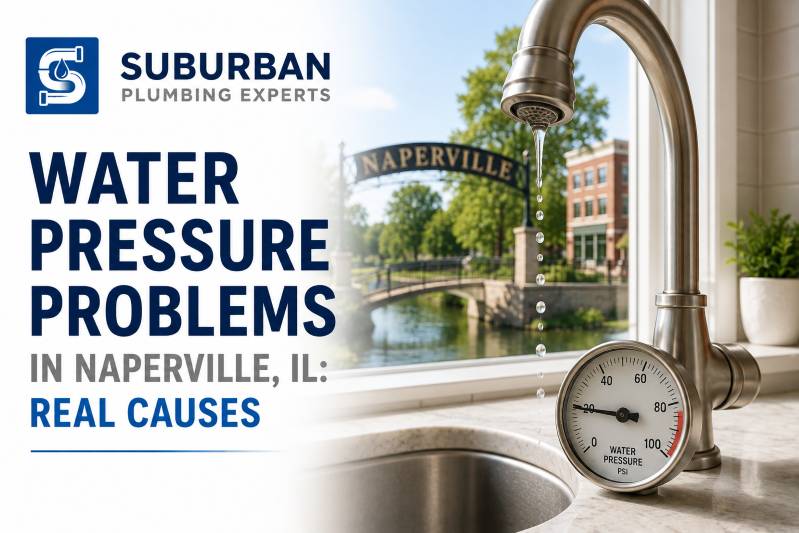
Most of what determines your home’s baseline water pressure isn’t in your house at all, it’s a water tower built decades before you moved in. Naperville is a useful, literal example happening in real time: the City’s Water Utility is currently replacing the elevated water tank next to the 5th Avenue Train Station, a tower built in the 1940s that’s reaching the end of its useful service life, with construction running from early 2025 into summer 2026. The old tower stays in service throughout construction so the area doesn’t lose pressure while the new one goes up. It’s a good, concrete illustration of a mechanism most homeowners never think about: an elevated tank’s height, not just the treatment plant miles away, is what actually pressurizes the water reaching your fixtures.
The Physics Behind Every Municipal Water Tower
An elevated tank works on gravity alone once it’s full: water stored above ground level flows downward through the distribution system, and that elevation converts directly into pressure at your tap. According to Snyder & Associates, a municipal water infrastructure engineering firm, each foot of elevation in a water tower produces roughly 0.43 psi of pressure, and most municipal systems are designed to deliver somewhere between 50 and 100 psi to customers as a result. That’s why a tower’s height is an engineering decision, not an aesthetic one, and why a system with aging or undersized elevated storage can struggle to maintain consistent pressure across an entire service area, especially during peak demand when many households draw water at once.
Naperville’s Water System, By the Numbers
Naperville’s Water Utility has purchased Lake Michigan water through the DuPage Water Commission since 1992, operating a distribution network of more than 1,250 miles of water main serving over 43,000 customers. A system this size depends on active maintenance to keep pressure consistent: the City’s Leak Detection Program, running since 2018, specifically targets water loss in the distribution system before it becomes a larger problem, and ongoing water meter replacement addresses aging meters that can otherwise misrepresent actual flow. The City takes a similarly hands-on approach to its sewer infrastructure, covered in our guide to Naperville’s sewer line rules and reimbursement programs, which is worth a read if pressure isn’t your only water-related question. None of this infrastructure work is visible from your kitchen faucet, but it’s the layer determining what pressure actually reaches your home before any household-level cause even enters the picture.
What’s Actually Causing Low Pressure Inside Your Home
Once water reaches your property at normal municipal pressure, several household-level issues can still restrict what makes it to your fixtures. Naperville’s water carries a hardness rating of about 8 grains per gallon, drawn from Lake Michigan rather than groundwater, which is milder than a private well but still enough to gradually build mineral scale inside pipes and fixtures over years of normal use, narrowing the interior diameter and reducing flow. This is the same hardness level behind the drain buildup covered in our guide to drain cleaning for Naperville homeowners, mineral scale narrows supply lines the same way it narrows drains. In homes with original galvanized steel supply lines, this effect compounds with internal corrosion that develops independently of water hardness, and the combination is often the real explanation for pressure that’s gradually worsened over years rather than dropped suddenly.
A sudden drop, by contrast, usually points to something specific: a partially closed shutoff valve, often left that way after previous plumbing work and never fully reopened, or a leak actively bleeding pressure from the system before it reaches your fixtures. A leak large enough to meaningfully affect pressure is also usually large enough to show up on a water bill, so an unexplained increase alongside a pressure drop is worth treating as a leak investigation rather than a coincidence. Our professional leak detection service can locate a supply line leak precisely without guesswork.
When the Problem Is Just One Fixture
If weak pressure is isolated to a single faucet or showerhead rather than the whole house, the cause is almost always local: a clogged aerator or showerhead accumulating mineral deposits from the water hardness described above. Unscrewing the aerator and soaking it in vinegar, or doing the same with a showerhead, typically clears it in a few hours. Weak pressure at every fixture in the house is a different, larger issue and points toward the supply line, the pressure regulator, or municipal-side causes rather than anything fixable at a single tap.
Why High Pressure Deserves Equal Attention
High pressure causes less visible frustration than low pressure but does more cumulative damage. Most residential plumbing codes require a pressure-reducing valve once incoming pressure exceeds 80 psi, and according to the EPA’s WaterSense technical guidance on service water pressure, most homes perform best in the 40 to 60 psi range. Pressure above the 80 psi threshold doesn’t just waste water, it shortens the working life of your water heater, washing machine, and every supply line joint in the house through constant stress they weren’t built to sustain. A pressure-reducing valve that’s failed, stuck, or was never installed is the most common cause, and it’s a targeted, inexpensive repair once correctly diagnosed rather than something to adjust by guesswork.
Testing Your Pressure Before You Call Anyone
A hose-bib pressure gauge, sold at most hardware stores, threads directly onto an outdoor spigot and gives a real number instead of a guess. With every fixture inside the house turned off, attach the gauge and read the static pressure. A result in the 40 to 60 psi range is normal; below 40 will feel noticeably weak, and above 80 is actively working against your plumbing’s lifespan. That single number is exactly what a plumber needs before setting foot in your home, and it narrows the likely cause considerably before any diagnostic visit even starts.
Should You Address the Water Hardness Itself?
Cleaning an aerator or replacing a showerhead treats the symptom of scale buildup, not the cause. A water softener installation addresses the mineral content directly, reducing the rate scale accumulates across every fixture, pipe, and appliance in the house rather than the one you happen to be cleaning this week. For a home where pressure loss, water heater strain, and fixture buildup all show up as recurring themes rather than isolated incidents, it’s worth evaluating alongside any plumbing repair rather than treating each symptom separately.
When It’s Time for a Professional Diagnosis
Persistent whole-house low pressure, pressure that’s dropped suddenly, or a suspected leak all warrant a professional look rather than continued guessing. In a home with original supply lines that have never been assessed, whole-house repiping may ultimately be the more durable fix than repeated cleaning and patching, particularly once internal corrosion has narrowed pipe diameter significantly. A licensed Naperville, IL plumbing team can run an actual pressure test, isolate whether the cause is regulator, supply line, or internal piping, and tell you honestly which repairs are worth doing now.
Frequently Asked Questions
What’s considered normal water pressure for a home?
Most homes perform best between 40 and 60 psi. Pressure below 30 psi is generally too low for comfortable daily use, and most plumbing codes require a pressure-reducing valve once incoming pressure exceeds 80 psi.
Does Naperville’s water tower replacement project affect my home’s pressure?
The City has structured the project so the existing tower stays in service throughout construction of the new one, specifically to avoid a pressure gap in the surrounding area. If you notice unusual pressure changes near the 5th Avenue Train Station area during the project, it’s worth confirming with the Water Utility directly.
Why does my water pressure seem to drop gradually over the years rather than suddenly?
Gradual mineral scale buildup from water hardness, combined with internal corrosion in older galvanized supply lines, narrows pipe diameter slowly over time. This is a different mechanism than a sudden drop, which usually points to a valve issue or a new leak.
Is high water pressure actually something to worry about?
Yes, arguably more than low pressure long-term. Sustained pressure above 80 psi stresses every joint, valve, and appliance connection in your home’s plumbing, often resulting in a leak or failure that goes unnoticed until real damage has occurred.
Can I test my own water pressure?
Yes. A hose-bib pressure gauge threads onto any outdoor spigot and gives a direct static reading with the rest of the house’s fixtures turned off, and it’s the same number a plumber will want before diagnosing further.
Licensed Water Pressure Diagnostics for Naperville, IL
Suburban Plumbing Experts has served Naperville and the surrounding suburbs since 1978. We hold Illinois Plumbing License #055-044116 and Sewer License #2565, and every technician on our team is a trained, background-checked employee, not a subcontractor. Whether your pressure problem is a quick fix or points to something bigger in your supply line, we’ll test it and diagnose it correctly before any work begins.
Dealing With Water Pressure Problems in Your Naperville Home?
Licensed, insured, and serving Naperville and Chicagoland since 1978. We test your actual pressure first and diagnose the real cause, no guessing, no unnecessary parts.
Naperville: 630-749-9057 | Emergency: 708-518-7765 | Open 24/7
—
Suburban Plumbing Sewer Line & Drain Cleaning Experts
Licensed & Insured | Open 24 Hours | Serving Naperville & the West Suburbs Since 1978
📞 Naperville: 630-749-9057 | 🚨 Emergency: 708-518-7765