
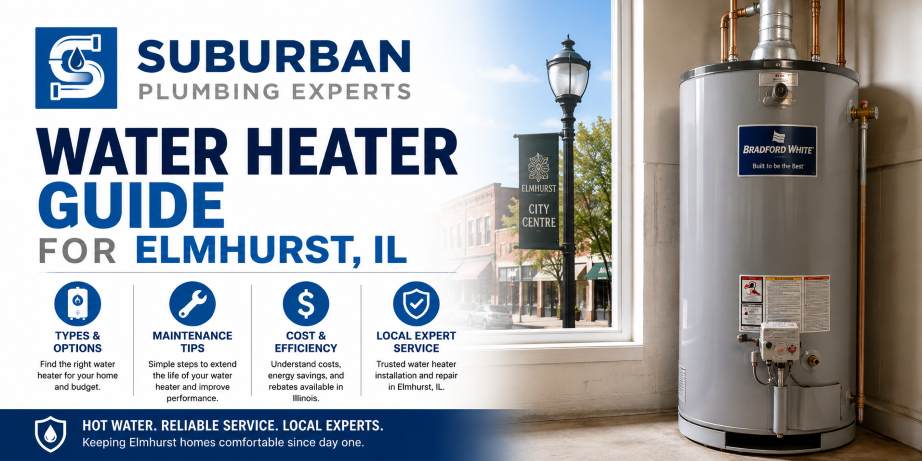
Elmhurst Water Heaters Fail Earlier Than National Averages Suggest They Should. Here’s What’s Actually Driving That, How to Read the Warning Signs, and How to Decide Between Repair and Replacement Before the Decision Gets Made for You.
A water heater is one of the few appliances in a home that runs constantly and gets noticed only when it stops working. For most Elmhurst homeowners, that moment arrives without much warning: a shower that never gets warm, a rumbling sound from the utility room that’s been getting louder for months, or a puddle at the base of the tank on a morning nobody has time for it. The unit was probably fine the day before. It rarely is the day this happens.
What makes Elmhurst a slightly different case than the national average is a combination of two local factors that don’t get much attention until they’ve already shortened a water heater’s life: the mineral content of the water coming into the home, and the age of the housing stock it’s running through. Neither one is dramatic on its own. Together, over years, they explain why a water heater that should last a decade in ideal conditions often needs attention well before that in a typical Elmhurst home.
Why Elmhurst Water Heaters Scale Up Faster Than You’d Expect
Elmhurst draws its water through the DuPage Water Commission, the regional authority headquartered right in Elmhurst that supplies Lake Michigan water to most of DuPage County. According to the DuPage Water Commission’s own water quality data, the water reaching most area homes runs at roughly 8 grains per gallon of hardness, which places it solidly in the hard water range. That hardness comes from dissolved calcium and magnesium carbonate, and every gallon that passes through a water heater’s tank leaves a little of that mineral content behind as sediment.
Over months and years, that sediment settles at the bottom of the tank and builds into a layer that insulates the water from the heating element or burner underneath it. The heater has to work harder and longer to reach the same temperature, which is usually the source of that rumbling or popping sound many homeowners notice as a water heater ages. It’s not a mechanical problem in the moment. It’s literally the sound of water boiling underneath a layer of scale, and it’s a reliable sign that efficiency has already started dropping even if hot water is still technically available.
This is also why an annual flush matters more in Elmhurst than it would in a genuinely soft water area. Flushing the tank clears sediment before it builds into a layer thick enough to cause real efficiency loss or premature element failure, and it’s one of the few pieces of water heater maintenance that meaningfully extends the unit’s working life rather than just checking a box.
What Elmhurst’s Housing Stock Adds to the Equation
Elmhurst’s neighborhoods span a genuinely wide range of construction eras, from homes built before 1939 near the historic district, through the postwar boom that defined much of the city’s core housing stock, to newer construction filling in lots where older homes have been torn down and replaced. Each era brings a different water heater situation.
Older homes are more likely to have a water heater installed in a space that was never designed around modern venting requirements, particularly if the unit has been swapped out more than once over the decades without the surrounding installation being fully reevaluated each time. A tank that vents adequately on paper can still be operating in a configuration that reduces efficiency or, in the more serious cases, creates a real safety concern that only shows up during an inspection. Homes with original or early-replacement galvanized supply lines add another layer to this. Corrosion inside galvanized pipe restricts flow and can affect water pressure at the water heater itself, and when a home has reached the point where that corrosion is a broader issue rather than an isolated section, repiping services using copper or PEX often solve more than one recurring problem at once rather than just the immediate one.
We’ve covered how this same housing age issue plays out on the sewer side of an Elmhurst property, including what a camera inspection actually reveals about a line that’s never been checked, in our Elmhurst aging pipes and sewer inspection guide, which is worth a look for anyone dealing with more than one aging system at once.
Signs Your Water Heater Needs Attention Now
A water heater rarely fails without giving some notice first, even if that notice is easy to dismiss as a minor annoyance. These are the signs worth acting on before they become an emergency.
- Inconsistent or lukewarm water. A gradual drop in how hot the water gets, or how long it stays hot, often points to a failing heating element or a thermostat that’s no longer reading accurately.
- Rumbling, popping, or knocking sounds. As covered above, this is almost always sediment buildup insulating the heating element, and it gets louder as the layer thickens.
- Rusty or discolored water from the hot tap only. If cold water runs clear and hot water doesn’t, the rust is likely coming from inside the tank itself, which usually means the tank’s interior lining has started to fail.
- Water pooling at the base of the unit. Even a small, slow leak at the tank’s base is a sign the tank itself may be cracking, not just a loose fitting, and it should be looked at immediately rather than monitored.
- A pilot light that won’t stay lit, or a unit older than 10 to 12 years. Either one on its own is worth a professional look. Together, they’re a strong signal that repair may no longer be the more cost effective option.
Not every leak announces itself as clearly as a puddle on the floor. A slow leak at a fitting or a failing pressure relief valve can run for weeks inside a wall or utility closet before it’s noticed, and by then real damage may already be underway. If you suspect water is going somewhere it shouldn’t without an obvious source, our leak detection services use acoustic equipment and thermal imaging to find it before it becomes a bigger repair than the water heater itself.
Repair or Replace: How to Actually Decide
The repair versus replace decision comes down to three questions that matter more than any single symptom on its own.
How old is the unit? A standard tank water heater typically lasts 8 to 12 years under normal conditions, and Elmhurst’s water hardness tends to push that toward the shorter end of the range without regular flushing. A unit past year 10 that needs a repair is generally a better candidate for replacement than repair, since the remaining components are aging on the same timeline as the one that just failed.
What’s actually failing? A thermostat, heating element, or thermocouple is a straightforward, relatively inexpensive repair on a unit that’s otherwise in good condition. A leaking tank, on the other hand, is not repairable in any meaningful sense. The tank itself is a sealed vessel, and once its lining has failed enough to leak, replacement is the only real option regardless of the unit’s age.
What does the repair cost relative to a new unit? As a general rule, if a repair is running close to half the cost of a comparable new installation, replacement is usually the better long term value, particularly on a unit that’s already past the middle of its expected lifespan. A straightforward answer here requires an honest, itemized diagnosis rather than a guess, which is part of why we walk through the actual numbers with a customer before recommending either path.
Tankless Water Heaters in Older Elmhurst Homes
Tankless systems are worth serious consideration for Elmhurst homeowners replacing a unit, particularly in homes where space is tight or hot water demand is high. They don’t carry the same sediment accumulation risk in the same way a tank does, since there’s no standing water sitting in a tank for scale to settle into, though periodic descaling is still recommended given the area’s water hardness.
The tradeoff in older homes specifically is installation complexity. A tankless unit often requires a larger gas line than what’s currently run to a tank heater’s location, along with venting changes that a tank system may not have needed. Neither of these is a reason to avoid a tankless system, but they are reasons to get an honest assessment of what a specific home’s existing infrastructure can support before assuming a straightforward swap is possible.
Permits and Working With the City of Elmhurst
Water heater installation in Elmhurst requires a permit through the City of Elmhurst’s Community Development Department, whether the replacement is a straightforward tank swap or a full switch to a tankless system. This isn’t unique to Elmhurst, most DuPage County municipalities require the same, but it’s a step that’s easy to overlook when a water heater fails suddenly and the priority becomes getting hot water restored as quickly as possible. A licensed plumber who does this work in the city regularly handles the permit as a standard part of the job, which keeps the installation properly documented for future resale or insurance purposes without adding delay to getting the work done.
Why Local Experience Actually Matters Here
Water heater problems look similar on the surface: no hot water, a strange noise, a small leak. What’s actually happening underneath varies enough between an older Elmhurst home and a newer one that a technician who’s worked hundreds of these specific properties diagnoses faster and more accurately than one working from a general checklist. That’s the difference between a specialist and a generalist in practice, not just in how a company describes itself.
Suburban Plumbing Experts holds Illinois Plumbing License #055-044116 and Sewer License #2565, and every technician who arrives at an Elmhurst property is a trained, background checked employee rather than a subcontractor. If your water heater needs attention today, our expert water heater services are available around the clock for both tank and tankless systems, gas and electric. For anything else going on in the house at the same time, from a slow drain to a sump pump that’s due for a look, our Elmhurst plumber page covers the full range of what we handle locally, along with direct contact information for scheduling.
Frequently Asked Questions
How often should I flush my water heater in Elmhurst?
Once a year is the standard recommendation, and it matters more here than in areas with genuinely soft water. Given Elmhurst’s roughly 8 grains per gallon hardness, an annual flush is what keeps sediment from building into a layer thick enough to reduce efficiency or shorten the unit’s lifespan.
How do I know if it’s the thermostat or the whole unit failing?
Inconsistent temperature alone often points to a thermostat or heating element, both of which are usually repairable. A leak at the tank itself, rust colored hot water with clear cold water, or a unit past 10 to 12 years combined with a failure point more toward replacement. A professional diagnosis is the reliable way to tell the difference rather than guessing based on symptoms alone.
Do I really need a permit just to replace a water heater?
Yes, in Elmhurst a permit is required for water heater installation through the City’s Community Development Department, regardless of whether it’s a like for like tank replacement or a switch to tankless. A licensed local plumber handles this as a normal part of the job.
Is a tankless water heater worth it for an older Elmhurst home?
Often yes, but it depends on the home’s existing gas line size and venting setup, both of which may need updating for a tankless system to work properly. That’s an assessment worth getting before assuming the switch will be a simple one for one swap.
Why does my water heater sound like it’s rumbling or popping?
That sound is almost always sediment buildup at the bottom of the tank insulating the heating element, which is common in hard water areas like Elmhurst. It’s a sign the unit needs a flush, and if it’s been happening for a while, an inspection to check how much efficiency has already been lost.
How long should a water heater actually last in Elmhurst?
A standard tank unit typically lasts 8 to 12 years nationally, and Elmhurst’s hard water tends to push toward the shorter end of that range without regular maintenance. Tankless units generally last longer, often 15 to 20 years, with proper descaling.
Water Heater Service for Elmhurst Homes & Businesses
Licensed, insured, and serving Elmhurst and the surrounding suburbs since 1978. Water heater repair, replacement, and installation for tank and tankless systems, available 24/7.
Emergency: 708-518-7765 | Suburbs: 630-749-9057 | Open 24/7
—
Suburban Plumbing Sewer Line & Drain Cleaning Experts
Licensed & Insured | Open 24 Hours | Serving Elmhurst & the Suburbs Since 1978
📞 Elmhurst: 630-749-9057 | 🚨 Emergency: 708-518-7765