
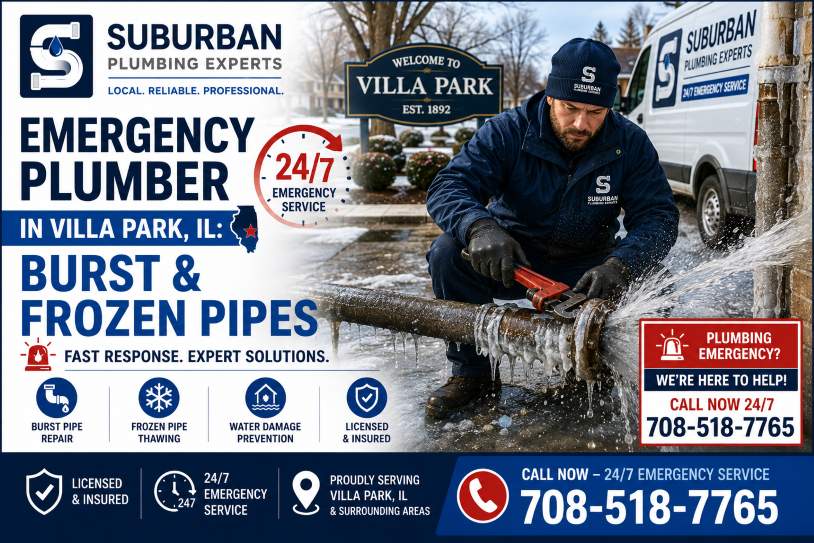
Villa Park Sits on Clay and Glacial Soil That Shifts Hard Every Freeze-Thaw Cycle, and the Village Runs Its Own Treatment Facility Just to Handle What Winter Does to the Sewer System. We’ve Already Thawed Pipes Here After a Homeowner Went Weeks Without Water. Here’s What You Need to Know Before It Happens to You.
A frozen pipe doesn’t wait for business hours, and neither do we. Villa Park’s mix of century-old company-town construction and a genuinely tough freeze-thaw climate makes burst pipes, frozen supply lines, and hidden underground leaks a real, recurring problem here — not a rare exception. This guide covers what actually happens when a pipe freezes or bursts in Villa Park, what our own crews have already handled here, and how to tell a fixture problem from a real emergency before it turns into one. If you’re dealing with basement flooding, sewage backup, or a question about the village’s sewer systems and flood reimbursement program, our separate guide to plumbing, sewer, and flood control in Villa Park covers that in depth — this guide stays focused specifically on frozen pipes, burst pipes, and hidden leaks.
Why Pipes Freeze and Burst in Villa Park Specifically
Villa Park sits on a mix of clay and glacial deposit soil that expands and contracts noticeably with seasonal temperature swings, placing real stress on underground lines and on the foundations of the village’s many basement homes. Combine that with Villa Park’s origin as an early-20th-century company town — built up quickly around the Ovaltine factory and the rail lines that served it — and a large share of the village’s housing has supply lines running through uninsulated crawl spaces, exterior walls, and basements that were never built to modern insulation standards. That combination is exactly why frozen pipes here aren’t a fluke; they’re a predictable outcome of the housing stock meeting a genuinely hard winter climate.
We’ve Already Thawed Pipes in Villa Park — Here’s What That Job Looked Like
This isn’t theoretical for us. Our team was called to a Villa Park home where a basement bathroom had been without water for several weeks — a new sink and vanity had just been installed, and still nothing would flow. The cause turned out to be ice blockages in both the hot and cold water supply lines feeding that bathroom. Our technicians cleared the ice and restored full water flow to the fixture. That’s the reality of a frozen line in an older Villa Park home: it doesn’t always announce itself with a dramatic burst. Sometimes it’s just water that quietly stops flowing to one part of the house, weeks before anyone realizes why.
What To Do the Moment You Suspect a Frozen Pipe
If a faucet suddenly produces no flow, or only a trickle, during a cold snap, treat it as a frozen line until proven otherwise. Shut off the water supply immediately if you notice any cracking, bulging, or active leaking near the suspected area — a frozen pipe under pressure can fail the moment it starts to thaw, and a shutoff now can be the difference between a repair and a flood. Never use an open flame to try to thaw a pipe yourself; it’s a genuine fire risk and can damage the pipe further.
Keeping cabinet doors open under sinks near exterior walls, letting faucets drip slightly during extreme cold, and maintaining a minimum indoor temperature around 55°F in unheated areas are all reasonable preventive steps — but once a line is actually frozen, professional thawing with the right equipment is what actually restores flow safely, the way we did for the Villa Park bathroom above. For a complete breakdown of what happens before, during, and after a severe Chicago-area freeze event, including prevention steps, emergency response, and what to do after a pipe bursts, our complete guide to winter plumbing emergencies in Chicagoland covers the full process.
Burst Pipes: What Happens After the Water Is Off
A burst pipe is a race against water damage from the moment it happens. Once you’ve shut off the main water supply, the priority shifts to locating the actual break and stopping it permanently — not just patching the visible symptom. Our emergency burst pipe repair service covers copper, galvanized, and PEX lines throughout Villa Park, with technicians available around the clock, because a burst pipe that happens at 1 a.m. doesn’t become less urgent just because it’s outside business hours.
When a Leak Doesn’t Announce Itself: Underground Leak Detection
Not every water problem shows up as an obvious puddle. Villa Park’s own published guidance tells residents that low water pressure is usually a fixture issue — check your valves, inspect your aerators, bypass your water softener — and to call Public Works if that doesn’t fix it. That’s accurate advice for problems on the village’s side of the connection. What it doesn’t cover is a hidden leak on your own private line: an unexplained jump in your water bill, a persistently damp or unusually green patch in your yard, or water pressure that never quite recovers even after checking every fixture. Those are signs of an underground leak that Public Works isn’t positioned to diagnose, because it’s on your side of the property line. Our leak detection service uses specialized equipment to pinpoint the exact source before any digging starts, rather than guessing at a location and tearing up more of your yard than necessary.
What Winter Does to Villa Park’s Sewer System Too
Frozen and burst supply pipes are only half the winter story here. Villa Park runs its own dedicated Wet Weather Flow Treatment Facility specifically to handle the extra load that heavy rain and snow/ice melt put on the village’s sewer network — a genuinely useful thing to know if your drains back up specifically during a January thaw or a big snowmelt event rather than any other time of year. Our companion guide to plumbing, sewer, and flood control in Villa Park covers the village’s full three-system sewer network and its flood reimbursement program in depth.
Which Pipe Material Actually Handles a Freeze Best?
Not all supply piping fails the same way in a hard freeze. Rigid materials like copper and galvanized steel have essentially no give — when the water inside freezes and expands, something has to crack, and it’s usually the pipe itself. PEX, the flexible plastic tubing used in most modern repiping work, can expand slightly under freeze pressure and is meaningfully more freeze-resistant than rigid metal pipe, though it isn’t freeze-proof either. If you’re already planning a repiping project in an older Villa Park home — especially one with galvanized supply lines original to the company-town era — freeze resistance is a real secondary benefit worth factoring in alongside the more common reasons for upgrading, like corrosion and reduced water pressure from decades of mineral scale buildup.
What NOT to Do When You Suspect a Frozen Pipe
A few common homeowner responses actually make a frozen pipe situation worse. Never use a propane torch, blowtorch, or other open flame anywhere near a pipe — beyond the fire risk, uneven heating from a torch can cause a rigid pipe to crack from thermal stress before it even fully thaws. Don’t leave a space heater unattended near a suspected frozen area, especially in an older basement or crawl space with exposed wiring or stored materials nearby. Avoid pouring hot water directly onto an exposed metal pipe, which can cause rapid, uneven expansion and crack a pipe that a slower thaw would have handled safely. And don’t assume a pipe that “thawed itself” overnight is fine — a line that refroze and thawed under pressure without visibly failing can still have hairline damage that shows up as a leak days or weeks later.
Finding a Leak You Can’t See: Thermal Imaging and Underground Detection
Some leaks never show up as a puddle at all — they’re behind a wall, under a slab, or running quietly underground for weeks before anyone notices the water bill. Beyond standard underground leak detection equipment, our thermal imaging inspection service can identify temperature differences behind walls and under flooring that point directly to a hidden leak or even a developing frozen section of pipe, without opening up drywall or flooring to go looking for it. That’s especially useful in an older Villa Park home where a slow leak inside an exterior wall can go undetected far longer than it would in a newer, better-insulated build.
Why Acting Fast Matters for Your Insurance Claim, Not Just Your Water Bill
Most homeowners insurance policies cover sudden, accidental water damage from a burst pipe — but that coverage typically comes with an expectation that you acted reasonably to prevent further damage once you knew about the problem. Shutting off your main water supply immediately, documenting the damage with photos before cleanup begins, and getting a licensed plumber out quickly all support a claim. Letting water actively run or delaying repair because it’s “just a slow drip” can give an insurer grounds to argue the damage was a maintenance failure rather than a sudden event, which is a very different conversation with your adjuster. Fast, professional response isn’t just about protecting your home — it protects your claim too.
Frozen Pipe Repair in Villa Park: Homeowner Questions Answered
Can Suburban Plumbing Experts thaw frozen pipes in Villa Park homes?
Yes. Suburban Plumbing Experts provides pipe thawing and frozen pipe repair services to help restore water flow when winter temperatures freeze residential plumbing. Frozen pipes can occur in exposed basement ceilings, crawl spaces, exterior walls, and other poorly insulated areas. Our plumbers can assess the affected line, determine an appropriate thawing approach, and check for signs of damage. If a pipe has cracked or burst, we can discuss the necessary repairs to get your plumbing system back in working order.
What should I do if a frozen pipe bursts in my Villa Park home?
If a pipe bursts, shut off your home’s main water supply as soon as you can do so safely, and avoid electrical hazards in areas where water has accumulated. Then contact Suburban Plumbing Experts for emergency plumbing assistance. Our team can locate the damaged section, explain the repair options, and help address the plumbing failure. Acting quickly can limit additional water damage to drywall, flooring, cabinets, and other parts of your home. If you suspect a frozen pipe but haven’t noticed a leak yet, don’t wait for it to burst before seeking professional help.
Can Suburban Plumbing Experts find leaks behind walls after a pipe freezes?
Yes. When a frozen supply line cracks, water may escape behind drywall, beneath flooring, or inside a ceiling before the damage becomes obvious. Suburban Plumbing Experts offers professional leak detection to help locate hidden plumbing leaks and narrow down the source of unexplained moisture. Depending on the situation, our plumbers can evaluate the affected plumbing and determine what repairs are needed. If you notice damp drywall, unexplained water stains, or a sudden drop in water pressure after a freeze, schedule an inspection before the damage spreads.
Should I replace old copper or galvanized pipes if they keep freezing?
Repeated frozen pipes may indicate that vulnerable plumbing needs better insulation, improved protection from drafts, or a more extensive repair. In older Villa Park homes, deteriorating galvanized piping can also contribute to restricted water flow and persistent plumbing problems. Suburban Plumbing Experts provides home repiping services and can evaluate whether repairing an isolated section or replacing aging piping makes more sense. PEX may offer greater flexibility during freezing conditions than rigid copper, but no pipe material is freeze-proof. Proper installation and protection against cold remain essential.
Why is my water pressure low after the pipes thaw?
Water pressure that remains low after a freeze may indicate a partially obstructed line, a damaged pipe, a hidden leak, or existing deterioration in the plumbing system. A pipe that has thawed is not necessarily undamaged. Suburban Plumbing Experts can inspect the affected plumbing, investigate persistent pressure problems, and recommend appropriate repairs or leak detection when necessary. If water flow suddenly changes during or after freezing weather, it’s worth having the cause identified rather than assuming normal service will return on its own.
Does Suburban Plumbing Experts provide emergency plumbing service for frozen and burst pipes?
Suburban Plumbing Experts provides 24/7 emergency plumbing service for urgent plumbing problems, including situations involving suspected frozen or burst pipes. A frozen line can become a serious problem when it cracks and begins leaking during a thaw. If you have an active leak, shut off the water supply if safe and call for assistance. Our team can help assess the plumbing emergency, explain the next steps, and determine which repairs are needed. We serve Villa Park and surrounding Chicagoland communities.
How can I prevent my pipes from freezing again next winter?
Protecting vulnerable plumbing before temperatures drop can reduce the risk of another freeze. Insulate exposed water lines, seal drafts near exterior walls and foundation openings, and keep vulnerable areas adequately heated during cold weather. If pipes have frozen repeatedly in the same location, Suburban Plumbing Experts can assess the affected plumbing and discuss practical solutions. Depending on the condition of the system, recommendations may include protecting exposed piping, repairing damaged sections, improving access to vulnerable lines, or considering home repiping when older pipes have ongoing problems. Addressing the underlying issue is often more effective than repeatedly dealing with the same winter emergency.
Frozen Pipe, Burst Pipe, or Hidden Leak in Villa Park?
Licensed, insured, and serving Villa Park since 1978 — with real, on-the-ground experience thawing frozen supply lines and locating hidden leaks in the village’s older homes. Available 24/7 for true emergencies, not just during business hours.
DuPage: 630-749-9057 | Emergency: 708-518-7765 | Open 24/7
—
Suburban Plumbing Sewer Line & Drain Cleaning Experts
Licensed & Insured | Open 24 Hours | Serving Villa Park & DuPage County Since 1978
📞 Villa Park: 630-749-9057 | 🚨 Emergency: 708-518-7765