
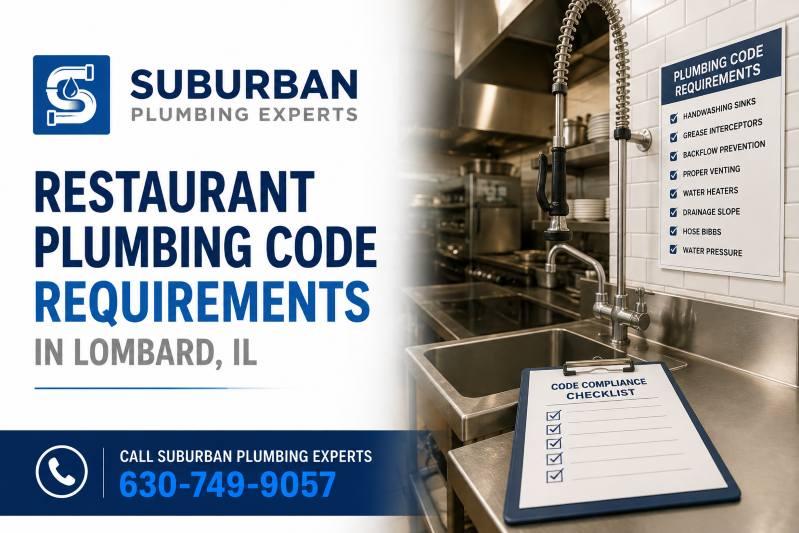
Restaurant Plumbing in Lombard Isn’t Bigger Residential Plumbing. It’s a Different Code Section Entirely.
A residential plumber and a restaurant kitchen plumber are working from different rulebooks. Lombard restaurants fall under DuPage County Health Department food service regulations in addition to the Illinois Plumbing Code, and that combination creates specific, non-negotiable requirements that have nothing to do with how a home kitchen is plumbed. Getting these wrong doesn’t just mean a callback, it means a failed health inspection, a delayed opening, or a permit that never gets issued. This covers what the code actually requires on the plumbing side specifically. For everything else about operating a compliant restaurant in Lombard, FOG compliance reporting, the Village’s Overhead Sewer Reimbursement Program, and ongoing inspection cycles, see our Lombard commercial plumbing guide.
Backflow Protection Isn’t Optional on a Single Fixture
According to the DuPage County Health Department’s Food Service Construction and Design Manual, every plumbing fixture in a food service facility must have backflow protection, installed according to the Illinois Plumbing Code and approved by the local plumbing authority. This matters more in a commercial kitchen than almost anywhere else, because the equipment involved, pre-rinse sprayers, chemical dispensers, carbonators, ice machines, creates real cross-connection risk between potable water and contaminated water if backflow protection fails or was never installed correctly. Our backflow prevention team handles this as standard practice on every commercial installation, not as an afterthought.
Every Piece of Equipment That Drains Needs an Air Gap, Not a Direct Connection
This is the requirement that trips up the most kitchen buildouts. The code requires indirect waste connections, open-site drain lines with an air gap through floor sinks or through-the-floor hub drains, for an extensive list of equipment: dishwashing machines, utensil washing sinks, prep sinks, pot washing sinks, pre-rinse sinks, silverware sinks, bar sinks, utility sinks, soda dispensers, ice machines, steam tables, pasta cookers, ice bins, salad bars, dipper wells, and walk-in cooler or freezer condensate. Two details are easy to miss and both result in a failed inspection: the connections must be rigid, hard-piped with an air gap, corrugated or flexible drain lines are not approved, and waste can never be routed into a bucket to receive discharge. This is one of the most common reasons a kitchen buildout stalls at inspection, and it’s worth confirming with your plumber before equipment is set in place, not after.
Grease Interceptors Have to Be Accessible, Not Just Present
The local Sanitary District determines the required size and number of grease interceptors for a given facility, and the code specifies two acceptable installation methods: an exterior grease basin, or an interior interceptor recessed into the floor so the lid sits flush, with a minimum 3-inch inlet and outlet. Either way, the interceptor has to be genuinely accessible for maintenance and positioned so it doesn’t interfere with the legs of the required 3-compartment sink or other fixed equipment. An interceptor that’s technically installed but buried under equipment or impossible to service without a major teardown doesn’t meet the standard, even if it passed initial inspection. Our grease trap cleaning service works from the same code requirements when servicing or evaluating an existing interceptor.
Water Heater and Sewage Requirements Are More Specific Than Residential
A 40-gallon storage capacity commercial gas water heater is the code minimum for food service operations, and if the unit is suspended, the support shelf needs a minimum of 80 inches of clearance above the finished floor. A tankless or heat-on-demand system is allowed but must be NSF approved specifically, not just any tankless unit. On the sewage side, all waste must discharge to a public sewer, underground or below-slab waste piping must meet Illinois State Plumbing Code minimums of at least 3 inches in diameter, and private sewage disposal systems, septic systems, are not permitted for food service operations under any circumstance. Our commercial water heater installation team sizes and installs to these specific standards rather than defaulting to residential equipment.
There’s No Grandfather Clause, and That Catches New Owners Off Guard
This is worth stating plainly because it surprises people taking over an existing restaurant space: the DuPage County ordinance provides no grandfather clause. Every establishment under new ownership, newly built, or remodeled must meet current construction, equipment, facility, and operational regulations, regardless of what was approved when the space was originally built out. A restaurant that passed inspection a decade ago under older standards does not carry that approval forward to a new owner. If you’re taking over an existing Lombard restaurant space, assume the plumbing needs a fresh compliance review against current code rather than assuming what’s already there is grandfathered in.
Plan Review Takes Time, Build It Into Your Timeline
Plan review typically takes up to 20 business days from the Health Department, and construction started before final plan approval risks unexpected costs or delays if changes are required afterward. The plumbing schedule required for submission needs to include the location and size of the water heater, all fixtures, drains and floor sinks, wastewater line connections, and grease trap size and location, detail that needs to be nailed down with your plumber well before submission, not worked out during construction. A plumbing location inspection is also recommended before drywall closes up the space, specifically to verify underground plumbing and fixture placement while it’s still accessible to fix.
When Something Goes Wrong Mid-Service
A commercial kitchen doesn’t get the luxury of waiting until morning when a grease line backs up during a Friday dinner rush or a water heater fails mid-shift. Our emergency plumbing services and burst pipe repair are available around the clock, and our commercial drain cleaning team understands the difference between a fix that gets you through service tonight and one that actually holds up under daily commercial volume.
Frequently Asked Questions
Does every fixture in a restaurant kitchen really need backflow protection?
Yes. The DuPage County code requires backflow protection on all plumbing fixtures in a food service facility, installed to Illinois Plumbing Code standards and approved by the local plumbing authority.
Can a dishwasher drain directly into a floor drain without an air gap?
No. Dishwashing machines are specifically listed among the equipment requiring an indirect waste connection with an air gap, through a floor sink or through-the-floor hub drain, using rigid, hard-piped connections rather than flexible or corrugated lines.
If I buy an existing restaurant, does its old plumbing setup still count as approved?
Not automatically. DuPage County’s ordinance has no grandfather clause, so a change in ownership requires the facility to meet current code, not whatever standard was in place when it was originally built or last approved.
Can I use a septic system for a restaurant in Lombard?
No. Private sewage disposal systems are not permitted for food service operations under DuPage County’s code. All restaurant sewage must discharge to a public sewer.
How long does the plan review process take before I can start construction?
Typically up to 20 business days, with an additional 10 business days if revisions are required. Starting construction before final approval risks having to redo work that doesn’t match approved plans.
Commercial Restaurant Plumbing for Lombard, IL
Suburban Plumbing Experts has served Lombard and the surrounding suburbs since 1978. We hold Illinois Plumbing License #055-044116 and Sewer License #2565, and every technician on our team is a trained, background-checked employee, not a subcontractor. From new buildout plumbing schedules through ongoing grease trap service and emergency repairs, our restaurant plumbing services are built around DuPage County’s specific code requirements, not generic commercial plumbing.
Building Out or Maintaining a Restaurant in Lombard?
Licensed, insured, and experienced with DuPage County’s food service plumbing code. From new construction to grease trap service to emergency repairs, we keep your kitchen compliant and running.
Lombard: 630-749-9057 | Emergency: 708-518-7765 | Open 24/7
—
Suburban Plumbing Sewer Line & Drain Cleaning Experts
Licensed & Insured | Open 24 Hours | Serving Lombard & the Suburbs Since 1978
📞 Lombard: 630-749-9057 | 🚨 Emergency: 708-518-7765