Bedford Park Packs Roughly 500 Companies — Many of Them Food Processing and Distribution Operations — Into Just Over 6 Square Miles, With a Residential Population Under 600. That Ratio Is Exactly Why Hydro Jetting Matters More Here Than in a Typical Suburb: the Sewer Lines Serving This Village Carry an Industrial Grease and Sediment Load That Rodding Alone Was Never Built to Fully Clear.
Bedford Park is one of the most industrially concentrated communities in Cook County — a village where roughly 90% of the land is dedicated to industrial and transportation use, home to hundreds of companies and a corridor with deep roots in food processing dating back to the Clearing Industrial District’s founding in 1888. The Illinois Institute of Technology’s Institute for Food Safety and Health operates right here on the Moffett Campus, on a site with its own history in industrial food production. That concentration of food and industrial activity produces a specific, recurring plumbing problem: fats, oils, and grease (FOG) entering drain lines faster and in greater volume than almost anywhere else in our service area. Our hydro jetting service is the method built to actually solve that problem, not just push it further down the line — and it’s one part of the broader plumbing services we provide throughout Bedford Park.
At a Glance
- What it is: High-pressure water — typically 1,500 to 4,000+ PSI for residential and commercial lines, higher for heavy industrial buildup — delivered through a specialized nozzle to scour the full interior wall of a pipe, not just punch a path through a blockage.
- Why it matters specifically in Bedford Park: Grease and sediment from food processing and industrial wash-down water accumulate on pipe walls at a rate residential lines never see, and that buildup narrows the pipe’s effective diameter over time even when water is still flowing.
- How it differs from rodding: Rodding cuts and clears a path through a blockage. Hydro jetting cleans the entire circumference of the pipe wall, removing the grease and scale that rodding leaves behind.
- The diagnostic step: A camera inspection before jetting confirms what’s actually in the line and whether the pipe can safely handle high-pressure water; a second camera pass after confirms the line is genuinely clear, not just flowing again temporarily.
- Who needs it most: Food processing and distribution facilities, restaurants, and any commercial kitchen — but also older residential lines with recurring, unexplained slow drainage that rodding alone hasn’t permanently resolved.
Why Bedford Park’s Sewer Lines Carry a Different Load
Bedford Park’s development history explains why this matters here specifically. The village grew out of the Clearing Industrial District, established in 1888, and its food-industry roots run deep — CPC International, maker of Karo corn syrup and other food products, anchored major operations in the area for decades, and that legacy continues today through the concentration of food processing and distribution companies still operating here, including the research institutions studying food safety at Illinois Tech’s Institute for Food Safety and Health, headquartered right on Archer Road. Facilities like these — along with the broader industrial base that makes up roughly 90% of the village’s land use — generate wash-down water, grease, and process residue that enters the sewer system daily at a volume and consistency residential neighborhoods simply don’t produce.
This isn’t a hypothetical concern. The EPA has documented that fats, oils, and grease can clog pipes and pumps both in public sewer lines and at wastewater treatment facilities — a national problem that concentrates hardest in exactly the kind of food-industry-dense corridor Bedford Park represents. Grease that enters a drain line hot, in liquid form, cools and solidifies against the pipe wall further downstream, building up in layers over months and years until the pipe’s effective diameter is a fraction of its original size — even while water technically still flows through the remaining opening.
What Hydro Jetting Actually Does That Rodding Doesn’t
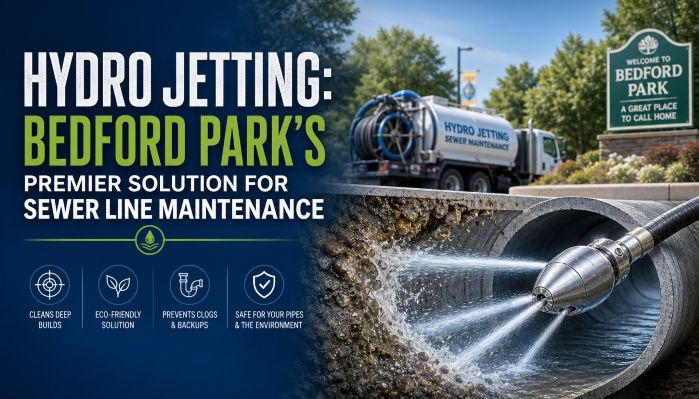
A rodding cable with a cutting head clears a blockage by cutting or punching a path through it — effective for a lot of residential clogs, but limited when the problem is a layer of grease and scale coating the full interior wall rather than a single obstruction. Hydro jetting works differently: high-pressure water, delivered through a nozzle with rear-facing jets, propels itself down the pipe while scouring the entire circumference of the interior wall as it goes. The result is a pipe that’s actually clean — not just a clog that’s been relocated or partially cleared.
For a Bedford Park facility with months or years of accumulated grease coating, that distinction is the difference between a fix that lasts and one that has the same problem returning within weeks. A line that’s been rodded repeatedly without resolving a recurring slow-drain problem is one of the clearest signs that the actual issue is wall buildup, not an isolated blockage — and it’s exactly the situation hydro jetting is built to solve.
The Process: Diagnose First, Then Clean, Then Confirm
A proper hydro jetting job doesn’t start with the water — it starts with a camera. Running a sewer camera through the line first confirms what’s actually causing the problem, how severe the buildup is, and whether the pipe’s condition can safely handle high-pressure water. A severely deteriorated or already-compromised pipe isn’t necessarily a good jetting candidate, and skipping this step is how a well-intentioned jetting job can turn a marginal pipe into a failed one.
Once the line is confirmed as a good candidate, the jetting nozzle is fed through the pipe from an accessible point, and high-pressure water clears and scours the line as the hose is fed and retrieved. A second camera pass afterward confirms the pipe is genuinely clean along its full length — not just clear at the point where flow was restored — which is the documentation that actually matters for a commercial property tracking maintenance for compliance or insurance purposes.
Beyond Hydro Jetting: What Bedford Park’s Industrial Properties Actually Need
Hydro jetting solves the pipe-wall buildup problem, but it’s one piece of a larger maintenance picture for a facility operating in this corridor. Grease trap service, floor drain maintenance under active production conditions, and vacuum truck pumping for accumulated sludge all come into play for the kind of industrial and food-processing operations concentrated in Bedford Park, and they’re all part of our broader commercial drain cleaning services across Chicagoland. We’ve covered the fuller Bedford Park picture — including what floor drain restrictions during peak production actually mean and what a complete maintenance program looks like for a facility here — in our complete guide to commercial plumbing and drain cleaning in Bedford Park. For the broader regional picture on hydro jetting specifically — costs, when it’s the right call versus rodding, and what to expect from a qualified provider anywhere in Chicagoland — see our complete guide to hydro jetting in Chicagoland.
Frequently Asked Questions
Is hydro jetting safe for older pipes in Bedford Park’s pre-1970 industrial buildings?
It can be, but it depends entirely on the pipe’s actual condition — which is exactly why a camera inspection comes first, not after. A technician adjusts pressure based on what the pipe can handle, and a line that’s already significantly deteriorated may need repair or replacement considered before jetting rather than as an alternative to it. Age alone doesn’t rule jetting in or out; documented condition does.
How often should a Bedford Park food processing or industrial facility schedule hydro jetting?
It depends on production volume and what’s going down the drain, but facilities generating consistent grease or process wash-down water generally need it more often than a typical commercial kitchen — sometimes multiple times a year rather than annually. The right interval for a specific facility comes from its own service and buildup history, which is something a camera inspection can help establish if you don’t already have that baseline.
We’ve had our line rodded multiple times and it keeps backing up. Would hydro jetting actually fix this?
Very possibly. A line that keeps recurring after repeated rodding is one of the clearest signs that the real problem is grease or scale coating the pipe wall rather than a single blockage rodding can clear — rodding punches through the immediate obstruction but doesn’t remove buildup along the rest of the line, which is exactly what keeps causing the same symptom to return.
Do you offer emergency hydro jetting in Bedford Park?
Yes — a backup at a food processing or industrial facility during active production hours is a business continuity problem, not just an inconvenience, and we treat it accordingly with 24/7 emergency availability.
Hydro Jetting Service in Bedford Park, IL
Licensed, insured, and equipped for the industrial-scale sewer demands Bedford Park’s food processing and manufacturing corridor actually requires — not residential equipment pressed into commercial service. Camera inspection, hydro jetting, and full documentation for compliance and maintenance records. Emergency line answered 24 hours a day.
Emergency: 708-518-7765 | Phone: 708-801-6530 | Open 24/7
—
Suburban Plumbing Sewer Line & Drain Cleaning Experts
Licensed & Insured | Open 24 Hours | Serving Bedford Park & the Suburbs Since 1978
📞 Bedford Park: 708-801-6530 | 🚨 Emergency: 708-518-7765