
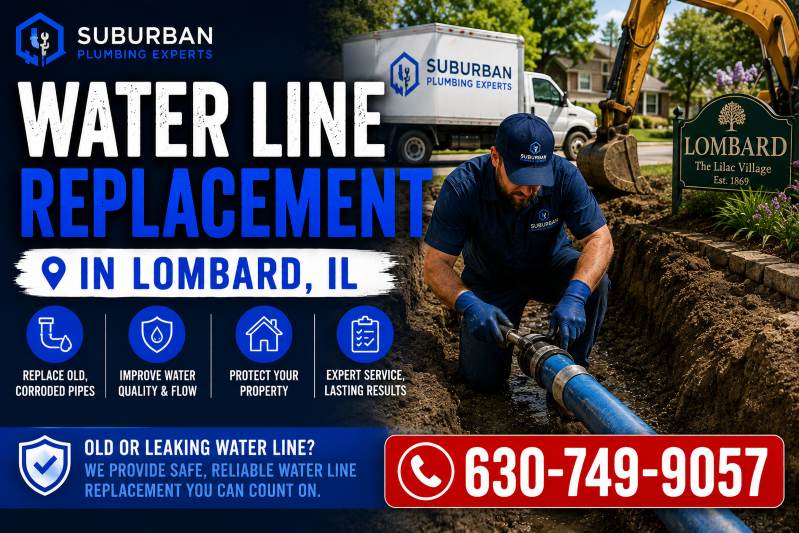
This Isn’t Really a “Should I Replace It” Question Anymore. Illinois Already Answered It.
Most articles about water line replacement frame it as a judgment call, weigh the signs, decide if it’s worth the cost. If your Lombard home has a lead service line, that framing is out of date. The Illinois Lead Service Line Replacement and Notification Act, signed into law in 2022, requires every lead service line in the state to be replaced, and it specifically prohibits partial replacement except in narrow circumstances. This isn’t a recommendation. It’s a statewide mandate with a compliance timeline already in motion. The real questions now are how urgent your specific situation is, what it costs, and what financial help is actually available, not whether replacement is optional.
What the Law Actually Requires, and Why Partial Replacement Is Banned
Under the Act, community water supplies across Illinois must inventory every service line in their system and submit replacement plans to the Illinois EPA, with full inventories due and replacement timelines running from 2027 through as late as 2042 or beyond depending on system size. The detail that matters most for homeowners: partial lead service line replacement, replacing only the utility-owned portion while leaving the homeowner’s portion in place, is prohibited except in specific circumstances. That rule exists because partial replacement can actually make things worse. Disturbing a lead line during partial work can dislodge scale and temporarily spike lead levels in the water, according to the EPA’s guidance on lead in drinking water, which is part of why federal and state rules increasingly push toward full replacement rather than a patchwork fix.
Why This Isn’t a Wait-and-See Health Risk
The EPA has set the maximum contaminant level goal for lead in drinking water at zero, based on the finding that there is no safe level of lead exposure, particularly for children. Lead is persistent in the body and bioaccumulates over time, and young children, infants, and fetuses are especially vulnerable because the same exposure level that has little effect on an adult can cause lasting harm in a developing child, including impacts on the nervous system and learning ability. Lead service lines are the leading source of lead in drinking water where they’re present. If your Lombard home was built before 1986 and you don’t know your service line material, that’s worth confirming before treating this as a someday project, our guide on whether your Chicago-area home has a lead water line walks through how to find out and what assistance programs exist across the region.
The Financial Help Most Lombard Homeowners Don’t Know About
The Village of Lombard funds a real program specifically for this situation: through its lead and galvanized water service line replacement program, the Village replaces the portion of a lead service line from the water main to the curb stop at no cost to the homeowner, and provides up to $5,000 or 75 percent of the cost, whichever applies, to replace the remaining section from the curb stop to the home. Given that partial replacement isn’t a legal option in most cases anyway, this program directly offsets what would otherwise be a full out-of-pocket replacement. It’s worth confirming your eligibility with the Village directly before assuming you’re facing the full cost alone.
Signs Your Water Line Needs Attention Now, Not Eventually
Beyond the lead-specific mandate above, general water line deterioration shows up in recognizable ways. Consistently low pressure throughout the house, not isolated to one fixture, points to a restriction somewhere in the line itself, corrosion narrowing the interior diameter, a developing leak bleeding off pressure, or sediment accumulation. Discolored water, rust-toned or cloudy, especially right when you first turn on a tap after the water has sat, points to corrosion inside the pipe itself, and it’s a more urgent sign in a home with older galvanized or lead piping than in one with copper or PEX. An unexplained rise in your water bill without a corresponding increase in usage almost always means water is escaping somewhere between the meter and your fixtures. Puddling or an unusually lush, green patch of yard that doesn’t track with rainfall is a classic sign of an underground leak. Banging, whistling, or gurgling in the pipes often means trapped air from a leak or a developing blockage, not just “old pipe noise” to ignore.
What Replacement Actually Costs
According to Angi’s cost data, main water line replacement averages around $1,704 nationally, with a typical range of $200 to $5,000 depending on length, material, and method. Trenchless replacement, boring small access points and pulling a new line through rather than digging the full length, runs roughly $75 to $150 per linear foot and leaves the yard largely undisturbed between those two points. Traditional open-trench replacement runs $50 to $250 per linear foot in materials and labor, with trenching and backfill work alone sometimes adding $1,500 to $13,000 before landscaping restoration. For most properties, trenchless costs more per foot but ends up comparable to or less than open trench once full yard restoration is factored in, which is why it’s usually the first option a contractor evaluates. If you’re still weighing whether your situation calls for a targeted repair instead of full replacement, our guide on the real cost of repair vs. replacement breaks down exactly how that decision gets made.
Copper, PEX, or Whatever’s There Now
Copper remains a durable, corrosion-resistant standard for water line replacement, with a genuinely long service life when properly installed. PEX has become a common modern alternative, flexible, resistant to the corrosion that affects older metal piping, and often faster to install in a trenchless application. Whichever material is used, it will outperform the galvanized steel or lead it’s likely replacing, both of which are legally being phased out of Illinois water systems precisely because they don’t hold up the way modern materials do. If your home’s interior plumbing is original alongside an aging service line, it’s often more economical to address both in a single coordinated project rather than separately, a point covered in more depth in our complete guide to home repiping.
Before Any Digging Starts
Illinois law requires anyone digging, on any project, to contact JULIE at 811 at least two business days beforehand, to have buried utility lines marked and avoid striking something unrelated during excavation. We cover why this step matters, and what happens if it’s skipped, in more detail in why your Chicago-area plumber should always call JULIE before they dig. A licensed plumber handles this as standard practice on every job that involves excavation, including water line replacement.
Frequently Asked Questions
Is water line replacement actually required by law, or just recommended?
For lead service lines specifically, yes, it’s required under the Illinois Lead Service Line Replacement and Notification Act, which mandates full replacement statewide on a timeline based on system size, and prohibits partial replacement in most circumstances.
Does Lombard offer any financial help for this?
Yes. The Village of Lombard’s lead and galvanized service line replacement program covers the main-to-curb-stop portion at no cost and provides up to $5,000 or 75 percent of the cost for the remaining section to the home.
How do I know if my home has a lead service line?
Homes built before 1986 carry meaningfully higher risk. Your water utility can often confirm service line material directly, and a licensed plumber can also visually inspect and test the line where it enters your home.
Is trenchless replacement always cheaper than traditional excavation?
Not per linear foot, but once full yard and landscaping restoration is factored in, trenchless often ends up comparable to or less than a traditional open trench, which is why it’s usually evaluated first.
What happens if only part of a lead service line gets replaced?
Beyond generally being prohibited under Illinois law, partial replacement can disturb existing scale inside the remaining lead sections and temporarily increase lead levels in the water, according to EPA guidance, which is part of why full replacement is the standard now.
Licensed Water Line Replacement for Lombard, IL
Suburban Plumbing Experts has served Lombard and the surrounding suburbs since 1978. We hold Illinois Plumbing License #055-044116 and Sewer License #2565, and every technician on our team is a trained, background-checked employee, not a subcontractor. From confirming your service line material to handling the Village’s assistance program paperwork to the replacement itself, our water line repair and replacement and lead service line replacement teams manage the full process.
Not Sure If Your Lombard Home Has a Lead Service Line?
Licensed, insured, and serving Lombard and Chicagoland since 1978. We’ll confirm your line material, check your eligibility for Village assistance, and give you a clear path forward.
Lombard: 630-749-9057 | Emergency: 708-518-7765 | Open 24/7
—
Suburban Plumbing Sewer Line & Drain Cleaning Experts
Licensed & Insured | Open 24 Hours | Serving Lombard & the Suburbs Since 1978
📞 Lombard: 630-749-9057 | 🚨 Emergency: 708-518-7765