
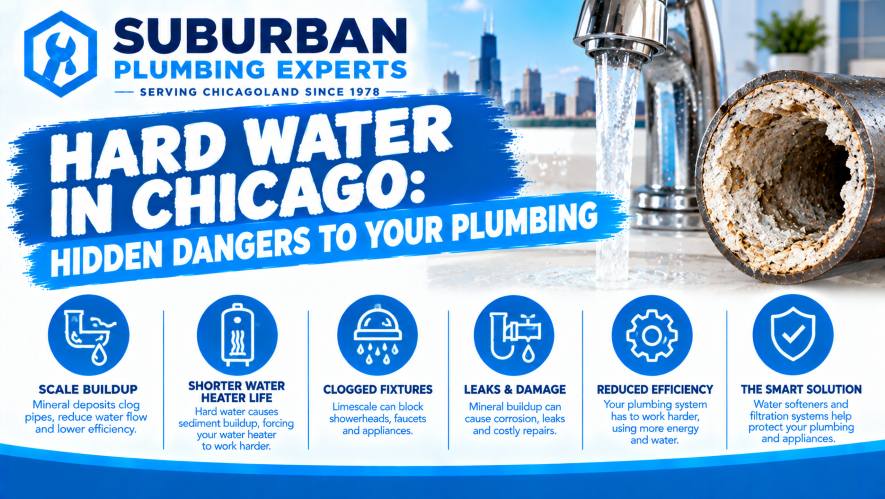
Hard Water Isn’t a Health Hazard. That’s Precisely Why So Few Homeowners Take It Seriously Until the Water Heater Fails Early, the Toilet Won’t Stop Running, and the Dishwasher Stops Getting Anything Clean, All Within the Same Year, All From the Same Cause.
If you live almost anywhere in the Chicago area, the water coming out of your tap is hard, meaning it carries a meaningful amount of dissolved calcium and magnesium picked up on its way from Lake Michigan or a local aquifer to your home. Hardness isn’t a contaminant and it isn’t dangerous to drink; the EPA’s own WaterSense program states plainly that water hardness is generally not a health hazard, even at the levels common in Chicago. That fact is exactly why hard water gets ignored for years at a time. There’s no warning label, no smell, no obvious symptom the day it starts causing damage. What it does instead is quietly tax every single thing in your home that touches water, a little more each year, until several of them start failing around the same time and it looks like bad luck rather than one shared cause.
What Hard Water Actually Is
Water hardness is the concentration of dissolved minerals, mainly calcium and magnesium, that water picks up as it moves through soil and rock before reaching a treatment plant or a well. It’s measured in grains per gallon (GPG) or milligrams per liter (mg/L, equivalent to parts per million), and higher numbers mean more dissolved mineral content. This isn’t unique to Chicago; it’s a function of the geology water travels through before anyone drinks it.
In Chicago’s case, the water supply draws from Lake Michigan, and the lake sits atop limestone and dolomite bedrock rich in calcium and magnesium carbonate. Some Chicagoland suburbs draw from wells rather than Lake Michigan directly, and well water passing through the same regional limestone formations tends to run at least as hard, sometimes harder, since it has more direct contact with mineral-rich rock. The exact number varies by municipality and by source, which is worth knowing since it means a household’s own water can be harder or softer than a neighboring suburb’s even a few miles away.
How Hardness Is Actually Classified
Water treatment professionals and university extension programs work from a standard four-tier classification based on the same USGS-derived ranges used nationwide:
Soft: 0 to 60 mg/L (roughly 0 to 3.5 grains per gallon)
Moderately hard: 61 to 120 mg/L (roughly 3.5 to 7 grains per gallon)
Hard: 121 to 180 mg/L (roughly 7 to 10.5 grains per gallon)
Very hard: more than 180 mg/L (above 10.5 grains per gallon)
Lake Michigan-sourced municipal water in the Chicago area is commonly measured in the hard range on this scale, and some well-supplied suburbs test into very hard territory. Because it varies by location, the most reliable way to know your own number is to check your municipality’s annual Consumer Confidence Report, which every water utility is required to publish, or to have your water tested directly, either with an inexpensive test strip or a professional water test.
What Hard Water Actually Does to a Home
This is the part that matters day to day, and it’s worth walking through in more detail than “it’s bad for your pipes,” since the mechanisms are different depending on what part of the home is affected.
Scale Buildup Inside Pipes and Fixtures
As hard water flows or sits, calcium and magnesium precipitate out and form scale, a hard, chalky mineral deposit that coats the inside of pipes, faucet aerators, showerheads, and any fixture with a small internal passage. Scale narrows the effective diameter of a pipe or fixture over time, which is why a home’s water pressure can decline gradually over years without any single dramatic event causing it. Faucet aerators and showerhead nozzles, with their small mesh screens and tiny openings, tend to show this first as reduced or uneven flow.
Accelerated Wear on Valves, Seals, and Fittings
Mineral deposits don’t just sit passively in a pipe. They build up unevenly on valves, gaskets, and rubber seals, preventing them from closing or sealing the way they were designed to. This shows up in places most homeowners wouldn’t immediately connect to water hardness, including the rubber flapper and fill valve inside a toilet tank. A flapper that’s stiffened and pitted by mineral buildup stops sealing properly, which is one of the most common reasons a toilet starts running or refilling on its own; our guide to a running toilet’s causes walks through exactly how that failure happens and how to fix it, and hard water is a big part of why those parts wear out faster in Chicago than they would in a soft water region.
Reduced Appliance Efficiency and Lifespan
Any appliance that heats or moves water, water heaters, dishwashers, washing machines, coffee makers, ice makers, accumulates scale on its internal heating elements and moving parts. An independent study conducted by the Battelle Memorial Institute and commissioned by the Water Quality Research Foundation found that hard water can cause as much as a 48 percent loss of efficiency in gas storage tank water heaters compared to units operating on softened water, along with significant scale accumulation on electric heating elements that shortens their working life. A less efficient water heater doesn’t just cost more to run; it also means longer wait times for hot water and inconsistent temperatures as sediment interferes with normal heating.
Your water heater is usually the single most visibly affected appliance in a hard water home, showing symptoms like popping or rumbling sounds, slower recovery between uses, and inconsistent temperature, all tied directly to mineral sediment accumulating on the tank bottom and heating element. Our complete Chicago water heater warning signs guide decodes each of those symptoms in detail and covers what to do about each one before it becomes an emergency, so this piece won’t repeat that ground here.
Stains on Dishes, Glassware, and Surfaces
Hard water leaves visible spots and film on dishes, drinking glasses, silverware, shower doors, faucets, and any surface that air-dries after being wet, since the minerals in the water are left behind as the water itself evaporates. This is cosmetic rather than damaging, but it’s often the first sign a household notices, well before anyone connects it to the pipes and appliances being affected at the same time.
Skin and Hair Effects
Hard water interferes with soap’s ability to rinse cleanly, leaving a thin mineral film on skin and hair after washing. This can leave skin feeling dry or tight and hair looking dull or harder to manage, and it can make existing skin conditions like eczema more noticeable for some people, though hardness itself isn’t a medical concern.
Soap Scum and Slow Drains
Because soap doesn’t fully dissolve in hard water, it forms a sticky, insoluble residue, soap scum, rather than rinsing away cleanly. That residue combines with hair, skin cells, and other debris to build up inside drain pipes over time, contributing to slow drains and clogs in showers, tubs, and bathroom sinks specifically, since that’s where soap use concentrates. A drain that’s slowing down gradually across multiple bathroom fixtures, rather than one sudden blockage, is a pattern worth connecting to water hardness rather than assuming it’s unrelated.
Finding Out Your Own Water’s Hardness
Before deciding whether hardness is worth addressing in your specific home, it helps to know your actual number rather than assuming based on Chicago’s general reputation for hard water. Three ways to find out, in order of effort:
Check your municipality’s Consumer Confidence Report. Every water utility in the country publishes one annually, and hardness (sometimes listed as “total hardness” or under calcium and magnesium concentrations) is often included even though it isn’t a regulated contaminant. If you’re on Chicago’s municipal supply or a suburb that purchases Lake Michigan water, this report is usually available directly from your municipality’s water department website.
Use an inexpensive home test strip. These give a quick grains-per-gallon or ppm reading and are widely available at hardware stores. They’re not lab-precise, but they’re accurate enough to tell you which classification tier your water falls into.
Have a professional water test done. A plumber or water treatment specialist can test your specific tap, which matters if you’re on a private well or suspect your home’s plumbing itself (older galvanized pipe, for instance) is adding to what the municipal supply already delivers.
What You Can Do Short of a Whole-Home System
A whole-home water softener addresses hardness at the source, but it’s a bigger decision than some households are ready to make right away, and a few smaller steps genuinely help in the meantime. Soaking a scaled showerhead or faucet aerator in equal parts white vinegar and water for an hour or two dissolves much of the mineral buildup without needing to replace the fixture. Wiping down glass shower doors and faucets after use, rather than letting hard water air-dry on the surface, meaningfully reduces the spotting and film that builds up over weeks. And replacing toilet flappers and fill valves proactively, roughly every five years rather than waiting for them to fail audibly, keeps one of the more common hard-water failure points from turning into a running toilet and a higher water bill.
None of these steps address the scale accumulating inside pipes, water heaters, or major appliances, which is the more consequential and less visible part of the problem. For that, treating the water itself at the point it enters the home is the only approach that actually works.
Water Softeners: How the Actual Fix Works
A water softener treats water as it enters the home through a process called ion exchange. Water passes through a tank containing resin beads charged with sodium or potassium ions; as hard water flows through, the calcium and magnesium ions swap places with the sodium or potassium on the resin, and the water that continues into the home’s plumbing comes out soft. The resin periodically regenerates using a stored brine solution, flushing the collected hardness minerals out to a drain and recharging itself for the next cycle, a process that’s fully automated on a modern system.
The effect isn’t just preventing new scale. Softened water is mildly corrosive to existing mineral deposits, so scale that’s already built up inside pipes and fixtures gradually dissolves and clears over the weeks and months after a softener is installed, which is part of why homeowners often notice water pressure and appliance performance improving rather than just holding steady.
A few things affect whether a softener is the right fit and how it should be sized: your actual measured hardness level (not just Chicago’s general reputation for hard water), your household’s daily water usage, and whether your home has adequate drainage and water pressure to support the system’s regeneration cycle. These are worth working through with someone who can test your specific water and assess your home’s plumbing, rather than guessing from a general hardness range; our water softener installation service covers sizing, selection, and installation for Chicago-area homes in detail.
Frequently Asked Questions
Is hard water actually dangerous to drink?
No. The USGS notes that the EPA has never set a legal limit for water hardness specifically because calcium and magnesium aren’t toxic. Hard water is a nuisance for plumbing, appliances, and household chores, not a health hazard.
How hard is Chicago’s water, specifically?
Lake Michigan-sourced municipal water in the Chicago area commonly falls in the “hard” range on the USGS classification scale, and some suburbs on well water test into the “very hard” range. Because it varies by exact location and water source, checking your own municipality’s Consumer Confidence Report or testing your water directly gives a more reliable number than a citywide average.
Can hard water actually damage my water heater?
Yes, meaningfully. An independent study found hard water can cause up to a 48 percent loss of efficiency in gas storage tank water heaters compared to softened water, on top of physically shortening the life of heating elements through scale accumulation. It’s usually the most visibly affected appliance in a hard water home.
Why does my toilet keep running, and could hard water be the cause?
It’s a common connection. Mineral buildup stiffens and pits a toilet’s rubber flapper, preventing it from sealing and causing the tank to run or refill on its own. If a toilet’s internal parts seem to wear out unusually often, hard water is a reasonable suspect alongside simple age.
Do I need a whole-home water softener, or will smaller fixes help?
Smaller steps like descaling showerheads and faucet aerators, wiping down glass surfaces, and replacing toilet parts proactively help with the visible symptoms, but they don’t address scale building up inside pipes, water heaters, and major appliances. A whole-home softener is the only approach that treats the water itself before it reaches anything in the house.
How do I know what size water softener I need?
Sizing depends on your actual measured water hardness, your household’s daily water usage, and your home’s drainage and water pressure, not just a general “Chicago has hard water” assumption. A professional water test and an assessment of your home’s plumbing are the right starting points before choosing a system.
—
Suburban Plumbing Sewer Line & Drain Cleaning Experts
Licensed & Insured | Open 24 Hours | Serving Chicago & Chicagoland Since 1978