
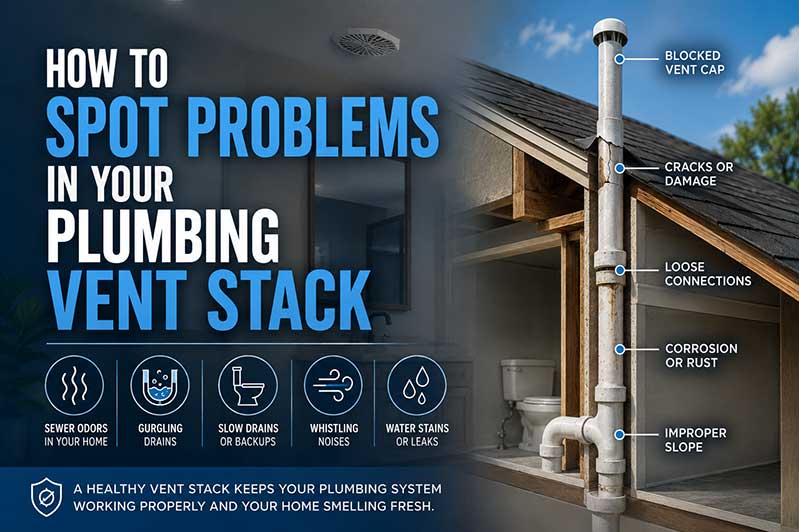
The Air Test Most Guides Recommend Only Checks One Vent. Most Homes Have More Than One.
A plumbing vent stack does two jobs at once: it lets air into the drain system so water can flow without creating a vacuum behind it, and it gives sewer gas a path out through the roof instead of into your living space. When it’s blocked, both jobs fail at the same time, which is why the symptoms show up as both drainage problems and, more seriously, a real health hazard that most homeowners underestimate as “just a bad smell.”
Sewer Gas Is a Real Health Risk, Not Just an Odor
The gas escaping through a blocked vent, or through a drain with a dried-out trap, is largely hydrogen sulfide, and the Illinois Department of Public Health is direct about what that actually means: exposure in the home commonly happens because of faulty plumbing, and drains with dry traps specifically allow it inside. At lower concentrations it causes eye irritation, sore throat, cough, and shortness of breath; prolonged low-level exposure can bring on fatigue, headaches, and dizziness. IDPH also notes something worth knowing: you can smell it at levels below what causes health effects, but at higher levels your sense of smell can become overwhelmed, so the absence of a strong odor doesn’t necessarily mean the air is safe. This isn’t a reason to panic over every whiff from a drain, but it is a reason to treat a persistent sewer smell as a real problem to solve, not just an inconvenience to mask.
Signs of a Blocked Vent
Slow drainage at more than one fixture at once, rather than just one, points away from a simple clog and toward a shared venting problem. Gurgling or bubbling when a different fixture drains is air being pulled or pushed through a trap’s water seal by a pressure imbalance, our guide on understanding gurgling drains covers the actual mechanics of why that happens. A toilet bowl’s water level fluctuating on its own, water hammer (a banging noise when a valve shuts suddenly), and the sewer gas smell covered above round out the common list. Any one of these alone is worth a look; more than one at once usually means the vent, not an isolated fixture, is the actual problem.
What Actually Blocks a Vent From Outside
Bird and squirrel nests are one of the most common culprits, a roof vent opening looks like a ready-made shelter to a lot of wildlife, and wasps are a close second, building nests just inside the opening where they’re protected from rain. Leaves and windblown debris accumulate the same way they do in a gutter. In winter, warm, moist air rising up through the stack meets cold air at the opening and condenses, and repeated freeze-thaw cycles can build that condensation into a ring of frost that gradually narrows the opening, sometimes closing it off almost entirely during a hard freeze, similar to the freeze risk we cover in our guide to gutter and downspout maintenance. Roofing debris from nearby work or storm damage can also find its way into an open vent pipe. If your vent has a cap or screen installed to keep debris and wildlife out, check that first, since the cap itself is sometimes the actual point of blockage rather than the pipe underneath it.
Vent Terminology Worth Knowing Before You Call a Plumber
A few terms come up often enough that knowing them makes it easier to describe your situation accurately. A main or stack vent runs the full height of the building and terminates through the roof. A common vent serves two fixtures on the same floor through a single connection. An individual, or revent, vent serves just one fixture and ties back into the main stack rather than penetrating the roof separately in every case. A wet vent is a pipe that carries both drainage and venting air for a fixture, common in tightly designed bathroom layouts. Knowing which of these applies to the fixture giving you trouble helps a plumber narrow down the likely cause before they’ve even arrived.
Air Admittance Valves: A Vent That Doesn’t Go Through the Roof
Not every fixture vents through the roof at all. An air admittance valve, sometimes sold under the brand name Studor vent, is a one-way mechanical valve that opens to let air into the drain system and closes to keep sewer gas from escaping, without needing a pipe run all the way up through the roof. They’re common on kitchen islands, remodels, and additions where running a conventional vent isn’t practical. If a fixture with an AAV starts showing the same symptoms as a blocked vent, gurgling, slow drainage, odor, the cause is usually the valve itself failing to seal or open properly rather than a physical blockage, and the fix is replacing the valve rather than clearing anything out of it. Not every jurisdiction allows AAVs in every application, so if you’re not sure whether your fixture has one, that’s worth confirming before assuming a roof-vent problem is the cause.
The Suction Test Has a Blind Spot: Multiple Vent Systems
The standard homeowner check, holding a hand over the roof vent opening while someone flushes a toilet inside and feeling for suction, is a reasonable first step, but it has a real limitation most guides don’t mention: many homes have more than one vent stack. Fixtures located far from the main stack, a powder room addition, a basement bathroom, a remodeled kitchen, often have their own secondary vent tied in separately to meet code requirements on maximum unvented distance. If your main roof vent tests clear but a specific fixture is still showing symptoms, the actual blocked vent, or a failed air admittance valve, may be somewhere else entirely, not visible from the same spot on the roof.
How to Check Safely
Treat the roof itself as the first safety decision, not an afterthought. If it’s steep, wet, icy, or you’re not confident on a ladder, this is a reasonable one to leave to a professional before you’ve even located the vent. Use a ladder with a stabilizer, keep it on solid, level ground, and have someone else home while you’re up there rather than working alone. If conditions are safe, locate the vent pipe, typically above the bathroom, and look inside with a flashlight before doing anything else; you may be able to see the blockage directly. Removing visible debris by hand, with gloves on, resolves a lot of cases without any further tools.
If You Live in a Condo or Multi-Unit Building
A shared vent stack running through a condo or apartment building typically serves multiple units by definition, which usually makes it a common element the association is responsible for maintaining, not an individual unit owner, the same boundary test we cover in our guide to condo plumbing responsibility. Beyond the responsibility question, roof access in a multi-unit building is often restricted for good reason, and a vent problem there can affect several units at once rather than just yours. Report it to your association or property manager rather than attempting a DIY roof check that you likely aren’t authorized, or safely positioned, to do yourself.
Why Cutting Into Your Vent Pipe Yourself Is a Bigger Deal Than It Sounds
Some advice online suggests cutting into the vent pipe from inside the attic to clear a stubborn clog from a different angle. Be careful with this one: altering a plumbing system, which is exactly what cutting and repairing a vent pipe is, falls under the same Illinois Plumbing License Law that governs the rest of your home’s plumbing, covered in more depth in our guide to licensed plumbers versus handymen. A poorly resealed cut in a vent pipe can create a new leak point or a code problem that’s considerably more expensive to fix than the original clog, on top of the fall risk of working in an attic space near the roofline.
When a Suction Test Isn’t Enough: Professional Smoke Testing
If a visual check and a basic suction test don’t turn up an obvious answer, especially if the affected fixture is far from the main vent you tested, a professional sewer smoke test gives a definitive answer instead of a guess. A safe, non-toxic smoke is introduced into the vent system, and it reveals exactly where it’s escaping, whether that’s a blocked section, a cracked pipe, or a disconnected joint, without any exploratory cutting. It’s a fast way to find out which of potentially several vents is actually the problem.
When to Stop and Call a Professional
Call a professional if the blockage isn’t visible or reachable from a safe vantage point, if a suction test on your main vent is clear but symptoms persist at a specific fixture, or if you’re dealing with a dead animal or debris lodged too far down to remove safely. Our complete guide to drain cleaning in Chicago covers when a drainage issue is a simple clog versus something that needs a broader look at the system.
Frequently Asked Questions
Is sewer gas from a blocked vent actually dangerous, or just unpleasant?
It’s a genuine health concern, not just an odor issue. Hydrogen sulfide exposure at lower concentrations causes eye and throat irritation, and prolonged exposure can bring on headaches, fatigue, and dizziness. Treat a persistent sewer smell as a problem worth solving rather than something to mask.
My roof vent tested clear with the suction test, but I’m still having drainage problems. Why?
Your home may have more than one vent stack. Fixtures far from the main stack often have their own secondary vent, and that’s the one that may actually be blocked even though the main roof vent tests fine.
Can I cut into my vent pipe myself to clear a stubborn clog?
It’s worth thinking twice about. Altering a plumbing system is regulated under Illinois law, and a poorly resealed cut can create a new leak or code issue on top of the fall risk of attic work near the roofline. This is a reasonable point to call a licensed plumber instead.
What causes a vent stack to freeze or block in winter specifically?
Condensation and frost can build up inside the vent opening during cold weather and gradually narrow it, occasionally closing it off almost entirely during a hard freeze, similar to how ice accumulates in a poorly insulated attic space.
What does a professional sewer smoke test actually show?
A safe, non-toxic smoke is introduced into the vent and drain system, and wherever it escapes shows exactly where a blockage, crack, or disconnected joint is located, giving a definitive answer instead of a guess when a basic suction test isn’t conclusive.
What’s an air admittance valve, and how do I know if I have one?
It’s a mechanical one-way valve that lets air into the drain system without a pipe running through the roof, common on kitchen islands and remodeled fixtures. If a fixture shows blocked-vent symptoms but doesn’t seem to have a roof vent at all, it likely has one of these instead, and the fix is usually replacing the valve rather than clearing a blockage.
Who’s responsible for a shared vent stack in a condo building, me or the association?
A vent stack serving multiple units is typically treated as a common element under most states’ condo laws, making it the association’s responsibility rather than an individual owner’s. Report the issue to your association or property manager rather than attempting a roof check yourself.
A Vent Stack Doesn’t Ask for Attention Until Something Else Fails First
Nobody thinks about their roof vent until a drain starts gurgling or a smell shows up that won’t go away. Knowing that it’s not just one pipe, that sewer gas is a genuine health concern and not just an unpleasant smell, and that cutting into it yourself carries more risk than it looks like, is what turns a vent stack problem into a quick, safe fix instead of a bigger one.
—
Suburban Plumbing Sewer Line & Drain Cleaning Experts
Licensed & Insured | Serving Chicago & the Suburbs Since 1978