
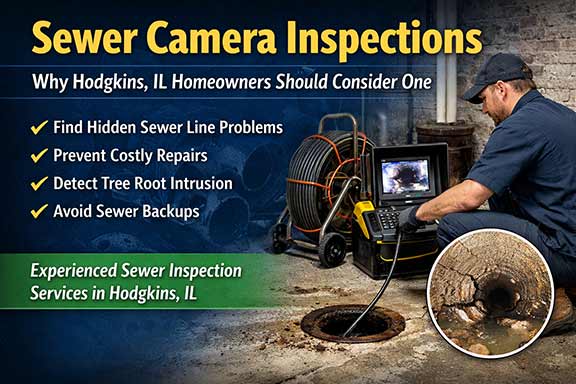
What’s Actually Under Your Yard in Hodgkins? Most Homeowners Have No Idea Until Something Goes Wrong.
Every fixture in a Hodgkins home eventually drains into one pipe, the sewer lateral running from the house to the village main. It’s buried, it’s out of sight, and for most homeowners it stays that way until a backup, a slow drain, or a foul smell forces the question. A sewer camera inspection is the only way to actually answer that question before it becomes an emergency, and it does it without digging up a single square foot of yard.
Hodgkins is a small, close-knit village, and much of its residential housing sits alongside a long industrial history tied to the nearby Illinois & Michigan Canal and the rail and freight operations that have anchored the area for well over a century. That combination, older residential streets adjacent to heavy industrial infrastructure, is exactly the kind of setting where knowing the real condition of your sewer line, rather than guessing, pays off.
What a Sewer Camera Inspection Actually Is
A sewer camera inspection uses a waterproof, high-definition camera mounted on a flexible cable, fed into the sewer line through an existing cleanout or other access point. The technician guides the camera through every bend in the line, and the footage streams live to a monitor, giving a real-time view of exactly what’s happening inside the pipe: cracks, offset joints, root intrusion, bellied sections, or blockages, all identified and located precisely rather than guessed at.
This isn’t a proprietary or informal technique. The industry standard for how these inspections are conducted and documented comes from the National Association of Sewer Service Companies’ Pipeline Assessment Certification Program, which gives inspectors a consistent, standardized way to identify, grade, and document defects so findings are objective and comparable rather than based on one technician’s impression.
Why This Matters More Than It Might Seem
It replaces guesswork with an actual answer. Without a camera, diagnosing a sewer problem means inferring from symptoms, slow drains, odors, backups, and guessing at the cause. A camera inspection shows the actual condition of the line and exactly where any problem sits, which means the repair that follows targets the real issue instead of a best guess.
It’s non-invasive. Traditional diagnosis without a camera often meant digging first and finding out what was actually wrong second, which could mean tearing up a driveway, a lawn, or landscaping just to locate a problem that might turn out to be minor. A camera inspection finds the answer first, so any excavation that follows is targeted to the exact spot that needs it.
It’s fast and doesn’t disrupt your household. A standard inspection is typically completed in a few hours, with no mess left behind and no interruption to your day beyond the visit itself.
It works across a wide range of problems. Whether the line is blocked, cracked, collapsed, or compromised by root intrusion, the same inspection method identifies which one you’re actually dealing with.
When a Camera Inspection Is Worth Scheduling
As routine, preventive maintenance, a sewer camera inspection every one to two years catches developing problems, root intrusion that’s just starting, a joint that’s begun to shift, while they’re still a rodding job rather than a repair job. That’s the difference between a minor maintenance cost and a major, unplanned one.
Outside of routine maintenance, a handful of signs mean it’s worth scheduling an inspection sooner rather than later:
- Frequent slow drains or clogs that keep coming back despite being cleared
- Sewer odors inside the home, or unusual gurgling sounds from drains
- Fluctuating water levels in the toilet bowl without an obvious cause
- Unexplained pest activity near drains or the yard, sometimes a sign of a cracked line attracting insects or rodents
Any of these can point toward a developing sewer backup, and catching it with a camera inspection before it becomes an active backup is almost always cheaper and less disruptive than dealing with the aftermath.
Buying or Selling a Home in Hodgkins
A sewer camera inspection is one of the few ways to know the real condition of a home’s sewer line rather than relying on what a seller says, or doesn’t say. For a buyer, it can prevent an unpleasant and expensive surprise a few months after closing. For a seller, a documented inspection showing a clean line is a straightforward way to remove a question mark from the transaction before a buyer’s inspector raises it first.
What Happens After the Inspection
The right next step depends entirely on what the camera actually finds:
- Minor root intrusion or a clog is typically resolved with mechanical sewer rodding, clearing the immediate obstruction.
- Grease or scale buildup along the pipe walls usually calls for hydro jetting, which cleans the full diameter of the line rather than just punching a path through the center.
- Structural damage, a collapsed section, significant offset, or deterioration beyond cleaning, calls for actual sewer line repair targeted to the exact section the camera identified.
Frequently Asked Questions
How often should a sewer camera inspection be done?
Every one to two years as routine maintenance is a reasonable standard for most homes, more frequently if the property has mature trees near the lateral or a history of clogs.
Does a sewer camera inspection require digging?
No. The camera is fed through an existing cleanout or other access point, and the inspection itself doesn’t disturb the pipe, the yard, or any landscaping.
How long does a sewer camera inspection take?
Typically a few hours, depending on the length and accessibility of the line.
What’s the industry standard for how these inspections are conducted?
NASSCO’s Pipeline Assessment Certification Program (PACP) is the recognized North American standard for coding and documenting sewer pipe conditions during a CCTV inspection, ensuring findings are consistent and objective rather than dependent on one inspector’s judgment.
Can a sewer camera inspection find a problem before it causes a backup?
Yes, that’s the main value of routine inspection. Root intrusion, joint separation, and early scale buildup are all visible on camera well before they progress to a full blockage or backup.
Licensed Sewer Camera Inspections for Hodgkins, IL
Suburban Plumbing Experts has served Hodgkins and the surrounding suburbs since 1978. We hold Illinois Plumbing License #055-044116 and Sewer License #2565, and every technician on our team is a trained, background-checked employee, not a subcontractor. If you’re seeing any of the warning signs above, or simply want a documented answer about the condition of your line, our Hodgkins, IL plumbing team can get you scheduled.
Ready to See What’s Actually in Your Sewer Line?
Licensed, insured, and serving Hodgkins and Chicagoland since 1978. We run the camera first and recommend the right fix based on what we actually find.
Suburbs: 708-801-6530 | Emergency: 708-518-7765 | Open 24/7
—
Suburban Plumbing Sewer Line & Drain Cleaning Experts
Licensed & Insured | Open 24 Hours | Serving Hodgkins & the Suburbs Since 1978
📞 Suburbs: 708-801-6530 | 🚨 Emergency: 708-518-7765