
Water Is Trying to Tell You Something. Here’s How to Read the Warning Signs Before They Turn Into a $20,000 Problem.
Chicago is one of the most water-challenged cities in the country for homeowners. Heavy clay soil that holds moisture for days. Over 38 inches of annual precipitation. A combined sewer system that surcharges during major storms. Mature tree canopy with root systems that travel dozens of feet underground. Flat topography that gives water nowhere to go on its own.
The result is predictable — and expensive. Basement flooding, foundation damage, chronically soggy yards, and mold problems are a daily reality for homeowners across Cook County and DuPage County who don’t have adequate drainage in place.
A French drain is often the solution — but the key is recognizing the warning signs early, before water damage has already done its work. Here are the ten most common signs that your Chicago-area home needs a French drain, what’s actually happening underground when you see them, and what you risk by waiting. Not all French drain systems solve the same type of water problem, though. Some are designed to intercept surface water outside the home, while others manage groundwater after it reaches the foundation. Our complete guide to interior vs. exterior French drain systems explains the difference, when each one is appropriate, and what Chicago homeowners should know before hiring a waterproofing company.
Sign #1: Water Pools in Your Yard After Every Rain and Doesn’t Drain Within 24 Hours
This is the most visible and most common sign, and Chicago homeowners see it constantly. After a significant rainstorm, low spots in the yard fill up with standing water — and stay that way for a day, two days, sometimes longer.
The problem isn’t the rain itself. It’s what’s underneath: Chicago’s Drummer series clay soil absorbs water far more slowly than sandy or loamy soils found in other parts of the country. When the clay is saturated — which in a Chicago spring can happen after just a few inches of rain — additional water has nowhere to go. It sits on the surface, slowly evaporating or finding its way toward the lowest point on your property.
If that lowest point happens to be near your foundation, you have a problem that goes well beyond a muddy lawn. Standing water within a few feet of your foundation exerts constant hydrostatic pressure against your basement walls — and that pressure eventually finds a way in.
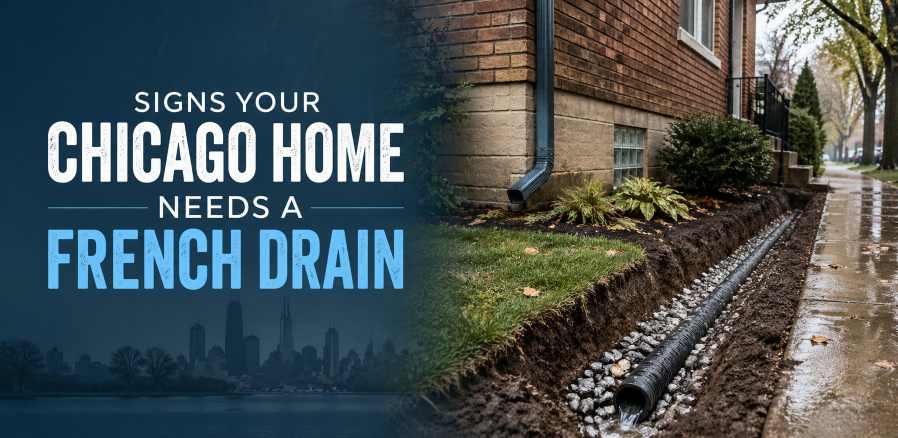
A properly installed exterior French drain intercepts that surface water before it reaches the foundation and channels it to a safe discharge point. The yard dries out within hours instead of days, and the pressure against your basement walls is eliminated at the source.
Sign #2: Your Basement Smells Musty Even When It’s Not Visibly Wet
You walk into your basement and notice it — that damp, earthy, slightly sour smell that no amount of air freshener touches. The floor looks dry. There are no visible puddles. But the smell is undeniable.
What you’re smelling is moisture that’s moving through your foundation and evaporating inside — a process called vapor transmission. Water in the saturated soil surrounding your basement migrates through porous concrete and block foundation walls at the molecular level, releasing into the air as humidity. That humidity feeds mold and mildew growth in the framing, insulation, and drywall of your basement — often before you can see any visible damage.
According to the CDC’s guidance on mold and dampness, mold in homes can cause respiratory symptoms, allergic reactions, and other health effects — and it thrives specifically in conditions of persistent moisture. A musty basement isn’t just unpleasant — it’s a health issue and a sign that your foundation drainage is failing.
An exterior French drain that relieves hydrostatic pressure around your foundation, combined with an interior perimeter drain where necessary, is the permanent fix. Dehumidifiers treat the symptom. Drainage addresses the cause.
Sign #3: You See White Powdery Residue on Your Basement Walls
This white, chalky deposit — called efflorescence — is one of the most reliable indicators that water is actively moving through your foundation walls. It forms when water seeps through concrete or masonry, picks up mineral salts as it travels, and then evaporates on the surface, leaving the salts behind as a white crust.
Efflorescence itself isn’t structurally dangerous, but what it represents absolutely is. It means water is consistently present in the soil adjacent to your foundation and is finding its way through the wall. Left unaddressed, that ongoing moisture infiltration will eventually cause spalling — where the concrete surface flakes and deteriorates — and can progressively weaken the wall itself.
If you’re seeing efflorescence at the base of your basement walls, particularly along the floor-wall joint, an interior French drain combined with a sump pump is often the most effective solution for permanently redirecting that water before it reaches the wall.
Sign #4: Water Stains or a Tidemark on Your Basement Walls or Floor
A dark horizontal line on your basement walls, water stains on the block or poured concrete, or discoloration on the floor — these are the calling cards of past flooding events. Even if the basement is dry when you’re looking at it, these marks tell you exactly how high the water has risen and how often.
In Chicago’s older neighborhoods, basement flooding during major rain events is so common it almost feels normal. It isn’t. Each flooding event deposits sediment, contributes to mold growth, increases hydrostatic pressure on the foundation, and shortens the life of whatever is stored or finished in the space.
If you’re seeing water stains at or above floor level, your drainage situation needs a professional assessment. The combination of Chicago’s combined sewer system surcharging and inadequate foundation drainage means many basements flood from multiple directions simultaneously — and solving it requires understanding which water is coming from where.
Sign #5: Your Yard Slopes Toward Your House Instead of Away From It
This one requires a careful look. Stand at the far end of your yard and look back toward your foundation. Does the ground appear to slope downhill toward the house? After it rains, does water seem to run toward the foundation rather than away from it?
This is called negative grading, and it’s a primary cause of foundation water intrusion in Chicago’s older housing stock. Over decades, soil settles around foundations, flower beds are built up against the house, and what started as a proper outward grade gradually reverses. Every rainstorm becomes a scenario where water is actively directed at your foundation rather than away from it.
While regrading the immediate area around your foundation helps, it often isn’t sufficient on its own for Chicago’s clay soil conditions. A French drain installed along the foundation perimeter captures water that has already moved toward the house and redirects it before it can create hydrostatic pressure or infiltrate through the wall.
Sign #6: Your Sump Pump Runs Constantly — Even When It Hasn’t Rained Recently
Your sump pump is a reactive system — it removes water that has already entered the sump pit. If it’s running frequently during dry weather, or cycling on and off continuously during rainy periods, it’s telling you that groundwater is consistently present at or near your foundation.
A sump pump that runs constantly is also a sump pump that will wear out faster, fail sooner, and leave you unprotected during the next major storm when you need it most. Our sump pump services cover inspection, repair, and replacement — but a chronically overwhelmed sump pump is often a symptom of inadequate drainage, not just an aging pump.
Installing a French drain that intercepts groundwater before it reaches the foundation significantly reduces the load on your sump pump — extending its life and giving you a layered defense rather than a single point of failure.
Sign #7: You Have Cracks in Your Foundation Walls or Floor
Horizontal cracks in poured concrete or block foundation walls are among the most serious warning signs a homeowner can encounter. They indicate that hydrostatic pressure — the pressure of water-saturated soil pushing against the wall — has exceeded the wall’s structural capacity in that location. This is not a cosmetic issue. It is a structural emergency.
Vertical cracks and diagonal cracks at corners are often caused by differential settlement and may also be water-related. Floor cracks, particularly those that are widening over time or showing moisture, indicate subslab water pressure.
Waterproofing and structural repair are necessary once cracking has occurred — but drainage is the only way to prevent further damage. Reducing the hydrostatic pressure against your foundation through a combination of exterior French drains and interior perimeter drainage is what stops the progression. Patching cracks without addressing the underlying drainage problem is like patching a leak without turning off the water.
Sign #8: Mold or Mildew Is Growing in Your Basement
Visible mold growth — black, green, or white fuzzy patches on walls, framing, insulation, or stored materials — means the moisture problem has moved from early warning to active damage. Mold requires three things to grow: organic material, warmth, and moisture. Your basement provides the first two in abundance. If it also has the third, mold will grow — and it will spread.
Mold remediation in a finished basement can run $3,000 to $15,000 depending on the extent of the growth and the materials affected. Remediation without fixing the underlying moisture source means it will return. The permanent fix is drainage — eliminating the moisture infiltration that’s feeding the mold in the first place.
If you have active mold growth in your basement, call a remediation company and a licensed plumber simultaneously. The remediation company removes what’s there. The plumber solves why it was there. It’s also important to make sure you’re hiring the right type of contractor for the drainage work itself. Many homeowners are surprised to learn that French drain installations often involve plumbing systems, sump pump connections, and code-regulated drainage work. Before comparing estimates, read our guide on why you should hire a licensed plumber instead of a landscaper for French drain installation.
Sign #9: Your Downspouts Discharge Near Your Foundation
Walk around your house after a heavy rain and watch where the water from your gutters goes. If your downspouts terminate within a few feet of the foundation — or discharge directly onto a splash block that directs water toward the house — every rainstorm is delivering a concentrated stream of water directly to the most vulnerable point of your home.
Downspout extensions can help move the discharge point further away from the foundation, but on a property with clay soil and inadequate overall drainage, the water simply pools further out in the yard and eventually migrates back. The comprehensive solution is connecting downspout drainage into a French drain system that actively carries the water away from the property entirely — to a catch basin, dry well, or street outlet.
Sign #10: Neighbors on Your Block Have Had French Drains Installed
This one sounds counterintuitive but it’s a real signal worth paying attention to. If multiple neighboring properties have installed French drains, sump pumps, or flood control systems, it tells you something meaningful about the drainage conditions in your specific area — the soil, the grade, the proximity to combined sewers, the water table.
In established Chicagoland neighborhoods, drainage problems tend to cluster. The soil conditions, the grade of the block, the age of the combined sewer infrastructure, and the density of mature tree roots are all shared factors. What your neighbors are experiencing, you are likely experiencing too — or will be soon.
The Metropolitan Water Reclamation District of Greater Chicago offers resources specifically for Cook County homeowners on managing stormwater and flood risk — including information on local rebate programs for flood control installation. If your block has a history of flooding, checking whether your municipality offers rebates for backwater valves or French drain installation is worth a phone call to your village hall.
What Happens If You Ignore These Signs
Water doesn’t announce itself before causing damage. It works slowly, persistently, and invisibly — saturating framing, feeding mold colonies, oxidizing steel reinforcement in concrete, dissolving the mortar joints in block walls, and undermining the bearing capacity of the soil beneath your foundation. By the time the damage is obvious, it’s often extensive.
Foundation repairs in the Chicago area run $5,000 to $30,000 depending on severity. Basement mold remediation and restoration in a finished space regularly exceeds $20,000. Structural repairs to a failing foundation wall can run $10,000 to $50,000. A French drain installation that could have prevented all of it typically costs a fraction of any of those numbers.
The signs are there. The question is whether you act on them before or after the damage is done.
What to Do Next
If you’re seeing two or more of the signs on this list, the right move is a professional drainage assessment — not a DIY trench with a bag of gravel from the hardware store. Chicagoland’s clay soil, combined sewer system, and freeze-thaw conditions require a properly designed system with correct pipe sizing, adequate slope, appropriate gravel, filter fabric, and a code-compliant discharge point.
Our French drain and drainage tile installation team assesses both exterior and interior conditions before recommending anything. We’ll tell you what’s driving your water problem, what type of system makes sense for your property, and what it will cost before we start any work. Not sure whether a French drain, sump pump, or backwater valve is the right solution for your specific water problem? Read our complete side-by-side comparison: French Drain vs. Sump Pump vs. Backwater Valve — Which One Does Your Chicago Home Actually Need?
Wondering about cost? Read our complete French drain installation cost guide for Chicagoland homeowners for a full breakdown by system type before you call.
Frequently Asked Questions: French Drains in Chicago
How do I know if I need an exterior or interior French drain?
Exterior French drains solve surface water problems — yard pooling, water running toward the foundation from above grade, negative grading. Interior basement French drains solve subsurface problems — water entering through the floor, hydrostatic pressure through the foundation wall at the footing, or a consistently overwhelmed sump pump. Many Chicago-area properties need both. A site assessment by a licensed plumber is the only way to know for certain which type your property requires.
Can’t I just regrade my yard instead of installing a French drain?
Regrading helps when the primary issue is surface water running toward the foundation. In Chicago’s clay soil environment, regrading alone is often insufficient because the soil still saturates quickly and holds water. A French drain actively removes water from the soil rather than just redirecting surface flow — which is what the conditions here typically require.
How long does French drain installation take?
Most exterior residential French drain installations take one to two days. Interior basement perimeter systems with concrete work take two to four days. We give you a realistic timeline before we start and work to minimize disruption to your yard and home throughout the process.
Do French drains require permits in Chicago and the suburbs?
It depends on the scope and municipality. Systems that connect to municipal storm infrastructure or involve significant excavation near the foundation typically require permits. We handle all permit requirements as part of the job — you don’t need to navigate that process yourself.
Will a French drain work in Chicago’s clay soil?
Yes — in fact, French drains are particularly well-suited to clay soil environments because they actively intercept and redirect water rather than relying on soil absorption. The key is proper design: correct gravel sizing, adequate filter fabric, proper slope, and an appropriate discharge point. An improperly designed system in clay soil will fail. A properly designed one will perform for 30 to 50 years.
Seeing These Warning Signs? Let’s Figure Out What Your Property Needs.
We assess both exterior and interior drainage conditions and give you a clear picture of what’s driving the problem — and what it will cost to fix it — before any work begins.
Or call us directly: 708-801-6530 | Open 24/7
—
Suburban Plumbing Sewer Line & Drain Cleaning Experts
Licensed & Insured | Open 24 Hours | Serving Chicago & the Suburbs Since 1978
📞 Suburbs: 708-801-6530
📞 West Suburbs: 630-749-9057
📞 Chicago: 773-570-2191