
Berwyn Is Known as the “City of Homes” for Its Rows of 1920s and ’30s Bungalows — But the Same Era That Gave Berwyn Its Character Also Gave It a Combined Sewer System Built for a Population and Rainfall Pattern That No Longer Exists, Sitting on Ground That Was Once Part of a Marsh Connecting the Chicago and Des Plaines Rivers. That Combination Is Why Sewer Backups Here Aren’t Bad Luck — They’re Physics.
Berwyn, Illinois sits about 9 miles southwest of downtown Chicago, and it’s earned its nickname honestly — walkable streets lined with rows of well-kept 1920s and 1930s bungalows give the city a character that draws people looking for exactly this kind of housing stock. But that same history is directly connected to a less charming distinction: Berwyn experiences sewer backups and basement flooding more frequently than most Chicago-area suburbs, and it’s not because of any one bad storm or aging pipe. It’s the combination of several factors working together, all rooted in decisions and geography from more than a century ago.
At a Glance
- The core problem: A combined sewer system carrying both sanitary sewage and stormwater in the same pipes, built for a smaller, less paved city than exists today.
- The terrain problem: Berwyn sits near the historic path of Mud Lake, the marshy wetland corridor that once connected the Chicago and Des Plaines Rivers — low-lying ground that still behaves like a natural water collection area.
- The soil problem: Heavy clay soil common throughout the area drains poorly, letting rainwater pool at the surface instead of soaking in.
- The development problem: Roofs, driveways, streets, and parking lots have replaced most of the natural absorbent ground that used to exist.
- What actually protects a home: A backwater valve or overhead sewer system, a documented annual sewer camera inspection, and scheduled professional drain cleaning — not just hoping the next storm is smaller than the last one.
Why Sewer Backups Are Common in Berwyn Homes
Combined Sewer System (CSS)
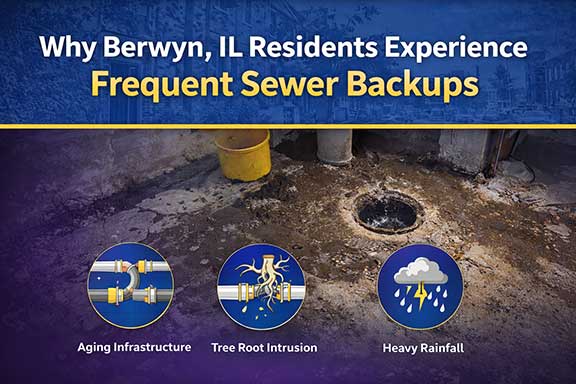
Much of Chicago, including large sections of Berwyn, still relies on a combined sewer system — municipal lines that carry sewage and stormwater in the same pipe network. According to the Metropolitan Water Reclamation District’s own explanation of how these systems work, most local sewers in the Chicago area were built more than a century ago and are required to carry far more water today than when they were first put into service. When a combined line is overwhelmed by heavy rainfall or snowmelt, the excess doesn’t stay contained in the storm system — it backs up through private sewer laterals and surfaces inside homes.
Aging City Infrastructure
The second compounding factor is age. Beyond simply not being sized for current stormwater and wastewater volumes, much of this infrastructure is old enough that the pipe material itself has begun to fail — corroding, cracking, and developing the kind of joint separation that creates blockages. A system that’s already struggling with capacity becomes even more prone to overflow when the pipes themselves are also degrading.
Intense Storm Events
Powerful summer storms and heavy snowmelt push an already-strained system past its limit. These events generate large volumes of stormwater in short windows, and shifting storm intensity and frequency patterns mean the system faces this kind of pressure more often than the infrastructure was ever designed to handle.
Extensive Low Terrain
Berwyn’s natural topography compounds the infrastructure problem. The area sits near the historic path of Mud Lake — the marshy wetland corridor that, as documented by the National Park Service at the Chicago Portage National Historic Site, once connected the Chicago River and the Des Plaines River across a low divide in the regional terrain. That marsh was drained and built over more than a century ago, but the underlying low-lying character of the land wasn’t eliminated by development — it was just covered. When heavy rain falls, water from higher-elevation areas still naturally flows toward and settles in this same historically low corridor.
Heavy Clay Soil
Consistent with the area’s history as poorly-drained marshland, the soil throughout much of Berwyn is heavy clay — a soil type that resists water infiltration and lets rainwater pool at the surface rather than absorbing into the ground. In an urban setting, that translates directly into a higher risk of basement flooding and sewer backup whenever significant rain falls.
Too Many Hard Surfaces
Urban development compounds all of the above by replacing natural absorbent ground with rooftops, driveways, streets, and parking lots. These hard surfaces prevent water from soaking into the soil at all, diverting nearly all of it directly into streets and sewer lines instead — exactly the kind of concentrated flow that overwhelms a combined system during a heavy storm.
These factors compound each other rather than operating independently, which is exactly why Berwyn ranks where it does on regional flood risk assessments. Homeowners who want the deeper picture — including the specific data behind Berwyn’s flood susceptibility ranking and the city’s own flood mitigation program — can read our complete guide to why Berwyn ranks among the most flood-susceptible communities in Northeast Illinois and what every homeowner can do about it.
What Homeowners in Berwyn Can Do to Protect Their Homes
Install a Backflow Valve
A backwater valve monitors your sewer line to ensure wastewater only flows in one direction. It’s equipped with a mechanism that stays open as long as water flows downhill and closes the moment flow reverses — which is exactly what happens in the moments before a surcharge backup would otherwise enter your home. Our flood control systems installations are built around this exact protection, sized and configured for each home’s specific setup rather than a one-size-fits-all approach.
Inspect Your Sewer Line Annually
The condition of your own sewer lateral plays a direct role in your exposure to backups — lines with significant buildup are more prone to clogs and blockages, and problems in the city’s sewer can trigger a backup more easily in a home whose own line is already compromised. A sewer camera inspection performed annually keeps you informed about your line’s actual condition instead of guessing based on how long it’s been since the last problem.
Schedule Professional Drain Cleaning
Cleaning your sewer line through hydro jetting or professional sewer rodding removes debris and buildup from inside the system before it becomes a blockage. Sewer lines cleaned on a regular schedule are measurably less likely to leak, clog, or back up compared to lines that only get attention after a problem has already occurred.
Hire the Right Plumber
The experience of the plumber managing your home’s sewer and drain issues genuinely matters here. An experienced Berwyn plumber who understands this city’s specific combination of aging infrastructure, low terrain, and clay soil can identify vulnerabilities a generalist might miss, and recommend solutions actually suited to Berwyn’s conditions rather than generic advice.
Real Work in Berwyn
We’ve addressed this exact set of problems directly in Berwyn homes — replacing a section of basement sewer line with cast iron pipe and a basin ejector with a Zoeller pump after a persistent backup, rebuilding a failing catch basin to restore proper stormwater drainage, and clearing a main sewer line with rodding and hydro jetting after a blockage severe enough that DIY tools couldn’t touch it. Every one of these jobs traces back to the same underlying conditions covered above — it’s not a coincidence that the same handful of failure patterns keep showing up across the city.
Frequently Asked Questions
Is a sump pump enough to protect my Berwyn home from sewer backups?
Not on its own. A sump pump removes groundwater that collects in a pit beneath your basement, which helps with a seepage or high water table problem — but it has no effect on sewage backing up through floor drains or toilets during a combined sewer surcharge event. If your basement flooding involves sewage odor or appears through fixtures rather than seeping through walls, you need a backwater valve or overhead sewer system, not just a sump pump.
My neighbor’s house has never flooded. Does that mean mine won’t either?
Not necessarily. Individual property history depends on lot grade, foundation condition, the specific state of that home’s private lateral, and even small differences in elevation that aren’t obvious at street level. Berwyn’s underlying infrastructure and terrain risk applies broadly across the city — a neighbor’s clean history isn’t a reliable predictor for your own property.
How often should I really have my sewer line inspected if I’ve never had a backup?
Annually is the standard recommendation, even without symptoms — buildup and deterioration inside a lateral often show no external signs until a blockage or backup actually occurs. A documented yearly inspection also gives you a real baseline, so if something changes year to year, you’ll actually know rather than find out during an active backup.
Does the city of Berwyn have any programs to help with flood control costs?
Berwyn has offered flood mitigation and rebate programs at various times, and Cook County also runs a countywide Sewer Backup Prevention Program offering reimbursement for qualifying backwater valve and overhead sewer installations. Program availability and amounts change, so the most current information is always with the city directly — worth a call before signing any flood control contract.
Sewer Backup Prevention & Repair in Berwyn, IL
Licensed, insured, and serving Berwyn since 1978. We install backwater valves and overhead sewers, perform sewer camera inspections and professional drain cleaning, and handle emergency backup response — with a real understanding of why this city’s combined sewer system, terrain, and soil work against you during heavy rain. Emergency line answered 24 hours a day.
Emergency: 708-518-7765 | Berwyn: 708-801-6530 | Open 24/7
—
Suburban Plumbing Sewer Line & Drain Cleaning Experts
Licensed & Insured | Open 24 Hours | Serving Berwyn & Cook County Since 1978
📞 Berwyn: 708-801-6530 | 🚨 Emergency: 708-518-7765