
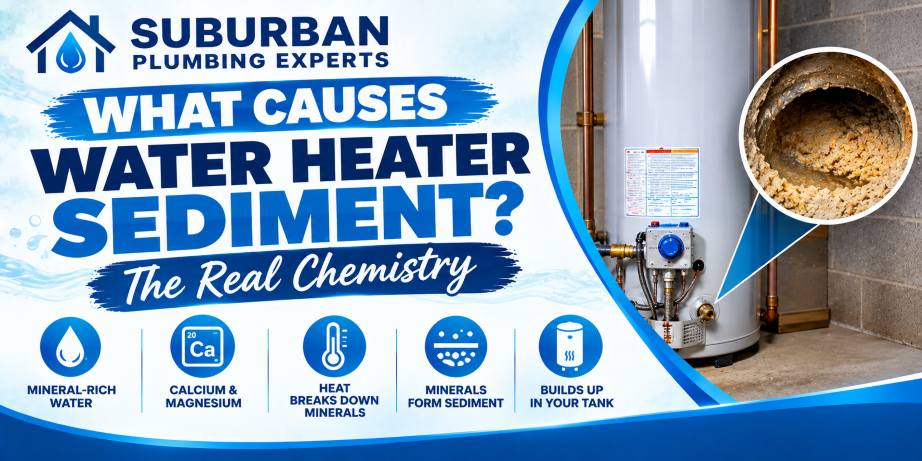
Water Heater Sediment Isn’t Just Buildup. It’s a Chemical Reaction Working Against You, and Heat Makes It Worse, Not Just Faster.
If your water heater is filled with treated, safe drinking water, it can seem confusing that sediment still forms inside the tank. The explanation isn’t a flaw in your water supply, it’s basic water chemistry, and it’s a little counterintuitive: heating water doesn’t just speed up mineral buildup, it actively causes it. Municipal water everywhere contains dissolved calcium and magnesium, more of it in hard-water regions, and while that mineral content stays fully dissolved and invisible at room temperature, heat itself pushes those minerals out of solution and onto the bottom of your tank.
The Real Chemistry: Why Heat Makes Minerals Fall Out of Solution
Most dissolved substances become more soluble as water gets hotter, which is why sugar dissolves faster in hot tea than iced tea. Calcium carbonate, the primary mineral behind water heater scale, does the opposite. Water treatment engineers call this retrograde, or inverse, solubility: calcium carbonate actually becomes less soluble as water heats up, meaning hotter water holds less dissolved calcium than cold water does, and the excess has nowhere to go but out of solution. That’s why scale forms specifically on heated surfaces, inside water heaters, on the heating elements of coffee makers, in boiler systems, rather than uniformly throughout your plumbing. The heating process itself is the trigger, not just an accelerant.
The Three Real Sources of Sediment
Dissolved minerals from your water supply
All water sources carry some level of dissolved calcium and magnesium, picked up as water travels through rock and soil before reaching the tap. The U.S. Geological Survey classifies water hardness on a scale from soft to very hard depending on regional geology, and homes on harder water see meaningfully faster sediment accumulation than homes on soft water, sometimes needing several times more frequent flushing.
Anode rod breakdown
Every standard tank water heater includes a sacrificial anode rod, usually aluminum, magnesium, or a zinc-aluminum alloy, that corrodes on purpose so the steel tank doesn’t have to. That’s exactly what it’s designed to do, but the byproduct of that corrosion is particulate that settles at the bottom of the tank along with mineral sediment. An aluminum anode rod nearing the end of its life can produce a distinctive gelatinous, jelly-like buildup, sometimes accompanied by a sulfur or rotten-egg smell, that’s a different substance entirely from mineral scale but gets lumped in with “sediment” by most homeowners.
Corroding tank components
Once corrosion starts on internal metal components beyond the anode rod itself, dip tubes, heating element housings, or the tank interior in an aging unit, small metal particles add to the sediment layer. Unlike mineral scale, this kind of sediment usually signals a tank that’s further along in its service life rather than a water chemistry issue alone.
How Sediment Actually Damages Your Water Heater
The mechanism is different depending on whether you have a gas or electric unit, and knowing which applies to you explains a lot about what you’re hearing and seeing.
Gas water heaters
The burner sits underneath the tank, and sediment settling directly on that surface acts as an insulating layer between the flame and the water. The burner has to run longer and hotter to transfer the same amount of heat through that layer, which is the direct cause of rising energy bills. It’s also the source of the popping and rumbling sound many homeowners notice: water trapped underneath and within the sediment layer boils into steam bubbles that then burst up through the sediment and the water above it, producing the sound.
Electric water heaters
Electric units heat via one or two submerged elements, and if sediment buries the lower element, that element can overheat and burn out prematurely since it’s no longer surrounded by circulating water carrying heat away efficiently. Compounding this, an electric water heater’s thermostat never actually touches the water; it’s mounted against the outside of the tank wall and reads temperature by conduction through the metal. A thick sediment layer between the water and the tank wall at that sensing point can cause the thermostat to misjudge the water’s actual temperature, keeping the element engaged longer than it should be.
The real explosion risk, explained accurately
Sediment-driven overheating on its own doesn’t cause a water heater to explode; the temperature and pressure relief valve exists specifically to prevent that by venting excess pressure before it becomes dangerous. The real hazard shows up when overheating and a failed or malfunctioning T&P valve happen together. The U.S. Consumer Product Safety Commission has recalled T&P valves specifically because a failed valve can’t avert rupture of the tank, which is the actual failure chain: sediment drives excess heat, and a compromised relief valve is what turns that into a hazard rather than sediment alone.
Signs You Have a Sediment Problem
Popping, rumbling, or crackling sounds during the heating cycle are the clearest sign, and they mean sediment has already built up enough to trap and release steam pockets. A noticeably shorter hot water supply than the tank’s rated capacity means sediment is physically displacing usable water volume. Rising energy bills with no other explanation point to the insulating effect described above. Water that runs slightly discolored or gritty at the very start of a draw, especially after the house has been unused for a stretch, is sediment being disturbed and pushed out with the first flow.
What Actually Fixes It
Flush the tank on a schedule
Flushing clears loose sediment before it compacts and hardens against the tank bottom. On moderately hard water, once a year is a reasonable baseline; on harder water, twice a year keeps buildup from accumulating between services. This is a DIY-feasible task, though our water heater maintenance service handles it along with a broader check of the anode rod, T&P valve, and other components while the tank is already drained.
Do a vinegar soak for stubborn buildup
White distilled vinegar, not cider or other flavored vinegars, is the standard choice here since it’s plain acetic acid without added sugars or coloring that can leave their own residue. Acetic acid actually dissolves calcium carbonate through a genuine chemical reaction, unlike some popular drain remedies that do little more than fizz. After draining the tank, close the drain valve, pour in a gallon of white vinegar, let it sit for several hours, then flush thoroughly to clear both the loosened sediment and the vinegar itself.
Install a water softener for a long-term fix
Flushing and vinegar soaks treat the symptom repeatedly; a water softener installation addresses the mineral hardness causing it in the first place, extending the interval between necessary flushes and reducing wear on every other water-using appliance in the house at the same time.
Replace the anode rod before it’s fully spent
A depleted anode rod stops protecting the tank from corrosion and, as covered above, can itself become a sediment source in its final stages. Checking and replacing the anode rod every two to three years, more often in harder water, is routine maintenance that most homeowners skip simply because it’s not visible.
When Sediment Has Already Done Damage
If the tank itself is corroded or actively leaking, replacement is the only economically sound option regardless of the unit’s age, since a compromised tank won’t be fixed by addressing the sediment alone. If the damage is limited to a burned-out element, a miscalibrated thermostat, or a clogged drain valve, repair is often reasonable, particularly on a unit still well within its expected service life. Our water heater repair service and replacement service can tell you honestly which situation you’re in rather than defaulting to the more expensive option.
A Realistic Maintenance Routine
Flush the tank annually on moderately hard water, twice a year if your water is notably hard. Check the anode rod every two to three years and replace it once it’s substantially consumed, well before it’s fully gone. Watch for popping sounds, reduced hot water capacity, and rising energy bills as your earliest warning signs, since all three typically show up before a sediment problem becomes serious. Have the T&P valve tested periodically as part of any water heater service, since it’s the actual safety backstop this entire issue depends on.
Frequently Asked Questions
Why does my water heater make popping or rumbling noises?
Sediment has built up on the tank bottom, and water trapped within that layer is boiling into steam pockets that burst up through it. It’s one of the earliest and most reliable signs of sediment buildup.
What is the white, jelly-like substance in my water heater?
That’s most likely the byproduct of an aluminum anode rod breaking down near the end of its service life, sometimes called aluminum hydroxide gel. It’s a different substance from mineral scale, and it usually means the anode rod needs to be checked and likely replaced.
Can sediment buildup actually cause a water heater to explode?
Not by itself. Sediment-driven overheating is a real risk factor, but the temperature and pressure relief valve exists specifically to vent excess pressure before it becomes dangerous. The genuine hazard arises when overheating occurs alongside a failed or malfunctioning relief valve, which is why that valve deserves attention during any service, not just the sediment.
How often should I actually flush my water heater?
Once a year on moderately hard water is a reasonable baseline. On notably hard water, twice a year keeps buildup from compacting between services and reduces how quickly you’ll need a deeper cleaning like a vinegar soak.
Is it safe to flush my own water heater?
For most homeowners, yes, it’s a straightforward DIY task. If you’re not comfortable working with the drain valve, the gas or electrical shutoff, or you’re unsure how long it’s been since the last flush on an older unit, having a professional handle it avoids the risk of disturbing a heavily corroded or brittle component.
Sediment Is Inevitable. Ignoring It Isn’t.
Every tank water heater accumulates sediment eventually, that part isn’t avoidable given how water chemistry works. What is avoidable is letting it go unaddressed long enough to insulate a burner, bury a heating element, or mask a failing relief valve. A once- or twice-a-year flushing habit, an anode rod that gets checked rather than forgotten, and attention to the early warning signs above are what separate a water heater that lasts its full rated lifespan from one that fails years early. Our water heater service team handles the full picture, not just the symptom you called about.
—
Suburban Plumbing Sewer Line & Drain Cleaning Experts
Licensed & Insured | Serving Chicago & the Suburbs Since 1978