
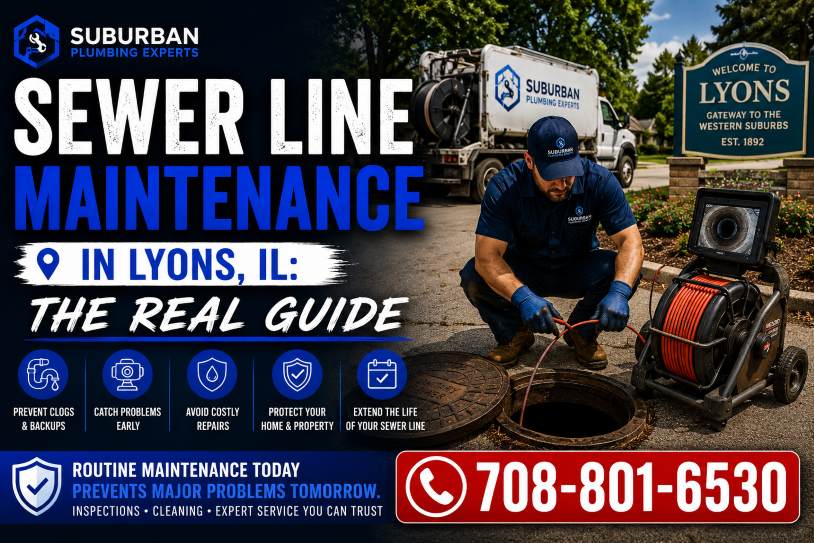
Lyons Sits Where Two Waterways Meet. That’s Exactly Why Your Sewer Line Deserves More Attention Than a Generic Maintenance Schedule.
Salt Creek empties into the Des Plaines River right at Lyons, a genuine confluence point rather than a town that just happens to be near water. That geography matters for sewer performance specifically, not just flood risk in the abstract. According to the Metropolitan Water Reclamation District’s own explanation of how local sewers work, basement backups often happen because rainwater enters the local sewer system faster than it can flow through, and most local sewers, built decades ago, are now required to carry considerably more water than when they were first installed. A sewer lateral that’s already restricted by buildup or root intrusion has even less margin to handle that load during a heavy rain event, which is exactly the scenario a river-adjacent community like Lyons experiences more often than a town farther from a floodplain.
What’s Actually Underground, and Why Its Age Changes Everything
Your sewer lateral is the single pipe carrying every drain in your home, kitchen, bathrooms, laundry, floor drains, to the village main. Everything downstream of your fixtures funnels through this one line, which is why a problem in the lateral tends to show up as symptoms in multiple, seemingly unrelated fixtures rather than just one. Clay tile, the standard material for decades before plastic piping became common, is laid in short sections joined together, and every joint is both a potential entry point for tree roots and a potential failure point as soil shifts over decades. Cast iron, common in a different construction era, corrodes from the inside over time, gradually narrowing the usable diameter even without any external damage. A home built well before modern PVC piping became standard is simply carrying more structural risk in this one specific system than a newer build would.
Root Intrusion: A Problem That Compounds Rather Than Stays Static
Tree and shrub roots grow toward moisture and nutrients, and a sewer line leaking even slightly at a joint is exactly the resource a root system will exploit. Once a root finds its way into a joint or crack, it doesn’t stop, it continues growing inside the pipe, catching debris and expanding the original opening with each growing season. A minor intrusion this year is typically a larger one next year, which is exactly why catching it early, while it’s still a cleaning job rather than a repair job, matters so much.
The Signs, and What Each One Actually Means
Slow drainage across more than one fixture points to a restriction in the shared lateral rather than a problem local to any single drain. Gurgling from a toilet or drain, especially when triggered by another fixture running elsewhere in the house, happens because trapped air is being forced through standing water as it searches for the easiest exit path past a restriction. A persistent foul odor means wastewater or gas isn’t moving through the system properly, either because the line is too restricted to carry waste through cleanly, or because a blockage is trapping gas that’s venting back through a fixture instead of outside as designed. An unusually lush, consistently damp patch of yard, especially one tracking in a line from the house toward the street, is a classic sign of a leak feeding the soil above it. None of these signs are dramatic individually, which is exactly why they get ignored until the line finally can’t keep up during a heavy rain event.
A Test You Can Run Yourself Before Calling Anyone
Run the kitchen sink at full flow for a minute or two while watching the basement floor drain. If water rises or backs up through the floor drain while the sink runs, the restriction is downstream of both fixtures, in the shared lateral rather than either fixture individually. A second version: run the kitchen sink and listen for the toilet. If it gurgles without being flushed, air displaced by the sink’s flow is finding the toilet bowl as its easiest exit path past a restriction elsewhere in the line. Neither test pinpoints the exact cause, but both confirm whether you’re dealing with a shared-line problem, which speeds up an accurate diagnosis once a professional arrives.
Why This Isn’t Just an Unpleasant Inconvenience
A sewage backup involves genuine health risk, not just an unpleasant mess. According to the CDC’s guidance on handling human waste and sewage, even trained workers with protective equipment follow strict hygiene protocols when in contact with raw sewage, because it carries real pathogen risk. That’s the same material that ends up on a basement floor during a backup, without any of the protective measures a trained worker would use.
Confirming What’s Actually Happening, Instead of Guessing
A sewer camera inspection remains the only way to see the interior condition of a lateral without digging, turning any of the signs above from a guess into an actual diagnosis. Professional inspections follow the framework established by NASSCO’s Pipeline Assessment Certification Program, the recognized North American standard for coding and documenting pipe conditions, meaning findings are based on a consistent standard rather than one technician’s subjective read of the footage. Our sewer camera inspection service uses this same standard for every inspection.
Rodding, Jetting, and Why the Difference Actually Matters
Mechanical rodding clears an isolated blockage by breaking a path through it with a cable, a fast and cost-effective fix for a straightforward, one-time clog. Hydro jetting uses pressurized water to scour the entire interior wall of the pipe rather than just punching through the center. According to Cam Spray, an industrial jetter manufacturer, this works because two factors combine during jetting: PSI, the pressure that breaks buildup loose from the pipe wall, and GPM, the flow rate that carries that loosened material out of the line rather than letting it resettle further down. That combination is why a jetted line typically goes considerably longer before needing service again than a rodded one.
What Root Removal and Repair Actually Involve
Once roots have intruded significantly, professional tree root removal clears the immediate blockage, but it doesn’t stop new roots from returning to the same leak point, since the underlying crack or joint is still there attracting them. For a line with a collapsed section, significant structural cracking, or a joint separated beyond what cleaning addresses, actual sewer line repair targeting the specific damaged section is the right call. Our guide to sewer line repair costs in the Chicago area covers real regional pricing by repair type, including what this area’s clay soil and frost-depth requirements do to cost.
The Insurance Question Worth Asking Before You Need It
Standard homeowners insurance frequently doesn’t cover sewer backup damage by default. According to Insurance.com’s coverage guide, water backing up through a drain or sewer is commonly excluded from a standard policy unless a separate water backup endorsement has been added, typically costing $50 to $250 a year for $5,000 to $25,000 in coverage per occurrence. Given Lyons’ position near two waterways, this is worth confirming on your policy now rather than discovering the gap while filing a claim.
A Maintenance Schedule That Actually Fits an Older Lyons Home
For a home on original clay tile or aging cast iron, a camera inspection every one to two years is a reasonable standard, more frequently if mature trees sit near the lateral’s path or the home has any history of slow drains. Between inspections, keeping fats, oils, and grease out of drains entirely, using a drain screen to catch hair and debris, and never flushing wipes or other non-biodegradable products all slow the rate buildup accumulates. None of this prevents root intrusion on its own, roots are drawn to any existing leak regardless of what goes down the drain, but it does reduce how quickly buildup compounds whatever intrusion is already happening.
Choosing Who Does This Work
Sewer-specific experience matters more here than general plumbing background. The full playbook for vetting any plumber, license verification, insurance, written estimates, is covered in our complete guide to choosing a plumber in the Chicago suburbs. For sewer work specifically, ask directly whether a camera inspection is included before any cleaning or repair recommendation, and whether the provider follows a documented inspection standard rather than an informal read of the footage.
Before Any Digging Happens
If a repair requires excavation, Illinois law requires contacting JULIE at 811 at least two business days beforehand to have buried utility lines marked. We cover why this step is legally required, and what can go wrong when it’s skipped, in why your Chicago-area plumber should always call JULIE before they dig.
Frequently Asked Questions
Why does Lyons’ location matter for sewer line maintenance specifically?
Lyons sits at the confluence of Salt Creek and the Des Plaines River, and local sewers, many built decades ago, now carry more water than they were originally designed for. A lateral already restricted by buildup or root intrusion has less margin to handle heavy rain events, which happen more often in a river-adjacent community.
How often should an older Lyons home get a sewer camera inspection?
Every one to two years is reasonable for a home on original clay tile or cast iron, more often if mature trees sit near the lateral or there’s a history of slow drains.
Can I test for a sewer problem myself before calling a plumber?
Yes. Running the kitchen sink at full flow while watching the basement floor drain, or listening for the toilet to gurgle, tells you whether the issue is in the shared lateral, which speeds up diagnosis once a professional arrives.
Does homeowners insurance cover sewer backup damage?
Not automatically. Standard policies commonly exclude sewer backup unless a separate water backup endorsement has been added, typically $50 to $250 a year for $5,000 to $25,000 in coverage.
Is rodding or hydro jetting the right choice for my line?
Rodding is typically faster and less expensive for a single, isolated clog. Jetting is the better choice for a line with recurring buildup or root intrusion, since it cleans the full interior wall rather than just clearing a path through it.
Licensed Sewer Line Maintenance for Lyons, IL
Suburban Plumbing Experts has served Lyons and the surrounding suburbs since 1978. We hold Illinois Plumbing License #055-044116 and Sewer License #2565, and every technician on our team is a trained, background-checked employee, not a subcontractor. From routine camera inspections to full sewer line repair, our Lyons, IL plumber can tell you honestly where your line actually stands.
Ready for a Sewer Line Checkup in Lyons?
Licensed, insured, and serving Lyons and Chicagoland since 1978. We run the camera first and give you a documented, honest answer about your line’s actual condition.
Lyons: 708-801-6530 | Emergency: 708-518-7765 | Open 24/7
—
Suburban Plumbing Sewer Line & Drain Cleaning Experts
Licensed & Insured | Open 24 Hours | Serving Lyons & the Suburbs Since 1978
📞 Lyonss: 708-801-6530 | 🚨 Emergency: 708-518-7765