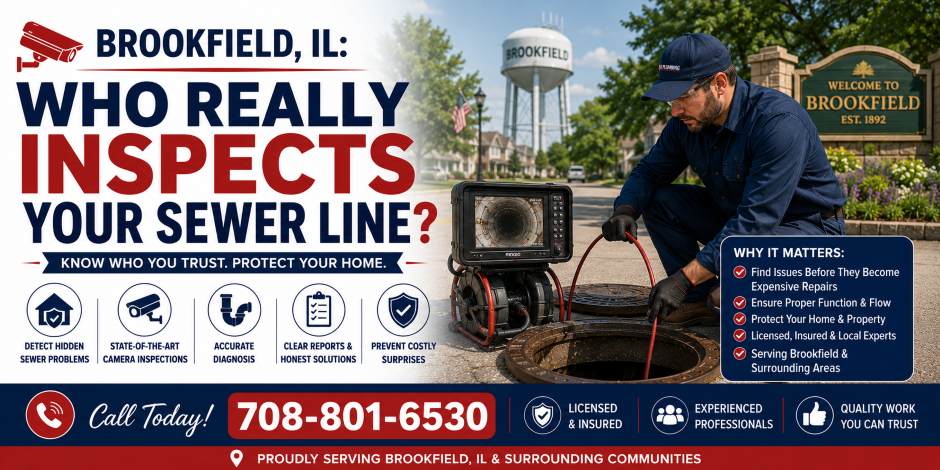
Most Brookfield Homeowners Assume Village Hall Handles Everything Underground. It Doesn’t. A Separate Government Agency Older Than the Village Itself Has Real Authority Over Your Sewer Connection — and Not Knowing That Can Hold Up a Renovation, a Repair, or a Home Sale.
This guide covers one thing, deliberately: sewer lines. Not flooding, not water quality, not lead pipes — the sanitary sewer line running from your Brookfield home to the street, what actually causes it to fail, who has real authority over which part of it, and how to tell whether a problem needs a quick clearing or a genuine repair.
The Agency Most Homeowners Have Never Heard Of
Here’s something that surprises most Brookfield homeowners the first time they hear it: when plumbing work touches anything outside the building foundation, the inspection authority isn’t the village at all. It’s the Metropolitan Water Reclamation District of Greater Chicago — MWRD, a special-purpose government agency established all the way back in 1889, the same year Brookfield itself got its start as a real estate developer’s subdivision. MWRD isn’t part of Chicago’s city government or Brookfield’s village government; it’s its own elected body with authority over wastewater treatment and sewer connections across Cook County. Per the Village of Brookfield’s own building and permitting guidance, the village handles inspections inside your foundation, while anything connecting to the municipal sewer outside that foundation falls under MWRD’s jurisdiction — and it’s on your contractor to flag when a project might trigger that separate review.
This isn’t trivia. An uninspected or improperly permitted sewer connection is exactly the kind of thing that surfaces at the worst possible moment — mid-renovation, or during a home sale when a buyer’s inspector finds a connection that was never properly signed off. Knowing the two-agency structure before you start a project, not after, is the difference between a smooth permit process and a stalled one.
Whose Pipe Is It, Actually
The sewer lateral running from your house to the point where it connects with the public main is yours. Not the village’s, not MWRD’s — yours to maintain, repair, and pay for, from the foundation wall to the street connection. That ownership line determines who you call first: a problem inside that stretch is a private plumbing repair, while an issue with the actual public sewer main under the street is a village or MWRD matter. A lot of confusion and wasted phone calls come from not knowing which side of that line a backup is actually on — something a licensed plumber can usually tell within minutes of looking, without you needing to sort out village versus MWRD versus your own responsibility first.
Why Sewer Lines Actually Fail in Brookfield
Brookfield’s older neighborhoods — Hollywood, Old Brookfield, Chevy Chase, the streets closest to Memorial Park and the zoo — were built out mostly between the 1920s and 1960s, which puts a lot of the sewer laterals underneath them squarely in clay tile and early cast iron territory. Clay tile pipe was built in short sections joined together, and every one of those joints is a potential entry point once the surrounding soil shifts even slightly. Cast iron corrodes from the inside, narrowing its own diameter over decades until what used to be a 4-inch pipe is functionally much smaller. And Brookfield’s mature tree canopy — decades of established growth throughout the village — means root systems have had plenty of time to find their way into whatever cracks and joints are available.
There’s a fourth failure mode worth naming separately: a pipe belly, where a section of line has settled below its original grade, creating a low spot where waste and water pool instead of flowing through. A belly doesn’t clear with rodding, because there’s no blockage to cut through — the pipe itself is sitting wrong. That’s a structural issue, not a maintenance one, and it’s exactly the kind of thing that gets misdiagnosed as “just needs rodding again” for years before someone finally runs a camera through the line and finds the actual cause.
Real Sewer Work We’ve Done in Brookfield
Here’s what that actually looks like on the ground. Our crews have run main line rodding through a Brookfield sewer line specifically to remove tree root intrusion, restoring flow that had been slowly choking off before anyone noticed. We’ve cleared a blocked toilet drain with rodding when a household’s daily routine ground to a halt, and cleared a clogged tub drain the same way, restoring normal flow without opening a wall or digging up a yard. When a line needed more than clearing, we’ve performed a small spot repair on a damaged sewer line — fixing the specific failed section rather than replacing the entire run, because a full replacement isn’t always the answer once you actually know where the damage is. That’s the kind of targeted, accurately diagnosed work our sewer line repair team handles throughout the village.
Rodding, Hydro Jetting, and Camera Inspection: When Each One Is the Right Call
These three tools solve different problems, and using the wrong one wastes money without fixing anything. Rodding — a steel cable with a cutting head run through your cleanout — breaks up whatever’s actively blocking the line right now and gets water moving again. It’s fast, and it’s the right first move for an active backup. Our full sewer line cleaning service covers this kind of routine clearing throughout Brookfield.
Hydro jetting goes further: pressurized water at up to 4,000 PSI scours the entire interior wall of the pipe rather than just punching through the blockage, which matters for a line that keeps clogging in the same spot every few months, since that pattern usually means buildup on the pipe wall itself, not a one-time obstruction. And when the cause of a repeat problem genuinely isn’t obvious, running a camera through the line is what turns a guess into an actual diagnosis — showing whether you’re dealing with roots, a shifted joint, a belly, or a structural break before anyone recommends a repair.
Spot Repair vs. Full Replacement: How That Decision Actually Gets Made
A damaged sewer line doesn’t automatically mean tearing out the whole run. When a camera inspection shows the damage is isolated to a short section — a cracked joint, a localized break — a spot repair fixes exactly that section without disturbing pipe that’s still structurally sound, which is exactly what we did on the job referenced above. Full excavation and replacement makes sense when the damage is spread across the line’s length, when the pipe material itself has reached the end of its useful life throughout, or when repeated spot repairs would end up costing more over time than doing the whole thing once. The honest answer only comes from seeing the actual condition of the line first — which is why camera inspection comes before any repair recommendation, not after.
Sewer Gas and Odor: A Symptom Worth Taking Seriously
A persistent sewer smell inside a Brookfield home, especially in a basement, is worth investigating rather than masking with an air freshener. The most common cause is a dried-out P-trap — the curved section of pipe under a sink, floor drain, or in an infrequently-used fixture that’s supposed to hold a small water seal blocking gas from coming back up. Rarely-used basement floor drains and guest bathrooms are the usual culprits, and the fix can be as simple as running water down the drain to refill the trap. But persistent odor that doesn’t resolve that way often points to something more serious: a cracked vent stack, a failed wax ring under a toilet, or a genuine break somewhere in the line allowing sewer gas to escape where it shouldn’t.
This isn’t just an unpleasant smell to live with. Sewer gas contains hydrogen sulfide and other compounds that can cause headaches, respiratory irritation, and in higher concentrations, more serious symptoms — which is part of why a persistent odor deserves an actual diagnosis rather than assumptions about what’s causing it. Our sewer odor detection service evaluates vent pipes, traps, and the sewer line itself to pinpoint the actual source before recommending a fix, rather than guessing based on which room the smell seems strongest in.
Warning Signs Worth Acting On Before a Full Backup
A sewer line rarely fails without warning — the signs are just easy to dismiss individually. Multiple fixtures backing up or draining slowly at the same time, rather than just one isolated drain, usually points to a problem in the main line rather than a single clogged trap. An unusually lush, green patch of grass over your yard’s sewer line path, especially one that stands out from the rest of the lawn, can mean wastewater is leaking underground and fertilizing the soil above it. Gurgling sounds from a toilet when you run the washing machine or a nearby sink are a classic sign of a partially blocked main line struggling to vent properly. Any one of these on its own might be nothing. Two or more together, especially combined with a persistent odor, is worth a camera inspection before it becomes an actual backup.
Frequently Asked Questions
Do I need an MWRD permit just to have my sewer line rodded or jetted?
Routine maintenance like rodding or hydro jetting an existing line generally doesn’t trigger MWRD involvement — that authority applies mainly to new construction, replacement work, or anything altering the actual sewer connection. It’s worth confirming for any project involving excavation or a new connection point, since that’s where MWRD’s inspection role actually kicks in.
My sewer backs up in the same spot every few months. Why does rodding keep being a temporary fix?
Because rodding clears the current blockage without addressing what’s causing it to rebuild. If roots, wall buildup, or a pipe belly are the real problem, rodding will keep working for a few months and then need repeating indefinitely. A camera inspection identifies the actual cause, and hydro jetting or a targeted repair addresses it instead of just managing the symptom on repeat.
How do I know if a sewer problem is my responsibility, the village’s, or MWRD’s?
The lateral running from your home to the point of connection with the public main is yours to maintain. A problem in the street itself, or in the public main, is a village or MWRD matter depending on the specific system involved. If you’re not sure which side of that line your issue is on, a camera inspection settles the question.
My basement has a faint sewer smell but no visible problem. What’s causing it?
The most common cause is a dried-out P-trap on a rarely-used floor drain or fixture — the water seal that normally blocks sewer gas has simply evaporated. Running water down the drain to refill the trap solves this most of the time. If the smell persists after that, it’s worth having the vent stack, wax rings, and the line itself checked, since a cracked vent or a genuine break can produce the same symptom.
I noticed a lush green patch in my yard along where my sewer line runs. Should I be concerned?
Yes, it’s worth checking out. An unusually green, fast-growing patch of grass over a sewer line’s path is a classic sign of a leak — the escaping wastewater is essentially fertilizing the soil above it. Combined with any drain slowness or odor, that’s a strong enough signal to warrant a camera inspection before the leak gets worse.
Can I clear a recurring clogged drain myself with a store-bought chemical cleaner?
Not effectively, and not safely long-term. Chemical drain cleaners dissolve the soft leading edge of a clog enough to temporarily restore flow, but they don’t reach deposits embedded in a decades-old pipe wall, and repeated use accelerates the corrosion that makes the problem worse over time.
Sewer Line Problems in Brookfield?
Licensed, insured, and headquartered right in Brookfield since 1978 — with a real track record of sewer rodding, hydro jetting, camera inspection, and spot repairs throughout the village. See our full Brookfield plumbing services page for everything else we handle.
Brookfield: 708-801-6530 | Emergency: 708-518-7765 | Open 24/7
—
Suburban Plumbing Sewer Line & Drain Cleaning Experts
Licensed & Insured | Open 24 Hours | Based in Brookfield Since 1978
📞 Brookfield: 708-801-6530 | 🚨 Emergency: 708-518-7765